
惯性聚合 高效追踪和阅读你感兴趣的博客、新闻、科技资讯
阅读原文 在惯性聚合中打开

推荐订阅源

cs.CV updates on arXiv.org
小众软件
小众软件
博客园_首页
博客园 - 聂微东
V
V2EX
WordPress大学
WordPress大学
freeCodeCamp Programming Tutorials: Python, JavaScript, Git & More
OSCHINA 社区最新新闻
OSCHINA 社区最新新闻
罗磊的独立博客
酷 壳 – CoolShell
酷 壳 – CoolShell
博客园 - 司徒正美
博客园 - 三生石上(FineUI控件)
奇客Solidot–传递最新科技情报
奇客Solidot–传递最新科技情报
S
SegmentFault 最新的问题
J
Java Code Geeks
Last Week in AI
Last Week in AI
The Cloudflare Blog
月光博客
月光博客
雷峰网
雷峰网
宝玉的分享
宝玉的分享
钛媒体:引领未来商业与生活新知
钛媒体:引领未来商业与生活新知
Hugging Face - Blog
Hugging Face - Blog
让小产品的独立变现更简单 - ezindie.com
有赞技术团队
有赞技术团队
人人都是产品经理
人人都是产品经理
博客园 - Franky
腾讯CDC
Jina AI
Jina AI
博客园 - 叶小钗
大猫的无限游戏
大猫的无限游戏
阮一峰的网络日志
阮一峰的网络日志
量子位
爱范儿
爱范儿
美团技术团队
T
Tailwind CSS Blog
博客园 - 【当耐特】
D
Docker
IT之家
IT之家
V
Visual Studio Blog
P
Proofpoint News Feed
L
LangChain Blog
Engineering at Meta
Engineering at Meta
C
Check Point Blog
G
Google Developers Blog
Google DeepMind News
云风的 BLOG
云风的 BLOG
Cyber Security Advisories - MS-ISAC
Microsoft Azure Blog
B
Blog RSS Feed
Recorded Future
Recorded Future

Google Developers Blog

Expanding Choice in Gemini Enterprise Agent Platform: Introducing Grounding with Parallel Web Search- Google Developers Blog Systems Engineering Playbook: Optimizing Qwen 3.5-397B MoE on Ironwood (TPU7x)- Google Developers Blog Unlocking the Next Era of On-Device AI with Google Tensor and Pixel- Google Developers Blog LiteRT.js, Google's high performance Web AI Inference- Google Developers Blog Bridging the Domain Gap: AI Race Coach built with Antigravity and Gemini- Google Developers Blog We terminated a TPU mid-training and it recovered in seconds: Introduction to elastic training with MaxText- Google Developers Blog ML Development in VS Code with Google Cloud Power: Workbench Extension Now Available- Google Developers Blog Why we built ADK 2.0- Google Developers Blog Build agentic full-stack apps with Genkit- Google Developers Blog Driving the Agent Quality Flywheel from Your Coding Agent- Google Developers Blog Build reliable multi-agent applications with ADK Go 2.0. Discover our new graph-based workflow engine, built-in human-in-the-loop, and dynamic orchestration- Google Developers Blog Build Cross-Language Multi-Agent Team with Google’s Agent Development Kit and A2A- Google Developers Blog How A2A is Building a World of Collaborative Agents- Google Developers Blog A2UI + MCP Apps: Combining the best of declarative and custom agentic UIs- Google Developers Blog Announcing the Agentic Resource Discovery specification- Google Developers Blog Enhance Security and Trust: New Session Metadata in Sign in with Google- Google Developers Blog Unlocking the Power of the TPU Stack: Introducing our new Developer Hub- Google Developers Blog DiffusionGemma: The Developer Guide Introducing the Google Colab CLI Gemma 4 12B: The Developer Guide Bringing Gemma 4 12B to your Laptop: Unlocking Local, Agentic Workflows with Google AI Edge Supercharge your integration workflow with the Google Pay & Wallet Developer MCP server How the community trained Gemma to "Think" with Tunix and TPUs The latest updates to Google Pay Enhancing Android Checkout with Dynamic Callbacks in Google Pay Empowering Service Providers and Hardware Partners with Gemini for Home Announcing ADK for Kotlin and ADK for Android 0.1.0: Building AI Agents on Android and Beyond Blazing fast on-device GenAI with LiteRT-LM One Year of Innovation: Celebrating 100k Members in the Google Cloud x NVIDIA Developer Community All the news from the Google I/O 2026 Developer keynote A Smarter Google AI Edge Gallery: MCP integration, notifications, and session continuity Google Tensor SDK Beta with LiteRT An important update: Transitioning Gemini CLI to Antigravity CLI Accelerating on-device AI: A look at Arm and Google AI Edge optimization Announcing Genkit Middleware: Intercept, extend, and harden your agentic apps Build Long-running AI agents that pause, resume, and never lose context with ADK Supercharging LLM inference on Google TPUs: Achieving 3X speedups with diffusion-style speculative decoding Building with Gemini Embedding 2: Agentic multimodal RAG and beyond Speeding Up AI: Bringing Google Colossus to PyTorch via GCSFS and Rapid Bucket Building real-world on-device AI with LiteRT and NPU Agents CLI in Agent Platform: create to production in one CLI
Measuring What Matters with Jules- Google Developers Blog
Nghi Bui · 2026-06-22 · via Google Developers Blog

AI coding agents are rapidly shifting from reactive assistants that complete tasks when prompted to proactive engines that continuously absorb context, spot emerging risks, and surface diagnostic insights before developers have to ask. At the center of this evolution is a shift from well-defined tasks to goals, which require the agent to explore the codebase, discover what is relevant, and surface diagnostic observations that help guide developers toward a higher-level objective.

Public benchmarks like SWE-Bench test an agent’s ability to complete tasks, like fixing a narrowly defined bug, but no benchmarks currently exist for goals. In our most recent paper, Agentic Coding Needs Proactivity, Not Just Autonomy, we argue that proactive agents must be graded on their insight policy—the ability to decide what matters, what evidence supports it, and whether to interrupt the developer or stay silent.
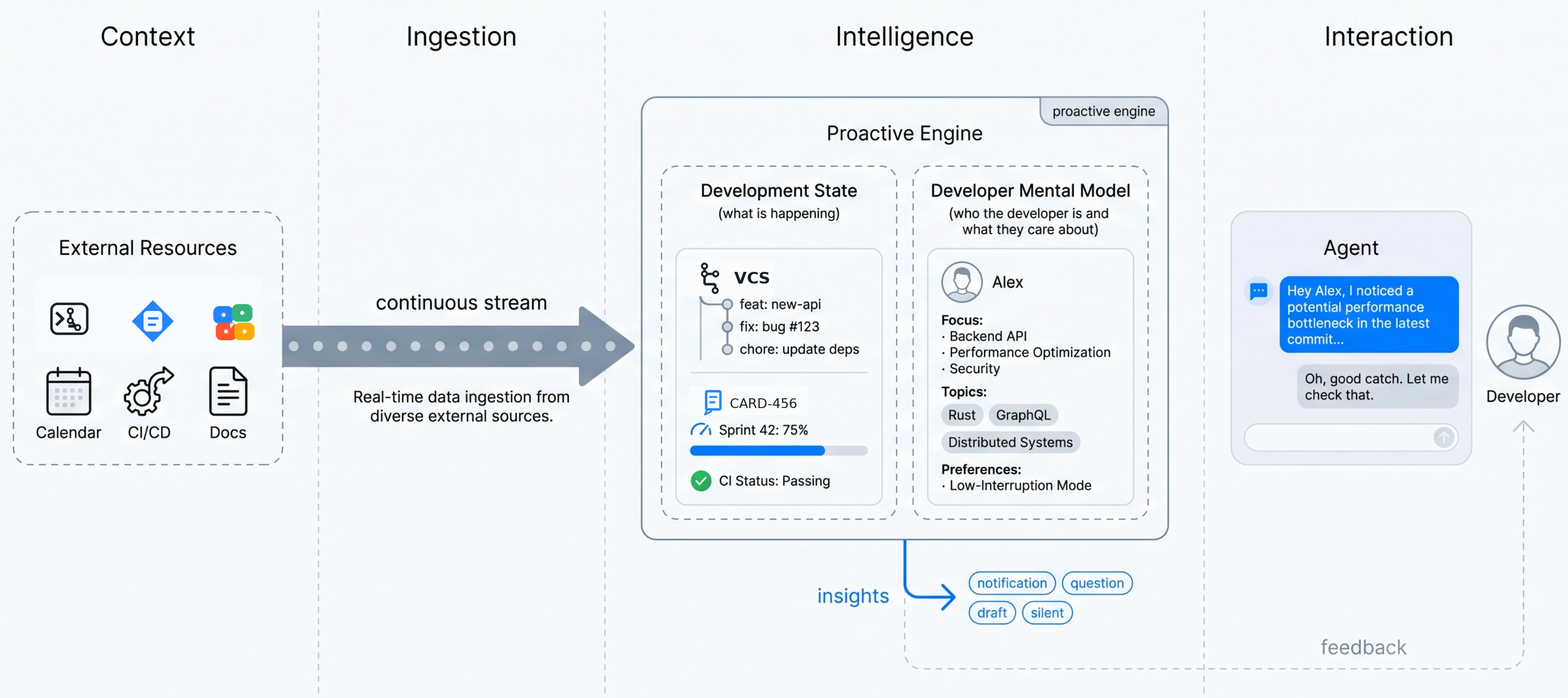
overview-abstract

The Figure above shows the design of a proactive agentic coding engine. Context streams into an engine that maintains development state and a developer model, emits insights (notify, question, draft, stay silent), and learns from response.

Leveraging real bug fixes as “ground truth”

Based on our work on continuous AI systems at Google Labs, we’ve found that building evaluations capable of grading a proactive agent on its insight policy requires establishing a “ground truth.” One way to build this “ground truth” is to analyze a team’s real bug-fixing history along two heuristics we term temporal proximity and semantic similarity.

Our hypothesis is simple: when engineers file and fix several related bugs within a short time period, those bugs are often symptoms of a single underlying engineering effort. A cluster of bugs around "sandbox timeout errors," "broker config failures," and "network isolation flaky tests" all point toward a common aspirational goal like "Strengthen sandbox execution reliability." Individually, each bug is too task-specific to serve as a goal. Together, they reveal the higher-level objective.

Building and testing our preliminary eval set

To build our preliminary benchmark and test our hypothesis, we used 705 bugs (1,178 CLs) from internal Google codebases to:

  • Cluster related historical bugs to reveal the higher-level "aspirational goals" developers were actually working toward.
  • Set the individual bugs within each cluster as our "ground truth" targets and reverted the codebase to its exact pre-fix state so the agent began where the human engineer did.
  • Allow the agent to investigate the codebase for up to three rounds (its "exploration budget," or N) before generating its final insights.
  • Use an LLM to judge the agent’s predicted insights from 1 (irrelevant) to 5 (exact match) against our “ground truth” targets.
  • Measure success by tracking the agent's average top score and how often it successfully produced a highly accurate match (Hit@K).

Preliminary results and what we learned

The preliminary results of our testing are exciting for two primary reasons.

The core diagnostic logic works: Given a single exploration round, the agent consistently identified a highly relevant insight (averaging 4.5 out of 5). It successfully captured the primary signal for straightforward engineering problems.

Exploration budgets matter: Complex, multi-faceted problems are naturally harder, but giving the agent more resources to investigate pays off. By increasing the exploration budget from two rounds to three, the agent’s Hit@5 accuracy (defined as the rate at which a correct diagnostic insight appears within its top 5 recommendations) rebounded significantly from 33% to 57%. This proves that extra passes directly help the agent uncover secondary signals it initially missed.

What’s next

These are preliminary results on an initial sample, and we are actively expanding coverage on multiple fronts. To start, we are expanding this evaluation to public GitHub data (issues and resolving PRs) to make this methodology broadly applicable to the wider AI community. We are also exploring how to ingest richer context streams like issue trackers, conversations, and design documents beyond just the codebase.

Read the full paper here and follow along with us at labs.google/code if you’re interested in learning more about our work on the future of coding at Google Labs.