








Richard Drury/DigitalVision via Getty Images
The Invesco QQQ Income Advantage ETF (QQA) is a passive index-fund-like ETF that offers top technology equity or ETF exposure, coupled with ELNs or equity-linked notes and a liquidity reserve that allows the fund managers to employ derivatives leverage as they deem fit for whatever the current market situation might be.
Here I'll explain how it's constructed, what its derivative layers enhance or affect in terms of performance (and how they do so), and what type of investor it's best geared for. The endgame is to give you as much meaningful information as possible so you can make more informed decisions regarding potential use of this ETF. So let's get started.
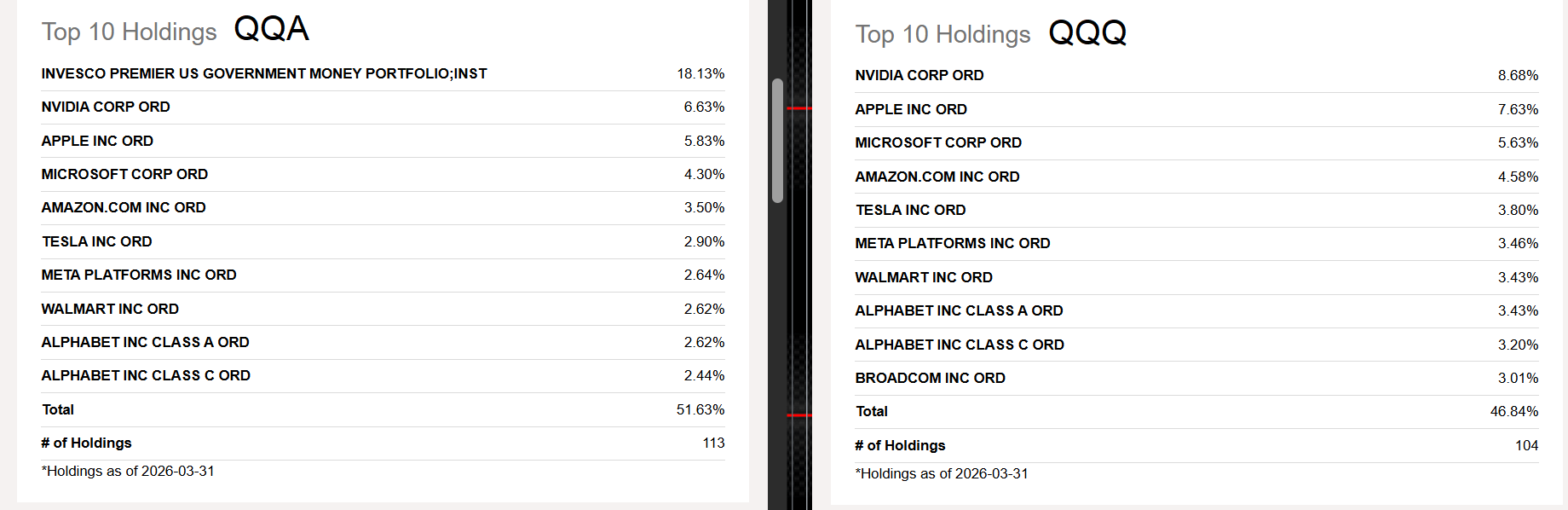
The ETF tracks the NASDAQ-100 Index (NDX), and uses a "full replication" method to make picks for its portfolio, which means whatever funds are earmarked for stock purchases are allocated using the index weightings, so it's nearly identical to the Invesco QQQ Trust, Series 1 ETF (QQQ)'s composition. There's a skew from the cash equivalents and ELN holdings, which I'll get to in a minute, but otherwise the holdings are just a mirror of QQQ.
SA
That's the first part of this ETF, and it accounts for the majority of holdings. Then come the cash reserves in the form of liquid assets like money market fund investments or holding treasury obligations. This could be as much as 20% of total assets, and it serves to provide immediate liquidity in a crisis situation and adds interest income to the mix.
The equity and cash buffer holdings don't offer any leverage, obviously, so that's achieved by a third ingredient in the form of equity-linked notes, or ELNs. Let's understand this instrument before we move ahead with our study of the ETF, since it's the part that generates the high yield (10% trailing).
ELNs are combinations of debt and leverage, the leverage part comprising an underlying options play. The "coupon" on the debt you're buying gives you some amount of downside protection in the form of the high yield, and you also benefit from a capped equity upside.
QQA's ELNs are structured as a way to offshore the options strategy, letting the ELN's issuing bank handle it. That's how QQA is able to sell itself as a passive fund with an ER of 0.29% (net of a 0.04% indefinite waiver).
ELNs are custom products, so there are specific strikes and other parameters for the underlying calls and cash-secured puts that won't match up with a different one, such as what the JPMorgan Nasdaq Equity Premium Income ETF (JEPQ) uses.
JEPQ's ELN-embedded calls are sold at or very near the money, so they require the fund managers to take an active approach, as opposed to QQA's passive strategy that uses out-of-the-money options. The premiums are lower with QQA, which is why you'll see JEPQ with a higher yield (10.5% trailing). That said, QQA does better than JEPQ on the ER front (cheaper) as well as on the TR front (yield + capital gains).
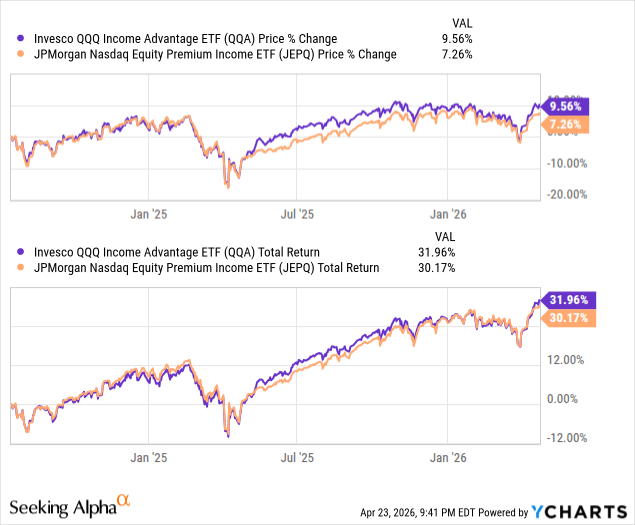
I'm not telling you that JEPQ is worse than QQA, because they suit two different priorities for income investors—either leverage more aggressively for higher income or stay passive and try to grab more upward momentum off the equity part. JEPQ investors are likely to be more income-oriented and less concerned about capital appreciation. On the other hand, QQA offers a lower but comparable yield, but with better exposure to long-term capital gains. This is reflected by their investment objectives: JEPQ's main goal is to "seek current income while maintaining prospects for capital appreciation" while QQA has a slightly different objective, which is to "seek total return through current income and long-term growth of capital." The Fundseekscurrentincomewhilemaintainingprospectsfor capitalappreciation.
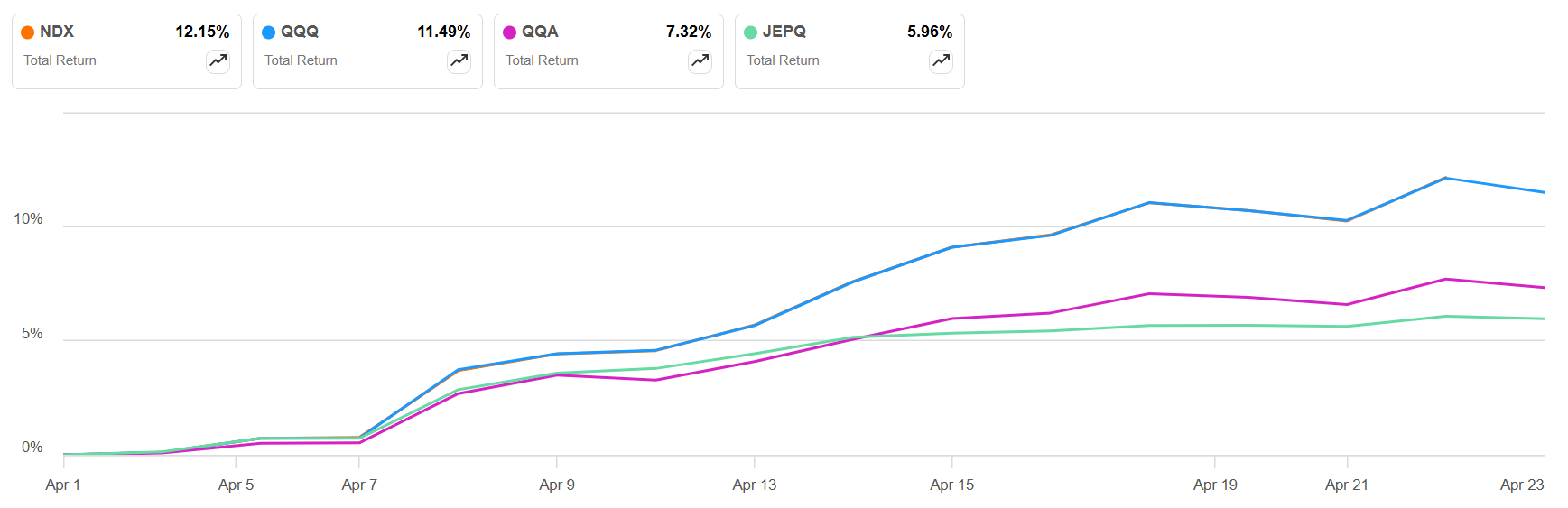
As of early April 2026 (the time of writing), the macro picture's playing out like it did last year after the Liberation Day tariffs first rattled the markets. Another bull rally has begun after a mixed year of growth and stagnation. In such an environment, investors who want a somewhat more cautious, income-forward way to participate in what may be flatter markets may choose QQA.
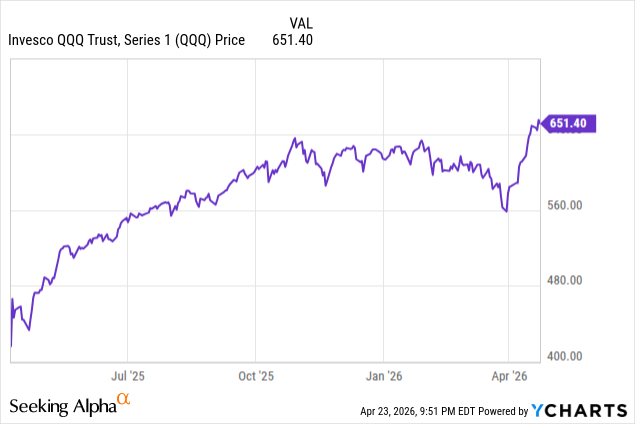
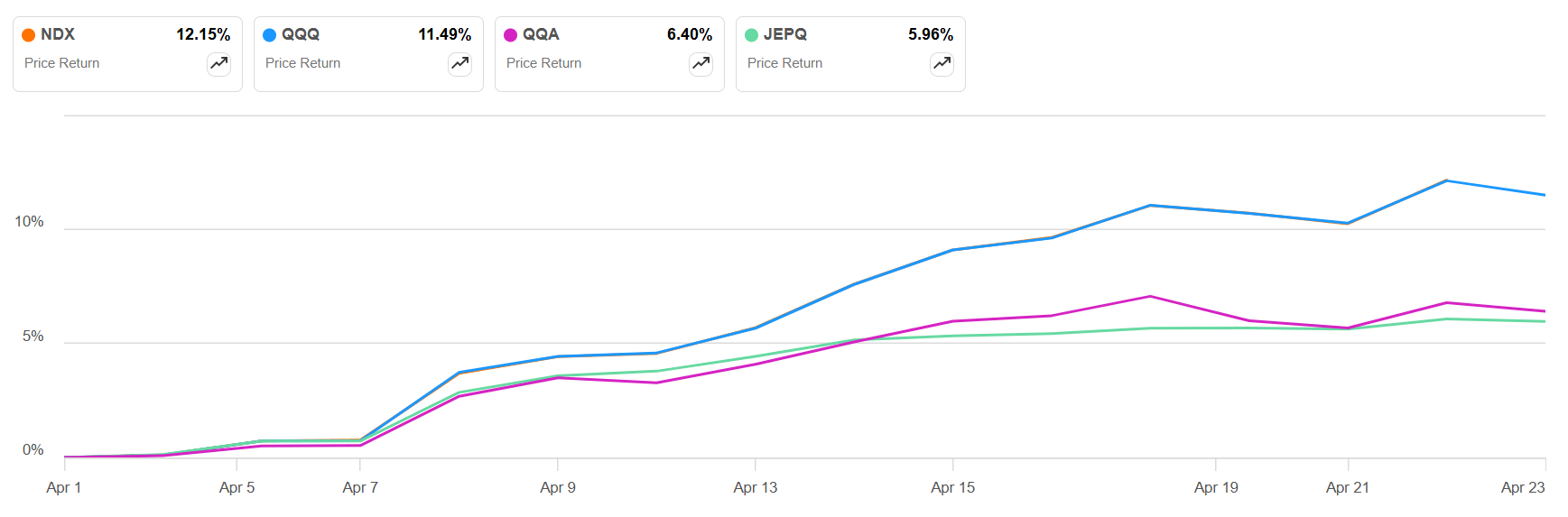
The S&P (SP500) lost 4.3% in Q1-26, even more than what was rotated out of European and Asian markets (ex-Japan). All this money came flowing back when the market went risk-on in April, and month-to-date gains have been so strong that QQA and JEPQ both missed out on a big chunk of upside. This illustrates the effect of structurally capped upside participation in this sort of ETF.
SA
That's the hurdle I'm talking about. You're getting a high yield but at great cost, which means these funds aren't going to get you alpha on a TR basis as long as the market stays strong.
SA
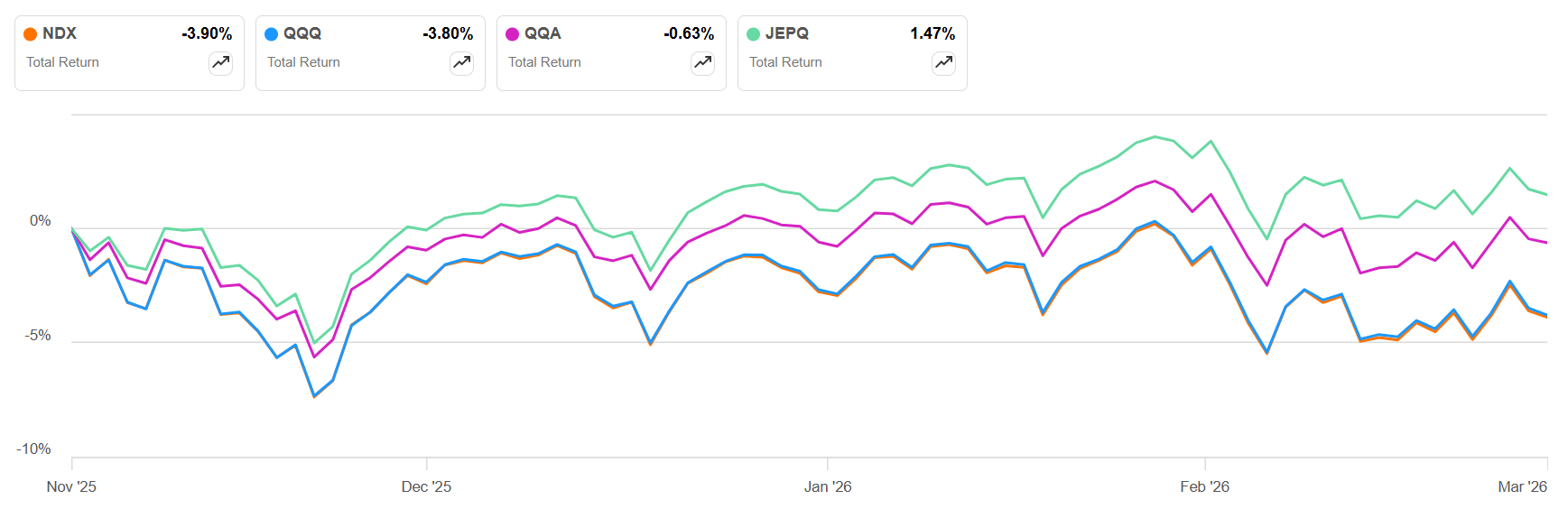
Funds like QQA and JEPQ do best when the market moves sideways, and these funds generally do better than pure equities during declines.
SA
If you noticed that JEPQ protected capital better than QQA, you're right. That's the protection you're getting from the high yield. In the November to March timeframe, when the market was moving sideways but gradually down, the high volatility of the NDX index would have boosted premiums in both ETFs, but since JEPQ's options have lower moneyness, they benefit more. The trade-off is the active management and the higher ER.
QQA could theoretically work for any income investor, so the right fit is a question of how much you want as income, how much upside you're willing to give up, and how much protection you're looking for.
The ETF holds quite a bit of liquid assets "to provide additional downside protection by limiting the Fund’s exposure to equity market risk." Read that as 'we keep a bunch of cash that earns short-term rates and further protects your assets.' Downside is always unpredictable, but you've got options premiums and interest income, both helping to offset any declines.
The best use case for this ETF is as an income engine that's complementary to a core equities portfolio. QQA will provide the additional equity base required to run the options strategy, and the options embedded in the ELNs will juice those securities to give you a monthly paycheck. Your main block of equities can then run free and capture full upside, and they get marginal downside protection from QQA.
This article answers three main questions about QQA:
Editor's note: This article is intended to provide a general overview of the ETF for educational purposes only and, unlike other articles on Seeking Alpha, does not offer an investment opinion about the ETF. Editor's note: This article is intended to provide a general overview of the ETF for educational purposes only and, unlike other articles on Seeking Alpha, does not offer an investment opinion about the ETF.
此内容由惯性聚合(RSS阅读器)自动聚合整理,仅供阅读参考。 原文来自 — 版权归原作者所有。