

惯性聚合 高效追踪和阅读你感兴趣的博客、新闻、科技资讯
阅读原文 在惯性聚合中打开

推荐订阅源

OSCHINA 社区最新新闻
OSCHINA 社区最新新闻
人人都是产品经理
人人都是产品经理
IT之家
IT之家
T
The Blog of Author Tim Ferriss
V
V2EX
博客园 - 聂微东
The Cloudflare Blog
Blog — PlanetScale
Blog — PlanetScale
A
About on SuperTechFans
U
Unit 42
Vercel News
Vercel News
L
LangChain Blog
博客园 - 司徒正美
H
Help Net Security
Recent Announcements
Recorded Future
Recorded Future
V
Visual Studio Blog
Jina AI
Jina AI
Microsoft Azure Blog
GbyAI
GbyAI
Y
Y Combinator Blog
C
Check Point Blog
博客园 - 三生石上(FineUI控件)
奇客Solidot–传递最新科技情报
奇客Solidot–传递最新科技情报
钛媒体:引领未来商业与生活新知
钛媒体:引领未来商业与生活新知
J
Java Code Geeks
The Register - Security
The GitHub Blog
The GitHub Blog
B
Blog RSS Feed
F
Fortinet All Blogs
B
Blog
G
Google Developers Blog
Cyber Security Advisories - MS-ISAC
云风的 BLOG
云风的 BLOG
爱范儿
爱范儿
MongoDB | Blog
MongoDB | Blog
F
Full Disclosure
有赞技术团队
有赞技术团队
罗磊的独立博客
博客园_首页
MyScale Blog
MyScale Blog
aimingoo的专栏
aimingoo的专栏
Google DeepMind News
M
MIT News - Artificial intelligence
N
Netflix TechBlog - Medium
Engineering at Meta
Engineering at Meta
量子位
I
InfoQ
小众软件
小众软件
P
Proofpoint News Feed

All Articles on Seeking Alpha

All Eyes On Cencora, A Healthcare Supplier That Could See Lots More Upside Simply Good Foods Doesn't Look Like A Growth Stock Anymore Applied Digital: Post-Earnings Clarity Confirms An Accelerated Path To $1 Billion NOI Target IBIT: Why I Stepped To The Side (Technical Analysis) (Rating Downgrade) XES: Oil Service Stocks Turn Pricey; Why It's Time To Take Profits (Rating Downgrade) The Only Dividend Strategy I'd Trust In A 3.5% Fed Funds World Opera: AI-Driven Advertising Prospects - Upside Potential And Rich Dividend Yields RenaissanceRe: Preferred Stock Hasn't Been This Appealing In Years Q1 Earnings Kick Off With Major Banks' Results: Bank of America, Netflix In Focus Sezzle: Consolidation Completed, Re-Rating Ahead Bitmine Immersion Q2 Preview: Ethereum Thesis Facing Important Report Card I Am Sharing 2 Of My Retirement High-Yield Gems The Software Narrative Is Leaking Badly Again Thanks To Anthropic Mythos The Muni Market Looks Appealing In Q2 AVIV: Should Keep Rising If The Ceasefire Holds Foundayo Explained: Lilly's New Weight Loss Pill And The Amazon Effect Sabesp: A New Privatization As An Opportunity! EchoStar: Potential Bull Trap At Play - Take Gains Off The Table Teladoc Health: Improving Fundamentals Support A Turnaround Story March CPI Inflation: 5 Reasons To Stay Calm Two 12%+ Yielding BDC Bargains (One Is My Top Deep-Value Pick) TechnipFMC: We Prefer Saipem With More Room To Improve Tesla: From Bye-Bye To Buy-Buy (Rating Upgrade) DMB: Vulnerable To High Interest Rates Western Midstream: A 9% Yield That Still Grows In A Downturn IQQQ: Tax-Efficient Income From The Nasdaq But Does Not Protect Against Declines Qualys Share Price Pulled Down By Potential Cybersecurity Disruptor S&P 500: A Dead Money Era May Be Here. How To Thrive In It Vistance Networks Looks Better Than Before With Powerful Earnings Growth Commerce Bancshares: Valuation, Not Quality, Is The Problem CuriosityStream: AI Is Not Enough For An Investment Here Akamai Collapse: Did Anthropic Just Kill Its Prospects? I Think Not Potential $5,000 Monthly Income - 12 Investments To Buy And Hold For The Next 10 Years Citizens Financial Group: Q1 Results Should Validate Recent Strength Weekly Indicators: The Consumer Continues To Spend Like There's No Tomorrow Don't Overlook Arthur J. Gallagher & Co. When Investing Global Ship Lease: Embedded Upside From Charter Repricing And Trade Disruption Marvell: Rating Upgrade On Data Center Boom EMCOR Group: Solid Business That Is Fully Valued High-Yield REITs I Would Trust For Retirement Income Rubrik's Growth Engines Are Working, But 18% Dilution Risk Weighs On The Upside Coeur Mining: The Market Is Still Pricing The Old CDE Morgan Stanley Direct Lending Has Some Issues, But The Price Makes It Buyable Exploring Digital Equity With These 3 Stocks Twin Disc's Pop Means It's Time For A Downgrade Peloton: Great Improvements But With An Idea Lacking Evidence Tap The Brakes And Buy SPLV Clean Up Your Portfolio With Bath & Body Works Devon-Coterra Merger: Good And Bad Tyson Foods: Pivoting Beyond Cyclicality Into Structural Growth DaVita: Further Upside Is Trickier (Rating Downgrade) Western Midstream: My Favorite High-Yield MLP Pick Uber: Why I'm Betting Big Victoria's Secret: Upgrading To A Cautious Hold, Due To The Sustained Demand MUC: Has Seen A Great Return, With More Gains Likely To Come Gogo: Incoming Growth Catalysts From MilGov And Galileo Adoption (Rating Upgrade) CEF Market Weekly Review: GAB Restrikes Its Rights Offering Ceasefire Brings Relief, But Outlooks Remain Complex Osterweis Capital Management Q2 2026 Equity Outlook Albemarle: Strategic Asset In Energy Security (Rating Upgrade) Why Amazon Is Not The AI Chip Provider Broadcom Is Global Partners: Watch Out For The Redemption Of The Preferred Shares International Consolidated Airlines: Hedging Provides Cushion Amid Oil Shock, We Still See Upside From Trading Houses To Tokio Marine: Buffett's Expanding Bet On Japan Bloom Energy: 115x Earnings Is Not Expensive Enough McGraw-Hill: The EdTech Sleeping Giant After A Chaotic Q1, I'm Buying XLK And XLC As The Market Exhales Trump Pressures Iran As Islamabad Talks Aim To Secure Lasting Middle East Truce Consumer Sentiment Plunges To Lowest Level On Record ZIM's $35 Buyout: Why The Market Is Wrong To Doubt Hapag Lloyd's Winning Bid (Rating Upgrade) Politics And The Markets 04/11/26 Comcast Has Finally Fallen Low Enough To Get Interesting CoStar: A Compounding Machine In The Trash Can Ondas: Very High Growth, Very High Uncertainty, Cautious Buy Riley Exploration Permian: A Solid Growth Story In A Cyclical Industry Metals Are Lost In Translation; Risk Assets Or Safe Haven? - Silver, Gold And Copper Outlook Federal Reserve Watch: Fed Keeps Adding Securities To The Portfolio AirJoule: Breakthrough Water Tech, But Still Too Early To Buy Unit Corporation: Warrant Litigation Proceeds Bridgemarq Real Estate Services Inc. 2025 Q4 - Results - Earnings Call Presentation Markets Weekly Outlook: Markets Brace For U.S.-Iran Talks Amid Post-Ceasefire Surge KLA Corporation: Success Already Priced In, Hold Rating Maintained Headline Inflation Surged In March, But Core Remained Muted How To Potentially Crush Bond Fund Returns With DIY Treasury Trading It's The Economy... Are The Semis And Transports Leading The Market To New Highs? Otsuka Holdings Co., Ltd. (OTSKY) M&A Call Prepared Remarks Transcript Consumer Price Index: Inflation At 3.3% In March FRP Holdings, Inc. (FRPH) Q4 2025 Earnings Call Transcript W.W. Grainger Proved Me Wrong. I Wish I Bought It Sooner Neurocrine Biosciences, Inc. (NBIX) Soleno Therapeutics, Inc. - M&A Call - Slideshow Phoenix Education Partners, Inc. 2026 Q2 - Results - Earnings Call Presentation Wallbridge Mining Company Limited (WM:CA) Presents at John Tumazos Very Independent Research Virtual Conference - Slideshow Higher Medicare Advantage Rates Push U.S. Managed Care Stocks Higher QuantumScape Corporation: New Buying Opportunities After The Selloff Should Not Escape You The Importance Of The Up Days Powell And Bessent Summon Bank CEOs For An 'Urgent' Meeting - What's Going On Evergreen Private Equity Investing In Retirement Plans: Key Benefits Of A Direct, Multimanager Approach U.S. IPO Weekly Recap: Pipeline Swells With Sizable IPO Filings As Metals Royalty Direct Lists Can Forgotten Biotech Break Out?
IFRA: A Primer On This Mid-Cap Heavy US Infrastructure ETF (BATS:IFRA)
The Alpha Sieve · 2026-06-18 · via All Articles on Seeking Alpha
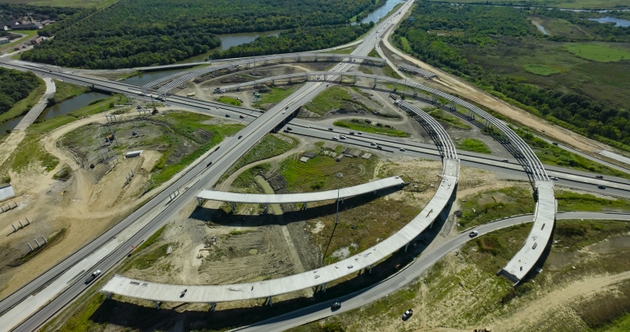
Aerial View of Highway Interchange Construction in Port Arthur, Texas

halbergman/E+ via Getty Images

Introduction to the iShares US Infrastructure ETF

The iShares US Infrastructure ETF (IFRA), which is backed by Blackrock (under its brand of ETFs-iShares), is a $4.25B product (in terms of assets under management) that has been in existence since April 2018. IFRA, which is priced at an expense ratio of 0.3%, pays dividends on a quarterly basis, with the annualized figure amounting to 1.57%.

How Is IFRA Built?

IFRA’s intention is to focus on stocks that stand to benefit from a boost in domestic (the US) infrastructure activities, and it goes about fulfilling its goal by tracking an index that is maintained by a third party called ICE Data Indices [IDI]. The index in question is the NYSE FactSet U.S. Infrastructure Index [NFUII], and it is constructed using a methodology developed by Fact Set (a global financial data comp).

NFUII which is reconstituted every March requires any potential constituent (which needs to be listed on the NYSE, NYSE American or the Nasdaq) to have a minimum market-cap of $300M (as well as an average 3-month daily traded value of $1M). Then, from this pack, all stocks that generate 50% or more of their revenue from infrastructure-related industries are considered. Basically, the goal is to procure either infrastructure enablers or infrastructure asset owners and operators, who generate 50% or more of their annual revenue from the US. Once the stocks are gathered (over 160 in total), they are then assigned equal weights, which get rebalanced four times per year.

What Are The Key Characteristics Of IFRA's Portfolio?

We know that IFRA focuses on infrastructure enablers and infrastructure asset owners/operators, but from which sectors (as per the traditional definitions of the Global Industry Classification Standards, or GICS) are they procured? Well, two sectors in particular (industrials and utilities) dominate with an aggregate weight of over 75% of the entire portfolio. The rest of the portfolio comes from the materials sector, the energy sector, and the discretionary sector, with the latter contributing an insignificant stake of less than 0.5%.
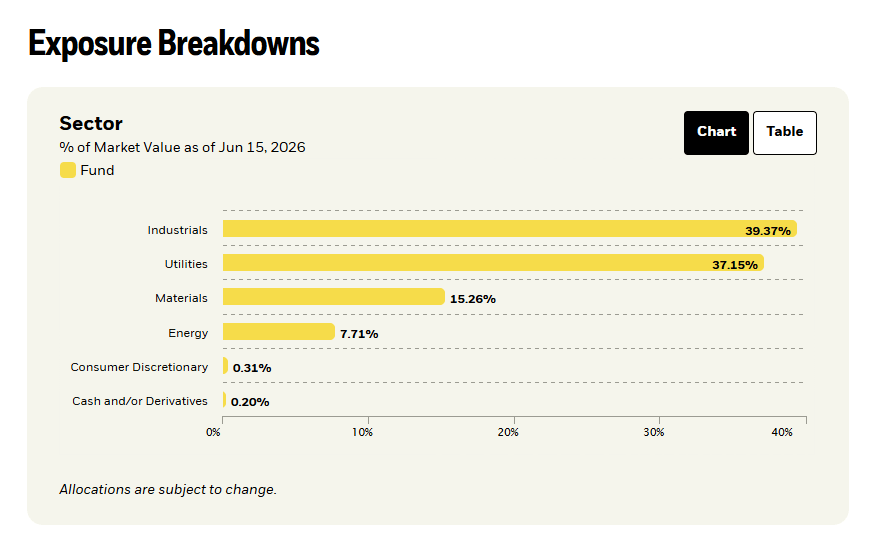
Sector exposure

iShares

Unlike a lot of products that track market-cap weighted indices (which ends up making them giant and large-cap heavy), IFRA’s target index follows an equally weighted policy. As a result, note that it isn’t giant or large-caps but the mid-cap bracket which dominates this portfolio with a 56% stake. Micro-cap exposure of around 2% is understandably low, as ICE Data Indices does not consider stocks with a free-float market-cap of less than $300M (at the time of construction).
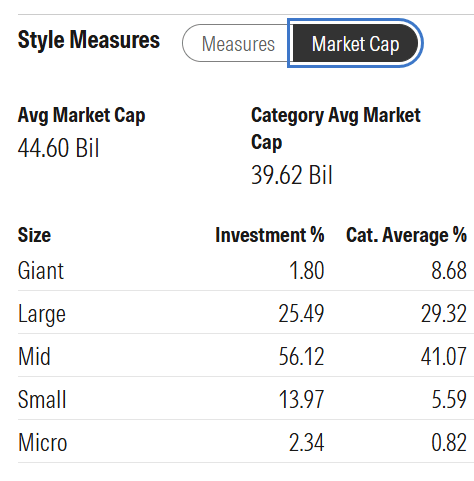
Market-cap breakup

Morningstar

Stylistically as well, it’s the mid-cap blended names which dominate this portfolio with an aggregate stake of one-third. For the uninitiated, blended stocks combine the best of both the value and growth style stocks (typically those with stable business models and high dividend payouts, in addition to strong growth prospects in terms of sales/earnings).
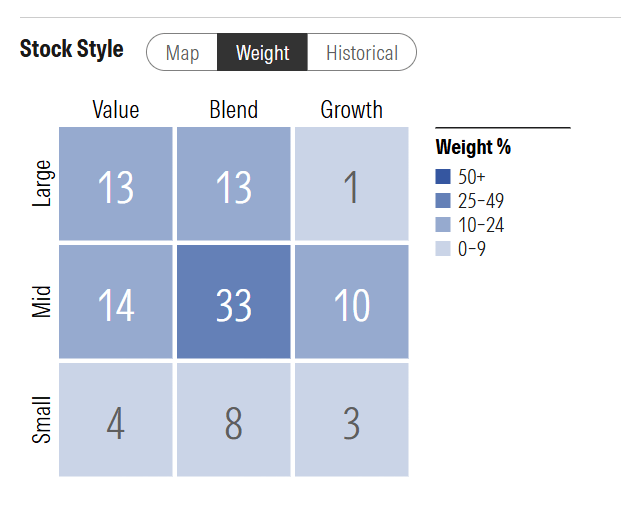
Style breakup

Morningstar

Who Is IFRA For?

IFRA represents a cost-effective vehicle (an expense ratio of 0.3% which is the lowest amongst pure play infrastructure ETFs, and 20bps lower than the ETF median of 0.5%) for those who want well-balanced and comprehensive coverage to stocks across the US infrastructure value chain. This portfolio not only includes traditional infrastructure stocks such as utilities and transportation plays (which tend to benefit from stable cash flows and high barriers to entry), but also those (like construction & engineering service firms, machinery and material providers) that are more cyclically themed, and are also favorably exposed to a growing impetus in US infrastructure spending appetite, are seeing a surge in backlogs. This balance between the two pockets, makes IFRA well positioned to thrive in both an upswing and a downswing of the broader economy.

IFRA would also be suitable for those who dislike the overcrowded large and giant-cap space (most ETFs follow market-cap weighted indices which end up focusing largely on these market-cap categories), and are more comfortable tilting towards the mid-cap space (which typically offers better growth prospects than giant and large-caps, and are also less volatile than small-caps).

What Are The Risks Associated With IFRA?

The stocks of IFRA are likely to be very sensitive to the shifting hues of Federal fiscal policy, particularly in light of the burdensome debt burden that the US government faces (government debt to GDP has been above 120% for multiple years, since the onset of the pandemic); if the ruling governments choose to turn more parsimonious and more fiscally responsible, or divert resources away from infrastructure projects to other areas of the economy, the stocks of IFRA could be adversely impacted. Needless to say, this is a cohort of stocks whose prospects are closely linked to the political climate of the country.
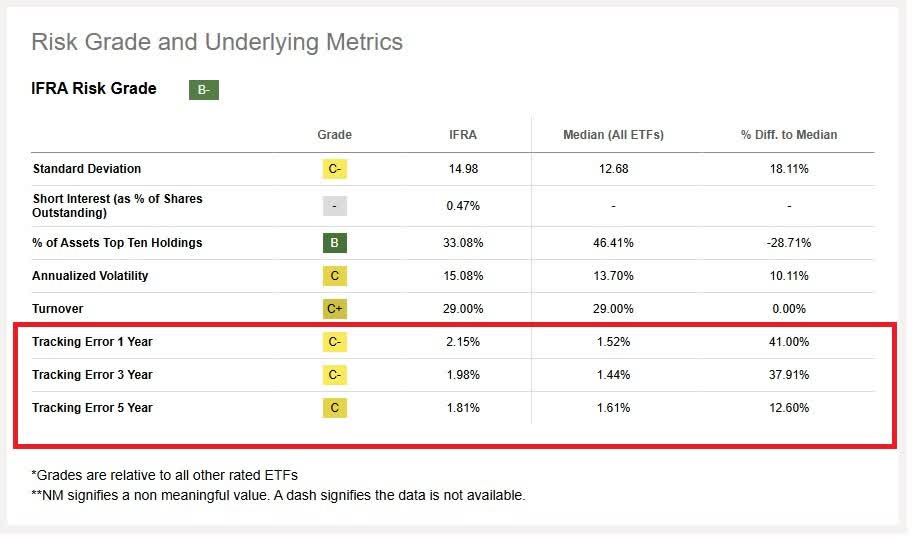
Tracking errors

Seeking Alpha

IFRA is a passively managed product, whose value is primarily derived from how effectively it tracks the NFUII. Rather than resorting to full replication, IFRA seeks to mirror the performance of NFUII through a more cost-efficient process known as ‘representative sampling’, where the former only owns a sample of stocks that in total have the same qualities as the latter. While IFRA may score on the efficiency front, it loses out on tracking capabilities (tracking errors are wider than those experienced by the median ETF), which appear to have gotten worse over the last three years and the last year alone.

Investors who own S&P 500-heavy portfolios, are unlikely to find IFRA as a apt diversifier, as it’s sensitivity to the movements of the US benchmark, are almost close to 1x. Put simply, for every 1% move in the S&P 500 (be it to the upside or downside), one can typically expect IFRA to move by around 0.9%.
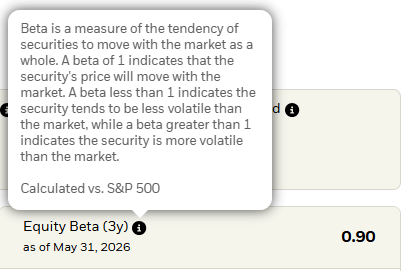
beta

iShares

The margins of businesses involved in the infrastructure space, also tend to be keenly impacted by commodity price volatility, tariff effects, and labor shortages.

Peers of IFRA

Two close peers of IFRA are the Global X U.S. Infrastructure Development ETF (PAVE), and the iShares Global Infrastructure ETF (IGF).

IGF, differs from the other two in that it is the only one which provides exposure to infrastructure stories beyond just America (US exposure which is still the largest is at 36%). This ETF, which is the oldest out of the lot, also offers the most concentrated infrastructure exposure (it only covers 78 stocks), with a heavy tilt towards transportation stocks (the other two are more spread out and tilt more towards the industrial sector. It also stands out for its high-yield (relative to the other two), and a predilection towards large-caps (as opposed to mid-caps).

PAVE, which is backed by Global X (unlike the other two), is a very industrial heavy portfolio (72% of the holdings). It is also the least cost efficient (an expense ratio of 0.47%), and also the least lucrative from a yield angle (not even half the yield of IFRA, which in turn lags IGF). Note that both alternatives to IFRA distribute less frequently than our ETF in focus. Out of the three IFRA appears to be the least portfolio prone to change (annual churn of only 10%)
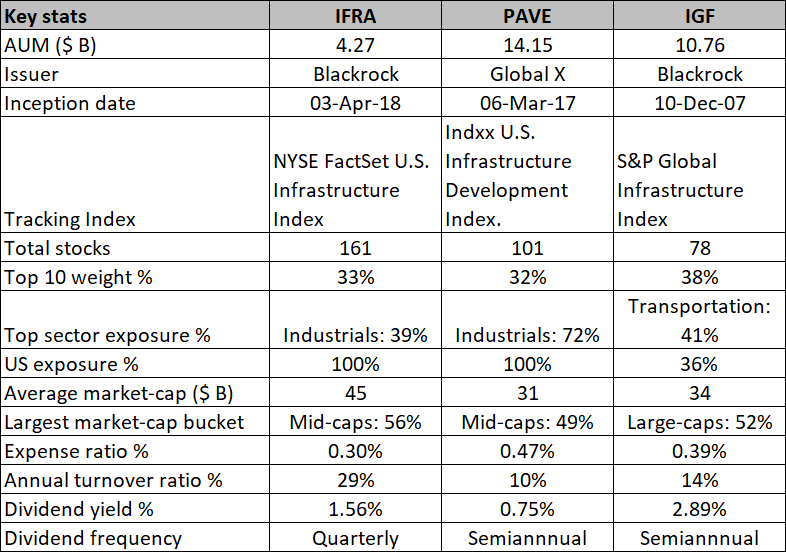
Key stats

Seeking Alpha, Morningstar

Summary

IFRA represents a cost-efficient ETF for those who want access to a pool of stocks from across the US infrastructure value chain that could thrive in expansionary as well as defensive macro conditions. IFRA, which tilts more towards mid-caps, still moves in close tandem with the S&P 500 and may not represent a great portfolio diversifier.

This article answers three main questions about IFRA:

  1. What are the key features of IFRA’s portfolio?
  2. What type of investor is IFRA suitable for, and what are the risks associated with it?
  3. Are there other passive ETF alternatives that offer exposure to infrastructure stocks?

Editor's note: This article is intended to provide a general overview of the ETF for educational purposes only and, unlike other articles on Seeking Alpha, does not offer an investment opinion about the ETF.