



CHARTCHAI KANTHATHAN/iStock via Getty Images
By Michael Kagan and Stephen Rigo, CFA
The first quarter of 2026 was defined by a sharp shift in market leadership and a material deterioration in investor sentiment by quarter end. January and February were relatively calm at the S&P 500 Index (SP500) level, but important changes were already taking place beneath the surface. That calm gave way to volatility in March, when U.S. and Israeli strikes on Iran triggered a broad selloff with the index declining 5.0% during the month. By quarter end, the S&P 500 was down 4.3%, though still up a healthy 17.8% over the trailing 12 months.
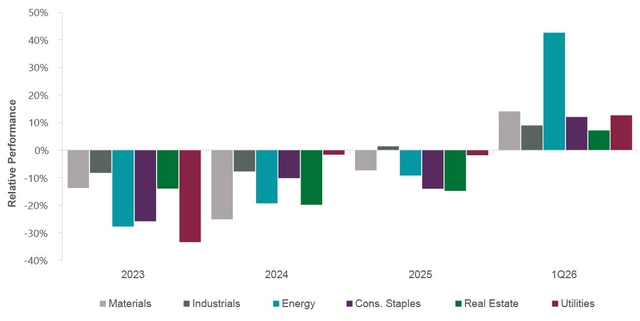
One of the quarter’s defining features was the emergence of new market leadership. Long-lagging sectors outperformed, reversing the AI-driven momentum that dominated the prior three years (Exhibit 1). Materials, industrials, energy, utilities, real estate and consumer staples all outperformed in the quarter despite having lagged the index in calendar years 2023, 2024 and 2025 (save for industrials’ in-line performance in 2025 largely due to AI-levered shares).
"The techno-optimist vision of an “age of abundance,” in which AI, robotics and automation drive sharply lower costs, is being challenged by scarcity across critical inputs."
Energy was the clear standout, rising 38.2% as the U.S.-Iran conflict pushed crude oil prices above $100 per barrel. Materials also performed well, led by chemicals and mining companies that benefited from concerns around geopolitical supply disruption. Industrials’ outperformance was driven primarily by defense companies and entities tied to AI and energy infrastructure. Finally, consumer staples, real estate and utilities found footing as relative safe havens after a protracted period of underperformance (staples shares have lagged the index by nearly 50% over the past three years).
Exhibit 1: Long-Lagging Sectors Outperformed
As of March 31, 2026. Source: ClearBridge Investments, Bloomberg Finance.
By contrast, information technology (IT) and communication services, which led the market in each year from 2023 to 2025, underperformed sharply in the first quarter, falling 9.1% and 6.9%, respectively. Weakness began in January during earnings season as investors increasingly questioned the return on the substantial capital expenditures being undertaken by major technology companies such as Microsoft, Alphabet, Amazon and Meta. Those concerns broadened over the course of the quarter, moving from hyperscalers to hardware companies (the AI “picks and shovels”) and eventually hit one of the market’s hottest corners: memory. Financials and consumer discretionary also lagged as investors reassessed expectations for capital markets activity, credit quality, travel demand and housing in the face of persistent inflation pressures, particularly higher fuel costs.
The near-term backdrop for equities has become less favorable over the past 90 days, and it should remain so even if the U.S. ultimately steps back from its campaign in Iran. The market is now contending with a more complicated mix of slowing labor demand, moderating wages and signs of inflation pressure.
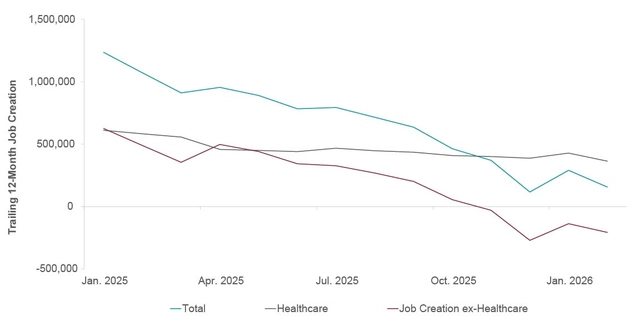
The labor market appears increasingly choppy. While March was a little better, during the previous four months overall payroll growth decelerated. Net job creation was negative excluding health care jobs, a lone bright spot for labor demand (Exhibit 2). Meanwhile, wage growth has steadily declined from its 2023 peak, straining the purchasing power of U.S. consumers, who are already outspending their income, on average. With corporations under pressure to demonstrate efficiency gains from investment in AI and automation, we do not expect labor conditions to reaccelerate meaningfully in the near term.
Exhibit 2: Job Creation Negative Except for Health Care
As of March 31, 2026. Source: ClearBridge Investments, Bureau of Labor Statistics.
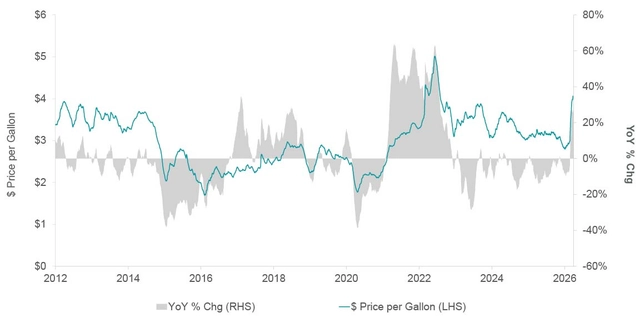
Meanwhile, inflation headwinds are tangible. The politicization and weaponization of energy infrastructure is likely to leave a long tail of higher energy prices. Yes, we are less dependent on oil than in previous energy shocks, but $4/gallon gasoline (up 28% year over year) will divert discretionary spending and mute the impact of higher tax refunds (Exhibit 3). The technology supply chain is also experiencing price pressure. With semiconductor foundries already struggling to meet surging demand, a potential helium shortage (an indispensable gas used in semiconductor manufacturing) due to natural gas infrastructure damage in the Middle East will raise the cost of incremental chip production. In addition, memory shortages driven by insatiable AI demand have pushed spot prices for this commodity materially higher, placing upward pressure on a broad range of products including phones, PCs and gaming consoles. In that context, the techno-optimist vision of an “age of abundance,” in which AI, robotics and automation drive sharply lower costs, is being challenged by scarcity across critical inputs.
Exhibit 3: Daily National Average Gas Prices
As of March 31, 2026. Source: ClearBridge Investments, Bloomberg Finance, American Automobile Association.
This, in turn, creates a difficult backdrop for the Federal Reserve. The Fed’s ability to ease financial conditions to support the labor market appears constrained given price pressure. Cutting rates risks reigniting runaway inflation. Meanwhile, raising rates to tame inflation risks further weakening of an already decelerating labor market. For risk assets such as equities, the concept of a Fed put supporting stocks is harder to bet on today, in our view.If geopolitical conditions stabilize and input cost pressures moderate, the economy may still have enough underlying momentum to move through this period without lasting damage.
"If geopolitical conditions stabilize and input cost pressures moderate, the economy may still have enough underlying momentum to move through this period without lasting damage."
Even so, the outlook is not uniformly negative. The year began with signs of economic acceleration: the ISM Manufacturing Index has posted three consecutive months of expansion (a first since 2022; Exhibit 4), and corporate earnings continue to exceed expectations. The Supreme Court decision has (at least temporarily) rolled back tariffs, and tax refunds may offer a modest near-term cushion for consumers. Finally, equity markets have remained resilient, leaving the wealth effect tailwind in place for America’s highest earners. In sum, if geopolitical conditions stabilize and input cost pressures begin to moderate, the economy may still have enough underlying momentum to move through this period without lasting damage. That possibility argues for selectivity rather than indiscriminate defensiveness.
Exhibit 4: A Return to Expansionary Territory
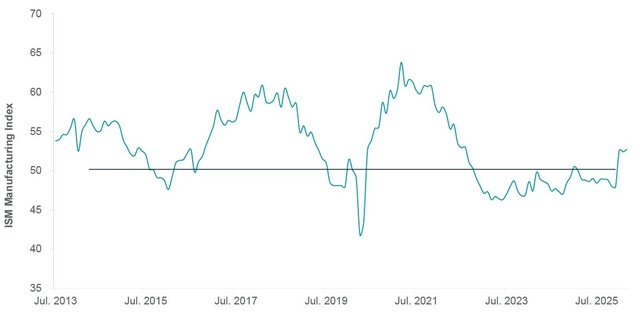
As of March 31, 2026. Note: A reading >50 denotes expansion, while <50 denotes contraction. Source: ClearBridge Investments, Bloomberg Finance, Federal Reserve.
Current conditions argue for a more cautious stance. The continued strength in high-beta AI and quantum computer stocks during the March market decline indicates that animal spirits remain high. In our view, the “buy the dip” mindset that was so successful over the past decade looks less reliable in an environment where inflation risk, policy uncertainty and labor market softening are all rising simultaneously.
The combination of a softer consumer backdrop and renewed cost pressure meeting a long period of uninterrupted credit expansion (with significant expansion in the unregulated corner of private credit) suggests that the early stages of a credit cycle may be forming. If that proves correct, investors may need to revisit playbooks that have not been relevant in over a decade. Future market corrections, in that scenario, may carry greater risk and last longer than many have come to expect.
As always, we remain focused on through-the-cycle outperformance with an emphasis on downside protection. We are closely evaluating balance sheet strength and cash flow durability across our AI-exposed holdings to ensure our exposure remains concentrated in companies with the financial resilience to withstand a cooling in today’s exceptionally strong environment.
The ClearBridge Appreciation ESG Strategy outperformed the benchmark S&P 500 Index in the first quarter of 2026. On an absolute basis, the Strategy had positive contributions from five of 11 sectors. The consumer staples and energy sectors were the main positive contributors, while IT, communication services and financials were the main detractors.
In relative terms, overall sector allocation helped while stock selection detracted. Stock selection in financials and consumer discretionary proved beneficial, while stock selection in the materials and IT sectors detracted from relative results. Overweights to materials and consumer staples and an underweight to IT also helped. An energy underweight detracted.
On an individual stock basis, the biggest relative contributors during the quarter were Costco (COST), ASML (ASML), Kinder Morgan (KMI), Eaton (ETN) and Linde (LIN). The biggest detractors were McCormick (MKC), Microsoft (MSFT), Bank of America (BAC) and not owning ExxonMobil (XOM) and Chevron (CVX).
During the quarter, we initiated a new position in Roblox in communication services. We exited Amphenol (APH) in IT and McCormick in consumer staples.
ClearBridge’s approach to ESG integration remains rooted in a simple but enduring principle: material environmental, social and governance factors are integral to long-term value creation. As the global sustainability landscape evolves amid shifting regulatory priorities, geopolitical complexity and rapid technological change, our approach continues to emphasize fundamental research, active ownership and a disciplined focus on materiality.
Our 2026 Stewardship Report highlights how this philosophy is translating into tangible outcomes, underscoring both the breadth of our engagement activity and the depth of our ESG integration across portfolios.
A defining feature of ClearBridge’s ESG integration is our proprietary ClearBridge Materiality Framework™, which identifies the ESG factors most relevant to each sector and subsector. Engagement priorities are derived from this framework at the company level, ensuring that these efforts focus on issues that are financially material and aligned with our fiduciary duty.
In 2025, several key themes emerged as focal points of engagement:
These themes reflect both structural global trends and evolving investor priorities. For example, climate-related engagements increasingly addressed not only emissions reduction but also adaptation and resilience topics, such as grid modernization, water management and disaster preparedness. Companies like DTE Energy, a utility making grid modernization and storm hardening investments, and Eaton, which builds backup power and electrical resilience systems, illustrate how investments in infrastructure resilience can support both sustainability outcomes and long-term earnings durability.
Similarly, the energy transition has elevated the importance of critical minerals, where demand for copper, lithium and rare earths is driven by electrification, AI infrastructure and renewable energy deployment. ClearBridge engagements in this area extend beyond environmental impact to include human rights, supply chain practices and community relations, particularly through collaborative initiatives such as PRI Advance, with which we have engaged with mining companies Antofagasta and Freeport-McMoRan.
The integration of new teams across regions in 2025 further strengthened the ClearBridge Materiality Framework™ by incorporating new insights from emerging markets, the U.K. and Australia. This global perspective enhances our ability to identify best practices, anticipate risks and engage companies more effectively across diverse regulatory and operating environments.
Insights from Global Engagements
ClearBridge’s global engagement activity provides a number of practical examples of how ESG considerations translate into investment insights and outcomes. Across regions, the most frequently addressed ESG factors in 2025 included energy transition risks, environmental impacts of operations, community relations, employee health and safety, capital allocation and executive compensation.
Several engagements illustrate our pragmatic approach focused on long-term value creation and positive change:
Responsible AI and Emerging ESG Themes
One of the most rapidly evolving areas of ESG analysis in 2025 was responsible AI. As AI adoption accelerates across industries, factors such as data privacy, ethical use of AI, labor implications and environmental impacts such as energy and water consumption from data centers have grown in importance in our analysis.
This reflects the increasing importance of technology-driven risks and opportunities in sustainability analysis. Responsible AI is now viewed as a material factor influencing competitive positioning, regulatory exposure and stakeholder trust. ClearBridge’s approach emphasizes balancing innovation with accountability, seeking to ensure that companies adopt AI in ways that are transparent, secure and aligned with long-term societal value.
The 2026 Stewardship Report highlights a year of continued progress for ClearBridge’s ESG platform, characterized by global engagement activity and deeper integration of material sustainability factors into investment decision making. As global markets continue to evolve, our approach positions us to navigate complexity while identifying opportunities that align sustainability with shareholder value.
Michael Kagan, Portfolio Manager
Stephen Rigo, CFA, Portfolio Manager
Past performance is no guarantee of future results. Copyright © 2026 ClearBridge Investments. All opinions and data included in this commentary are as of the publication date and are subject to change. The opinions and views expressed herein are of the author and may differ from other portfolio managers or the firm as a whole, and are not intended to be a forecast of future events, a guarantee of future results or investment advice. This information should not be used as the sole basis to make any investment decision. The statistics have been obtained from sources believed to be reliable, but the accuracy and completeness of this information cannot be guaranteed. Neither ClearBridge Investments, LLC nor its information providers are responsible for any damages or losses arising from any use of this information. Performance source: Internal. Benchmark source: Standard & Poor's.
Editor's Note: The summary bullets for this article were chosen by Seeking Alpha editors.
此内容由惯性聚合(RSS阅读器)自动聚合整理,仅供阅读参考。 原文来自 — 版权归原作者所有。