



惯性聚合 高效追踪和阅读你感兴趣的博客、新闻、科技资讯
阅读原文 在惯性聚合中打开

推荐订阅源

Cyber Security Advisories - MS-ISAC
GbyAI
GbyAI
Stack Overflow Blog
Stack Overflow Blog
Recent Announcements
D
DataBreaches.Net
量子位
C
Cybersecurity and Infrastructure Security Agency CISA
G
Google Developers Blog
小众软件
小众软件
Application and Cybersecurity Blog
MyScale Blog
MyScale Blog
让小产品的独立变现更简单 - ezindie.com
Cisco Talos Blog
Cisco Talos Blog
P
Proofpoint News Feed
V
Vulnerabilities – Threatpost
Security Latest
Security Latest
T
Tenable Blog
Vercel News
Vercel News
AWS News Blog
AWS News Blog
Forbes - Security
Forbes - Security
M
MIT News - Artificial intelligence
S
Security Affairs
奇客Solidot–传递最新科技情报
奇客Solidot–传递最新科技情报
Hacker News - Newest:
Hacker News - Newest: "LLM"
美团技术团队
L
Lohrmann on Cybersecurity
博客园 - 司徒正美
Last Week in AI
Last Week in AI
罗磊的独立博客
Project Zero
Project Zero
Cyberwarzone
Cyberwarzone
S
Schneier on Security
S
Secure Thoughts
T
Threatpost
Exploit-DB.com RSS Feed
Google DeepMind News
B
Blog RSS Feed
Y
Y Combinator Blog
F
Full Disclosure
N
Netflix TechBlog - Medium
博客园 - 叶小钗
A
Arctic Wolf
腾讯CDC
cs.CL updates on arXiv.org
T
The Exploit Database - CXSecurity.com
Jina AI
Jina AI
Apple Machine Learning Research
C
Check Point Blog
C
CERT Recently Published Vulnerability Notes
www.infosecurity-magazine.com

All Articles on Seeking Alpha

All Eyes On Cencora, A Healthcare Supplier That Could See Lots More Upside Simply Good Foods Doesn't Look Like A Growth Stock Anymore Applied Digital: Post-Earnings Clarity Confirms An Accelerated Path To $1 Billion NOI Target IBIT: Why I Stepped To The Side (Technical Analysis) (Rating Downgrade) XES: Oil Service Stocks Turn Pricey; Why It's Time To Take Profits (Rating Downgrade) The Only Dividend Strategy I'd Trust In A 3.5% Fed Funds World Opera: AI-Driven Advertising Prospects - Upside Potential And Rich Dividend Yields RenaissanceRe: Preferred Stock Hasn't Been This Appealing In Years Q1 Earnings Kick Off With Major Banks' Results: Bank of America, Netflix In Focus Sezzle: Consolidation Completed, Re-Rating Ahead Bitmine Immersion Q2 Preview: Ethereum Thesis Facing Important Report Card I Am Sharing 2 Of My Retirement High-Yield Gems The Software Narrative Is Leaking Badly Again Thanks To Anthropic Mythos The Muni Market Looks Appealing In Q2 AVIV: Should Keep Rising If The Ceasefire Holds Foundayo Explained: Lilly's New Weight Loss Pill And The Amazon Effect Sabesp: A New Privatization As An Opportunity! EchoStar: Potential Bull Trap At Play - Take Gains Off The Table Teladoc Health: Improving Fundamentals Support A Turnaround Story March CPI Inflation: 5 Reasons To Stay Calm Two 12%+ Yielding BDC Bargains (One Is My Top Deep-Value Pick) TechnipFMC: We Prefer Saipem With More Room To Improve Tesla: From Bye-Bye To Buy-Buy (Rating Upgrade) DMB: Vulnerable To High Interest Rates Western Midstream: A 9% Yield That Still Grows In A Downturn IQQQ: Tax-Efficient Income From The Nasdaq But Does Not Protect Against Declines Qualys Share Price Pulled Down By Potential Cybersecurity Disruptor S&P 500: A Dead Money Era May Be Here. How To Thrive In It Vistance Networks Looks Better Than Before With Powerful Earnings Growth Commerce Bancshares: Valuation, Not Quality, Is The Problem CuriosityStream: AI Is Not Enough For An Investment Here Akamai Collapse: Did Anthropic Just Kill Its Prospects? I Think Not Potential $5,000 Monthly Income - 12 Investments To Buy And Hold For The Next 10 Years Citizens Financial Group: Q1 Results Should Validate Recent Strength Weekly Indicators: The Consumer Continues To Spend Like There's No Tomorrow Don't Overlook Arthur J. Gallagher & Co. When Investing Global Ship Lease: Embedded Upside From Charter Repricing And Trade Disruption Marvell: Rating Upgrade On Data Center Boom EMCOR Group: Solid Business That Is Fully Valued High-Yield REITs I Would Trust For Retirement Income Rubrik's Growth Engines Are Working, But 18% Dilution Risk Weighs On The Upside Coeur Mining: The Market Is Still Pricing The Old CDE Morgan Stanley Direct Lending Has Some Issues, But The Price Makes It Buyable Exploring Digital Equity With These 3 Stocks Twin Disc's Pop Means It's Time For A Downgrade Peloton: Great Improvements But With An Idea Lacking Evidence Tap The Brakes And Buy SPLV Clean Up Your Portfolio With Bath & Body Works Devon-Coterra Merger: Good And Bad Tyson Foods: Pivoting Beyond Cyclicality Into Structural Growth DaVita: Further Upside Is Trickier (Rating Downgrade) Western Midstream: My Favorite High-Yield MLP Pick Uber: Why I'm Betting Big Victoria's Secret: Upgrading To A Cautious Hold, Due To The Sustained Demand MUC: Has Seen A Great Return, With More Gains Likely To Come Gogo: Incoming Growth Catalysts From MilGov And Galileo Adoption (Rating Upgrade) CEF Market Weekly Review: GAB Restrikes Its Rights Offering Ceasefire Brings Relief, But Outlooks Remain Complex Osterweis Capital Management Q2 2026 Equity Outlook Albemarle: Strategic Asset In Energy Security (Rating Upgrade) Why Amazon Is Not The AI Chip Provider Broadcom Is Global Partners: Watch Out For The Redemption Of The Preferred Shares International Consolidated Airlines: Hedging Provides Cushion Amid Oil Shock, We Still See Upside From Trading Houses To Tokio Marine: Buffett's Expanding Bet On Japan Bloom Energy: 115x Earnings Is Not Expensive Enough McGraw-Hill: The EdTech Sleeping Giant After A Chaotic Q1, I'm Buying XLK And XLC As The Market Exhales Trump Pressures Iran As Islamabad Talks Aim To Secure Lasting Middle East Truce Consumer Sentiment Plunges To Lowest Level On Record ZIM's $35 Buyout: Why The Market Is Wrong To Doubt Hapag Lloyd's Winning Bid (Rating Upgrade) Politics And The Markets 04/11/26 Comcast Has Finally Fallen Low Enough To Get Interesting CoStar: A Compounding Machine In The Trash Can Ondas: Very High Growth, Very High Uncertainty, Cautious Buy Riley Exploration Permian: A Solid Growth Story In A Cyclical Industry Metals Are Lost In Translation; Risk Assets Or Safe Haven? - Silver, Gold And Copper Outlook Federal Reserve Watch: Fed Keeps Adding Securities To The Portfolio AirJoule: Breakthrough Water Tech, But Still Too Early To Buy Unit Corporation: Warrant Litigation Proceeds Bridgemarq Real Estate Services Inc. 2025 Q4 - Results - Earnings Call Presentation Markets Weekly Outlook: Markets Brace For U.S.-Iran Talks Amid Post-Ceasefire Surge KLA Corporation: Success Already Priced In, Hold Rating Maintained Headline Inflation Surged In March, But Core Remained Muted How To Potentially Crush Bond Fund Returns With DIY Treasury Trading It's The Economy... Are The Semis And Transports Leading The Market To New Highs? Otsuka Holdings Co., Ltd. (OTSKY) M&A Call Prepared Remarks Transcript Consumer Price Index: Inflation At 3.3% In March FRP Holdings, Inc. (FRPH) Q4 2025 Earnings Call Transcript W.W. Grainger Proved Me Wrong. I Wish I Bought It Sooner Neurocrine Biosciences, Inc. (NBIX) Soleno Therapeutics, Inc. - M&A Call - Slideshow Phoenix Education Partners, Inc. 2026 Q2 - Results - Earnings Call Presentation Wallbridge Mining Company Limited (WM:CA) Presents at John Tumazos Very Independent Research Virtual Conference - Slideshow Higher Medicare Advantage Rates Push U.S. Managed Care Stocks Higher QuantumScape Corporation: New Buying Opportunities After The Selloff Should Not Escape You The Importance Of The Up Days Powell And Bessent Summon Bank CEOs For An 'Urgent' Meeting - What's Going On Evergreen Private Equity Investing In Retirement Plans: Key Benefits Of A Direct, Multimanager Approach U.S. IPO Weekly Recap: Pipeline Swells With Sizable IPO Filings As Metals Royalty Direct Lists Can Forgotten Biotech Break Out?
Why AI's Productivity Boom Could Impact Mortgage Rates
2026-05-10 · via All Articles on Seeking Alpha
AI, decisions in banking. Banker, aided by AI technology, serves as a proficient manager, utilizing artificial intelligence for advanced loan analysis to make informed financial decisions in banking

mdisk/iStock via Getty Images

By Jim Iuorio

Prior to November 2022, artificial intelligence (AI) was something most people associated with futuristic movies. Then OpenAI released ChatGPT, and everything changed. AI was no longer an invisible algorithm quietly powering the world’s most sophisticated companies. Suddenly, the average person could use it to write code, compose poems, edit articles and much more.

The adoption was staggering. ChatGPT reached 100 million users in just two months, making it the fastest-growing consumer application in history at the time, and it has never looked back. Over the next three years, AI became the single most dominant investment theme on Wall Street, working its way into business models across every sector of the economy.

But is it a good thing? That seems to depend on who you ask.

The general consensus is that powerful emerging technology ultimately benefits society and raises our standard of living. The transition, however, can be rocky. There is a growing perception that AI may already be stifling traditional job growth, as companies slow hiring in anticipation of reducing their need for employees. While that has far-reaching implications across the economy, I want to focus on one area: lending rates and mortgages in particular.

A Housing Market Already Under Stress

The housing market has been a serious concern and a source of heated debate for the past five years. In 2021, the Federal Reserve began raising interest rates to combat sky-high inflation. In roughly one year, the 30-year fixed rate mortgage went from under 3% to well over 7%.

Raising rates to fight inflation is designed to address the problem from the demand side. The theory in housing seems fairly straightforward: if money is more expensive to borrow, buyers will be less aggressive in pursuing new homes.

But that is not quite what happened. Most housing analysts now conclude that raising mortgage rates so dramatically, after such a prolonged period of historic lows, effectively froze the supply of homes that would normally come to market. If someone is sitting on a 3% mortgage, there is little incentive to trade it in for a 7% one. Combined with a decrease in new builds, housing inventory dried up and prices rose even higher.

So Where Do Mortgage Rates Come From?

Before exploring how AI might affect mortgage rates, it helps to understand what drives them in the first place.

The average 30-year fixed mortgage is actually held for about 12 years. Because of that, mortgage rates closely track the U.S. 10-year Treasury yield, which is the nearest matching maturity. Historically, the spread between the 10-year yield and the 30-year fixed mortgage rate averages around 180 basis points. In plain terms, if the 10-year Treasury yield is sitting at 4%, one would expect the 30-year fixed rate to be somewhere around 5.8%.
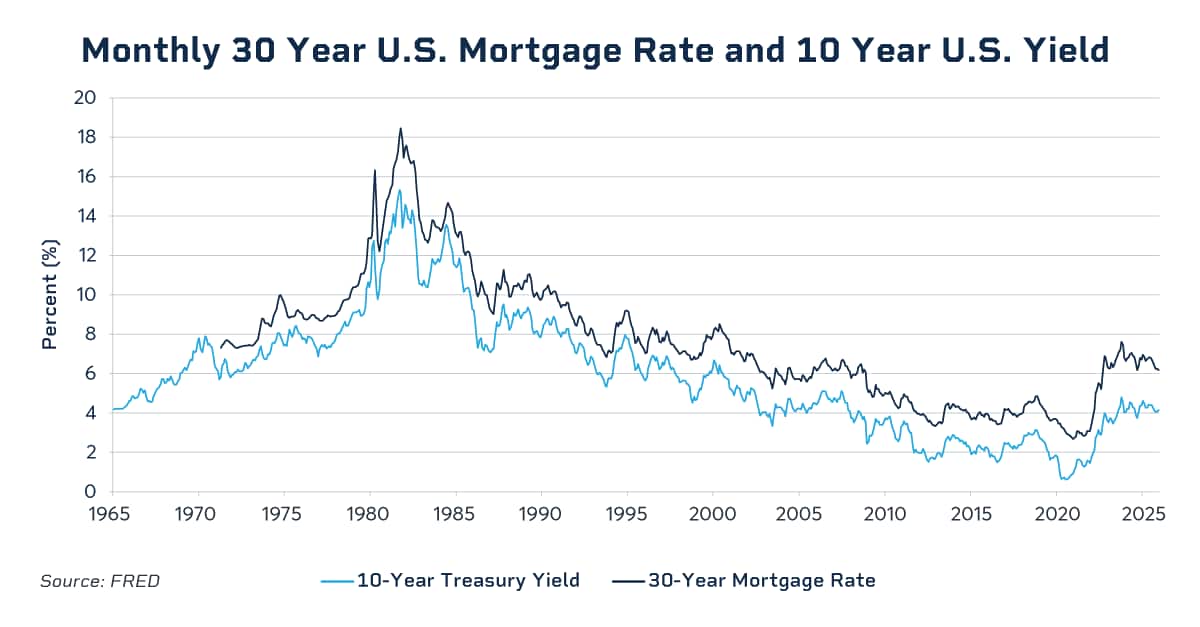
Monthly 30 year mortgage rate and 10 year US yield

That spread exists for two reasons. First, a mortgage carries default risk that a U.S. Treasury bond simply does not. Second, there are real servicing and administrative costs baked into every mortgage. AI could potentially affect both the Treasury yield side of the equation and the factors that create the spread. Here are a few potential ways those scenarios might play out.

Scenario 1: AI Sparks Deflation, Rates Fall

If the biggest economic impact of AI turns out to be massive productivity gains spread across most sectors of the economy, the effect could be deflationary. We saw something similar play out in the 1990s with the internet. Many economists give Federal Reserve Chairman Paul Volcker full credit for reducing inflation in the early 1980s, but a compelling case can be made that the maturation of the internet was a significant deflationary force in its own right.

It is also worth noting that slower job growth, one of the more visible side effects of AI adoption, would likely further dampen consumer spending and add another layer of downward pressure on prices. Disinflation (where prices rise, but slowly) or outright deflation (where prices decline) makes owning long-duration bonds more attractive, which pushes yields lower. History also tells us that the Fed tends to cut short-term rates when disinflation becomes a concern, pulling yields lower across the entire curve. The end result of this scenario would likely be meaningfully lower mortgage rates.

Scenario 2: AI Fuels a Boom, Rates Rise

Alternatively, the AI revolution could ignite a massive domestic economic expansion. In that environment, investment money might flow out of the relative safety of U.S. Treasuries and into higher-returning opportunities in the market. That rotation could push bond prices down and yields up. If the economic boom also generates demand-driven inflation, it would only accelerate the selling pressure on bonds. In this scenario, mortgage rates could move higher.

Scenario 3: AI Compresses the Spread

This scenario gets less attention but may be the most interesting. Even if Treasury yields stay right where they are, AI could narrow the spread between the 10-year yield and the 30-year fixed mortgage rate.

It is possible that AI will improve risk assessment while simultaneously reducing the servicing and administrative costs embedded in the mortgage process. If one assumes that 30% to 50% of that 180 basis point spread is administrative in nature, cutting those costs in half with AI would not be a trivial result. Borrowers could see meaningfully lower rates even in a flat-rate environment, simply because the cost of originating and managing a mortgage comes down.

Where the Evidence Points

No one can say with certainty which of these scenarios will dominate, and it is entirely possible that elements of all three play out simultaneously. However, many analysts seem to believe the weight of evidence points toward lower rates.

For market participants looking to manage this uncertainty, Mortgage Rate futures offer a way to hedge mortgage servicing rights and pipeline risk that can be associated with a changing rate environment. The contract is based on the Optimal Blue Mortgage Market Index, which tracks real-time rate lock data from over one-third of U.S. residential mortgage originations.

The combination of AI-driven productivity gains, the deflationary pressure of a slower labor market and the prospect of leaner mortgage operations creates a compelling case that mortgage rates are more likely to fall than rise over the coming years. For prospective homebuyers who have been sitting on the sidelines waiting for relief, that may finally be the light at the end of a very long tunnel.​​​​​​​​​​​​​​​​

Original Post