










Richard Drury/DigitalVision via Getty Images
The Vanguard FTSE Pacific ETF (VPL), which got listed on March 4, 2005, has managed to accumulate a total AUM of $8.6B since its inception. VPL, which is issued by Vanguard Capital Management, LLC, is priced at an expense ratio of 0.07% and has traditionally made distributions four times per year (although as of June 2026, it is yet to make any quarterly distributions in 2026)
VPL doesn’t actively pick any stocks, but rather, through a process known as full replication, attempts to own all the stocks (and in the same proportion) as an index called the FTSE Developed Asia Pacific All Cap Index ((FDAPACI)). If not for full replication, passive ETFs typically track their target indices through a sampling process (where they only include a sample of stocks that in aggregate have the same qualities as the index). Note that FDAPACI isn’t built or maintained by Vanguard, but through a third party called FTSE Russell (which, in turn, is a subsidiary of the London Stock Exchange Group).
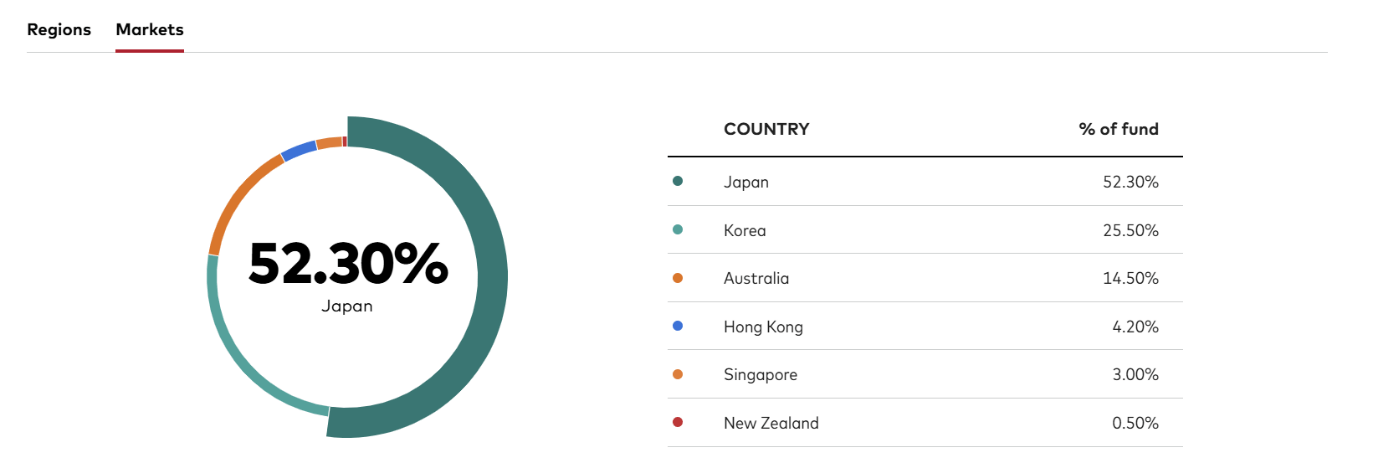
FDAPACI is a market-cap weighted index (meaning the largest stocks receive the largest weights in the portfolio) that attempts to cover over 2,300 stocks (across differing market caps) from six countries based in the Asia Pacific region, namely Australia, Hong Kong, Japan, South Korea, New Zealand, and Singapore.
It’s fair to say that VPL is a developed market-oriented product, as five out of the six countries it covers are classified as developed markets (DM) by prominent global index providers such as FTSE and MSCI. The only bone of contention here is South Korea, which is classified as a DM by FTSE but is still considered an EM (emerging market) by MSCI. With regards to relative exposure within these six countries, VPL is heavily dominated by stocks from the Japanese economy, which alone account for over half the portfolio! Also, exposure from New Zealand could be deemed as insignificant at less than 1%.
Vanguard
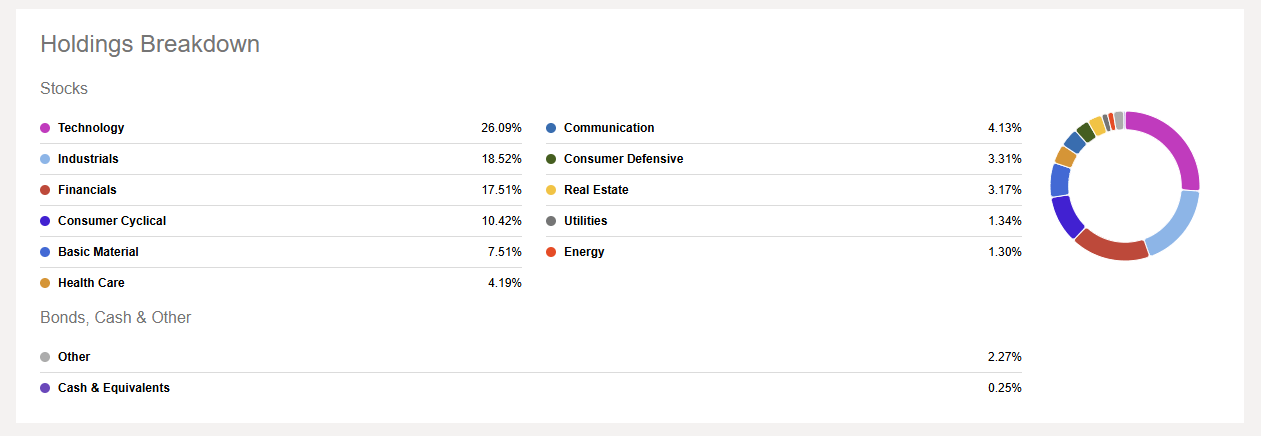
VPL picks up stocks from 11 different sectors, with four sectors in particular (technology, industrials, financials, and consumer discretionary) enjoying a double-digit percentage stake. Among these sectors, it is the technology sector that dominates with a portfolio stake of over 26%.
Seeking Alpha
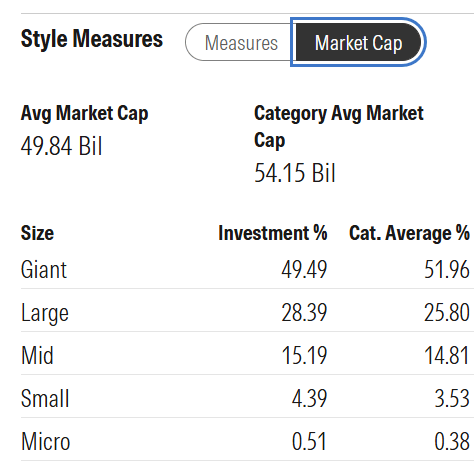
As implied earlier, VPL offers coverage to stocks from different market-cap brackets (giant, large, mid, and small cap), although given that it weighs its constituents on the basis of their respective market caps, it inevitably ends up tilting towards the giant-cap spectrum (half the portfolio, whereas small and micro caps account for less than 5%).
Morningstar
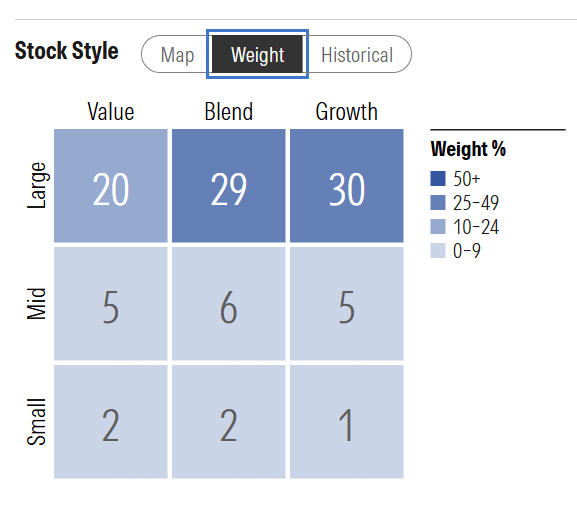
From a stylistic perspective, VPL has relatively equal exposure (of 36-37% of the portfolio) to growth-style stocks, as well as blended stocks (growth stocks that also have some value qualities like relatively strong payouts, and relatively cheap valuations).
Morningstar
VPL invests in assets that are denominated in non-USD currencies, but its NAV is denominated in USD, which means appreciation of the latter could end up adversely impacting the net returns of VPL, even if VPL’s assets show no progress (to the upside or downside) in local currency terms.
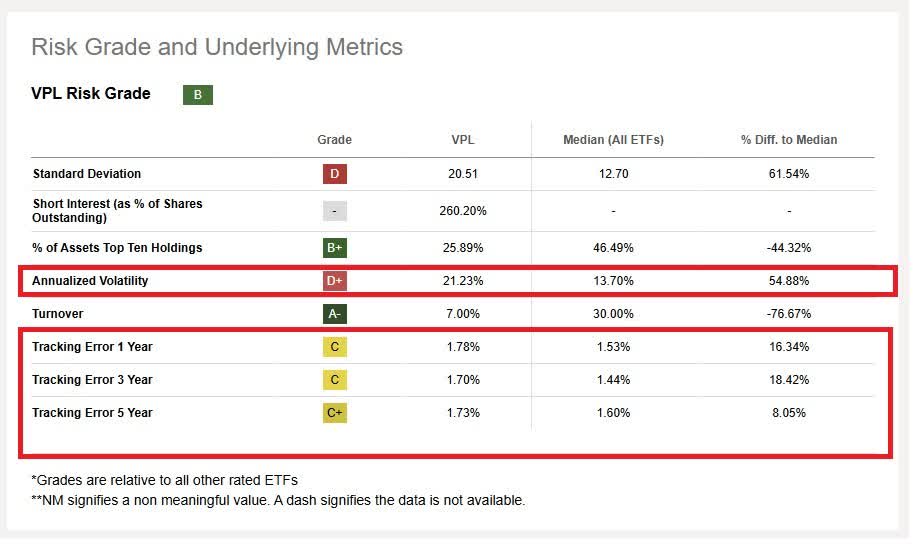
VPL’s returns are typically not very stable (its annualized volatility profile is over 700 bps wider than the volatility that a median ETF typically witnesses, suggesting wide dispersion from its average returns over time), so it wouldn’t be a source of comfort for those who like to invest in ETFs that offer relatively steady and linear returns.
Seeking Alpha
For a passive ETF that resorts to full replication (rather than sampling) in tracking a certain index, VPL’s above-median tracking errors of over 1.7% (across different time durations) are not very ideal and suggest that this product is not doing a good enough job in mirroring the performance of FDAPACI.
With well over half this portfolio coming from Japan alone, investors ought to be mindful of risks that are very specific to the Japanese economy, ranging from a shrinking and aging workforce (thus potentially driving reduced local demand for goods, as well as labor shortages, which could spike labor-related costs that end up eating into the margins of Japanese businesses), a transition to a normalized rate environment (from negative rates and aggressive yield control measures) driving higher borrowing costs, and a severe dependence on energy imports (close to 90%), making businesses here vulnerable to global energy shocks and geopolitical tensions.
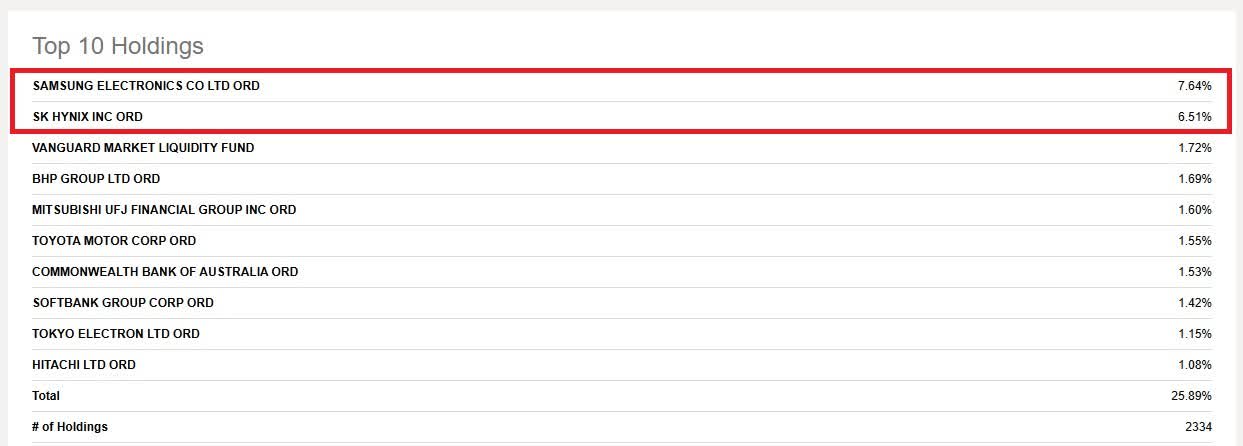
VPL may offer coverage to over 2,300 stocks, but it still suffers from some degree of top-heaviness with two stocks from South Korea alone- SK Hynix and Samsung Electronics (SSNLF)—jointly accounting for over 15% of the portfolio. This wouldn’t necessarily be an issue if these were businesses that were likely to see stable and consistent demand, but the reality is that they are massively exposed to the semiconductor memory market, which has traditionally been accustomed to a boom-and-bust cycle.
Seeking Alpha
VPL could be seen as an ideal vehicle for those who want a cost-efficient, Japanese-heavy (over half the portfolio) portfolio of developed market stocks from the Asia Pacific region. VPL’s expense ratio of 0.07% is just a fraction of what it costs to own a median ETF that is priced at 0.5%.
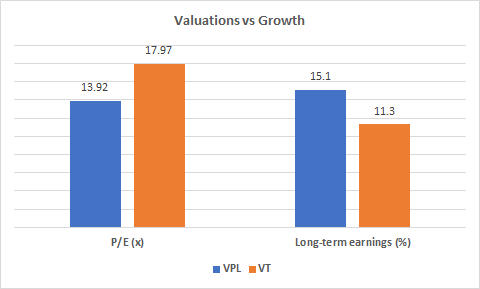
VPL may play to the sensibilities of GARP-style (growth-at-a-reasonable-price) investors, as it is priced at a reasonable earnings multiple of less than 14x (which works out to a discount of over 20% relative to the corresponding multiple of global stocks), yet offers solid enough long-term earnings growth potential of over 15% (nearly 400bps more than global stocks). While these multiples and the differentials are unlikely to remain static, they do represent an opportunity for value-conscious investors to get a long-term high-growth portfolio.
Morningstar
YCharts
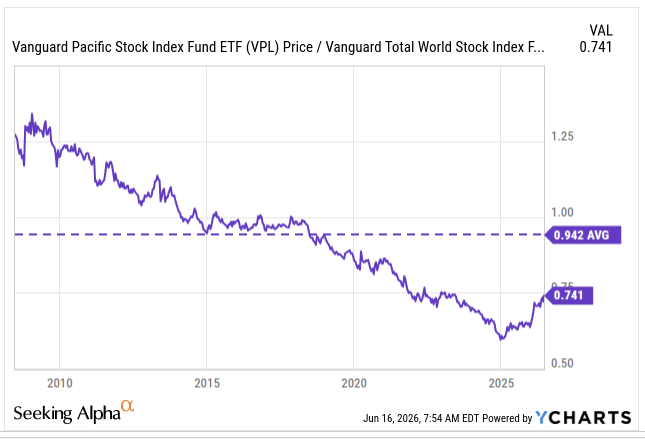
Because of the favorable valuation-to-growth trade-off that VPL offers, it may also serve as a suitable option for those that appreciate the theme of mean reversion in the market. Note that VPL’s current relative strength ratio (vs. global stocks) of 0.74x is currently trading at a +20% discount to its long-term mean.
VPL will also appeal to long-term investors who like to see portfolios with wide coverage (over 2,300 stocks) that are not prone to a great deal of change (VPL only turns over about 7% of its portfolio on an annual basis, which is not even one-fourth the level of churn that a typical ETF encounters).
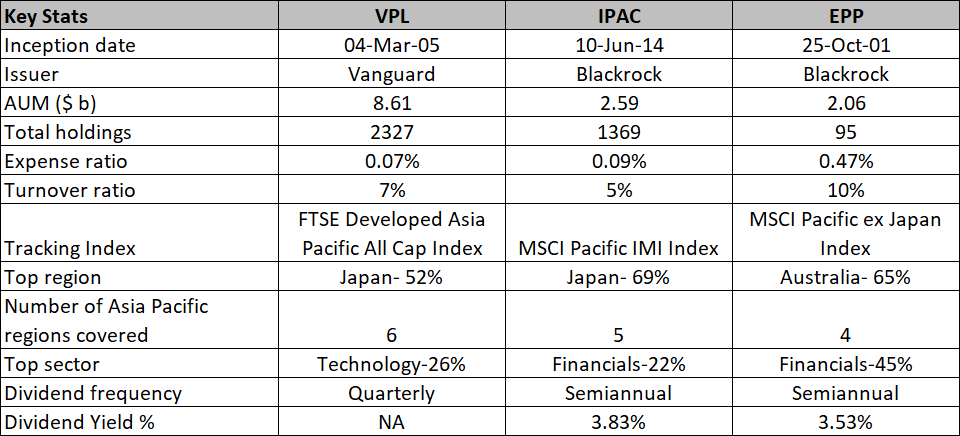
Besides VPL, two passively managed Pacific-focused alternatives that could be considered from the Blackrock stable are the iShares Core MSCI Pacific ETF (IPAC) and the iShares MSCI Pacific ex Japan ETF (EPP), which have around $2B of AUM lower than VPL’s.
While IPAC offers coverage to Asia Pacific stocks, note that it tracks an index that is built and maintained by MSCI (not FTSE Russell, as is the case with VPL). This matters because (as noted earlier) MSCI does not consider South Korea to be a developed market, which means this is a Pacific portfolio excluding South Korea, resulting in even stronger Japanese exposure than VPL (69% as opposed to 52% for VPL).
EPP, as you may have inferred from its nomenclature, is once again an MSCI-focused developed market product (which means no Korean stocks), but it also does not consider stocks from Japan. This makes its portfolio very concentrated towards Australian stocks (almost two-thirds of EPP’s portfolio, whereas it only accounts for less than 15% in VPL and less than 20% in IPAC).
From a cost-efficiency angle, VPL is still best-in-class (EPP’s expense ratio is a lot higher), and both these alternatives tilt more towards financial stocks (with EPP the tilt is a lot stronger as it accounts for almost half the portfolio).
Both these alternatives follow a semi-annual distribution frequency, and their annual churn rate is not greatly different from VPL despite offering much lower coverage (especially EPP which covers less than 100 stocks)
Seeking Alpha, ETF prospectus
VPL is a Japan-heavy developed market portfolio that sources stocks from six different Asia Pacific countries. It comes across as a cost-efficient, widely spread ETF for GARP-style investors. VPL’s volatility profile is on the higher side, and it could be sensitive to the cyclical nature of the memory component of the global semiconductor industry.
This article answers these three main questions about VPL:
Editor's note: This article is intended to provide a general overview of the ETF for educational purposes only and, unlike other articles on Seeking Alpha, does not offer an investment opinion about the ETF.
Editor's Note: This article discusses one or more securities that do not trade on a major U.S. exchange. Please be aware of the risks associated with these stocks.
此内容由惯性聚合(RSS阅读器)自动聚合整理,仅供阅读参考。 原文来自 — 版权归原作者所有。