













DKosig/iStock via Getty Images
“Be careful what you wish for, lest it come true.”—Aesop
For several quarters, we've highlighted that market gains have been dominated by momentum and growth. Stocks that were rising kept rising, while laggards fell further behind. This created a historically wide gap in P/E multiples between our portfolio and the S&P 500—and, more importantly, left Oakmark Fund's P/E well below even that of the Russell 1000 Value Index.
Our conclusion was straightforward: since we were “more value” than the value indices, Oakmark should shine when the Russell Value eventually outperformed the S&P. It finally outperformed last quarter: the S&P 500 declined more than 4% while the Russell 1000 Value rose by over 2%. Did Oakmark outperform the value index as expected? No. We did better than the S&P but still declined. What happened?
Typically, when the Russell Value outperforms, it's because low P/E stocks beat high P/E stocks. Since we believed the premium investors were paying for high-growth companies exceeded what fundamentals justified, we expected lower P/E stocks to outperform. But that's not what occurred last quarter.
To understand why, consider how the Russell 1000 Growth and Value indices are constructed. Companies are ranked by price-to-book and expected two-year growth. Lower price and growth are called value; higher price and growth are called growth. The top 50% of market cap becomes the growth index, and the rest becomes the value index (with some companies in both). Because higher-growth stocks have recently outperformed, the number of companies in the growth index has shrunk. As a result, many high multiple, above-average growth businesses have been pushed into the value index.
These higher-growth, higher-P/E stocks drove the Russell Value's strong first-quarter performance. For example, the Index's semiconductor-related stocks, which ended 2025 with an average forward P/E of 29, increased 15% and accounted for a large share of the index's return. Within the Russell Value, the highest P/E quintile outperformed the lowest by 390 basis points (+3.5% vs. -0.4%). This was clearly not the low P/E rebound we anticipated. Instead, the spread between high and low P/E stocks widened further—despite already being historically large. Our portfolios remain positioned for that spread to narrow, an opportunity we believe is even more compelling today.
As long-term investors, we typically hold stocks for about five years—the time it usually takes for our view of value to converge with the market's. While overall turnover is inflated by position size management and tax trading, Oakmark Fund's name turnover has averaged about 20% annually. With 50–60 holdings in Oakmark Fund, that implies fewer than three new positions per quarter. Last quarter, we added eight—triple the average and the most since the dot-com crash. Why now?
Broad market moves don't necessarily expand our opportunity set. When most stocks rise or fall together, relative attractiveness changes little. Opportunities grow when performance diverges—allowing us to sell stocks near our value estimates and reinvest in those trading well below them.
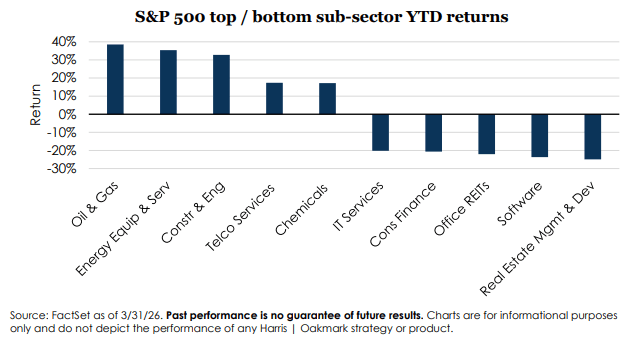
That divergence was extreme last quarter: the 50 th -best stock in the S&P 500 outperformed the 450 th -best by 44 percentage points, a divergence not seen since the Covid shutdown in 2020. Sector dispersion was similarly wide. Energy stocks rose sharply while software declined. Accordingly, we sold primarily in energy and industrials and redeployed capital primarily into software and financials.
When we evaluate potential trades, our goal is to improve the portfolio by making it cheaper, higher growth, or lower risk. By our estimates, last quarter's trades achieved all three. Our buys had lower P/Es but higher expected growth than our sells. They also had lower historical correlation with the portfolio, meaning we expect the new positions to slightly reduce portfolio volatility. It's common to improve one metric without hurting the others; improving all three is rare.
Adds/new buys Trims/Final sales Forward P/E ratio 14x 15x EPS growth 12% 10% Correlation 51% 57%
Source: FactSet as of 3/31/26. The P/E ratio shown is the dollar-weighted average of security-level NTM price-to-earnings for all new buys and adds where the share amount increased by at least 25%. This same approach is applied for final sales and trims, capturing those that decreased share count by 25% or more. For EPS Growth, an identical dollar-weighted calculation is used. Both the security-level P/E ratios and EPS statistics are sourced from FactSet's forward-looking mean consensus estimates. For each group, average correlation is calculated as the dollar-weighted average of the trailing one-year correlation of each security to the portfolio, based on daily returns measured through 3/31/2026.
I'll close with a reminder of how critical the price paid is to future returns. For most of the period following the Great Financial Crisis, investors have been rewarded for ignoring price, buying great businesses outperformed buying great values. This drove a historically wide gap between the "haves" and "have-nots." If we're right that the P/E gap has become unsustainably wide, simply buying better businesses regardless of price will no longer be effective.
AI has been a common concern driving down prices across our recent purchases: fears that it will replace financial advisors, insurance brokers, and even software and entertainment providers. Interestingly, the companies we've invested in expect AI to enhance—not diminish—their businesses. While that debate will take time to resolve, one thing is certain: stock prices have changed.
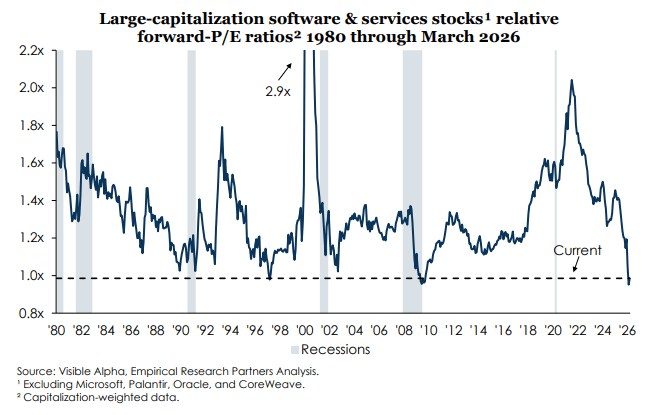
As shown in the above chart from Empirical Research, software stocks are trading cheaper than the S&P 500, their lowest ever relative P/E. At their 2021 peak relative multiple, more than double the Index, fundamental performance needed to be far superior just to produce average stock performance. Investors needed to ask, "Are the businesses really that good?"
With AI uncertainty now at least partly reflected via lower prices, we believe the risk/reward has improved significantly. Consider that the software stocks in Oakmark Fund now trade nearly 30% cheaper than average industrial stocks. This reframes the question: "Are software businesses so much worse than industrials that they deserve such a large discount?" We believe the answer is an emphatic no, especially considering their much higher expected growth. When stock prices change, the questions investors need to answer also change.
Stepping into controversy after sharp declines is nothing new for Oakmark. It doesn't guarantee success, but it has been central to our approach and long-term results. It's also a key reason why, in an industry where firms often come and go, Harris | Oakmark is celebrating its 50th anniversary this year.
We appreciate the trust you place in us to help achieve your family's financial goals, and we remain invested alongside you.
William C. Nygren, CFA
Portfolio Manager
Harris | Oakmark
Average Annual Total Returns (03/31/2026)
Since Inception (08/05/1991) 12.68%
10-year 13.50%
5-year 11.21%
1-year 10.04%
3-month -2.47%
Expense Ratio: 0.89%
Expense ratios are as of the Fund's most recent statutory prospectus dated January 28, 2026, as amended and restated April 2, 2026; actual expenses may vary. Returns for periods of less than one year are not annualized.
Past performance is no guarantee of future results. The performance data quoted represents past performance. Current performance may be lower or higher than the performance data quoted. The investment return and principal value vary so that an investor's shares when redeemed may be worth more or less than the original cost. To obtain the most recent month-end performance data, visit Oakmark.com .
This material is not intended to be a recommendation or investment advice, does not constitute a solicitation to buy, sell or hold a security or an investment strategy, and is not provided in a fiduciary capacity. The information provided does not take into account the specific objectives or circumstances of any particular investor, or suggest any specific course of action. Investment decisions should be made based on an investor's objectives and circumstances and in consultation with his or her financial professionals. The information, data, analyses, and opinions presented herein (including current investment themes, the portfolio managers' research and investment process, and portfolio characteristics) are for informational purposes only and represent the investments and views of the portfolio managers and Harris Associates L.P. as of the date written and are subject to change and may change based on market and other conditions and without notice. This content is not a recommendation of or an offer to buy or sell a security and is not warranted to be correct, complete or accurate. Certain comments herein are based on current expectations and are considered "forward-looking statements." These forward-looking statements reflect assumptions and analyses made by the portfolio managers and Harris Associates L.P. based on their experience and perception of historical trends, current conditions, expected future developments, and other factors they believe are relevant. Actual future results are subject to a number of investment and other risks and may prove to be different from expectations. Readers are cautioned not to place undue reliance on the forward-looking statements. The price-to-earnings ratio ("P/E") compares a company's current share price to its per-share earnings. It may also be known as the "price multiple" or "earnings multiple", and gives a general indication of how expensive or cheap a stock is. Investors should not base investment decisions on any single attribute or characteristic data point. Reference to the Fund's forward P/E is based on the weighted average P/E of all underlying stocks in the Fund's portfolio. The S&P 500 Index is a float-adjusted, capitalization-weighted index of 500 U.S. large-capitalization stocks representing all major industries. It is a widely recognized index of broad, U.S. equity market performance. Returns reflect the reinvestment of dividends. This index is unmanaged and investors cannot invest directly in this index. The Russell 1000® Value Index measures the performance of the large-cap value segment of the U.S. equity universe. It includes those Russell 1000® companies with lower price-to-book ratios and lower expected growth values. This index is unmanaged and investors cannot invest directly in this index. Investing involves risk; principal loss is possible. There is no guarantee the Fund's investment objective will be achieved. Value stocks may fall out of favor with investors and underperform growth stocks during given periods. The Fund's portfolio tends to be invested in a relatively small number of stocks. As a result, the appreciation or depreciation of any one security held by the Fund will have a greater impact on the Fund's net asset value than it would if the Fund invested in a larger number of securities. Although that strategy has the potential to generate attractive returns over time, it also increases the Fund's volatility. These and other risk considerations are described in detail in the Fund's prospectus. Before investing in any Oakmark Fund, you should carefully consider the Fund's investment objectives, risks, management fees and other expenses. This and other important information is contained in a Fund's prospectus and summary prospectus. Please read the prospectus and summary prospectus carefully before investing. For more information, please visit Oakmark.com or call 1-800-OAKMARK (1-800-625-6275). Harris Associates Securities L.P., Distributor, Member FINRA. QCM-5138US-07/26 OPINION PIECE. PLEASE SEE ENDNOTES FOR IMPORTANT DISCLOSURES.
Important Disclosures
Editor's Note: The summary bullets for this article were chosen by Seeking Alpha editors.
此内容由惯性聚合(RSS阅读器)自动聚合整理,仅供阅读参考。 原文来自 — 版权归原作者所有。