



koyu/iStock via Getty Images
The world is currently experiencing an era of global water bankruptcy, where water demand exceeds nature's ability to replenish it, affecting roughly 75% of the global population. - World Resources Institute
I was inspired to write this Absolute Return Letter after reading “The weaponisation of water” in the Lancet. You can find the article here , should you want to learn more.
Simple logic would suggest that higher temperatures around the world would result in too much water. After all, won't higher temperatures cause more ice to melt and thus lead to rising sea levels? That is indeed correct, but life isn't that simple. Allow me to explain.
When the temperature changes, the total amount of water doesn't change – only the state and location of it. The amount of water on planet Earth is nearly constant, whatever the temperature is.
Climate change has led to melting ice sheets all over the world; however, melted ice doesn't flow into freshwater reservoirs but into the ocean; i.e. drinkable freshwater is turned into non-drinkable saltwater. Also, warm air holds more water moisture than cold air, i.e., when the temperature rises, the atmosphere becomes more humid, as plenty of water is 'stolen' from surface water on the ground, rivers, lakes, etc.
Higher temperatures accelerate the evaporation so that rainfalls become rarer, leading to more land areas suffering from drought despite the increased humidity. And it is increasingly the case that, when it finally rains, the rainfall is often so heavy that it causes flooding and other damage.
A recent report from the UN states that:
Adding to that, we know that 70% of all major aquifers are in long-term decline because groundwater is being pumped faster than it is replenished, and we know that almost 100 million people in eastern and southern Africa face extreme hunger regularly because of drought.
In Southern California, catastrophic wildfires rage with increasing regularity, and water levels on the Mississippi River are at record lows. Further north, stream flows in the Northeastern part of USA are also at record low levels. Worst of all, I have learnt that children are particularly badly affected. Worldwide, 920 million children (one-third of all children) are highly exposed to water scarcity and to the accompanying malnutrition.
All this adds up to a pretty dire picture. Commentators like to turn climate change into a CO 2 crisis but, in reality, poor access to freshwater is a far bigger problem. Regular floodings not only damage buildings and infrastructure; they also contaminate freshwater supplies with saltwater and sewage.
Whether you are a climate change hardliner or a sceptic, the water crisis should not be ignored, and that is why it should form part of your investment strategy.
Water is by far the most important commodity on Earth. Without it, most of us won't survive for more than 72 hours. It therefore puzzles me that many investors pay remarkably little attention to it.
Furthermore, it is, far and away, the most powerful weapon at your disposal, if you want to control large population groups. The earliest example (that I can think of) of using water as a weapon goes back to the 15 th century. Leonardo da Vinci and Machiavelli worked jointly on a plan to divert the Arno River away from Pisa – a plan that was designed to strengthen Firenze's position vis-à-vis its rival city, Pisa.
I could mention plenty of other examples from around the world. Take for example the ongoing conflict between Ethiopia and Egypt where people in Egypt, who rely on the river Nile for more than 90% of their freshwater needs, only have limited access to freshwater, following Ethiopia's decision to build a massive dam. Or take the ongoing conflict in Tibet between India and China. I could go on for hours, as there are so many examples, but you probably get the point.
I bring water scarcity up for a couple of reasons:
In other words, we should probably focus less on CO 2 and much more on the water crisis, as it has the potential to lead to significant instability. I am painfully aware that some of you will argue that so does CO 2 . There is a massive difference between the two issues, though. The technology to turn CO 2 into green fuel is well-advanced, and that will likely fix that problem down the road. There is no technology in place to produce more water. We must look after what we already have.\
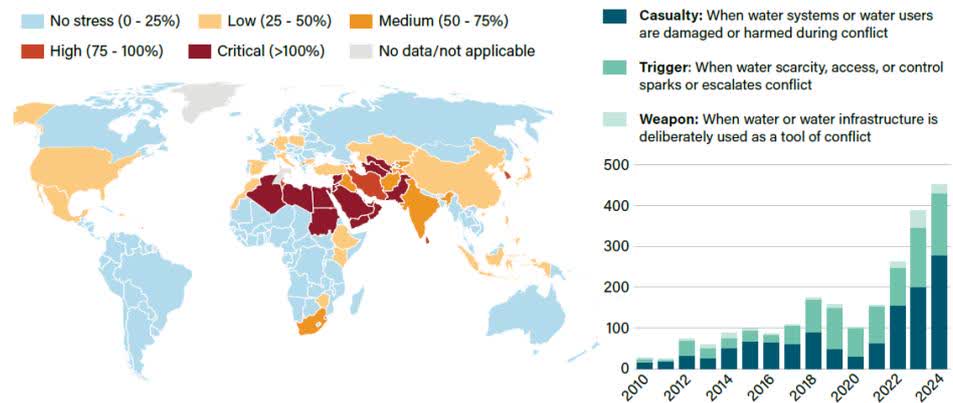
Source: Eurasia Group
For most investors, the modus operandi when investing in water is to invest in water utility companies. They account for a sizeable proportion of all water companies; they generate stable earnings, pay decent dividends and are easy to understand. Take for example the popular iShares S&P Global Water ETF (CGW). Water utilities account for almost 40% of all investments in that ETF.
Here is the problem. Water utility companies do not have the means (technologically or otherwise) to fix the problem. They are, in my opinion, part of the problem . You need to take a different approach, if you want to invest in this theme.
I can think of many industries which are likely to see strong earnings growth for many years to come as a consequence of this problem. First and foremost, you should invest in water technology companies – companies that install pumps, valves, pipes, leak detection systems or indeed entire water treatment systems.
Furthermore, you should include companies that manufacture and install smart meters. Users of water, whether households or businesses, tend to constrain themselves, if their usage is measured.
Companies which specialise in wastewater treatment and/or hazardous water treatment should also be included, and so should companies that design and build desalination plants. As you can see, the list is long but contains no water utilities. I really don't think that is the right way to invest in water.
Until now, I have made no mention of the agricultural industry, but I am not going to finish this letter without pointing out how bad things are in that industry. Over 70% of all freshwater used globally is used in the agricultural industry, and the number is rising as a consequence of climate change.
The Israelis are well ahead of the curve in terms of how to use water more efficiently when irrigating. In almost all other countries, irrigation systems are dominated by sprinklers; however, the Israelis have invented a drip irrigation systems, which has proven far more efficient. Up to 60% less water is used this way when compared to sprinkler systems. The drip irrigation technology could quite possibly be the biggest investment opportunity of them all. 95% of all irrigation systems worldwide are still based on sprinklers.
Niels
© Absolute Return Partners LLP 2026. Registered in England No. OC303480. Authorised and Regulated by the Financial Conduct Authority. Registered Office: 3 rd Floor, 45 Albemarle Street, Mayfair, London W1S 4JL, UK Important Notice This material has been prepared by Absolute Return Partners LLP (ARP). ARP is authorised and regulated by the Financial Conduct Authority in the United Kingdom. It is provided for information purposes, is intended for your use only and does not constitute an invitation or offer to subscribe for or purchase any of the products or services mentioned. The information provided is not intended to provide a sufficient basis on which to make an investment decision. Information and opinions presented in this material have been obtained or derived from sources believed by ARP to be reliable, but ARP makes no representation as to their accuracy or completeness. ARP accepts no liability for any loss arising from the use of this material. The results referred to in this document are not a guide to the future performance of ARP. The value of investments can go down as well as up and the implementation of the approach described does not guarantee positive performance. Any reference to potential asset allocation and potential returns do not represent and should not be interpreted as projections. Absolute Return Partners Absolute Return Partners LLP is a London based thematic investment manager committed to megatrend investing. We aim to benefit from long term thematic trends including Climate Change, the Era of Disruption, Last Stages of the Debt Supercycle among others. You can find more information about the megatrend we invest in accordance with on our website. We are authorised and regulated by the Financial Conduct Authority in the UK.
Editor's Note: The summary bullets for this article were chosen by Seeking Alpha editors.
此内容由惯性聚合(RSS阅读器)自动聚合整理,仅供阅读参考。 原文来自 — 版权归原作者所有。