
惯性聚合 高效追踪和阅读你感兴趣的博客、新闻、科技资讯
阅读原文 在惯性聚合中打开

推荐订阅源

Threat Intelligence Blog | Flashpoint
T
Troy Hunt's Blog
Scott Helme
Scott Helme
T
Threat Research - Cisco Blogs
T
Tenable Blog
L
LINUX DO - 热门话题
V
Visual Studio Blog
I
Intezer
Blog — PlanetScale
Blog — PlanetScale
Cisco Talos Blog
Cisco Talos Blog
A
Arctic Wolf
C
Cyber Attacks, Cyber Crime and Cyber Security
F
Fortinet All Blogs
aimingoo的专栏
aimingoo的专栏
Know Your Adversary
Know Your Adversary
CTFtime.org: upcoming CTF events
N
Netflix TechBlog - Medium
SecWiki News
SecWiki News
I
InfoQ
Microsoft Security Blog
Project Zero
Project Zero
W
WeLiveSecurity
Microsoft Azure Blog
A
About on SuperTechFans
Recorded Future
Recorded Future
Cyber Security Advisories - MS-ISAC
Vercel News
Vercel News
S
Securelist
Spread Privacy
Spread Privacy
L
LangChain Blog
云风的 BLOG
云风的 BLOG
G
Google Developers Blog
MongoDB | Blog
MongoDB | Blog
Google DeepMind News
Recent Commits to openclaw:main
D
Darknet – Hacking Tools, Hacker News & Cyber Security
C
CERT Recently Published Vulnerability Notes
罗磊的独立博客
K
KPMG report finds enterprise disconnect between AI and its ROI | CIO
The Last Watchdog
The Last Watchdog
Attack and Defense Labs
博客园 - 司徒正美
Help Net Security
Help Net Security
L
Lohrmann on Cybersecurity
人人都是产品经理
人人都是产品经理
Forbes - Security
Forbes - Security
Hacker News - Newest:
Hacker News - Newest: "LLM"
PCI Perspectives
PCI Perspectives
博客园 - 【当耐特】
T
Tor Project blog

TIME

How to Watch the TIME100 Gala Red Carpet Livestream Why Epstein Survivors Should Testify Before Congress What to Know About the U.K.’s Generational Smoking Ban With ‘Donnyland,’ Ukraine Becomes Latest to Propose Naming Something After Trump Iran’s Supreme Leader No Longer Reigns Supreme What the Passage of the Virginia Redistricting Plan Means for Control of Congress Robert F. Kennedy Jr. Defends Spending Cuts to Health Agencies Breaking Down the Chilling Ending of Unchosen What to Know About Allegations Against Rep. Cory Mills Amid Calls for Expulsion From Congress Mexico’s President Calls For Investigation After CIA Members Killed in Cartel Operation Democratic Rep. Sheila Cherfilus-McCormick Resigns Ahead of Potential Ethics Sanctions What to Know About Trump’s New Executive Order on Psychedelic Drugs With Michael, the King of Pop Gets a Not-So-Regal Biopic Can a Documentary Help End Gang Violence? Trump Order to Require Banks to Collect Citizenship Info 'In Process,' Bessent Says A Muslim Faith Leader on the Failures That Led to the Iran War, and What Comes Next Trump Says U.S. Will Extend Cease-Fire With Iran Baby Reindeer Creator's Half Man Tests Our Tolerance for Pain. But to What End? What to Know About Shooting at Pyramid in Mexico and Security Concerns for World Cup How American Schools Can Address Political Polarization What to Know About the Louisiana Shooting That Killed 8 Children ‘Dark Money’ Floods Virginia Redistricting Fight, With Millions Linked to Peter Thiel Trump Accuses Iran of ‘Total Violation’ as Strait of Hormuz Remains Shut This Halal Beauty Company Boss Has Big Ambitions What to Know About Allegations of Excessive Drinking by FBI Director Kash Patel Iran Reimposes Control of Strait of Hormuz and Fires on Tankers Welcome to the Second Gilded Age Why the Federal Government Is Making Chicago O’Hare Airport Cut Hundreds of Flights a Day Lee Cronin's The Mummy Is Not a Brendan Fraser Movie. It's Way More Cursed May Bob Odenkirk Always Have as Much Fun as He's Having in Normal What We Know About the ‘Massive’ Military Complex Being Built Beneath the White House The Bigger Energy Lesson Behind Iran’s Control Over the Strait of Hormuz Trump Nominates Dr. Erica Schwartz as CDC Director Even If You Think You're SNL'ed Out, Lorne Offers Some New Angles on Lorne Michaels Modern Dating Is Making Us Less Secure How Businesses Can Apply for Tariff Refunds Through New Portal How Hormuz Could Shape China’s Taiwan Strategy State Department Cracks Down on Visas of People ‘Working on Behalf of U.S. Adversaries’ Israeli Troops to Stay in Southern Lebanon Despite Ceasefire, Netanyahu Says Here’s How to Best Watch the Lyrid Meteor Shower House Democrats Move to Impeach Defense Secretary Hegseth Trump’s Feud With the U.K. Over North Sea Oil: What to Know What The Pitt Says About Burnout, and Why Self-Care Won’t Solve It The Seven Democrats Who Joined Republicans in Opposing Measure to Block Arms Sales to Israel The Looming Risk of Too Many Satellites and Debris in Space 'It's Not Working': Diplomats Fear Trump's Iran Envoys Are Making Things Worse Why Trump’s Strait of Hormuz Blockade May Be a Gift to China Trump Has Abandoned His Affordability Promises Letting AI Do Your Work Erodes Your Confidence, According to a New Study What to Know About the Live Nation Verdict and Its Effect on Ticket Prices Philanthropy Must Choose Courage Over Caution How AI Can Beat Cancer Breaking Down the Action-Packed, Haunting Finale of 'Beef' Season 2 ‘No More Excuses’: Europe Announces Age Verification App in Effort to Crack Down on Social Media Love Is War in Beef's Imperfect But Still Thrilling Second Season U.S. Takes Step Closer to Popular Vote for Presidential Elections as Virginia Joins Compact Senate Blocks Iran War Powers Resolution for Fourth Time ‘It Beats Pitchfork Rebellions and the Guillotine’: Why These Super-Rich Americans Are Asking For Higher Taxes Trump Says Iran War ‘Close to Over,’ Hints at Possible Deadline Ahead of Royal Visit TIME Is Looking For the World's Top HealthTech Companies of 2026 The Neuroscience of the Self Amid Trump's Blockade, Threat of Escalation Leaves Thousands of U.S. Forces on High Alert Shirin Ebadi Rauw Alejandro: The 100 Most Influential People of 2026 Walter Hood Kica Matos Chloe Kim Victoria Beckham American Men Are Set to Be Automatically Registered for the Draft Hungary’s Viktor Orbán Ousted by Voters After 16 Years in Power. Here’s What That Means Medicaid Cuts Could Force More Kids to Become Caregivers Trump Says U.S. Will Blockade Strait of Hormuz After Iran Peace Talks Fail Eric Swalwell Resigns from Congress How Trump’s Proposed Triumphal Arch Stacks Up Against Others Around the World Trump Says U.S. Has Begun ‘Clearing Out’ Strait of Hormuz As Iran Peace Talks Begin The Big Unanswered Question about the Tracking of ICE Observers How NASA Achieved the Historic Artemis II Splashdown Watch Live: Artemis II Crew Returns to Earth Is a Super El Niño Coming in 2026? Here’s What Scientists Are Saying What ‘Emotional Flooding’ Really Means—And How to Handle It What to Know About the U.S. Postal Service’s ‘Severe Financial Crisis’ Israel's War Against Lebanon, Explained America’s Cost-of-Living Crisis Is Really a Pay Crisis Netflix Shark Thriller Thrash Doesn't Know What Kind of Creature Feature It Wants to Be Calls to Impeach Trump Collide With Reluctant Democratic Leadership J.P. Morgan Is Thinking About Climate Tipping Points Why the U.S.-Iran Ceasefire Won’t Last You, Me & Tuscany Delivers Everything It Promises—Including Tomatoes The Christophers Is One of the Best Movies of the Year So Far Not Even Keanu Reeves Can Breathe Life Into the Painfully Unfunny Outcome Breaking Down the Ending of The Miniature Wife Starmer Says He's 'Fed Up' With Trump as Europe Splinters From U.S. Over Iran War What Jamie Raskin Will Tell House Democrats About the 25th Amendment and Impeachment Euphoria Returns, Older But Not Wiser ‘A Perfect Storm’: How AI Is Transforming the Global Scam Industry Women’s Brains Are a $1 Trillion Opportunity Is Hungarian Leader Viktor Orbán, an Icon of the Far Right, About to Be Ousted by Voters? White House Reportedly Warns Staff Against Insider Trading As Lawmakers Raise Concerns Bondi Won’t Testify as Scheduled in House Epstein Probe. Lawmakers Are Threatening to Hold Her in Contempt Melania Trump Says Lies Linking Her to Jeffrey Epstein ‘Need to End’
Remembering Alan Greenspan: the Fed Chair, Bookkeeper, and Bandleader
John Hope Bryant · 2026-06-23 · via TIME

Quincy Jones once told me something that I have never forgotten.

He said that when he was coming up as a young musician in New York, there was a kid in his circle who played clarinet and saxophone. A smart kid. A careful kid. A kid who could sit in any room and, within minutes, understand exactly how everything worked. He went to Juilliard. He played with the great Stan Getz—side by side, night after night, in the Henry Jerome Orchestra—and somewhere along the way, the other musicians figured something out about him that he was only beginning to figure out about himself.

He was the one you went to when the numbers didn't add up.

Between sets, while the rest of the band disappeared into the green room, this kid was doing the bookkeeping. Running the ledgers. Filing the tax returns for his bandmates. He understood money the way the others understood music—intuitively, structurally, as a system with its own logic and rhythm. And somewhere in those years of playing beside Stan Getz — one of the greatest jazz voices of the twentieth century — he made a discovery about himself that changed the course of American history.

That kid was Alan Greenspan. And today, he is gone. He was 100 years old.
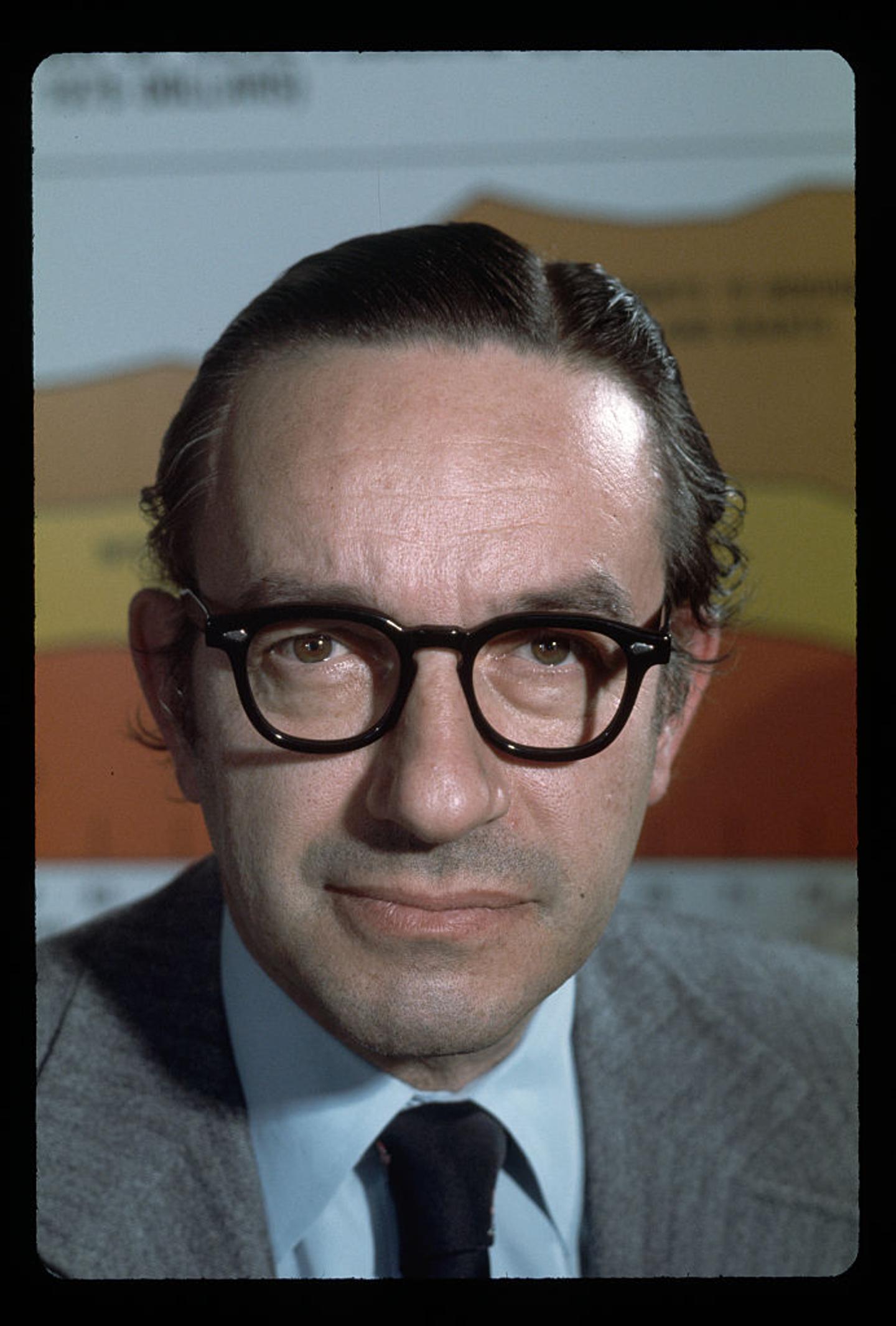
Economist Alan Greenspan around 1974. Wally McNamee/Corbis—Getty Images

Greenspan was a good musician. But his true gift was economics. So he put down the saxophone, picked up an economics textbook, and eventually became one of the world’s most powerful financial voices.

Jones, of course, went on to become one of the greatest music impresarios in history. Two young men from the same rooms, the same bandstands, the same late nights. One would go on to conduct the global economy. The other would go on to conduct the world's greatest musicians.

That was the lesson Quincy shared with me—not a story about failure, but a story about wisdom. About the courage to know your true gift. About the grace to follow it, even when the path isn't yet clear.

Now, the world is full of tributes to the maestro of monetary policy—the Oracle, the Fed Chairman who steered the American economy for nearly two decades under four presidents, the man whose briefcase and eyebrows moved bond markets. All of it is true. All of it is warranted.

But Greenspan’s life, and indeed his impact, was so much bigger than his resume. I learned this the first time I met him. 
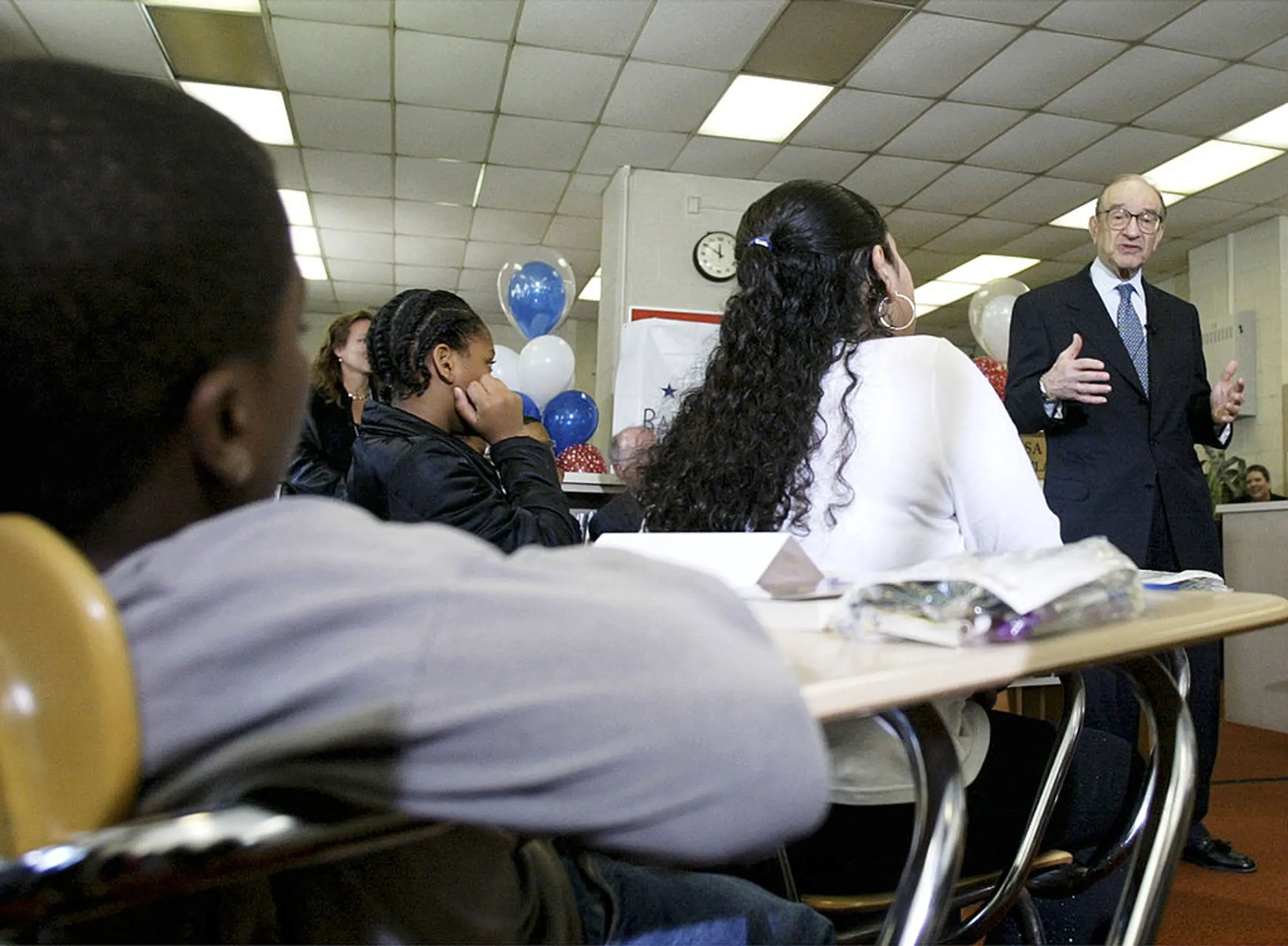
Alan Greenspan takes questions from children at the John Philip Sousa Middle School on June 5, 2003 in Washington, D.C. Mark Wilson—Getty Images

In 2003, Greenspan came to Washington to visit a school library in John Philip Sousa Middle School, a community that the American economy had largely bypassed, for an event about the importance of financial literacy. The plan, as the Fed's staff made clear to me beforehand, was precise. Formal. Controlled.

While I would typically greet people with warm hugs and chit-chat, the Chairman, I was informed, would deliver prepared remarks. There would be no improvisation.  This is the Fed, they told me. This is the Fed Chairman.

Backstage, I gave Greenspan a hug.

To my surprise, he smiled. Not a polite smile. A real one. And in that moment, quietly, told him to put the prepared remarks down. “Speak from your heart,” I said. “These kids need to hear you, not your staff.”

He looked at me for a moment. And then he put the papers down.

What happened next is captured in these photographs, taken that morning and rarely seen since. The most powerful economic voice in America, the man who famously chose his words with surgical precision, who had elevated deliberate ambiguity to an art form, stood in front of a room full of children and spoke from his heart.

No script. No prepared text. No Fed-speak. Just a man, a room, and a conversation about money and possibility and the future.

That is your orchestra leader right there. Not the one who insists on the score as written. The one who reads the room, feels the shift in the air, and adjusts—in real time, on the spot—to what the music is actually asking for. Greenspan was a chairman who could come in with prepared remarks and still offer an unrepeatable performance.

Greenspan grasped, perhaps better than anyone, that the distance between the community economy and the global one is not fixed and that financial literacy—understanding how money works, how credit works, how wealth is built—is the civil rights issue of this generation. 

In 2003, that idea was not yet mainstream. And then Alan Greenspan walked into that school library, put down his prepared remarks, and talked to children like they mattered. Because he believed they did.

When the most powerful economic voice in America shows up—not in a press release, not in a statement, but in person, in a school, speaking from his heart.

Throughout his life, Greenspan used his presence, his authority, his platform to bring other voices into tune. Telling the world that this music, too, deserved to be heard.

That is the version of Greenspan the world will miss most. The young musician who understood money better than he understood the saxophone. The bandmate who did your taxes between sets. The economist who became the Maestro—not of one instrument, not of one section, but of the largest, most complex economic orchestra in the history of the world. And the man who, 50 years after those late nights in New York, walked into a classroom, set aside his script, and told a new generation that they, too, had a part to play.

That the same qualities that make a great musician—discipline, listening, the willingness to find your true register and commit to it completely—are the same qualities that build lasting wealth. Greenspan understood that money, like music, is a language. And everyone deserves to be fluent.

Leaders like Alan Greenspan gave my work early credibility at a time when it needed it most. He didn't have to show up. He chose to. And in doing so, he did what the great ones always do—he pointed the way. Not with a policy, but with his presence. Not with a speech, but with his time. And on that particular morning, not with prepared remarks, but with something rarer: his authentic self.

That was Alan Greenspan at his best. Reading the music. Adjusting to it. Conducting something that no one had written down in advance.

His wife, Andrea Mitchell, said that he had "irrational exuberance" for baseball, jazz, and the people he loved. That made me smile. Of course he did. The jazz never really left him. It just found a different instrument.

Alan Greenspan lived one hundred years. He shaped an era. He made mistakes and said so. He moved markets and he moved a roomful of kids in a school library. He was equally serious about both. That is the man I knew. That is the man I will remember.