





Warning: This post contains spoilers for Beef’s Season 2 finale.
The speech Ashley (Cailee Spaeny) delivers in the final scene is pitch-perfect. Eight years have passed since the chaos that swallowed Monte Vista Point country club—the embezzlement, the kidnapping, the bodies in Seoul—and here she stands at the microphone as the club’s new general manager, talking about bees, thanking sponsors, gesturing toward the community in a scene that echoes the season’s opening. Next to her, Austin (Charles Melton) holds their young son Ashton in his arms. “I am so grateful to be serving you all as general manager,” she says, the sun easing toward dusk.
On its face, it is the picture of arrival. But Beef’s second season is more interested in what such pictures conceal. Creator Lee Sung Jin’s follow-up to his acclaimed debut season in 2023 follows two couples at the country club: Josh (Oscar Isaac) and Lindsay (Carey Mulligan), the club’s previous general manager and his interior designer wife, and Austin and Ashley, young employees navigating their own private ambitions. It is, at its core, a season about what capitalism does to love and what love does in return. The finale moves between a propulsive chase through Seoul and a series of still, devastating confessions before landing in an epilogue that places the season inside a force far older and more patient than any of its characters.
The fall of the house
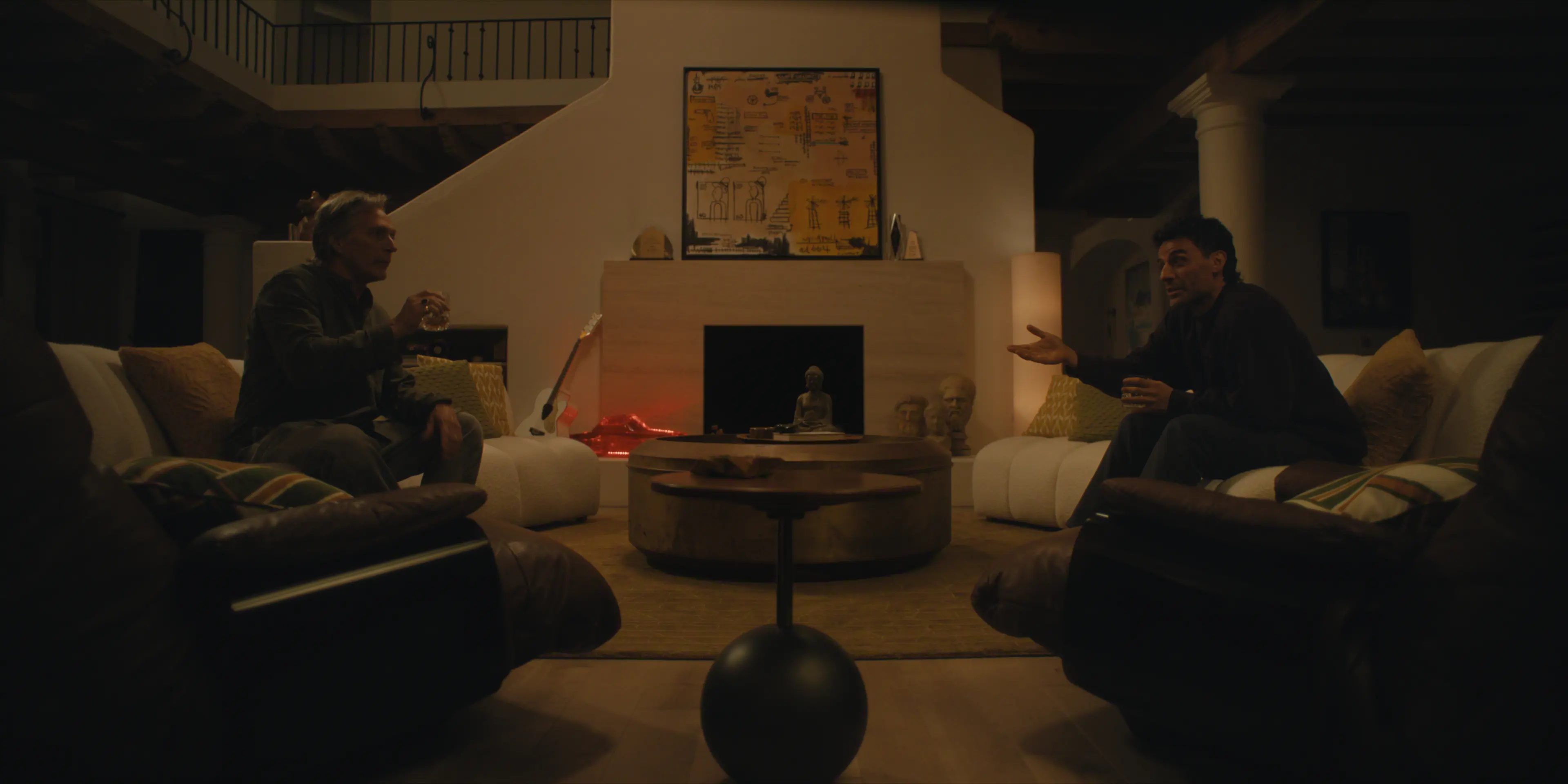
Troy (William Fichtner) and Josh (Oscar Isaac) in the Season 2 finale of 'Beef' Courtesy of Netflix
The episode opens in darkness. Josh awakens with a noose around his neck, a kidnapper reading a fake suicide note he plans to plant on his person pinning the Monte Vista Point money laundering on Lindsay. The scene is nightmarish and almost black-comic—the kidnapper musing that this line of work makes it hard to sleep—before it erupts in violence. Josh survives by accident; the scaffolding collapses.
In Korea, meanwhile, Lindsay, Ashley, Austin, and Eunice (Seoyeon Jang) converge at Trochos, the medical clinic at the center of the season’s unraveling chaos. Dr. Kim (Parasite’s Song Kang-ho), Chairwoman Park’s husband, delivers a hallway monologue about marriage that starts as a profession of personal philosophy and arrives somewhere closer to confession. In a first marriage, you’re in love. In a second, Chairwoman Park (Youn Yuh-Jung) told him, you don’t look for love—you look to love life with someone. “But that is not life’s true face,” Dr. Kim says. “Money and power mask it.” With the USB that contained the evidence of Park’s cover-up now missing, Dr. Kim made his own calculation: work with the authorities, take a lesser sentence for accidentally killing his plastic surgery patient, get there before Park turns on him first.
Due to the language barrier, Lindsay, Austin, and Ashley understand almost none of this—they catch the word “dinner” and assume he’s offering a Korean gazpacho—until Dr. Kim finally gets the message across. Then Park arrives, and Lindsay punches her squarely in the face.
What follows is a chase through the halls of Trochos that is part thriller, part farce: carts shoved, batons dodged, a body tumbling through a wall of glass into the Seoul streets below. Lee had roughed it out early. “All I wrote down for the finale was ‘Oldboy-style fight with skin flying around,’” he says. The sequence delivers. But Dr. Kim doesn’t make it. He is shot through the head just as escape seems close, a death so sudden it lands like a tragic exclamation point. Park’s men look for the rest of the group on a hillside street. Then Josh, who has caught a plane to Seoul, appears at the top of the hill, frantically calling Lindsay’s name and revealing their whereabouts to their pursuers. She turns around. In front of her: Josh. Behind her: Park’s men.
What we carry
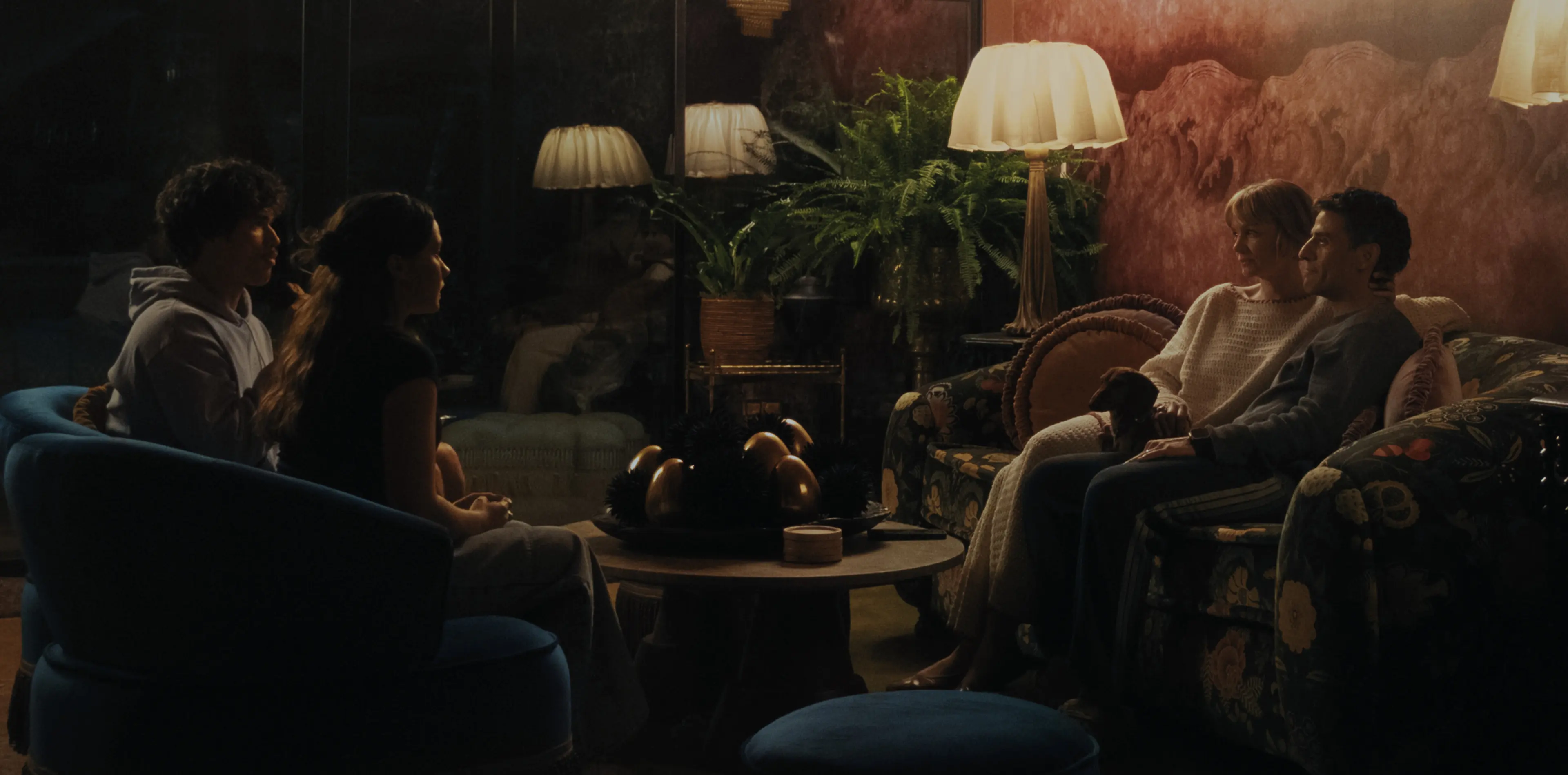
The two couples, face to face, earlier in the season Courtesy of Netflix
In the rooms where Park’s men hold the two couples, the season’s real climax takes place through confession. The four of them sit imprisoned by Park and her enforcers in adjacent rooms, speaking through shared walls.
Josh and Lindsay sit on the floor, having reached an apparent detente in their bitter divorce proceedings. They agree, with tired practicality, that Ashley and Austin will probably throw them under the bus—and that they’ll have to return the favor. Josh fights back tears. He heard a fact on a podcast once: the average human only lives for 960 months. Lindsay stares off. “Well, we haven’t wasted it,” she says. “Nope,” Josh says. It is, in its low register, one of the season’s most tender exchanges: two people who loved each other badly and well, briefly allowing themselves to acknowledge that before their inevitable downfall.
In the adjacent room, Ashley tries to make Austin envision a future with her. She paints a picture of their life 10 years from now: a child with Austin’s smile, sloppy joes on Sundays, a yard. “We know how the world works now,” she tells him. “We know how hard it is.” Lee wrote those pages the night before filming. “I was just imagining what someone in Ashley’s predicament would say to someone she loves to try and get him to stay,” he says. “She paints such a beautiful picture.”
For Melton and Spaeny, the scene was theirs to figure out. “It had to make sense for us, and we had to do that in reverence to Sonny's words,” Melton says, referencing Lee. Neither would hold a position if the other wasn't with them. "There’s that [feeling of] safety,” Melton adds. “I may feel good sitting down here, but Cailee doesn’t. … That's just kind of how fluid and open the process was.”
Austin eventually tells Ashley the truth: he’s not in love with her anymore. He reaches for the words to explain what drives her—her parents’ divorce, her terror of being left by anyone—with neither cruelty nor absolution. “We’re all just acting out because of something that happened before,” he says. “You don’t want me, Ash. You just don’t want to be left by me.” Ashley starts crying, almost inaudibly. It’s the most honest exchange between them all season.
Then Josh asks to see Chairwoman Park. He wants to confess to everything—take the blame for all of it—as long as Lindsay goes free. The moment he says it, Lindsay shouts through the wall in protest. She listens as he is led away. A tear streaks down her cheek.
Chairwoman Park, meanwhile, delivers her own philosophy in the hallway of Trochos as she walks alongside her bound captives. In the scene, Park argues that capitalism is a “system of nature, system of the self,” and that love itself “lives in the system.” Youn, for her part, agrees with the writing’s intent, though her own description of love is more tender. “Every age has a love,” she says, and at her stage of life, love “requires sacrifice.” It is one of the season’s most chilling speeches because what Park says is coherent enough to tempt belief.
The smile that falls
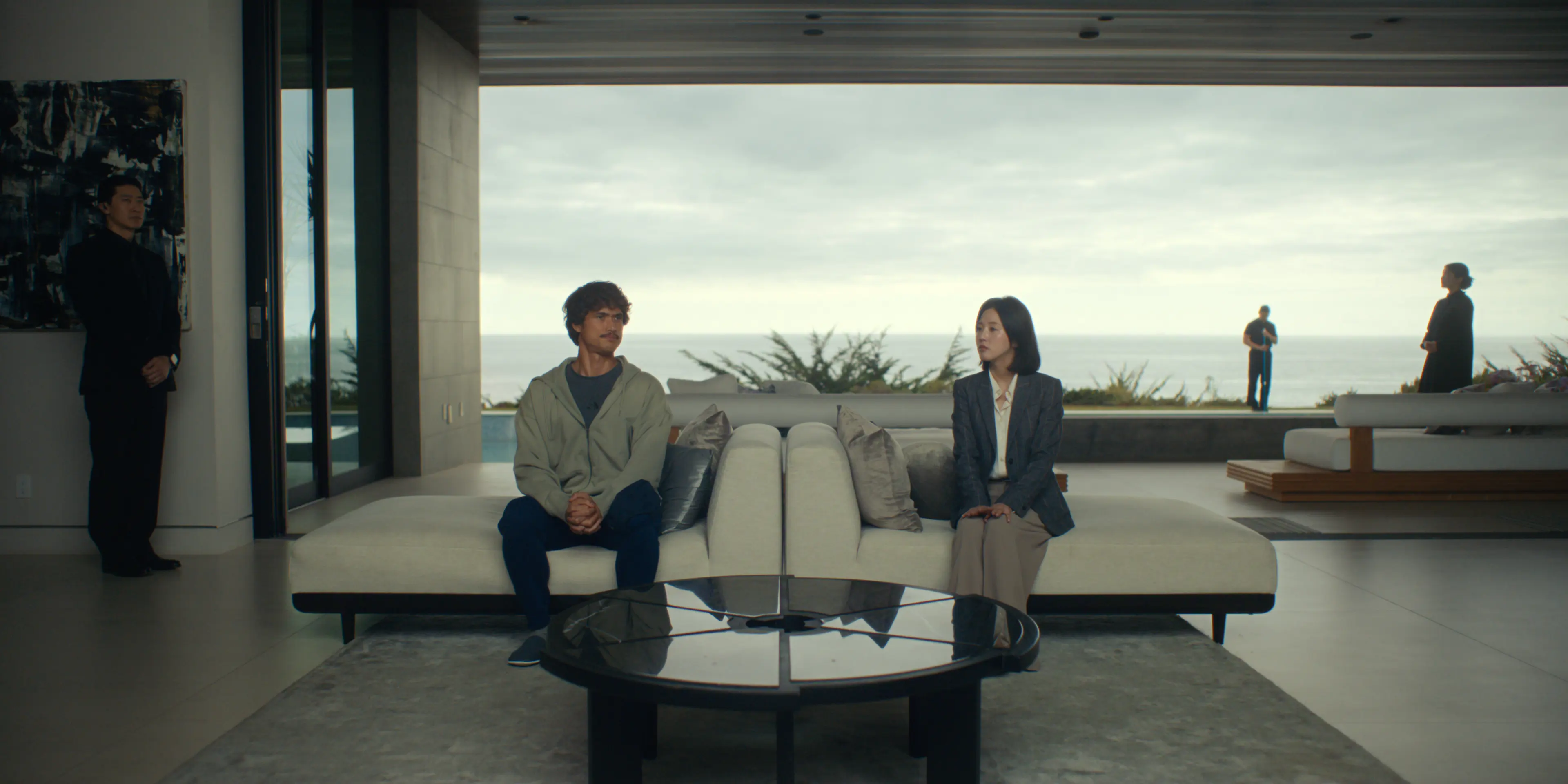
Austin and Eunice, before their fateful trip to Seoul Courtesy of Netflix
Austin escapes through a ceiling panel. Low Roar’s “Nobody Loves Me Like You” plays as he drops over a security wall and finds a taxi. He calls Eunice. He has the USB—Ashley had it all along and finally decides to toss it through a hole in the wall, realizing her plans have fallen apart—and he’s headed to the police station. He tells her he’s broken up with Ashley. Eunice pauses, then says she’ll contact the authorities. He says he loves her. She says the same.
Then he hangs up, and his smile dissolves.
That pause before Eunice says she loves him back leaves just enough room for doubt to find its opening—whether it reads as hesitation on her end, the possibility that she doesn’t love him in return, or simply the weight of the moment registering on his face—and what plays out in Melton’s expressions is the season in miniature. Austin spent eight episodes learning that the life he imagined and the life possibly available to him need not be the same, and one hesitation from the person he chose is enough to send him back toward the one he already knows.
Lee says the scene worked because Melton gave him “such an open canvas” to work with; the camera stays on his face long enough that his expressions carry the viewer through that entire reckoning without a word of dialogue. “We were just like: Charles, be in the moment, whatever comes up,” Lee says. “There is one particular take—the take that’s in the show—where he does this crazy smile, and we just see the smile fall.” Once he found that take in the edit, Lee said he was “filled with joy.”
For Melton, the pull makes sense given who Austin is: a man with “innate earnestness,” a desire to do right by others even at his own expense, but whose sense of self was always a “mask” shaped by assimilation, people-pleasing, and the structures around him. The familiar road, however worn, still feels like a road home, or at least a safer one. Austin gives the driver a different address.
The kiss and the reckoning
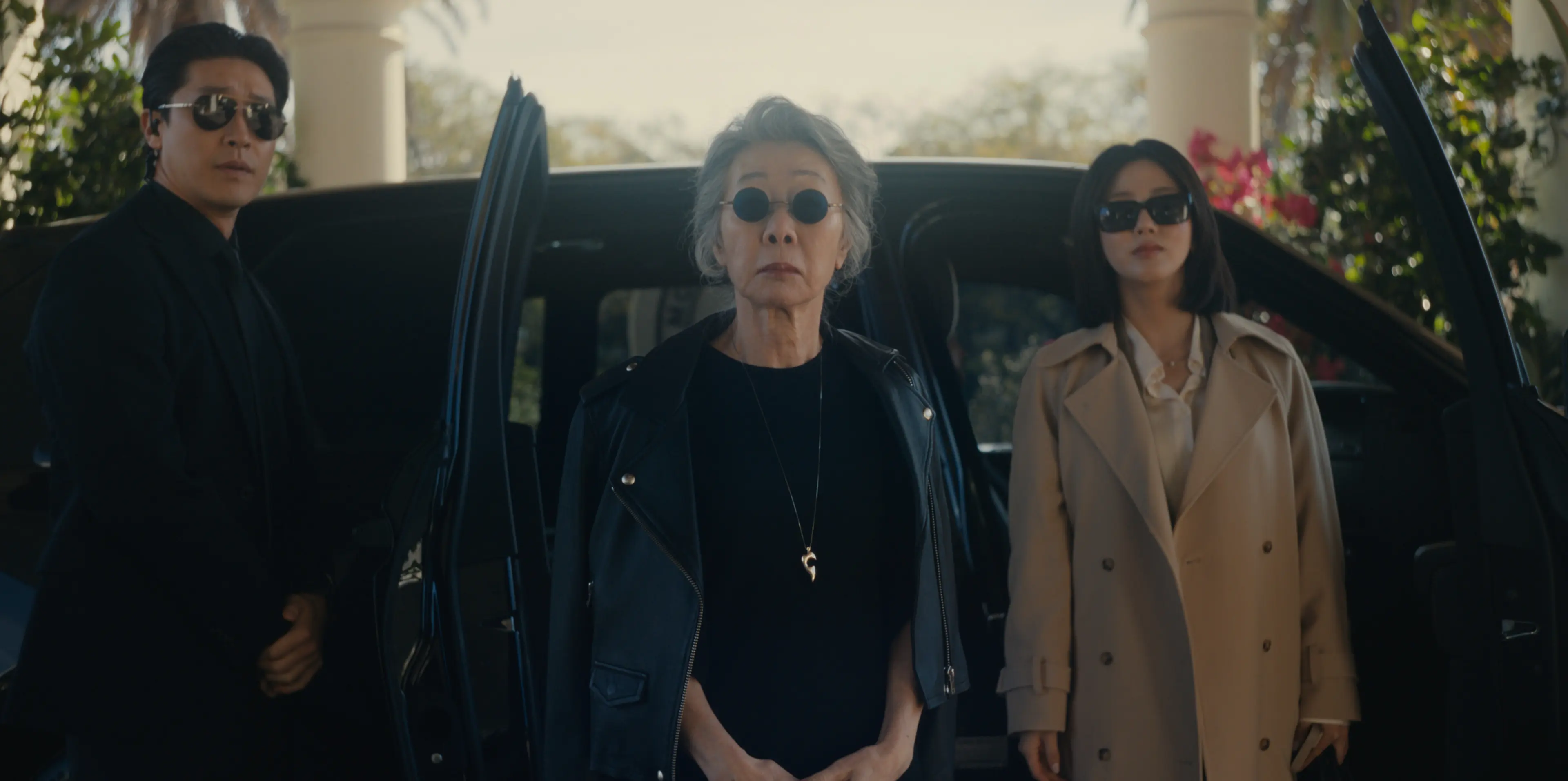
Chairwoman Park, imposing and in charge Courtesy of Netflix
Back at Trochos, police haul Josh out in handcuffs. Lindsay climbs over a barricade and runs to him. She kisses him—his face in her hands, her head leaning into his—and says she’s sorry. “It’s going to be OK,” he tells her. “I’m going to wait for you,” she says, before the camera begins to encircle them.
That shot—the camera wrapping around Josh and Lindsay as the music swells—was the final scene the production filmed in Seoul. “Once we wrapped, everyone was crying,” Lee says. “That feeling just permeated the set.” It existed in his imagination long before he’d written the season’s later episodes. He heard the music cue first, from composer Finneas O’Connell. “I literally hadn’t written the back half yet: I just had this vision of two people kissing and a camera wrapping around them. I had no idea which characters it was going to be.”
For Melton, filming in Korea resonated personally. “Coming to Korea was going to be me coming home with Beef,” says the actor, whose mother was born in Korea and whose family lived there for several years during his childhood. “In some ways that can parallel Austin coming home. But what did he come home to?” He and the rest of the cast felt it when the cameras stopped rolling. “We all just embraced and held each other after,” Melton adds.
Lee had always conceived of the season as “meditating on love and marriage across time,” with Josh and Lindsay embodying a marriage in autumn: “You’re trying to enjoy the last leaves before everything goes cold.” He goes on: “You realize things too late. You try to hold on as things slip away.” One of his dogs died during the mix, eerily echoing an earlier plot point from episode 5. He offers the detail plainly, as evidence of what the scene was reaching for. It had to feel like a moment already dissolving.
The cycle completes
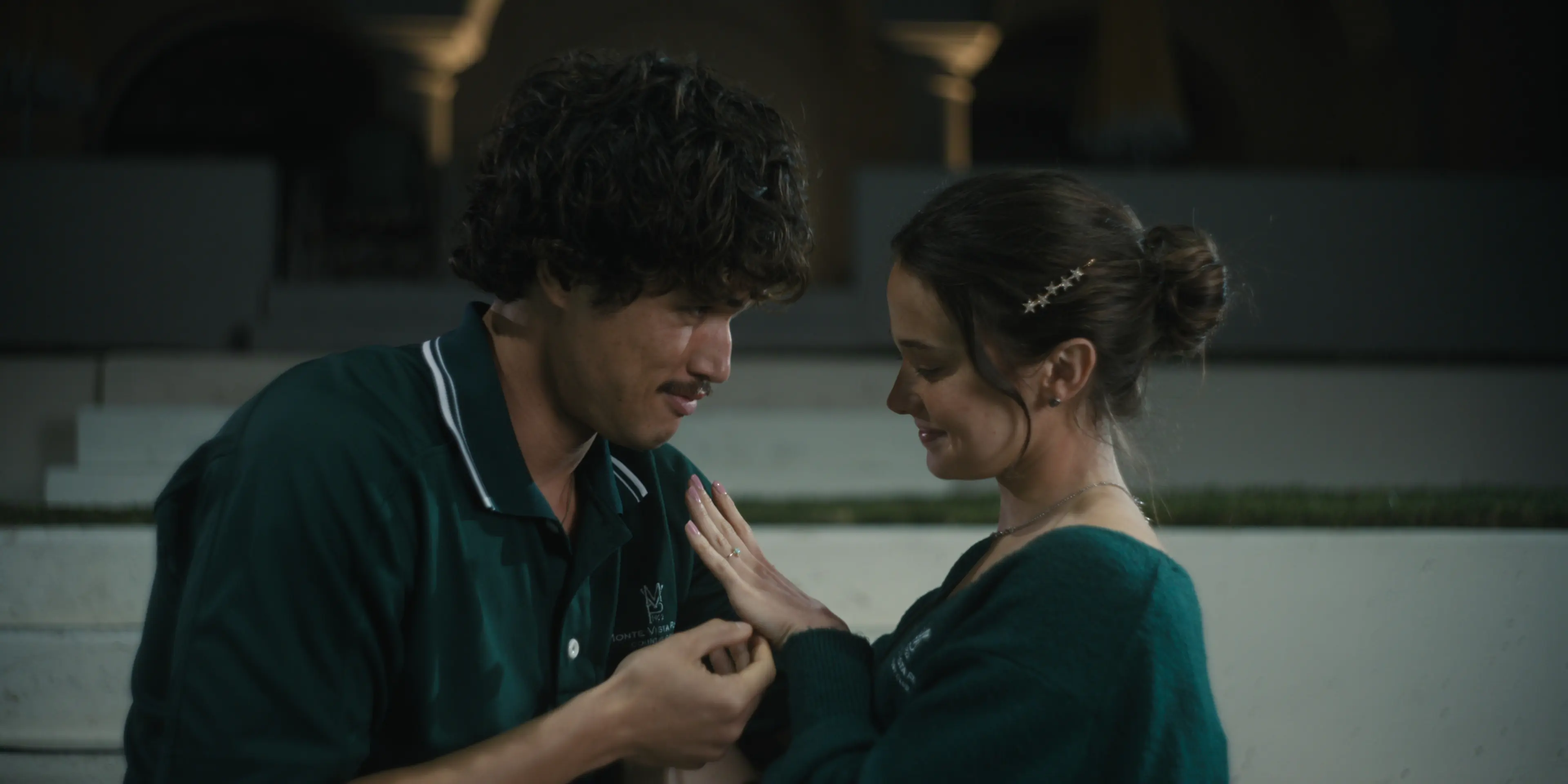
Austin and Ashley end the season still together, but a world away from their innocent beginning Courtest of Netflix
The finale’s epilogue, set eight years later, is more unsettling than any twist because instead of throwing us off the scent, it keeps its promises. Ashley at the microphone. Austin holding their son. Troy (William Fichtner) and Ava (Mikaela Hoover), formerly couple-friends of Josh and Lindsay’s, at their car door. “We must do a double date soon,” Ava says, a deliberate echo of the season’s opening, when she said the same to Josh and Lindsay. Everything has migrated one slot to the right.
Then the surface gives way. In their car, Ashley looks exhausted, and Austin stares off. “What’s wrong?” she asks. “Nothing,” he says, and turns the ignition.
Lee seeded it throughout: Josh glimpsing himself in a hallway, Lindsay seeing her alternate self drift into athleisure, Ashley gradually becoming “Josh 2.0,” Austin watching a man trail his wife through the Trochos lobby carrying her shopping bags. “We planned all of those seeds intricately, so that when that bookend hit, hopefully you feel that the passing of the torch is earned,” he says.
Melton and Spaeny shot the time jump before finishing the Korea episodes, before they’d read the full arc. “Poor Cailee and Charles,” Lee recalls. “They’re like: how did we get here? How do we have a kid?” The image works because it requires no explanation. Austin in the driver’s seat, staring into the middle distance. The headlights flare. The cycle is complete.
Josh, meanwhile, is in prison and somehow at ease—distributing cigarettes and Gushers with the easy charm he once brought to Monte Vista Point. A fellow prisoner tells him Lindsay has remarried and moved to the countryside. Does Josh want her address? He doesn’t. His face settles into what reads as acceptance, the easy kind, which sometimes costs the most.
Lindsay watches Josh’s post-release interview on her phone. “I made a lot of mistakes,” he says. “But most importantly, I’m really happy that everyone I love is happy.” He glances briefly into the camera; he knows she’s watching. Her daughter enters. We glimpse her new partner. Lindsay says she’ll be out in a second. She closes the door and sits alone on the floor, staring off.
The beast and the circle
Then comes Park. At a cemetery, she speaks to a grave—her first husband’s, possibly. She says she never wanted to be like her mother: old and filled with regret. She is now both. “Even with all the money in the world, you could never buy the passing of time,” she says. “The changing of seasons. This great, even beautiful cycle of life.” Park lays her cheek against the grass mound before the tombstone. That moment resonates with Youn, who thought of her own late mother while filming the scene. “The love from my mother was sacrifice, but she didn’t realize [it],” she says. Youn also recognizes Park’s contradiction: she has “all the money in the world” yet is still “not satisfied about love.”
The camera rises. Above Park, concentric circles emerge: abstract outlines of the different homes and lives of the season’s characters—Ashley and Austin, Josh and Lindsay when they were still together and arguing, each life a separate chamber in a larger architecture. Higher still. And then: a drawn beast, paws extended, holding all the circles together.
Lee says they “intentionally left that top shot kind of long” to give viewers a “canvas” to project their own emotions onto. The moment draws from Buddhist and Hindu paintings of samsara: the cycle of death and rebirth, depicted across centuries as a circle of lives held in the claws of the God of Death. “We just took that as inspiration: our interpretation of samsara,” he says. The image reframes everything that came before—Josh’s prison swagger, Lindsay staring off in her bathroom, Austin and Ashley sitting deflated in the dark. None of it was meant as resolution; it was just the wheel turning. One cycle closes, another opens, and the beast holds all of it with the same indifferent patience it always has.
The image remains deliberately open. “Depending on where you’re at in your life, you’ll probably interpret this concept of samsara differently,” Lee adds. The finale, he says, is meant to work like the endings he loves most—The Sopranos, that cut to black—which offered “moments that allow you to participate and think about your own life.”
That final image gives the season its widest frame. It reveals a world in which every private drama sits inside a larger cycle: love, ambition, delusion, compromise, repetition. The beast is not necessarily evil; it may simply be life itself, vast enough to hold all of it without preference.
Beef Season 2, seen whole, depicts a world in which the old promises of upward mobility have been claimed by someone else. The country club is the setting and the argument: a place, as Lee puts it, where “no matter how hard the employees work, they’re never going to be members.” All that remains is figuring out what to do with the life that’s left. Some characters accept the structure and call it peace; some escape it and call it freedom. Most land somewhere in the middle, playing the most culturally acceptable—if not the most authentic—versions of themselves until headlights catch the truth in the face. Austin’s dissolved smile in that taxi remains the finale’s defining human image; the beast in the sky later expands the meaning. The fading smile is where the wound shows: the instant a man gets what he thought he wanted and realizes recognition is not the same thing as freedom. “There is no performance,” Melton says of his approach. “The performance comes from the audience, in the space between.” That space—between decision and consequence, between the story we tell about ourselves and the one the camera sees—is where Beef has always lived. In that brief collapse of Austin’s face, the whole season stares back.