








President Donald Trump described Andy Burnham as “extremely liberal” in his first public assessment of the man likely to become Britain’s next Prime Minister.
When asked by reporters in the Oval Office on Wednesday what he knows about Burnham, Trump replied: “I see that he was, I guess, the mayor of a town. I hear he's extremely liberal. Extremely. So that means he probably won’t open up the North Sea.”
Burnham was the mayor of Greater Manchester until he won the Makerfield by-election last week, earning him a seat in Westminster as a newly sworn-in Member of Parliament.
“I gave Keir Starmer some pretty good advice,” Trump continued, referencing the incumbent Prime Minister. “I said, ‘open up the North Sea.’”
Trump has long argued that the U.K. should expand its drilling in the northeastern arm of the Atlantic Ocean to increase oil and gas production.
If Burnham becomes Britain’s next leader, it’ll be up to him to help heal the rift between Washington and Westminster.
Asked whether he hoped Burnham would make him one of his first international visits, Trump said: “No. I think we're probably of a different persuasion. He's very liberal.”
He then went on to criticize London’s mayor Sadiq Khan, with whom he has shared many disagreements, referring to him as “grossly incompetent” and a “horrible representative” of the U.K.
Experts tell TIME that re-establishing close ties between the U.K. and U.S. will be critical moving forward.
However, in what could prove to be a strong first step, Burnham has signaled an openness to discussing oil and gas production in the North Sea. “I don’t have a sort of fixed position,” he said earlier this month.
Andrew Roe-Crines, a senior lecturer in political communication at the University of Liverpool, tells TIME that despite their ideological differences, he predicts Burnham will want to “highlight areas of mutual interest” before meeting Trump.
Some of these areas could be “economic interests, security sharing, and broader ideological alignments of freedom and Western values,” he says.
Trump delivered his assessment of Burnham during a joint press briefing alongside NATO Secretary General Mark Rutte after they shared a closed-door meeting.
Tensions have been high between Trump and the alliance, as the U.S. President has repeatedly lambasted NATO nations who refused to allow the U.S. access to joint bases for offensive strikes and conflict-related activities during the Iran war.
Trump renewed those criticisms in the Oval Office, claiming: “We were let down. We didn't need help on this at all. We demolished them [Iran], and literally the first week, but it would have been nice if they would have said we'd like to help.”
“I was disappointed with Italy, I was disappointed with the U.K.,” he said. “We're disappointed with Germany and France. We're disappointed with most of them.”
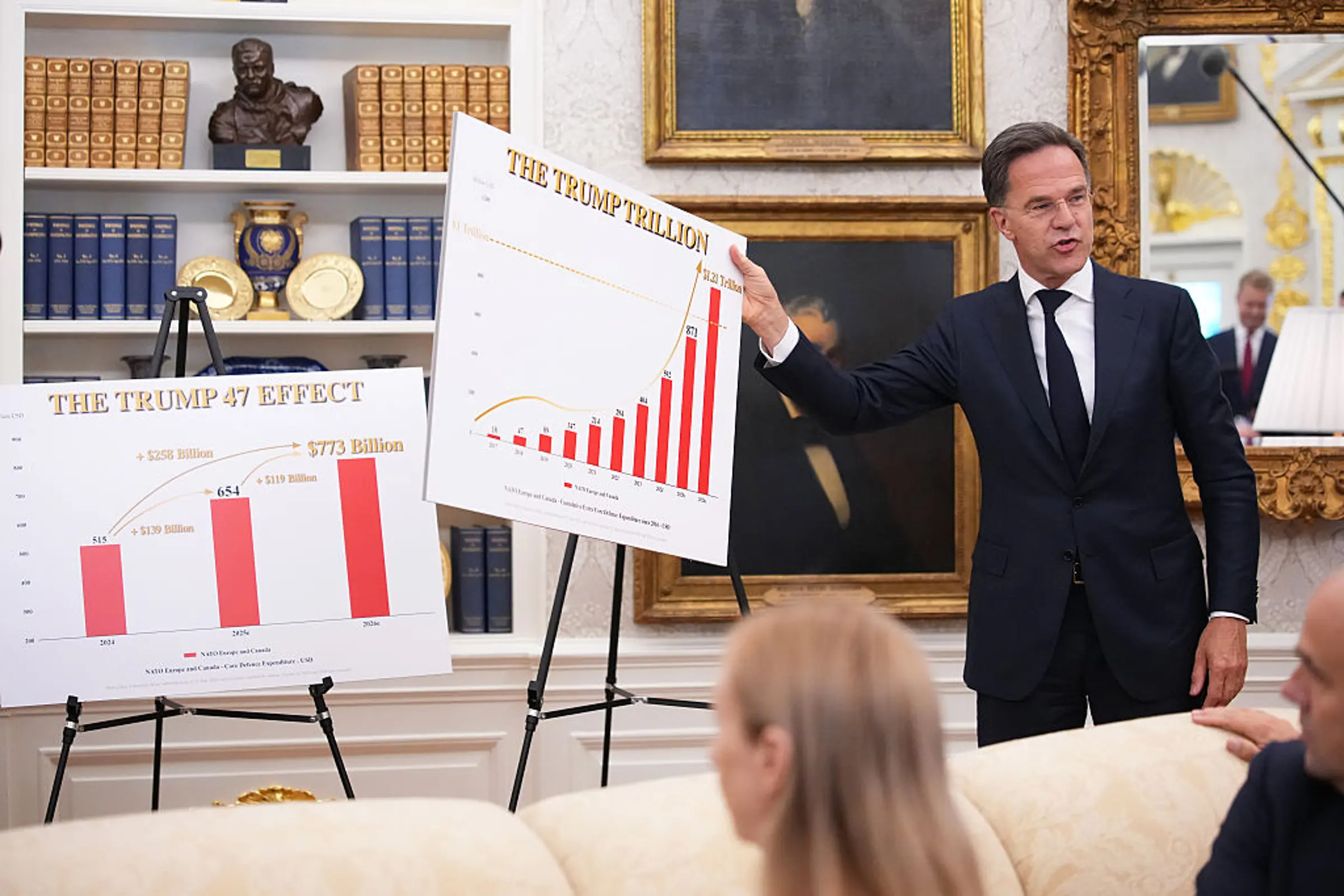
NATO Secretary General Mark Rutte shows a chart during a meeting with U.S. President Donald Trump in the Oval Office of the White House on June 24, 2026. Andrew Harnik––Getty Images
Rutte, who is often described as the “Trump whisperer” for his combination of public flattery and private diplomacy, attempted to ease the tension.
“I know there have been isolated cases about which you are really disappointed, but generally speaking, your European allies have been there,” he told the President.
Trump has also long criticized NATO allies for not sufficiently investing in their defense spending. Rutte presented cardboard charts to show how much countries in the alliance have stepped up their defense spending since Trump first entered office in 2017.
U.S. Defense Secretary Pete Hegseth, during an address at the NATO headquarters in Brussels last week, also scolded allies over their “shameful” response during the Iran war.
He argued by denying the U.S. access to joint military bases, they had put America’s sons and daughters “at risk.”
He announced a review of U.S. military troops in Europe that “will examine America's force posture and basing in Europe” and will include consultations with the U.S. Congress.
“It will be designed to ensure that NATO is moving fast and irreversibly toward Europe leading, stepping up to take primary responsibility for the defense of Europe,” Hegseth said.
Last month, Washington told allies it would be scaling back the number of military assets it dedicates to the alliance—an attempt to remedy an "unhealthy co-dependence in the NATO Force Model on U.S. forces,” according to NATO's top commander, U.S. Air Force General Alexus Grynkewich.
Rutte has since emphasized that the withdrawal of U.S. troops “will not have an impact on NATO's defense plans” and will unfold gradually in a "structured” way.