







Ukraine has moved a step closer to joining the European Union with a crucial phase of the membership negotiation process now underway.
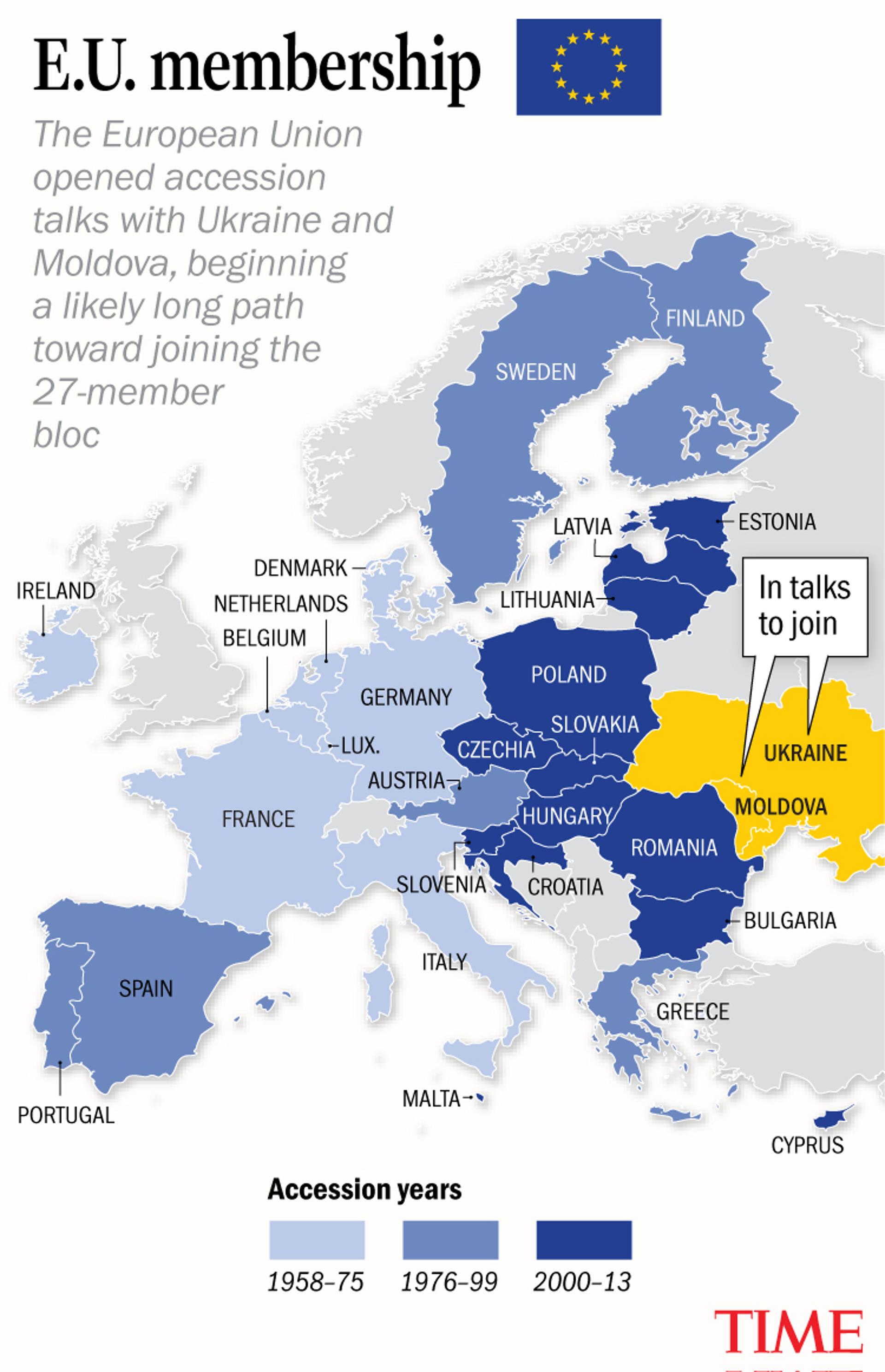
European officials on Monday launched accession talks with both Ukraine and Moldova after all E.U. member states agreed last week to open the first negotiating cluster for the two countries.
Ursula von der Leyen, European Commission president, and António Costa, European Council president, framed the progress as a way to “strengthen peace, security, and prosperity” across Europe amid global uncertainty.
The night before the start of negotiations, Russia launched another deadly attack on Ukraine, prompting condemnation from E.U. leadership.
“On the day Ukraine opens its first negotiation cluster with the E.U., Moscow shows again what it fears most. A democratic Ukraine, firmly anchored in Europe,” remarked Marta Kos, the European Commissioner for Enlargement.
Zelensky has long framed Ukraine’s bid to join the E.U. as a way to bolster its security guarantees amid attacks from Russia.
Kaja Kallas, E.U.'s chief diplomat, in March said it was her wish that “Ukraine is going to join [the] European Union soon,” although she declined to give an exact timeline.
Despite strong political support from some European leaders, Ukraine faces a long, complex path before membership of the bloc becomes a reality.
Here’s what you need to know about the accession process and what it entails.
When did Ukraine officially move to become part of the European Union?
Ukraine formally applied for European Union membership in February 2022, shortly after Russia’s full-scale invasion.
In June 2022, Ukraine was granted candidate status, with E.U. leaders agreeing in December 2023 to open accession negotiations.
Frank Schimmelfennig, a professor of European politics at ETH Zurich whose research focuses on European integration, tells TIME that granting candidate status was as much a political signal as a technical decision.
“The original decision was not driven by progress in democratic and rule of law reform. It was driven by the Russian invasion, and the desire to support Ukraine, and to send a signal that Ukraine is part of the family and a future member state,” he says.
The first accession conference with Ukraine was held in June 2024, formally opening negotiations.
Another important milestone came in September 2025, when Ukraine completed the European Commission’s screening process. The review examined a wide range of policy areas to assess compliance with the E.U. acquis—the body of common E.U. law.
Despite those advances, all 27 member states must unanimously approve each step of the accession process.
One of the biggest obstacles had been Hungarian former Prime Minister Viktor Orbán, an ally of Russian President Vladimir Putin.
“Hungary had always blocked the opening of this first cluster of negotiations,” says Schimmelfennig.
When Orbán’s 16-year rule came to an end in March after he was defeated by pro-European conservative Péter Magyar, that obstacle was removed.
What has Ukraine done so far in an effort to be eligible for E.U. accession?
Ukraine has long harbored ambitions to join NATO, but efforts have effectively been shut down, with U.S. President Donald Trump telling Zelensky last year to give up on the idea.
By contrast, Ukraine has made significant progress toward meeting E.U. membership requirements.
Countries seeking membership must demonstrate stable democratic institutions, a functioning market economy, respect for minority rights, adherence to the rule of law, and the ability to implement the E.U. acquis.
According to a European Commission report published in November 2025, Ukraine had “adopted roadmaps on rule of law, public administration reform and on the functioning of democratic institutions, as well as an action plan on national minorities.”
The report also identified areas requiring further work, particularly around maintaining strong and independent anti-corruption institutions.
Zelensky's top aide Andriy Yermak resigned late last year after Ukraine's anti-corruption agencies searched his home.
Ukraine has continued aligning its laws and regulations with E.U. standards through the Association Agreement framework.
According to the latest report released in 2026, Ukraine has implemented roughly 84% of the required reforms across various sectors since 2014, the year it signed an “Association Agreement” with the intention of deepening ties with the bloc.
In April 2026, Ukrainian ministers also approved a National Program for Adaptation designed to incorporate E.U. legislation into Ukrainian law and accelerate integration efforts.
However, there have also been setbacks that raised concerns with European officials.
Last year, Zelensky signed a bill that critics said limited anti-corruption agencies.
Following protests and pushback from E.U. officials, he swiftly reversed course and restored the independence of Ukraine’s two main anti-corruption bodies.
What happens next as the intricate process progresses?
While opening negotiations mark a significant milestone for Ukraine, many hurdles remain.
Schimmelfennig explains that negotiations now move into a more technical phase, with Ukrainian officials and the European Commission meeting to assess progress.
“[The Commission] will present the E.U.'s list of conditions to be fulfilled, and on the other side, Ukraine will tell the E.U. what they plan to do, and how they plan to meet these conditions. From time-to-time they will come together again, and check where things stand,” he says.
Accession negotiations are divided into six clusters, with the first cluster considered the most important.
Known as the “fundamentals” cluster, it focuses on democracy, rule of law, governance, and judicial reform.
Schimmelfennig notes that “you cannot close any of the other chapters and clusters unless you meet certain benchmarks for this first cluster.”
The remaining clusters cover areas such as agriculture, sustainability, trade, and economic policy, but all depend on meeting the requirements established under the first cluster.
“This first cluster, the fundamentals, is basically horizontal. It pervades on all of the other issues,” he says.
The European Commission is responsible for evaluating progress and recommending when negotiation chapters can be provisionally closed.
Ukraine is eager to have the decision on accession fast-tracked by 2027, although that timeline has been met with skepticism.
The Commission has instead pursued what it calls a “frontloading” approach, encouraging countries to begin implementing reforms before negotiations formally advance.
"We have done a large portion of the work with the two countries already in advance of this important day," Kos told TIME on Monday, remarking on the status of talks for Moldova and Ukraine. "We all took the frontloading very seriously and it will work to speed up their entry into the E.U."
The last time the European Union added a new member state was in 2013, with the accession of Croatia.
Who ultimately decides if Ukraine is granted membership?
The decision of E.U. enlargement ultimately stands with the member states.
Throughout the accession process, every cluster must be opened and closed unanimously.
Schimmelfennig says this “creates a lot of veto points in the process and a lot of opportunities for individual countries to block the progress in the negotiations.”
Once all negotiation clusters are completed, the European Commission drafts an accession treaty outlining the terms of membership.
The treaty must then be approved by the European Commission, the European Council, and the European Parliament before being ratified by all member states and the candidate country.
Schimmelfennig notes that complications can arise even at this stage. France, for example, could require a national referendum before approving Ukraine’s accession.
Attitudes toward Ukraine’s membership also vary across Europe.
Countries such as Germany and France both reportedly support a faster “symbolic” membership for Ukraine and have generally been more supportive of Ukraine’s aspirations.
Others remain more cautious. Even under its new leadership, Hungary has signaled opposition to any effort to fast-track Ukraine into the bloc.
In Brussels, Schimmelfennig says 2030 is often viewed as the “magic date” for potential membership, but he cautions that Ukraine still faces a lengthy process with no guaranteed timeline.
He points to Serbia, which started formal accession negotiations with the bloc in 2014 before talks stalled.
“On the accession negotiations, [Ukraine] is starting from a very low level of compliance with some of the requirements that the E.U. has, so it's definitely going to be a hard road for Ukraine to travel,” he says.