









British Prime Minister Keir Starmer has fiercely denied accusations that he deliberately misled lawmakers over his appointment of former U.K. ambassador to the U.S. Peter Mandelson.
"No, I did not mislead the House of Commons. I accept that information that I should have had, and information that the House should have had should have been before the House, but I did not mislead the House," Starmer said Monday when asked if he "inadvertently misled” the lower house of parliament.
The rousing session in Westminster unfolded amid mounting calls for Starmer—the leader of the ruling Labour Party—to resign, after it was revealed last week that Mandelson failed the security vetting in January 2025, only for his appointment as ambassador to go ahead the following month anyway on account of the Foreign Office overruling the decision.
Starmer denied having prior knowledge of the initial failed vetting process, telling parliament that “a deliberate decision was taken to withhold that material” from him.
Olly Robbins, a top civil servant at the Foreign, Commonwealth and Development office (FCDO), was sacked after the sequence of events came to light. Robbins told the Foreign Affairs Select Committee on Tuesday that there was an “atmosphere of pressure” from Cabinet officials to get “Mandelson out to Washington quickly.”
Embattled Prime Minister Starmer said he only learned last week that “the Foreign Office officials granted [Mandelson] developed vetting clearance against the specific recommendation of the United Kingdom Security Vetting [UKSV].”
“If I had known before he took up his post that UKSV recommendation was that developed vetting clearance should be denied, I would not have gone ahead with the appointment,” he insisted.
Starmer said that the correct vetting process had been followed and that a review of the process took place in September, after Mandelson was sacked from the role when a newly-released batch of files revealed he shared a closer than previously disclosed relationship with the late convicted sex offender Jeffrey Epstein.
But Starmer’s defense has done little to abate calls for him to resign, with leader of the Conservative Party Kemi Badenoch telling him his "reputation is at stake.”
Taking issue with the timeline of events put forward, opposition leader Badenoch argued that if Starmer found out about the failed vetting last Tuesday, he should have told parliament at the “earliest opportunity,” in accordance with ministerial code, which she argued should have been during Prime Minister’s Questions last Wednesday.
And it’s not only members of the opposition who are holding Starmer to task, as he is also facing stern criticism from some of his Labour peers.
As the British leader navigates the growing crisis, here’s what to know about the series of events that led to Monday’s tense parliamentary session, what fired former U.K. official Robbins said in his testimony about the security vetting row, and where things currently stand.
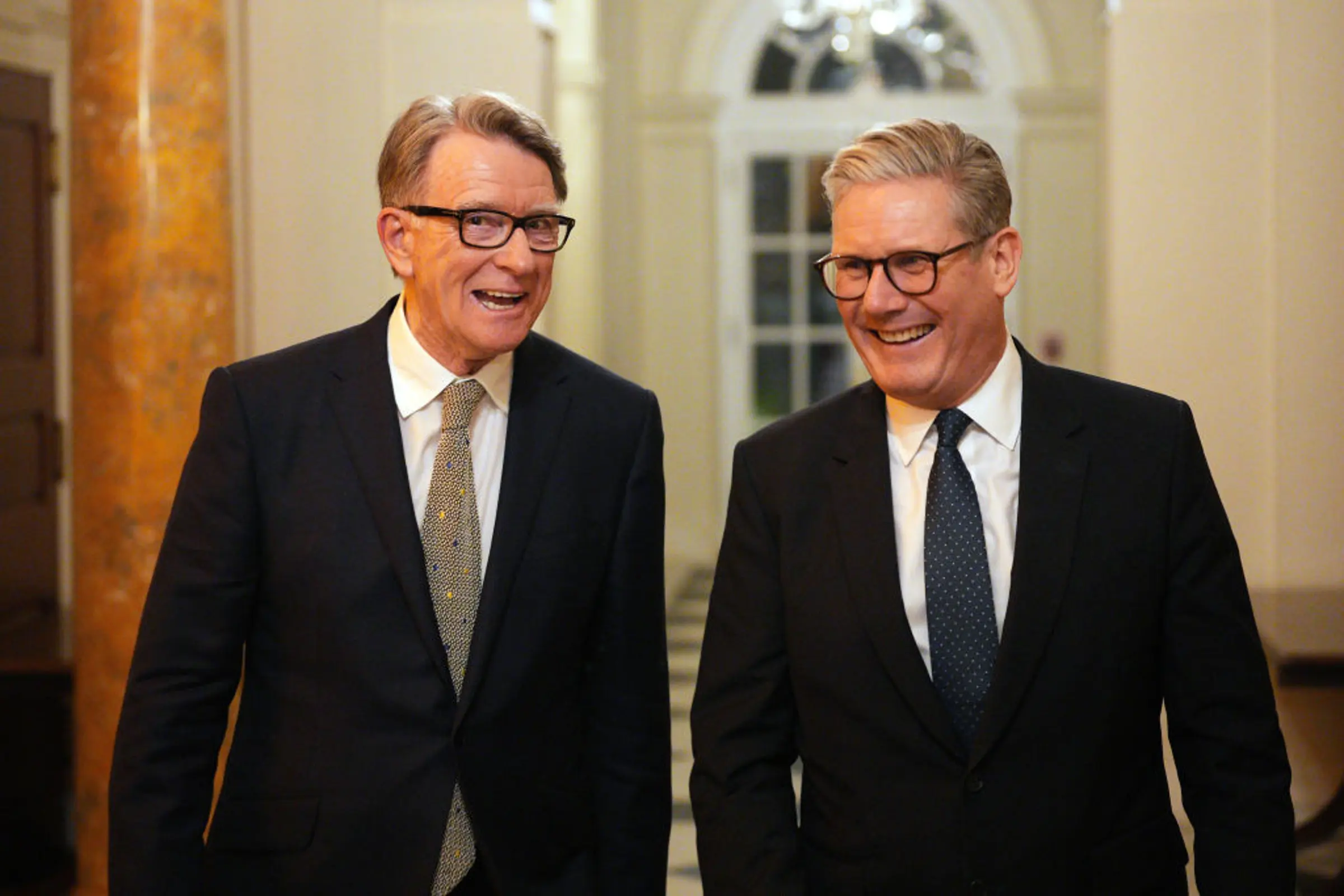
Peter Mandelson with U.K. Prime Minister Keir Starmer at the official ambassador's residence in Washington, D.C. on Feb. 26, 2025. Carl Court—Getty Images
The controversial appointment of Peter Mandelson
Mandelson was announced as the incoming ambassador to the U.S. by Starmer in late 2024.
Having served in a number of cabinet and advisory positions under multiple Labour governments since the 1990s, the seasoned politician was viewed by some as a strong pick—although his previous resignations did raise some concern.
In 1998, he resigned as trade and industry secretary after a secret loan from a fellow minister was revealed. In 2001, he resigned again, this time from his position as Northern Ireland minister, over allegations of misconduct related to a passport application for the Hinduja brothers. An inquiry later cleared him of wrongdoing.
He was also known to have had some type of relationship with Epstein, which Starmer initially defended, prior to additional information coming to light.
“The Ambassador has repeatedly expressed his deep regret for his association with him [Epstein]… I have confidence in him and he’s playing an important role in the U.K.-U.S. relationship,” said the Prime Minister.
Mandelson officially started the role in February 2025, but in September he was fired after emails between himself and Epstein were published, unveiling a closer than previously divulged relationship. The correspondence also showed that Mandelson maintained a relationship with Epstein after the disgraced financier was first convicted of procuring an underage girl in 2008.
Upon his dismissal, Mandelson told embassy staff that he felt "utterly awful" about his "association" with Epstein.
Mandelson, when serving as Business Secretary under former Prime Minister Gordon Brown from 2008-2010, appeared to tell Epstein he would lobby other government officials in an effort to reduce a tax on bankers’ bonuses.
In another email, he appeared to have forwarded an internal government report to Epstein which showed ways the U.K. might raise funds after the 2008 financial crisis. He also seemingly tipped off Epstein that Brown would be resigning in 2010 and that the E.U. would announce a €500 billion bailout to stem the Greek debt crisis.
In February, Mandelson was arrested “on suspicion of misconduct in public office” and was released after questioning, set to remain under investigation.
A government inquiry into the former ambassador’s appointment to Washington was launched, with initial findings published in March.
More findings are due to follow once the police investigation is concluded.
Fired official says he felt political pressure to approve Mandelson
Robbins, who assumed the position of permanent under-secretary of state and head at the Foreign, Commonwealth, and Development Office in January 2025—a month after Mandelson had been announced as the pick for U.S. ambassador—said 10 Downing Street had a “generally dismissive” attitude towards Mandelson’s vetting clearance.
He emphasized that his department still completed the relevant vetting to the "normal high standard,” but claimed there was a focus on getting Mandelson out to Washington, D.C. “quickly.”
His team was subjected to “pressure” and “constant chasing” from No. 10’s private office, he claimed.
An official spokesperson for Downing Street swiftly rejected Robbins’ testimony.
“There is a distinction clearly between asking reasonably for updates on an appointment process… I would draw a distinction between the idea of pressure and, you know, being kept informed about the process and the progress of the appointment,” the spokesperson is quoted as telling reporters.
Robbins said he was briefed during the process that the security vetting body considered Mandelson to be a "borderline case" and were "leaning towards" recommending that clearance be denied, but the Foreign Office decided that the identified risks could be "managed or mitigated.”
The fired official also said that the identified risks did not relate to Mandelson’s Epstein relationship. He declined to say whether any other security concerns were flagged that have not already been made public.
When pushed on why he didn’t tell others, such as Starmer, about the vetting team’s concerns, he said he would “absolutely not" have considered it as the decision making “must remain confidential.”
This is where Robbins and Starmer most differ, as Starmer maintains he should have been told.
Following the hearing, a spokesperson for Downing Street said Starmer told his Cabinet on Tuesday that Robbins is a “man of integrity and professionalism” who made an “error of judgment.”
Starmer faces mounting calls to resign following the latest Mandelson-related revelation
In a significant blow for the Prime Minister, one of his Labour peers has joined calls for him to resign.
“He cannot conceivably continue as a credible Prime Minister any longer,” Lord Maurice Glasman told the Telegraph. “If you can’t own your mistakes, you can’t move. All he needed to say was ‘we made an error.’ But he’s completely stuck in saying he hasn’t done anything wrong, so this can’t go away.”
Suspended Labour lawmaker Diane Abbott also criticized Starmer’s handling of the situation.
“Ordinary people don't really care about process and procedure. They want transparency,” she said. “He [Starmer]insists on saying ‘nobody told me anything, nobody told me.’ The question is, why didn't the Prime Minister ask?”
Starmer faced further criticism during an emergency debate in parliament, which took place in his absence on Tuesday afternoon.
Labour lawmaker Imran Hussain suggested a "full, transparent and independent inquiry on this whole situation that uncovers the truth and leads to consequences, including for the Prime Minister."
Ian Byrne, another Labour member of parliament, claimed the Mandelson vetting row is indicative of a far larger issue and argued a "toxic culture" has taken hold of "the governing of our country."
Meanwhile, opposition leader Badenoch has doubled down on her argument that Starmer misled parliament.
“I'm only holding the Prime Minister to the same standard to which he held others,” she said Monday, referring to a previous occasion where Starmer stated if a Prime Minister misleads parliament, they should resign.
“Does he stand by those words, or is there one rule for him and another for everyone else?” she queried aloud.
Badenoch previously said that Starmer’s position was “untenable” following Robbins’ dismissal.
Leader of the Liberal Democrats Ed Davey has voiced similar concerns.
“He blames his officials. He says he had no idea. He gives every impression of a Prime Minister in office, but not in power,” Davey said in the House of Commons Monday.
“We need a government of honesty, integrity and accountability. So will the Prime Minister finally accept that the only way he can help to deliver that is to resign?”
Ellie Chowns, a member of the Green Party, also questioned Starmer's staying power during another tense parliament session, asking the room: “Does the Prime Minister not recognize that the best thing he can do to restore trust and integrity is to take true responsibility and resign?”