



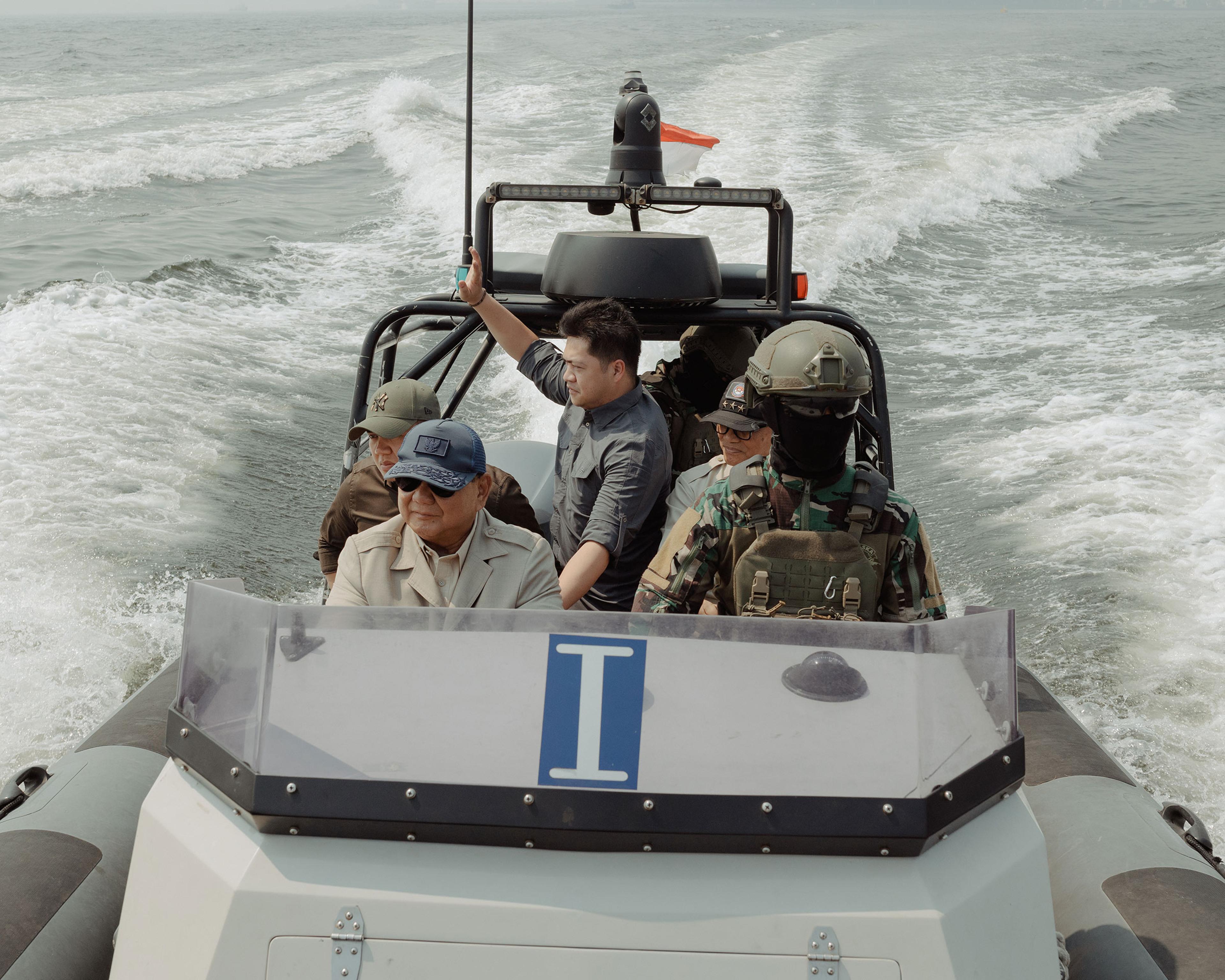
A dozen masked commandos crouch inside a jet-black navy dinghy as it carves across shimmering Jakarta Bay. At the bow, loops of 12.7mm bullets spill from a tri-barreled gatling gun; at the stern, Prabowo Subianto, Indonesia’s Defense Minister and President-elect, appraises the fishing boats and rusting refueling stations that pepper the inky water. It's a scene familiar to Prabowo from his time leading the nation’s special forces—although today’s mission targets not AK47-totting rebels, but stench and squalor.
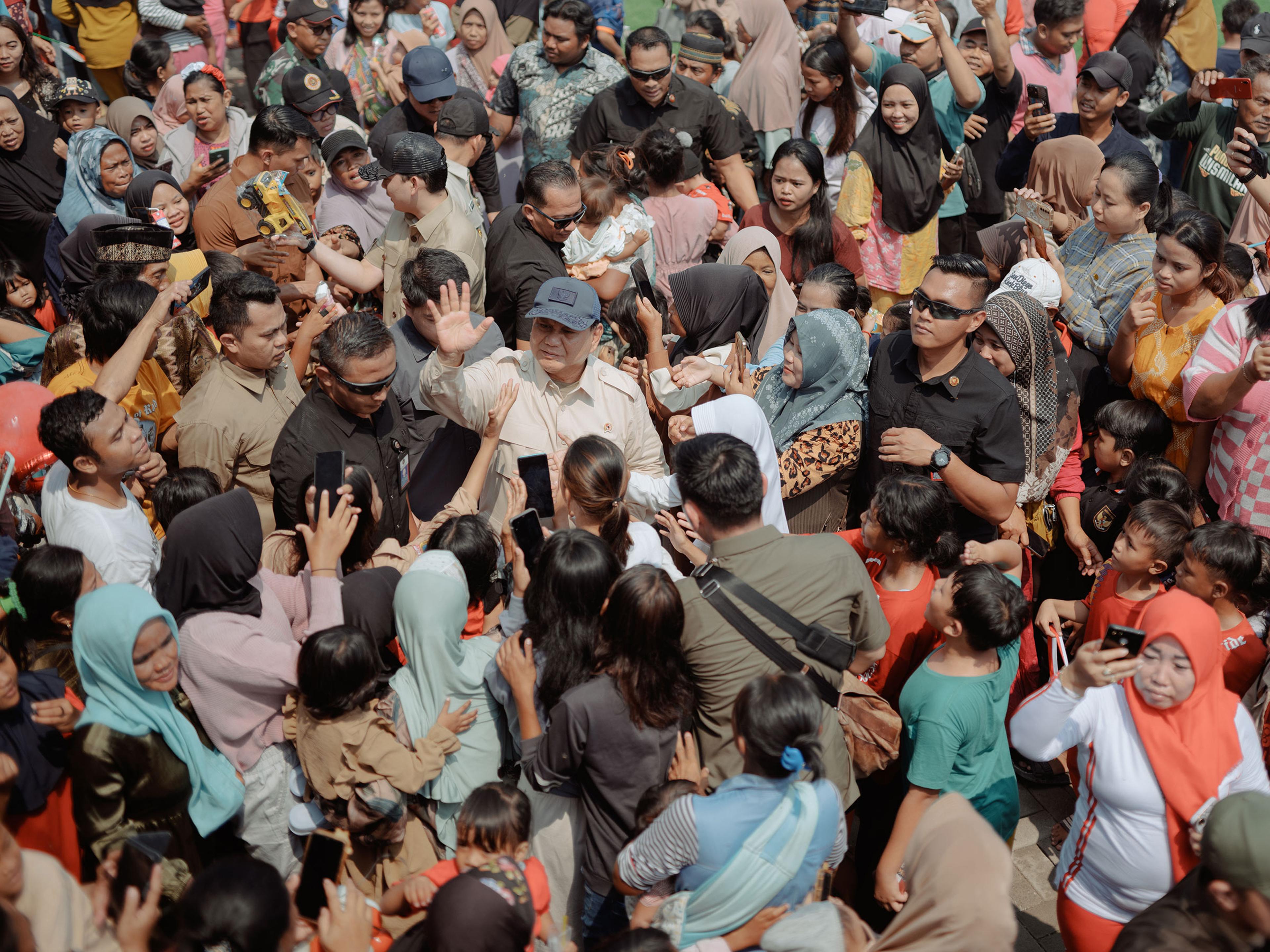
As the dinghy docks at Muara Angke, a slum perched on the northern shore of Indonesia’s sprawling capital, Prabowo, 72, clambers onto land and plunges into a cheering crowd, shaking hands and kissing babies. In his wake, aides pass out plastic trinkets from trash bags to barefooted kids. One mother carries forward her young son, who is blinded by easily treatable cataracts. Prabowo listens to her tearful pleas and instructs a secretary to take them straight to a doctor; the same for an old woman with a tumor sprouting out of one nostril.
“There are officials in uniform everywhere so why haven’t they already helped them?!” Prabowo spits bitterly as we struggle through the melee.
It feels like a campaign stop, but Prabowo isn’t campaigning: he already won Indonesia’s highest office with over 58% of the vote in February elections and will be inaugurated on Oct. 20. That landslide saw over 96 million votes cast for the former general—the most ever for a single candidate anywhere in recorded history. It was two weeks before polling day that Prabowo last stopped by Muara Angke to be “heartbroken,” he says, by its pauperized inhabitants wallowing waist-deep in floodwater filled with human excrement and discarded mussel shells. (Harvesting the seafood is the main local industry.)
Prabowo immediately ordered the National Defense University to construct 200 new low-cost floating and stilted houses fitted with solar panels, indoor bathrooms, and filtered drinking water. Those ubiquitous mussel shells were gathered from the gutter and ground into low-cost bricks and paving slabs; a blight turned to homes. This return trip in August was simply to kick the tires, inspect that all was shipshape like an officer on parade, though the deafening three-syllable chants of “Pra-bo-wo!” telegraphed the local reaction even before he had stepped onto the dock.
“It’s heartwarming,” Prabowo tells TIME of his reception during over six hours of interviews, his first with Western media since his election victory. “But it’s also sad. The way these people lived. And there’s still so much work to do.”
If Prabowo’s success dragging Muara Angke out of the mire is impressive, he faces a stiffer challenge to uplift all of Indonesia’s 280 million people. The archipelago nation of more than 17,000 islands is Southeast Asia’s biggest economy and has made great strides under the previous two terms of outgoing President Joko “Jokowi” Widodo, who still enjoys a remarkable 77% approval rating, but must step down due to term limits. Jokowi boosted health and education services for poorer Indonesians and launched grand infrastructure projects including toll roads, seaports, and airports. He slashed tape hampering foreign investment and championed a “downstream” policy to retain the fruits of Indonesia’s bountiful resources locally.
Having transformed from a fierce rival to champion of Jokowi, Prabowo was billed as the continuity candidate, though he has bold ideas of his own. In contrast to his predecessor’s grandiose plans to host marquee events like Formula 1 racing or the Olympics, Prabowo prioritizes direct action that immediately improves lives. He is rolling out a $30 billion plan to offer free meals in schools; intends to fight endemic corruption by raising civil service salaries and using technology such as AI; and plans to utilize new farming techniques to turn the world’s fourth-most populous nation into a food exporter within five years. Poverty, meanwhile, he plans to eradicate in two. “Almighty God and the people of Indonesia gave me the mandate,” he says. “I always say we need power, but to do good with that power.”
Yet Prabowo is a controversial figure, to put it mildly. He was one of the most feared generals under reviled dictator Suharto—not to mention the strongman’s son-in-law. Serious human-rights accusations meant he was banned from visiting the U.S. until his appointment as defense minister in 2019. He unsuccessfully ran for president twice before with divisive campaigns that brazenly courted the Islamic right. He finally triumphed by reinventing himself as a gemoy, or cute and cuddly, grandpa, whose trademark dancing on the stump garnered many millions of views on social media amongst younger voters unburdened by historical baggage. Yet activists fear Prabowo’s rise will herald an erosion of democracy and emboldening of a military already accused of serious abuses in restive minority regions.
As Southeast Asia’s largest country and top economy, Indonesia has always been the lynchpin of its strategically vital region. But with over a quarter of the world's supply of minerals, it has also emerged as a battleground between the U.S. and China for the copper, gold, and nickel essential for the green transition and any tech economy. Neither has a lock. Regular Chinese intrusions into Indonesia’s territorial waters stoke public outrage, while Washington’s support for Israel in the Gaza crisis has proved toxic in a nation with more Muslims than any other.
Prabowo nods in all directions. His first foreign trip after his election victory was to meet Chinese President Xi Jinping. In July, he also met Vladimir Putin in Moscow, describing Russia as a “great friend.” At the stump, Prabowo railed against Western “double standards” and insisted “we don’t really need Europe anymore” in response to E.U. import restrictions.
“We respect all great powers,” Prabowo tells TIME. “China is a great civilization. And the United States is a great power [but] sometimes makes mistakes. They forgot who their true friends are. Some parts of the U.S. administration, at a certain point, have an opinion about me. But I always put the interests of my people first.”
He may have spent two decades in the political wilderness, but Prabowo has been preparing for this his entire life. In contrast with Jokowi, a former carpenter raised in a shanty and Indonesia’s first leader without military or political connections, Prabowo is very much of elite stock. His grandfather founded Indonesia’s central bank, while his father served as minister for the economy under first President Sukarno. But his father was forced into exile for joining a failed rebellion, so Prabowo spent his childhood in Singapore, Malaysia, Hong Kong, Switzerland, and England.
Upon returning to Indonesia, Prabowo joined its army special forces unit, Kopassus, later receiving training in the U.S. Army’s Fort Bragg and Fort Benning. His marriage to one of Suharto’s daughters kept him close to power as he climbed the military ziggurat. But after Suharto was toppled in 1998, Prabowo was discharged from the armed forces for alleged human rights violations relating to the detention of democracy activists and he went into exile in Jordan.
Shunned by the military elite that made him, Prabowo joined his younger brother Hashim’s mining and agribusiness empire. After a quiet return to Indonesia, he set about consolidating his place in the nation’s new democratic politics. After two failed presidential bids in 2014 and 2019, Prabowo finally triumphed, thanks in part to backing from the popular Jokowi.
It wasn't a natural union. The two had been fierce rivals and Prabowo’s 2019 presidential run ended with thousands of supporters converging on Jakarta to protest what they claimed was a stolen ballot. (The results tallied with pre-elections polls and independent monitors found no malfeasance.) Eight people were killed and more than 600 injured as protesters armed with rocks and fireworks torched cars and battled police. Prabowo says he had an epiphany when inspecting dozens of supporters nursing wounds and sputtering from caustic tear gas.
“This young boy, no more than 17 or 18, looked at me and said, ‘Prabowo, we are ready to die for you!’” he recalls. “I dropped to the side, shook him and said, ‘No, I don't want you to die for me. You must live for your parents and for Indonesia.’ And then I just told myself, I'm not going to have these young kids die for me. I don't want that.”
It was a climbdown that ultimately sparked his ascent. After Prabowo ordered his followers home, Jokowi sent an emissary to seek talks. The two adversaries unexpectedly bonded and Jokowi invited Prabowo into his administration. Although initially reluctant, Prabowo found the offer of leading his beloved armed forces impossible to turn down. “Jokowi is a very decent man,” says Prabowo, adding with a grin: “And I would like to consider myself somewhat decent also!”
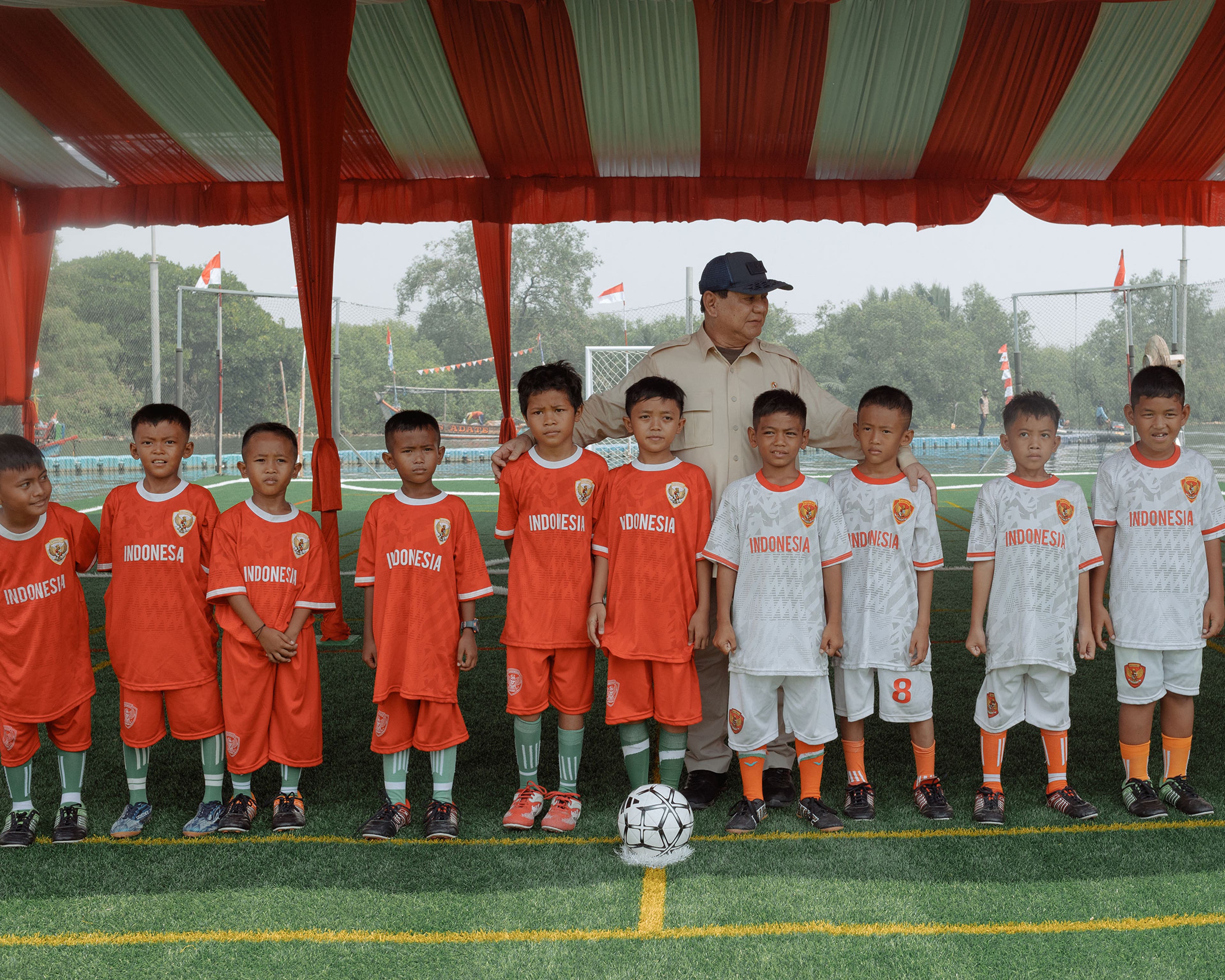
This softening belied Prabowo’s formidable reputation as a battle-hardened Kopassus commando, when the culture, as he puts it, was “kill or be killed.” But Prabowo is too complex a character to be distilled as simply the “massacre general,” as he sums up his Western reputation with a resigned eyeroll. Along with the local Bahasa and Betawi dialects, he speaks fluent English, French, and German. Over grilled ribeye and octopus salad at his favorite Italian restaurant in Jakarta, he’s gregarious company, musing at length about the importance of cartographers in the Napoleonic wars, controversial links between race and intelligence in the 1994 treatise The Bell Curve, and the role of religious sectarianism in the European renaissance. He’s currently devouring a biography of Catherine de' Medici. “I’m an avid student of history,” he says.
Extremely health conscious, he rises at 6 a.m. to swim before beginning his day, listening to rock, classical, or military music on underwater headphones as aides linger nearby to note down any ideas that spring between lengths. He detests smoking, which can be problematic in a nation where almost three-quarters of the male population lights up, and has even scolded foreign dignitaries who indulge in the habit. (Smokers on Prabowo’s team are constantly trying to duck out for a quick puff without being noticed.) And he’s obsessed by education and IQ, reeling off the supposed intelligence scores of historical figures.
“Einstein was 200; Napoleon was 180,” he estimates. “I’m just 105, I’m not that smart, but I like to use smart people. I have a lot of 130, 140 people working for me.”
Once part of Jokowi’s team, Prabowo proved a diligent and unswerving colleague, abjuring any opportunity to undermine his former foe. When the 2024 election came around, Jokowi shunned the candidacy of his own party colleague to instead back Prabowo, who agreed to run alongside Jokowi’s eldest son, Gibran Rakabuming Raka, who will now serve as vice-president.
Yet many Indonesians are perturbed by Jokowi’s brazen attempts to retain influence from behind the scenes. A failed attempt to change election rules to allow his youngest son to run for the deputy governor post of Central Java brought thousands onto the street, with demonstrators in Jakarta even trying to break down the gates of parliament. Jokowi has also installed loyalists in key posts in the police, judiciary, and defanged the nation’s anti-corruption commission.
Prabowo has no dynastic ambitions—his only son is an award-winning Paris fashion designer—and he scoffs at the idea that Jokowi’s maneuverings portend conflict ahead. “The majority of the Indonesian people want continuity,” Prabowo says. “The fact that [Gibran] is with me strengthens that bond.”
Prabowo may not be orchestrating the shredding of democratic norms, but he’s a primary beneficiary, and liberals fear what he will do with the more centralized power structure that Jokowi is bequeathing him. Others believe his family’s web of business interests will offer opportunities for graft and favor. “Prabowo’s origins at the very center of the old New Order of Suharto, which was very corrupt and run by predatory business and political alliances, suggests that he's certainly used to those sorts of arrangements,” says Vedi Hadiz, professor of Asian studies at the University of Melbourne. (Prabowo counters that fighting corruption is at the very top of his agenda.)
Yet his predecessor’s obsession with legacy is problematic—not least Jokowi’s signature scheme of Nusantara, Indonesia’s new capital hewed out of 400,000 hectares of the Borneo rainforest, complete with ostentatious eagle-shaped presidential palace. While 12,000 civil servants were scheduled to move in by September, only a fraction of their lodgings have been built. Prabowo has vowed to continue the project, highlighting how moving the capital from choked, sinking Jakarta has been mooted by various presidents from Sukarno and was even part of his own 2014 election platform. “It's a very noble ideal,” he says, “and right for the national integration of our people.”
But at $30 billion, it’s an expensive gambit, especially as Nusantara has also proven a hard sell to foreign and domestic investors. But the project has only received about $3.5 billion of the $6.4 billion investments expected by the end of 2024—all from local companies and state-owned institutions. That changed last month when a Chinese property firm Delonix Group broke ground on a $33 million complex of hotels and offices in Nusantara. “This will bring confidence in other investors to enter the new capital,” Jokowi said at the ceremony.
The fear among Western diplomatic circles is that Nusantara increases Indonesia’s susceptibility to influence from China, which is already engaged in several transformative infrastructure projects, notably the flagship Jakarta-Bandung high-speed railway. However, wooing the superpower increasingly entails its own costs. Under Jokowi, Indonesia banned the exports of raw nickel ore—a key component of EV batteries—in 2020 to pursue a “downstream” policy of processing raw materials locally to retain more of the value-add, with Prabowo insisting he’s “completely on the same page.” But the fact that over 90% of Indonesia’s nickel smelters are built by Chinese companies has led to friction with the U.S.
Last October, nine U.S. senators wrote a letter urging the Biden administration to reject a potential free trade agreement with Indonesia due to “weak labor protections, Chinese dominance of Indonesian mining and refining, significant biodiversity impacts” among other concerns. Already, the 2022 Inflation Reduction Act stipulates that electric vehicles containing China-sourced batteries and metal components are not eligible for $7,500 tax rebates. Such geopolitical impediments are already pushing Jakarta to diversify its investor pool for extractive industries.
For Prabowo, the priority is to appear “part of the American geopolitical community but economically to court China,” says Hadiz. “Like Jokowi, he will want Chinese investment into infrastructure and the capital city project.”
Prabowo insists his goal is to keep Indonesia non-aligned, even if geopolitics renders this tightrope ever narrower.
“We have the history of always being neutral,” he says. “When an Indonesian leader leaves this tradition, he brings us into disaster. So we respect the Americans, we want more American participation here, but we also respect China.”
It was not always that way, of course, with Prabowo’s military career focused on countering leftist threats fostered by Beijing. Like many military men, Prabowo is hesitant to discuss his past campaigns. “Don't ask an old soldier to tell war stories,” he demurs. “They’ll keep talking and talking.” But over lunch in the Defense Ministry he eventually acquiesces.
Soon emerge tales of Prabowo becoming stranded in a minefield, one comrade’s severed leg flying past his face; a suicide pact with another when cornered under heavy fire; and impersonating the noise of a buffalo to contact partisans deep in the Timorese jungle, only to be confronted by the real thing.
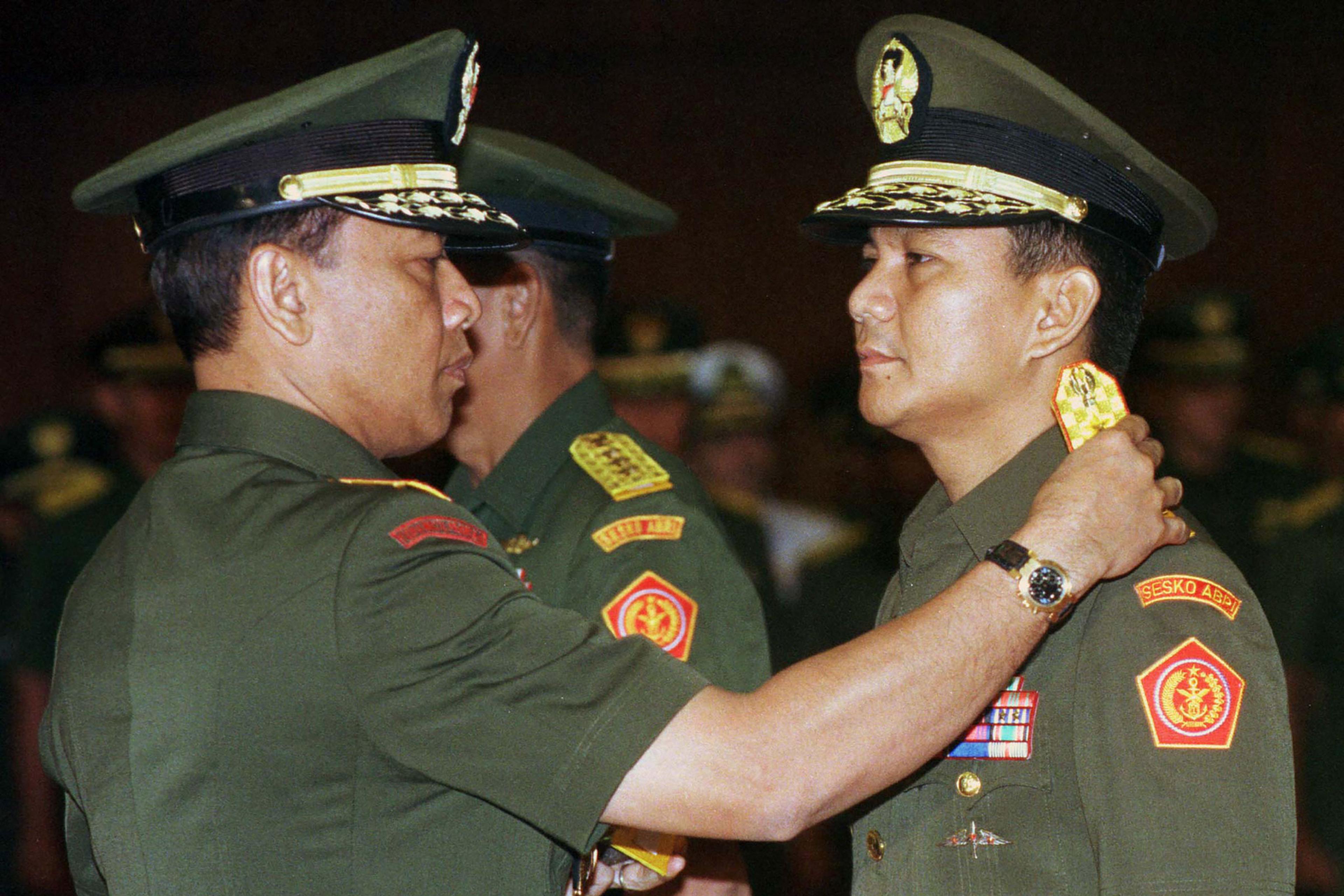
While Prabowo insists he “served with honor” throughout his military career, accusations dog his various deployments. During his tours of Timor-Leste, where some 180,000 Timorese perished during the 1975-1999 Indonesian occupation, he stands accused of overseeing the 1983 massacre of some 200 people in Kraras, today dubbed the “town of widows.” In Timor-Leste’s 2005 Chega! Truth and Reconciliation Report, Prabowo’s name appears 19 times. “Prabowo should be in jail,” says Naldo Rei, a former child soldier for the Timorese resistance who was repeatedly imprisoned and tortured by the Indonesian military. “Not just for Timor-Leste but also inside Indonesia. Many people are hungry for justice.”
In August 1998, just months after the fall of Suharto’s regime, Prabowo was discharged from the military for his alleged role abducting at least 23 activists; one was found killed, nine were returned, and 13 others remain officially missing. Although Prabowo was never formally charged with any crime, a 2005 investigation by Indonesia’s National Human Rights Commission concluded that responsibility lay with the Kopassus unit under direct orders of its then commander: Prabowo.
Prabowo denies all allegations. “I've never caused any human rights abuses,” he says. “My conscience is clear.” He also points out how some former democracy activists detained under the Suharto regime are now his supporters, such as one named Budiman Soedjatmiko, whom Prabowo not entirely reassuringly told during a campaign event: “Sorry man, I used to chase you. But I’ve already apologized, right?”
While calls for accountability will never disappear, there is an appreciation across the region that the demise of dictatorship and birth of democracy involve events that most can, if not forgive, at least accept. “We are all very happy that Prabowo is the president,” Timor-Leste President Jose Ramos-Horta tells TIME in Dili. “Ironically, Indonesian people who served in Timor, civilian or military, have more attachment and care more about Timor-Leste than those with zero involvement. With Prabowo, we may upgrade our relationship.”
The staunch backing of Ramos-Horta, who won the 1996 Nobel Peace Prize for advocating for Timor-Leste self-determination, indicates historic baggage won’t count against Prabowo in the international arena. There's little doubt the cosmopolitan Prabowo will be more at home in the world than Jokowi, who tended to shun international fora like the U.N. General Assembly. In June last year, Prabowo even presented a peace plan for Ukraine at the Shangri-la Dialogue, calling for a demilitarized zone and a U.N. referendum.
The question is whether Prabowo will finally rouse this sleeping giant from its slumber. “People always want Indonesia to be more active,” Prabowo says, “but we have to take care of our people first.”
At Prabowo’s ranch in the hills south of Jakarta, 400 young men in crewcuts and oil green uniforms fidget in an amphitheater as the Dutch war epic The East plays overhead. Suddenly, the screen turns white and Prabowo strolls on stage, prompting all to stand and launch into a traditional Javanese war dance, punching the air, thumping chests, and chanting in hypnotic unison. The display ends and Prabowo strolls the ranks of recruits, asking their home province, their university major, and razzing a couple of the stoutest about their paunch.
These are recent university graduates from across Indonesia recruited for Prabowo’s flagship project, dubbed Graduates for Development. The plan is to eventually recruit 50,000 smart young Indonesians—minimum IQ 110—into this special civil service program, instill them with military discipline and patriotic zeal, and dispatch them to far-flung provinces to guide development projects. Much like his success building houses in Muara Angke, Prabowo wants to sidestep Indonesia’s Kafkaesque bureaucracy with direct action.
First duty, he says, will be the free school meals roll-out, after which they will be entrusted to teach farmers new sustainable agricultural techniques, and then help small businesses grow through applied technology. Prabowo says he “borrowed” the concept from John F. Kennedy’s Peace Corps and his “best and brightest” philosophy. “I'm a man of action,” Prabowo says later that evening over dinner in his ranch library, as he quietly passes scraps of meat to two of his favorite dogs, Kiki and Romeo, ensconced by his feet. “I cannot see suffering, poverty, and injustice and not do anything.”
Following 10 years of the “son of the slums” Jokowi, Prabowo represents a return to power for the nation's aristocracy, though today’s informed, sophisticated Indonesians won’t be satisfied with scraps from his table. Prabowo knows his controversial background means judgement will be quicker and more withering. But after so many years in the wilderness, he’s determined not to waste time. “The success of society rests on the wellbeing of your people,” he says, eyes suddenly narrowing: “You are either with me or you can get out of the way.”
—With reporting by Koh Ewe/Singapore and Leslie Dickstein/New York