


This article is part of The D.C. Brief, TIME’s politics newsletter. Sign up here to get stories like this sent to your inbox.
Barack Obama is back to making headlines with long magazine profiles and going viral with carefully choreographed made-for-social-media videos. He’s urging Democrats to stand up to an unpopular wartime President and raising boatloads of cash that outpace the GDP of some nations. He’s encouraging his base to believe in big hope and change, while peddling must-have merch and tickets to his big events.
No, you did not get in a time machine back to 2008. It’s all happening. Again.
The 44th President is about to open his presidential campus—yes, it’s more than just a library—and its dean is about to be ubiquitous as if he were back on the ballot. But what is remarkable about the Return of Obama is not just the price tag—$850 million and counting for a conference center, a vegetable garden, and, yes, an NBA-regulation basketball court—or the physical size of his 19-acre complex on the South Side of Chicago. (It’s not that big for a presidential center, Obama allies argue; George W. Bush’s $250 million complex in Dallas clocks in at 23 acres, including 15 acres of wildflowers.) It’s that Obama’s perch might be the last one to manifest in a way Americans have come to expect in a post-presidency footprint. Obama may be back again, but that does not mean there’s necessarily going to be another such again for his successors, either by design or misstep.
President Donald Trump is already promoting a skyscraper in Miami that will house his post-White House presence. An AI-feeling sizzle reel drew gasps and mockery when it was published. It’s got the gold escalators, a decommissioned Air Force One, Mar a Lago-style terraces that make it all seem more look like a glitzy gathering spot for galas than a research hub for future scholars looking for primary-source documents scarred by Sharpie notes in the margins.
Fundraising is underway for that project, as his inner circle understands that Trump’s ability to raise cash might be at its peak as he sits in the Oval Office and ready to do deals. Meta and ABC News have already ponied up a combined $40 million to settle complaints of unfairness from the President himself that were decried by critics as thinly-veiled shakedowns. The money, after legal fees, will seed Trump’s library ambitions, which could end up topping $1 billion and may end up housing a Trump Hotel outpost.
"I don't believe in building libraries or museums," Trump recently told reporters. "Could be [an] office, but it's most likely going to be a hotel with a beautiful building underneath and a 747 Air Force One in the lobby."
Meanwhile, former President Joe Biden remains in the very early stages of planting his sapling of a post-presidency in Delaware. (A city has yet to even be announced, let alone a site.) To say fundraising has been slow to come together would be generous; Biden’s advisers have aimed for $200 million for his building but ended last year with just $4 million, all of it transferred from a surplus Inauguration fund from 2020. Planners say they are gunning for an $11 million target by the end of next year but around Washington, the thinking is that Biden might end up having to settle for a piece of planned University of Delaware classroom project already named Biden Hall.
Most Presidents save the legacy-building cash grab for their second term, waiting a few months so as to give re-election donors a reprieve. Up until summer of 2024, Biden thought he was heading into a re-election campaign that would give him plenty of time to hoover up dollars after his second Inauguration in 2025. Instead, Biden became an annoyance to the Democratic Party that found itself scrambling to assemble a 100-day sprint for Kamala Harris. Donors are not rushing to help the 83-year-old great grandfather at this point.
“Presidents and their supporters have a finite time in which to raise enough money to ensure they can write their own history and control their legacy for decades to come, and they do everything they can to take advantage of that time,” writes Anthony Clark, a former Hill aide who wrote a fascinating history of presidential libraries, The Last Campaign. “This isn’t history, and it’s not education. It’s a sales pitch.”
He isn’t wrong.
Why do we have presidential libraries?
Every President dating back to Herbert Hoover has gotten their own government-funded library to house—and protect—their archives when they leave office. But where people can actually visit them in the way we usually think of them—museums with exhibits, replicas of the Oval Office as decorated by the boss, dresses worn by First Ladies—is actually a private enterprise, especially when it comes to the gobs of cash needed to fund the construction. The National Archives and Records Administration takes control over the state papers and official records from the government helmed by the President for his terms and can pitch on some maintenance costs and research staff, but the shiny monuments to the Commander in Chief are actually privately funded and run. So, no, your tax dollars aren’t funding the dozens of works of art commissioned for Obama’s campus and aren’t expected to be used to build that hulking, gold-hued statue of Trump in his promotional video.
Put in plain speak: the Archives protects the historical record and the fun part is out of the former President’s pocket. Under the Presidential Records Act, all government material remains the government’s when a President leaves office. The librarians regulate the record and work with the President’s people to decide what to display—but not what to sell in the gift shops.
That’s how John F. Kennedy’s handwritten edits to “Ask Not” inaugural address and Jacqueline Kennedy’s letters arranging the funeral after her husband’s assassination live alongside a 3 billion-year-old lunar rock in the display about the space program in that library in Boston. Or how Richard Nixon’s Yorba Linda, Calif., library puts a signed 1972 SALT I nuclear treaty signed by both the U.S. leader and Soviet chief Leonid Brezhnev on the same campus as his version of The Beast limo and Marine One. Or how Jimmy Carter’s notes on the Iranian hostage crisis, his memos on the Panama Canal’s transfer, and his notes from the Camp David Accords are under the same roof as his Nobel Peace Prize and the infamous “Red Phone” he took as a souvenir.
Right now, the contents of Biden’s presidential library are actually in a government storage site in College Park, Maryland. Biden will have access to them when he decides where he will host visitors looking to see his narrative about his leadership during Covid, his domestic agenda like the energy and infrastructure laws, and major foreign policy moments like supporting Ukraine and leaving Afghanistan.
The bulk of Trump’s records from his first term also went to a government warehouse in the D.C. region, although their provenance is sure to be a matter of debate. During Trump’s first term, there was a team of staffers tasked with reassembling documents that, despite a law requiring them to be sent to the Archives, had been torn up or shredded. And Trump denied reports included in Maggie Habermann’s must-read book on the President that White House toilets were clogged with documents Trump wanted to dump.
And then, of course, there were the boxes and boxes of material Trump hoarded in Mar a Lago, including matters that were highly classified and considered sensitive. (Biden, too, discovered he had secrets in his garage and cooperated with investigators. Unlike Trump, Biden did not go to court to argue to keep the material.)
How Obama is shaping his own legacy
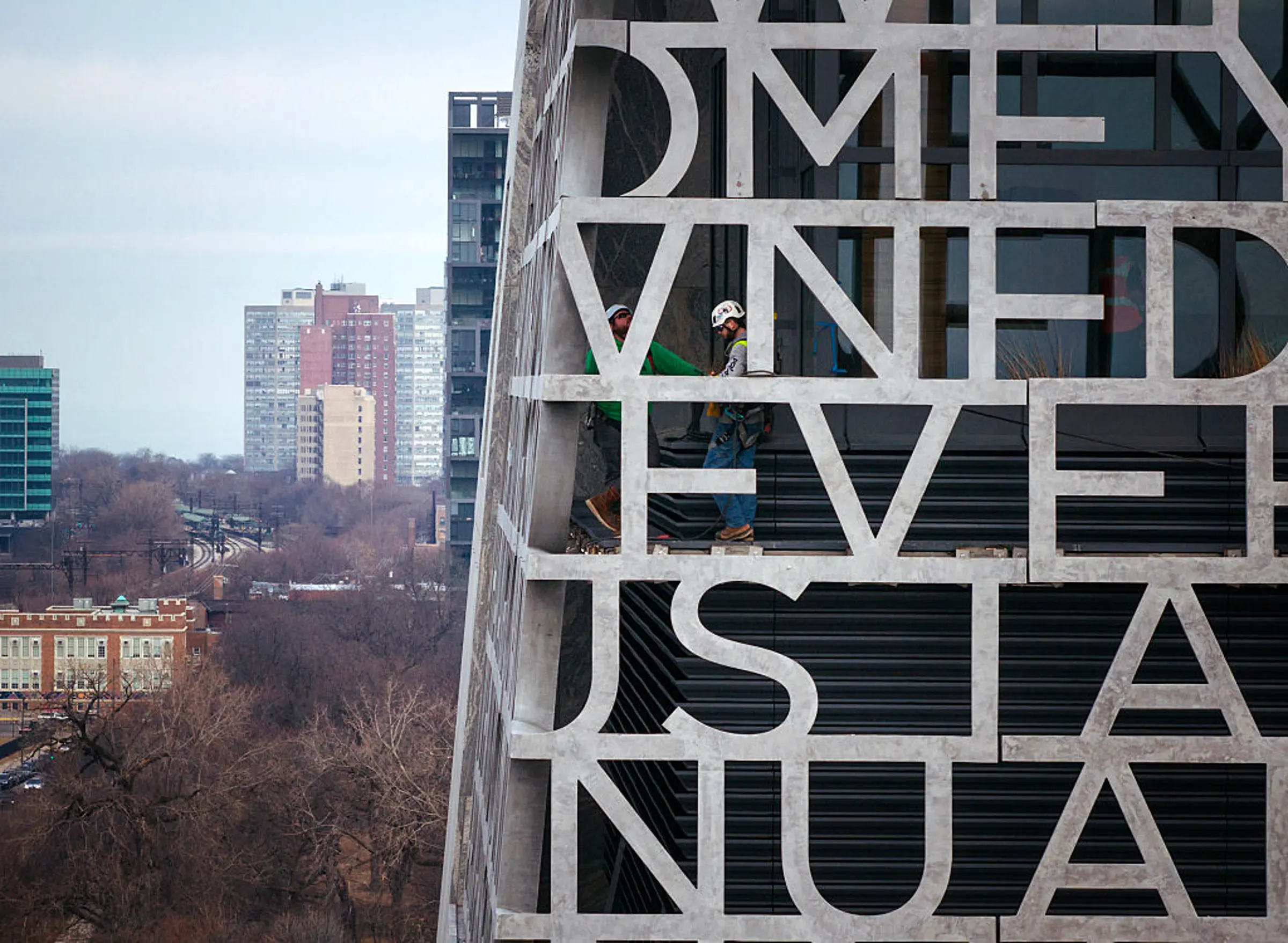
Workers finish installing words from Obama's speech marking the 50th anniversary of the Selma march on the exterior of the Obama Presidential Center building in Chicago on Feb. 17, 2026 E. Jason Wambsgans—Chicago Tribune/Tribune News Service via Getty Images
Neither Trump’s nor Biden’s post-presidency projects, at least right now, are going to look like what has come before. Obama’s is by far the most expensive of the nation’s presidential libraries, but is otherwise much in the mold of those of Presidents George W. Bush in Texas or Bill Clinton in Arkansas. Those still-impressive temples to the former Presidents are full of documents and photographs on display from their terms, plus behind-the-scenes stories about key positive moments of their presidencies. The other stuff? Well, let’s just say when I last stopped at the Bush library on the campus of Southern Methodist University, the whole tale of Hurricane Katrina and the Wall Street meltdown of 2008 took up little more than a 12-foot putt. And when I stopped in the Clinton library at the start of Hillary Clinton’s second run for President, it was full of partisan whitewashing, including a dig at independent counsel Kenneth Starr (“a conservative activist who had never before prosecuted a case”) and Clinton’s resulting impeachment (“no constitutional or legal basis”).
None of this is particularly egregious given the mythmaking role of these operations, which force the professionals from the archives to co-exist with the partisan allies of the President in question. At least in normal situations.
The Obama operation does not plan on housing the paper archives on-site and instead will leave those in the Archives’ warehouses. Instead, Obama says the entire collection will be digitized and available for scholars to look from anywhere. So, no, it actually isn’t the Obama Library, although the City of Chicago is building a new branch of the local library on the site for neighbors.
Franklin Delano Roosevelt kicked off the whole enterprise as we know it today with 13 presidential libraries around the nation. FDR built a presidential library in New York’s Hudson River Valley near his home to house his papers close and then donated it to the government. “To bring together the records of the past and to house them in buildings where they will be preserved for the use of men living in the future, a nation must believe in three things. It must believe in the past. It must believe in the future. It must, above all, believe in the capacity of its people so to learn from the past that they can gain in judgement for the creation of the future,” he said at the library’s Hyde Park dedication in 1941.
It’s a far cry from the current approach to these libraries that now come with hype reels but in practice are really, really nice community centers. On Monday, to mark Star Wars Day—”May the Fourth Be With You”—Obama released a video promoting the opening of his library with Luke Skywalker himself, actor Mark Hamill.
“Mark, I am glad you are here. I want to tell you about someone,” Obama says in the video. “A young person born into ordinary circumstances but restless, unsatisfied. A kid with big dreams. A bit of a rebel. They join a scrappy group of underdogs and set out to change things,” the former president continues.
Hamill gets the nod to the Star Wars origin story: “By blowing up a giant space laser?”
Obama, now 64, leans into the dad-joke vibe, saying it’s a campus for the next generation, “a place to come together, get inspired, and become a Force—for change.”
The public is going to get its first in-person look on June 19. The sales window opened on Wednesday is already sold out into late July. Tickets are $30 to visit what could be the last traditional presidential library in a while.