





Historically, joint meetings of Congress for visiting foreign leaders provide an opportunity to reinforce ties between the U.S. and its allies, and that’s exactly what the Queen managed to achieve.
Delivered in May 1991, during President George H. W. Bush’s Administration, Elizabeth’s address was widely considered a triumphant hit.
Her Majesty was speaking at a “high point in the special relationship” between the two countries, Dr. Craig Prescott, a University of London lecturer who studies the constitutional and political role of the monarchy, tells TIME. “It was the post-[Gulf] war position that Britain and America worked together for the common good.”
Elizabeth honed in on the importance of the transatlantic alliance during a considered address that came in under 15 minutes. In a display of humility, she personally thanked the American public “for their steadfast loyalty to our common enterprise throughout this turbulent century.”
The Queen’s trip came over two months after the end of the Gulf war, at a time when then-British Prime Minister John Major and President Bush enjoyed a strong relationship.
Charles’ trip boasts a vastly different backdrop.
Although it's intended to mark America’s 250th year of independence, it comes at a time wrought with geopolitical tensions amid the Iran war.
Trump’s repeated lashing out at NATO allies—and his threat to pull the U.S. out of the alliance altogether—has prompted further concern.
The trip faced challenges before it even started, as several U.K. lawmakers called for it to be cancelled, in light of the current friction, with one prominent political figure querying: “Why is Keir Starmer rewarding this bullying behaviour with a state visit from the King?”
But Trump, a long-time admirer of the royals, has expressed hope that this state visit could repair the historically strong U.K.-U.S. alliance.
And when Buckingham Palace announced on Sunday that it would move forward with the trip, despite the shooting incident at the White House Correspondents Dinner, Trump referred to the King as “brave.”
“Queen Elizabeth's speech sets the stage quite nicely, you could almost frame King Charles' as a natural continuation of that,” Evie Aspinall, director of the British Foreign Policy Group, tells TIME.
“We're seeing the U.S. and Europe fracturing, so to Charles, it's an opportunity to try and bring everyone back together and re-cement the importance of U.S. and European ties.”
The core themes of Elizabeth’s address remain relevant, she says, although the King is facing a tougher environment given the current state of play.
“What you saw with the Queen's speech was that it tried to move above the politics of the day. It talked about trends, values, and alignment, and I think Charles will want to do the same, but underneath it, he's trying to reaffirm the importance of NATO, strengthen transatlantic alliance, and reopen channels of communication,” Aspinall adds.
Ahead of the all-important address, here’s what else to know about the Queen’s successful turn in front of Congress and how it might set the pace for Charles’ own offering.
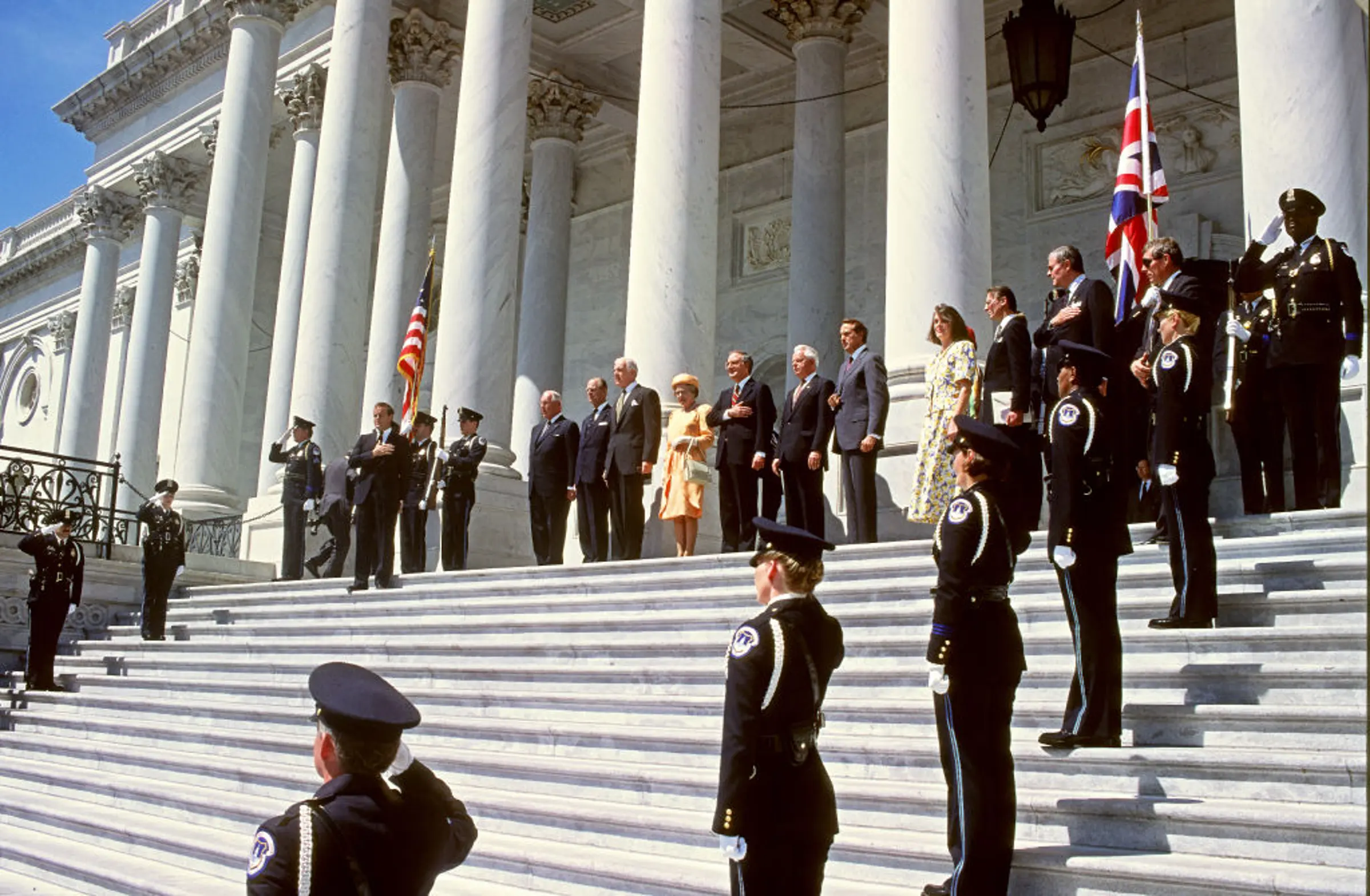
Queen Elizabeth II stands out on the steps of the U.S. Capitol in Washington, D.C., in May 1991. Howard L. Sachs––Getty Images
The U.K.-U.S. relationship remained Elizabeth’s core focus
Elizabeth placed the alliance of the U.K. and U.S.—and the rich history between the two nations—at the center of her address.
“Your Congress and our parliament are the twin pillars of our civilizations and the chief among the many treasures that we have inherited from our predecessors,” she told American lawmakers.
Elizabeth pointed to the success of the joint U.S.-U.K. military efforts during the Gulf War, which saw more than 50,000 British soldiers deployed to assist the U.S.
She acknowledged the broader geopolitical shifts of the time, such as the revolutions of 1989 in Eastern Europe that would lead to the eventual collapse of the Soviet Union at the end of 1991. She also celebrated how the U.N. had become an “essential instrument in the promotion of peace and cooperation.”
Reflecting on the aftermath of the Gulf war, the Queen recognized there was further work to be done—highlighting the U.K. and U.S.’ shared goals.
"Unfortunately, experience shows that great enterprises seldom end with a tidy and satisfactory flourish," Elizabeth said. “Together, we are doing our best to re-establish peace and civil order in the region, and to help those members of ethnic and religious minorities who continue to suffer through no fault of their own. If we succeed, our military success will have achieved its true objective."
Charles will also want to focus on the threads of commonality and examples of unity, experts tell TIME, although the task is arguably greater given the current discord between Starmer’s government and the Trump Administration.
"It's feeling more tense as a visit than Queen Elizabeth was, but it also feels more important than ever,” Aspinall tells TIME. “In many ways, this is a speech designed to win over Trump. For Charles, the best thing he can do is lean into the history of the relationship, the depth of the relationship, and why it has been so important throughout history, and will continue to be so.”
Prescott agrees that the monarchy remains “Britain's trump card” and could help renew the often called “special” relationship between the two nations.
"It's useful that this visit coincides with the 250th anniversary, to point out that the links between Britain and America go deeper than any one individual President and only one individual Prime Minister,” he says.
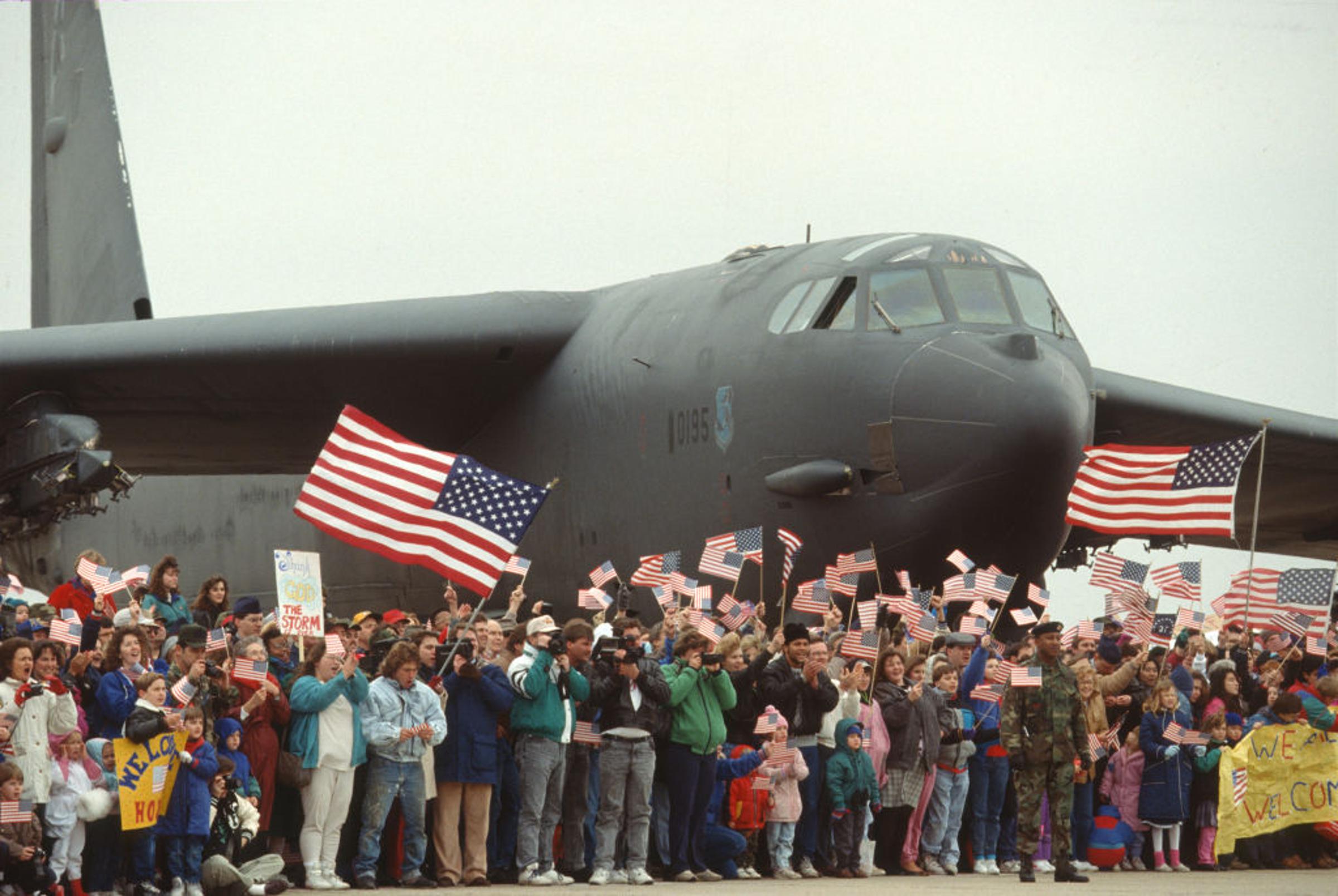
View of people, many with American flags, on the tarmac at Langley Air Force Base (AFB) as they await the return of U.S. troops from Operation Desert Storm during the Gulf War, Hampton, Virginia, in 1991. Allan Tannenbaum––Getty Images
The Queen warned against “continental insularity” and urged for stability
Elizabeth repeatedly emphasized the importance of continued collaboration between the U.S. and Europe, noting that “the best progress is made when Europeans and Americans act in concert.”
“We must not allow ourselves to be enticed into a form of continental insularity,” she insisted.
The remarks reflected a moment when transatlantic cooperation was widely seen as the default, Prescott says.
“This was agreed in 1991, in a sense you might think about this speech as being quite dull but reading [it] in 2026, it's so much more interesting once you really get a sense of how things have changed,” he says, pointing out that some view Trump’s current approach as leaning more toward isolationism.
The Queen also championed the importance of durable peace and stability.
“Some people believe that power grows from the barrel of a gun. So it can, but history shows that it never grows well, nor for very long. Force in the end, is sterile,” the Queen told Congress.
Aspinall says the period in which the Queen was speaking was marked by “a moment of great tension,” but also a transition toward peace following the completion of the Gulf War and the approaching end of the Cold War.
“She was trying to emphasize a move away from these periods of instability and conflict and move towards a more peaceful time,” Aspinall adds.
Elizabeth stressed that “the primary interest of our societies is not domination, but stability—stability so that ordinary men and women everywhere can get on with their lives in confidence.”
That message carries great resonance today, as instability and uncertainty regarding conflicts and struggling economies is impacting people across the world.
“The U.K. has been fairly forthright in the last few weeks in distancing itself from the U.S. war in Iran. There will be an opportunity for Charles to softly reaffirm the thing we want most is peace, which is subtly pushing against the war in Iran without overtly condemning it,” says Aspinall.
Prescott adds that while the Queen warned against “naked aggression,” such an approach in discussing the Iran war would be more “complex” for Charles, as “the U.S. is the aggressor in the eyes of some.”
“But I think there is a sense that the King could draw out this feeling, and reflect on what the Queen said as a reminder of how we did succeed together in a coalition,” he says.
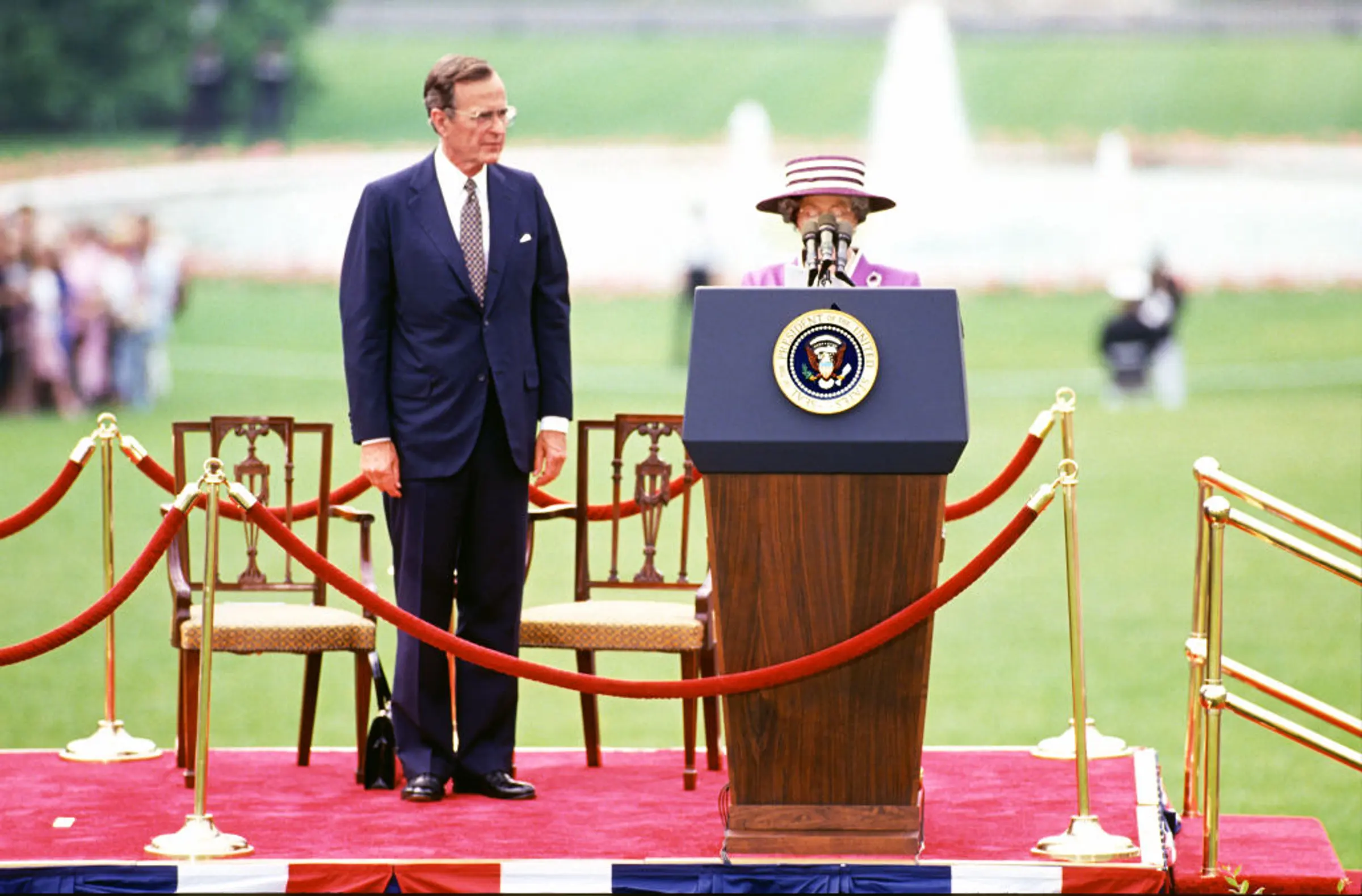
Former U.S. President George H.W. Bush listens as British monarch Queen Elizabeth II delivers remarks on the White House lawn in Washington, D.C., on May 14, 1991. Arnie Sachs––Getty Images
The role of humor and cultural references
Elizabeth instantly put Congress at ease by starting her address on a jovial note.
“I do hope you can see me today from where you are,” Elizabeth said, drawing laughter.
The remark was in reference to a moment that occurred earlier during the visit, when a microphone mistakenly had not been lowered as she took to the stage to deliver a speech after Bush, who was significantly taller than Her Majesty.
As a result, the Queen’s face was briefly obstructed by the microphones, prompting the press to dub her “the talking hat.”
By launching the address with a joke—an inside joke, at that—the Queen set the stage for her inclusive address that ultimately earned her a rousing round of applause across party aisles.
Elizabeth also quoted a line from American poet and essayist Ralph Waldo Emerson’s 1847 work titled English Traits.
Experts tell TIME that cultural references may also offer Charles some relief in his address.
It is “almost certain that Charles will [also] include some sort of literary reference,” Prescott says.
Aspinall agrees, musing that the King may well champion “soft power and cultural relations, especially in a time that feels very volatile” as a way “to build some of those bridges.”