








It’s common knowledge that D-Day was a major turning point in World War II, and that the events on the beaches of Normandy altered the course of history as we know it. But do you know what the weather was like that day?
That may seem like an inconsequential question, but correctly predicting the weather on June 6, 1944, was a huge factor in the success of the Allied forces. Invading during inopportune weather would spell certain doom for Allied troops and a potentially fatal blow to their efforts against the Axis powers. Pressure, directed by Anthony Maras and written by Maras and David Haig, dramatizes the true story of the extremely stressful 72 hours before D-Day, in which General Dwight D. Eisenhower (Brendan Fraser) has meteorologist Captain James Stagg (Andrew Scott) produce a weather forecast to decide when to launch the D-Day operation.
Pressure manages an impressive feat of making a movie about the weather feel completely captivating. Though of course, it’s about more than just weather. “Its a film about decision making, about leadership, and about speaking truth to power,” says Maras. “So much could rest on this one decision. What does it mean for the people making that choice, and how do they bring their best selves to the table?”
Throughout the film, Stagg delivers varying weather reports to Eisenhower at Southwick House in Hampshire, England (the real Southwick House is surrounded by modern buildings, so instead Pressure filmed at Mentmore Towers, which was also used in Batman Begins). The weather reports keep changing, leading to constant verbal sparring among Eisenhower, Stagg, American meteorologist Irving Crick (Chris Messina), and other leaders in the Allied Forces. As time to D-Day gets closer, the intensity increases. The right move could mean the end of the war, but so could the wrong move.
The heroic weatherman
Haig also wrote the 2014 play of the same name, upon which the film is based. He was tasked with finding a story of an unknown Scottish hero, and that’s how he stumbled upon this unknown history of World War II. “I researched James Stagg, son of a plumber who lived in a village outside Edinburgh and discovered this story. It was absolutely irresistible,” reflects Haig. He recognized the story could have a similar appeal as The Imitation Game, particularly in the way scientists on the fringes of a major event could have a profound impact. Stagg is emblematic of “the ordinary within the extraordinary,” says Haig.
To give Stagg an all-important sense of humanity outside of his no-nonsense approach to meteorology, Haig ensured the film had moments between Stagg and his wife, who is set to give birth any day to their first child. But the top secret nature of his mission meant he couldn’t be with her during the 72 hours. “By bookending the film with his relationship with his wife, the audience knew not to misinterpret this man as the story evolves. He does have compassion from the start, but it’s buried in this slightly tough exterior.”
Maras came across the screenplay Haig had written for a film adaptation after directing his last feature, Hotel Mumbai. He had been fascinated how the weather functions as “this all-powerful but invisible force. All powerful because it literally dictates life on Earth, and always has, but invisible because we’ve become so used to it.” Haig’s script brought that to life for him, and the tight pacing and time structure had him locked in. “To have it so focused on this one monumental decision in the 72 hour window, it’s something that really made me sit up and take notice,” he says.
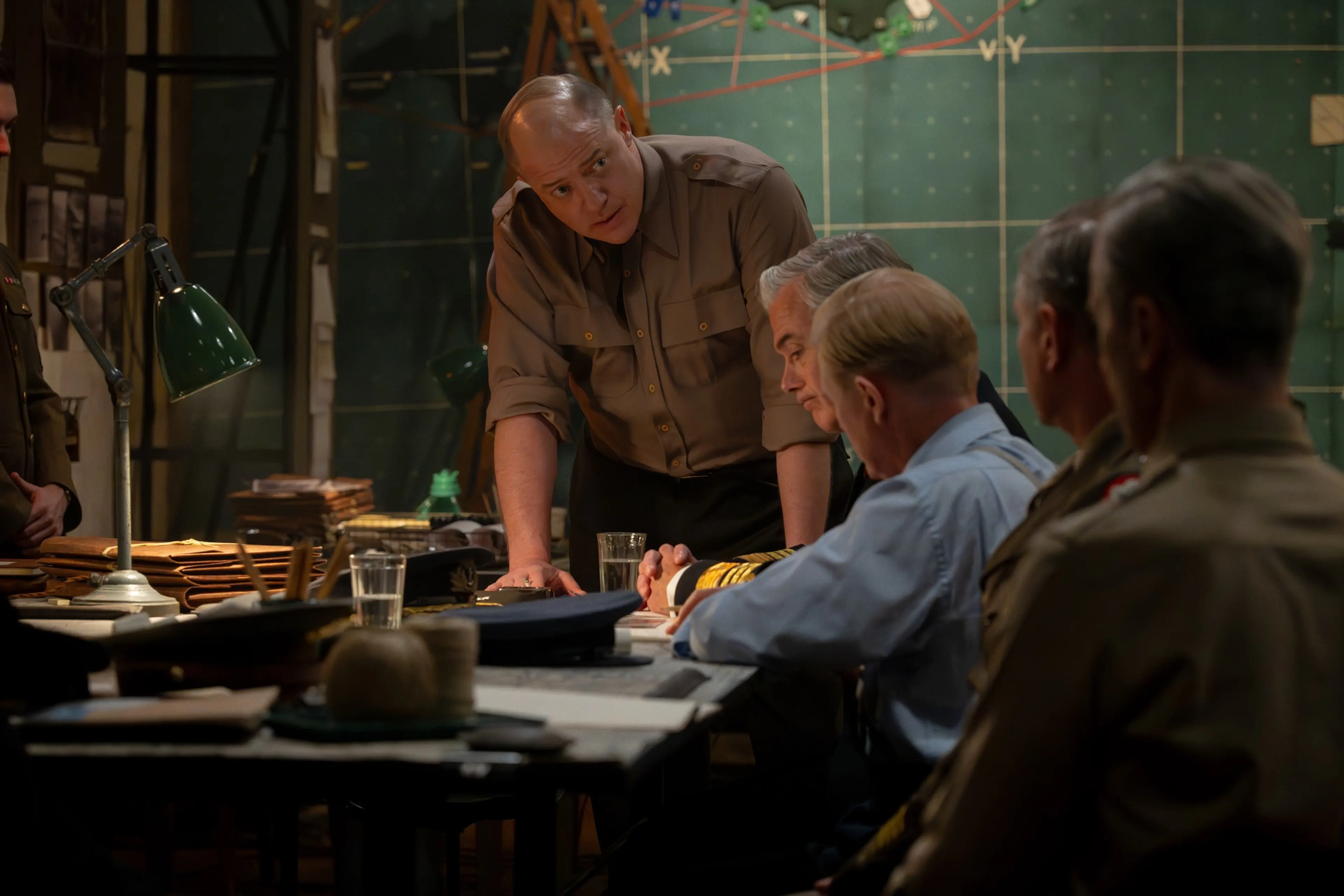
Brendan Fraser as General Dwight D. Eisenhower Alex Bailey—Focus Features/STUDIOCANAL
The disastrous training exercise
The film opens with a look at Exercise Tiger, a training exercise that was nothing short of a catastrophic failure, just 6 weeks before D-Day on April 28, 1944. What was supposed to be a routine practice quickly became a staggering disaster.
The exercise on Slapton Sands in England was full of new draftees and it was designed to give them first-hand experience of what war could feel like, including the use of live ammunition. That way, “they could get used to the sights and the sounds and smells of what it would look like—it’s an assault on the senses,” explains Maras. But there were a series of problems on the day. “There was a miscommunication when the dispatch time would be. It took more time than usual for some of the group to get ready than the others, which meant they needed to delay the landing on the beaches by an hour or so, in order for them to do the bombing as they were heading in, so they could get a feeling of it, without the explosives actually hitting them. But they weren’t aligned, landed at the initially agreed time, and not an hour later as they should have, and got blown to smithereens.”
That’s already a crushing loss, but there was another equally devastating incident during Exercise Tiger, one that featured in Haig’s original play. German U-Boats had intercepted signals from the Allied Forces and attacked the allied boats. “It was hell on water,” says Maras. “There were oil slicks, hundreds of meters long, if not longer, that were completely alight. Men were in sinking ships, and their only choice was to jump into a flaming ocean. You can only imagine what that does to troop morale.”
Having seen how many lives could be lost with one simple mistake added an unfathomable pressure on Eisenhower, which made the decision of when to launch D-Day all the more challenging. “It hangs over the neck of Eisenhower,” says Maras.
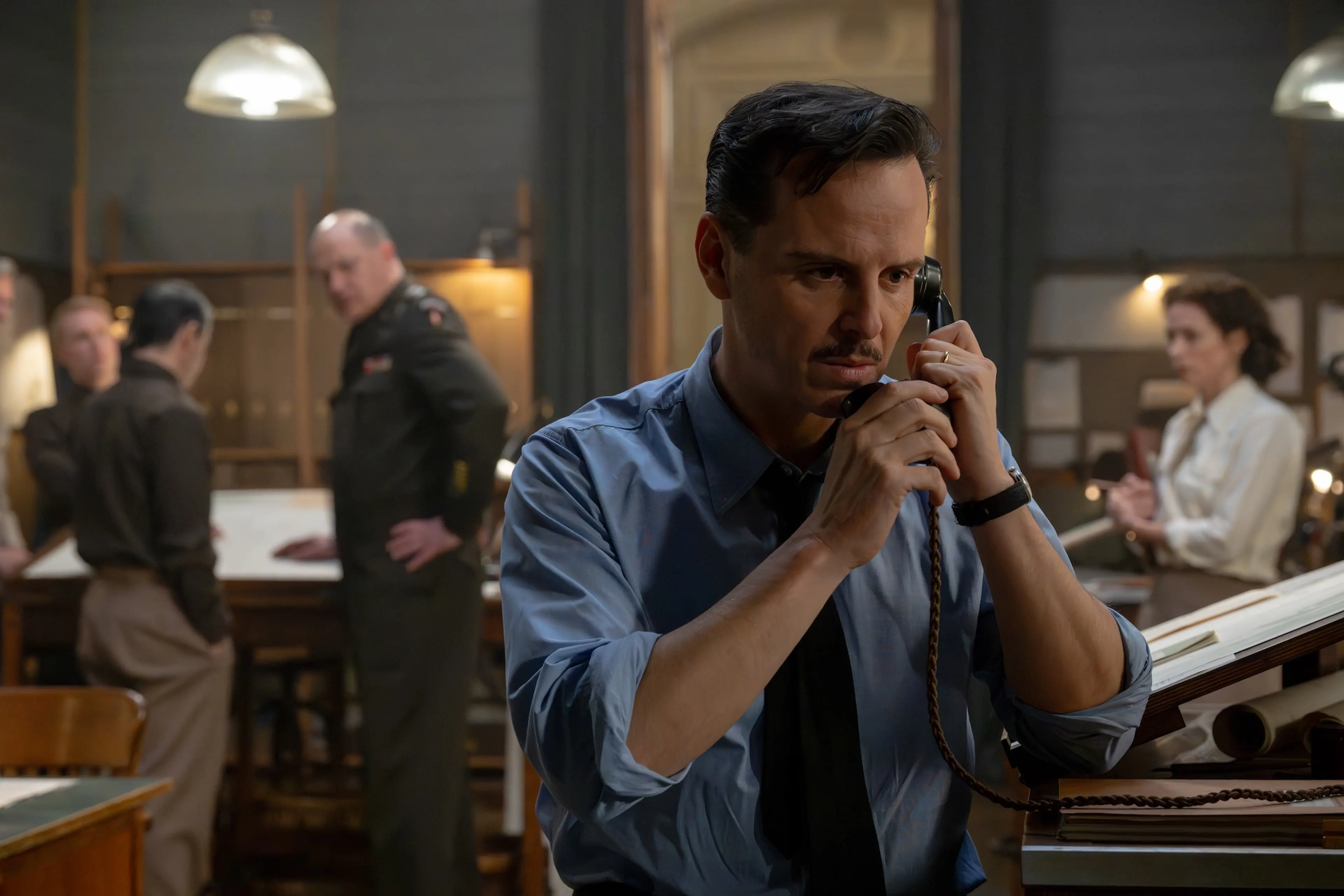
Andrew Scott as Captain James Stagg Alex Bailey/Focus Features/STUDIOCANAL
A staggering surprise
To ensure the story of Pressure was as accurate as possible, the pair did a ton of research. To get inside the minds of the characters (all of whom were real people), there were a ton of memoirs to read through. “There’s a memoir by Stagg,” says Haig, “which is dry, but accurate and very revealing about those meetings with the Allied West.” Those scenes are crucial to the film, in which Stagg presents his findings as they develop over the 72 hours, each report more urgent than the last. In those meetings, Stagg’s findings would often provide a contrast to Crick, whose memoirs were also used. The two had different forecasting methods, which led to separate conclusions and more confusion amongst key decision makers.
There were also two memoirs from Kay Summersby (Kerry Condon), Eisenhower’s personal secretary, which Haig calls “extremely informative and very moving,” as well as a number of books written by Eisenhower. Haig also credits a book by Norwegian meteorologist Sverre Pettersen, “Weathering the Storm: Sverre Petterssen, the D-Day Forecast, and the Rise of Modern Meteorology." “The meteorological philosophy of these storms, and the current affected by the storms was fairly revolutionary in its time, which is all evidenced in the literature of the period,” says Haig.
The research continued long after the film was shot. “It didn’t end until we finished the sound mix,” says Maras. As one example, they found that they needed to write the lines the radio operators are saying in the film’s control room scene at the end of the film. “They had to be accurate, so we went back to the original records.
Plenty of peripheral details also informed their research, including various forms of etiquette. “What’s the etiquette when an American walks into a room as opposed to the British? What do they do with their hats? It’s all those little things, as well as the biggest geopolitical and character-based things, and the archival footage all informs that,” says Maras. They found around 50 hours of archival footage to pore through, which was an enormous task to undertake.
Maras shared an incredible story about the research team. They soon found that they needed a larger team, so people in research kept recruiting other people they knew. One of those workers was named James Stagg. It was an extraordinary coincidence. But that man wasn’t just some guy with the same name—he was the real grandson of James Stagg, who had just shown up to do research on a new film, unaware that it had any connection to his own life. “His father was born at the end of our movie, and came straight into the doors of our office 80 years later to cut archival footage,” says Maras.
There’s an immense attention to detail that gives Pressure a strong sense of urgency. Just as Exercise Tiger looms over Eisenhower, the scale of what could happen if D-Day launches at the wrong time is felt by audiences. Even though it’s a foregone conclusion that D-Day was a success, the mystery and unpredictability of weather gives Pressure its verve.
Because of Stagg, D-Day was moved forward by a day, from June 5 to June 6th. With the help of Crick and other meteorologists, he identified a gap in the early hours of the 6th, which provided a surprise opportunity to strike. “They’ll never see a gap like this coming,” Stagg says in the film. He was right.
Many years later, Eisenhower was asked by President John F. Kennedy how the Allied Forces won the war. Reportedly, Eisenhower said: “We had better meteorologists than the Germans.”