








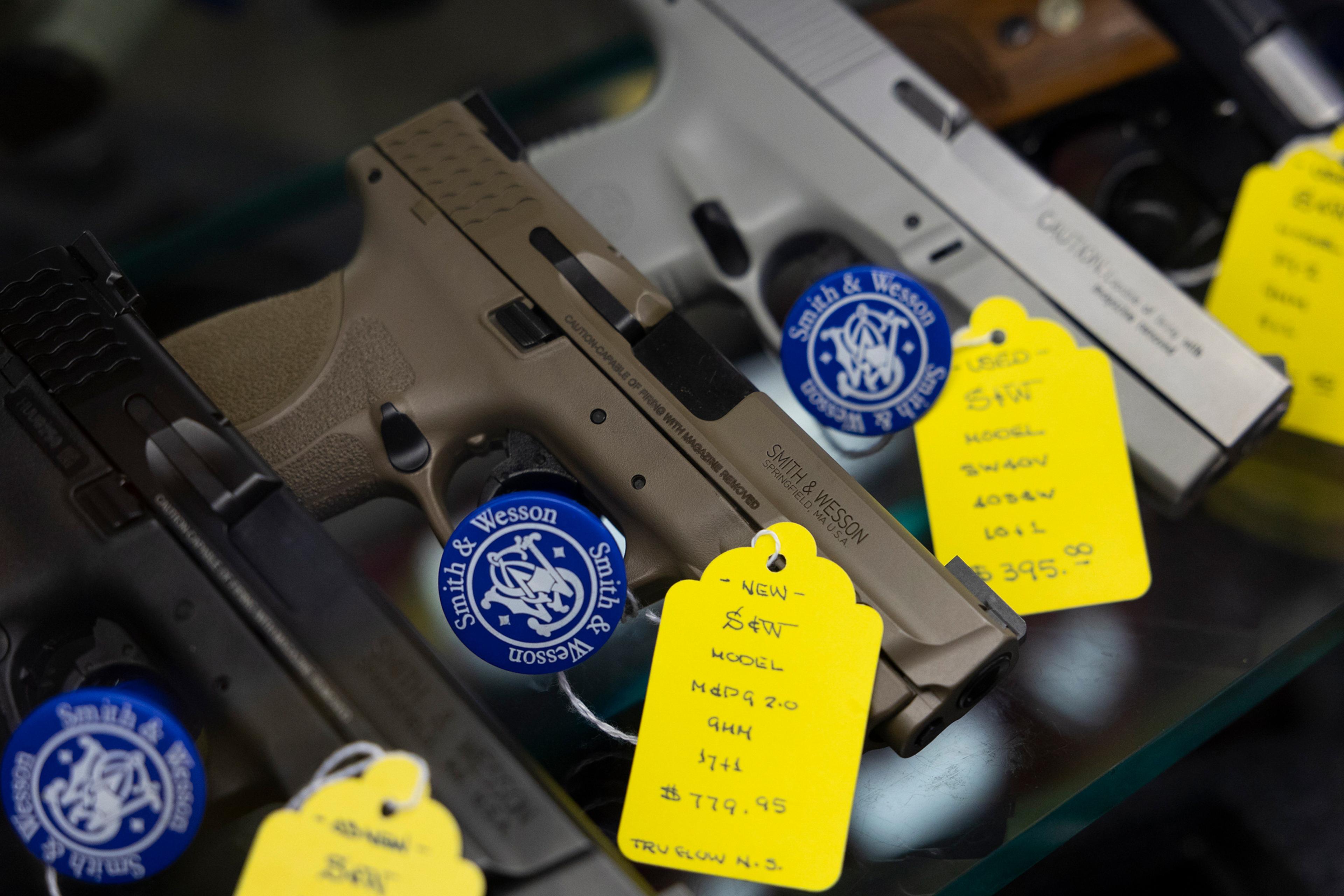
It was her years as a teacher in the Seattle-area Catholic School system that made Sister Judy Byron particularly sensitive to gun violence. “We had fire drills in Washington, we had earthquake drills, but never in my wildest imagination would I ever have thought someone would have come in with a firearm to the school where I was,” she says. And then came the school shooting at Columbine, and years later, Sandy Hook. “I remember thinking at the time, if we don’t do something now, when we’ve murdered all those little first graders, we never will. And of course we didn’t.”
She knew more could be done by one of the biggest stakeholders in gun violence: gunmakers. “Every time there’s an incident you hear from everyone—even the NRA will put out a statement—but we never hear anything from the firearms manufacturers,” says Byron, who is an Adrian Dominican Sister, an order of about 400 nuns with a motherhouse in Michigan. “They have to be part of the solution to this.”
Almost a decade after Sandy Hook but only months after horrific shootings in Buffalo, New York and Uvalde, Texas, Byron, together with an unlikely group of activists, is going head to head with the U.S.’s biggest gun manufacturer, Smith & Wesson. On Sept. 12, the storied gunmaker held its annual shareholder meeting online. Along with the usual run-of-show for these events—re-electing board members, ratifying some salaries, approving an omnibus stock plan and officially re-installing its auditors—shareholders were asked to vote on Item 5, a proposal to get the gun manufacturer to adopt a comprehensive human rights policy. Byron and her band of investors sought to encourage the company to take a look at the way its business operations may impinge on the rights of others.
The proposal did not pass, but Byron seems undaunted. “We will continue engaging these two firearm manufacturers,” she says, pointing to recent victories her group has had with a similar vote at Sturm Ruger, and as part of the consortium who asked major credit card companies to start to give gun sales a particular merchant code, which they have now agreed to do. “Many, many groups got involved in pushing [the credit card companies],” she says. With the firearm manufacturers, we seem to be only the only investors that are really engaging them on these issues.”
Byron is the leader of a consortium of 14 religious shareholders, the Northwest Coalition for Responsible Investment, who have hatched an ambitious—and possibly quixotic—plan to open another avenue for conversation about the fraught issue of gun ownership in America, which despite dozens of deadly incidents since Sandy Hook has been stuck in a cycle of finger-pointing and inaction. While most of the members of the Coalition are other religious orders, and thus unlikely gun investors, they seek to use shareholder power to nudge gun companies into reckoning with the effect of firearms in America. The effort stems from conversations Byron had in 2016 with the Interfaith Coalition for Corporate Responsibility (ICCR), a mix of faith-based and ethics-based investors who together have about $4 trillion in managed assets, and who have long used investment as a form of engagement with the corporate America.
The unusual shareholder initiative is non-binding and seemed modest enough. It asked that the company “adopt a comprehensive policy articulating its commitment to respect human rights,” and requested “a description of proposed due diligence processes to identify, assess, prevent and mitigate actual and potential adverse human rights impacts.”

Sister Judy Byron, director and coordinator of the Northwest Coalition for Responsible Investment, in her office in Seattle, March 2018. Elaine Thompson—AP
The proponents of the policy say that Smith & Wesson needs to explore and communicate the risks it may be facing—and thus shareholders may be facing—as a manufacturer of a dangerous product. These include reputational risks, that people will suddenly find the stock abhorrent and sell their shares after a horrific event involving a product the company makes (the Marjory Stoneman Douglas High Schoolshooter in Parkland, Florida used a Smith & Wesson weapon); financial risk, that the company will be sued and have to pay damages—as Remington was and did—and legal risks, that a change in gun laws may one day limit the company’s profitability. Smith & Wesson’s board asked shareholders to vote against the proposal.
“Our lens for this is that they need to take a very holistic look at their policies, procedures, products and practices,” says Laura Krausa, System Director of Advocacy Programs for for CommonSpirit, and another member of the coalition, who was also one of the lead petitioners at Sturm Ruger. “They need to have a third-party auditing firm really talk with the wide spectrum of stakeholders to understand where they have some rights risks that could impact their bottom line.”

Laura Krausa, director of advocacy for CommonSpirit, a nonprofit hospital chain, at her home in Wheat Ridge, Colo., in May 2022. Daniel Brenner—The New York Times/Redux
In its advice to shareholders, Smith & Wesson said that it had already taken steps to identify and manage any financial risks it faced and that the originators of the proposal have a gun-control agenda rather than the best interest of shareholders at heart. The shareholder activists disagree. “We believe, honestly, that reasonable and sensible solutions to prevent gun violence and to promote gun safety both can and should peacefully coexist with the Second Amendment,” says Krausa. Smith & Wesson declined several interview requests made by TIME to its media representative
Whether as a result of this tactic or the increased regulatory scrutiny weapons manufacturers have been under since President Biden came into office, Smith & Wesson has recently gone on the offensive, stepping up its communications with its shareholders and customers, releasing several documents about its products, procedures and operating principles. On Aug. 15 CEO Mark Smith came out swinging on social media, accusing the “government and its lobbying partners in the media” of causing “the surge in violence and lawlessness” and then “shifting the blame on to Smith & Wesson” and other gun companies and gun owners.
Making the religious case for gun control
Many Christians are guns-rights supporters, but the group attempting to influence Smith & Wesson say their faith has led them the other way. Krausa works in violence prevention and shareholder advocacy for Commonspirit, a large non-profit health system associated with the Catholic church, with about 1000 clinics in 21 states. She sees engagement with gun companies as part of a larger approach to addressing the violence that often sends victims through Commonspirit’s doors. “Obviously, one reason we’re very interested in this is that we see this coming into our facilities,” she says. “Gun violence is rampant. In FY ’21, we had 3,200 incidences of injuries that came into our facilities. The cost of that is $32 million. And the human cost is far worse.”
Like Byron, she feels that gun manufacturers are the missing piece in the struggle to lower gun violence. “There’s a lot of people trying to solve this problem,” she says. “But so far, the gun manufacturers haven’t joined that group. And because they do happen to make the product that is part of the problem, it seems very reasonable that they should come to the table and discuss solutions as well, and really look at how rights are being violated or potentially violated by their products.”
Reverend Doug Fisher, an Episcopal Bishop in the western Massachusetts, and another member of the shareholder group, also got involved after the shooting at Sandy Hook, when some local church leaders formed Bishops United Against Gun Violence. In 2012, they started trying to help craft state and federal legislation to address what he calls “the absolute public health crisis of gun violence.” Progress in that area stalled, says Fisher, “and so we thought, ‘Well, maybe if we get in dialogue with the gun manufacturers, we can invite them to be part of the solution rather than part of the problem.” And so the Episcopal church took gun companies off the list of stocks it would not hold and became weapons investors.
Progress on engaging the gun companies, however, has been slow. The first shareholder proposal at Smith & Wesson was in 2018, asking for a gun safety report. It passed, but the groups felt the resultant report was half-hearted and shoddily done, mostly copied off the internet rather than reflecting any original thinking. The human rights policy was proposed in 2019 and again in 2021, each time garnering a slightly larger percentage of votes; last year, 44% of shareholders were in agreement. The percentage of shareholders who voted for it this time is not yet available.
Byron says executives from Smith & Wesson met with representatives from the group several times, but the two sides have been unable to persuade each other of the merits of their position. This frustrates her. “You know, even Philip Morris International has a human rights policy,” she says.
One advantage the faith-based proponents have is that, as people who believe in eternity, they are prepared to play the long game. The ICCR was founded when the Episcopal church bought shares in General Motors in 1971 and asked it to disinvest from South Africa, which it eventually did. It took apartheid another 23 years to fall. The movement has more recently worked with hotel chains on trafficking and pharmaceutical companies on HIV and AIDS drugs as well as campaigns around racial justice and environmental protection.
They lose more than they win, but sometimes the losses are all they need. After an unsuccessful shareholder vote at Gilead Sciences in the early 2000s, the pharmaceutical firm nevertheless decided to make its HIV drugs more available in developing countries. “[The company] really became a leader in addressing HIV AIDS,” says Byron. More recently, in February 2021, a shareholder proposal for a human rights report at food giant Tyson was voted down by investors, but by the end of the year, after the ICCR indicated its intention to try again, the food giant agreed to have an independent party conduct just such an audit.
Byron, the kind of nun who favors Hawaiian shirts, tries to be even-handed about what Smith & Wesson is doing. “One good thing they do that I wouldn’t have known [before meeting the corporate secretary] is they don’t let any of their product be shown in video games—the shooter video games kids use,” she says. But she cannot hide her disbelief that the firearms manufacturer couldn’t do more. Her group would like them to “really look at that supply chain and see if there are any places where guns are disappearing or being sold where they shouldn’t be sold,” and “to look at how they market the products and who they market them to, and where they market them now.”
Her biggest ask, however, is for better safety features. “We get the same song and dance all the time about why technology doesn’t work in guns,” she says. “In the future I see that guns will have to be technologically smart.” She uses the example of passcodes and facial recognition on smartphones. “You know, if you couldn’t use my cell phone here on my desk, there’s no reason why if I had a gun on my desk, you should be able to pick it up and use it. I mean, it’s just, I don’t think it makes sense in this age.”
Fisher says improving its products’ safety features would make Smith & Wesson a better company. “Car companies are always trying to make their cars safer,” he says. “I can safely pull out of the parking lot outside right now because there’s a rearview camera. Why can’t gun companies do the same thing? Why can’t they do things to make their products safer?”
This is a particularly sensitive point for Smith & Wesson, since a former CEO, Ed Shultz, agreed to start to develop more safety mechanisms in 2000, in return for the withdrawal of lawsuits against the company mounted by several states. The reaction was brutal: gun wholesalers and many small retailers boycotted the brand, the company was dropped by its law firm and sold by its British owners, Shultz was forced out and the plan was dropped. Ever the nun, Byron is sympathetic to the company’s travails. “That trauma is in their DNA,” she says. “They feel that, you know, they’re not gonna make that mistake again.”
But she points to the example of Edward Stack, the CEO of Dick’s Sporting Goods, another company in which the shareholder activists invested and had more success. By the time they met with him, Stack had already been moved to act by the 2018 Parkland shooting. He removed large-capacity magazines and rifles from stores. The blowback was also intense; 65 employees quit straight away and sales dropped. But the company recovered and retail giants Walmart and Kroger made similar moves not long afterwards. “All it takes is, you know, a leader who really sees what the problem is and what they could do about it,” says Byron.
Ed Shultz’s departure was 22 years ago, before the tragedies at Sandy Hook, Parkland and Uvalde, Texas. Recent surveys have shown an increasingly large majority of Americans favor stricter gun laws. Can things change? “We needed the support of the major investors like BlackRock and Vanguard,” says Byron. “We won’t know until they publish their votes if they supported the resolution.” Smith & Wesson’s largest investors are institutional fund managers such as BlackRock, Vanguard and the hedge fund Renaissance Technologies.
Both the activist group and Smith & Wesson have met with these investors’ representatives on several occasions, as well as with governance groups that advise shareholders, such as Glass Lewis and Institutional Shareholder Services (ISS). When a similar proposal requesting a human rights impact study passed at Sturm Ruger in June, that company’s CEO, Christopher Killoy, blamed the institutional investors, who “blindly followed the guidance” of governance groups. Both Glass Lewis and ISS recommended voting in favor of the proposal at Smith & Wesson this year. But they also recommended that the last time it didn’t pass, in 2021.
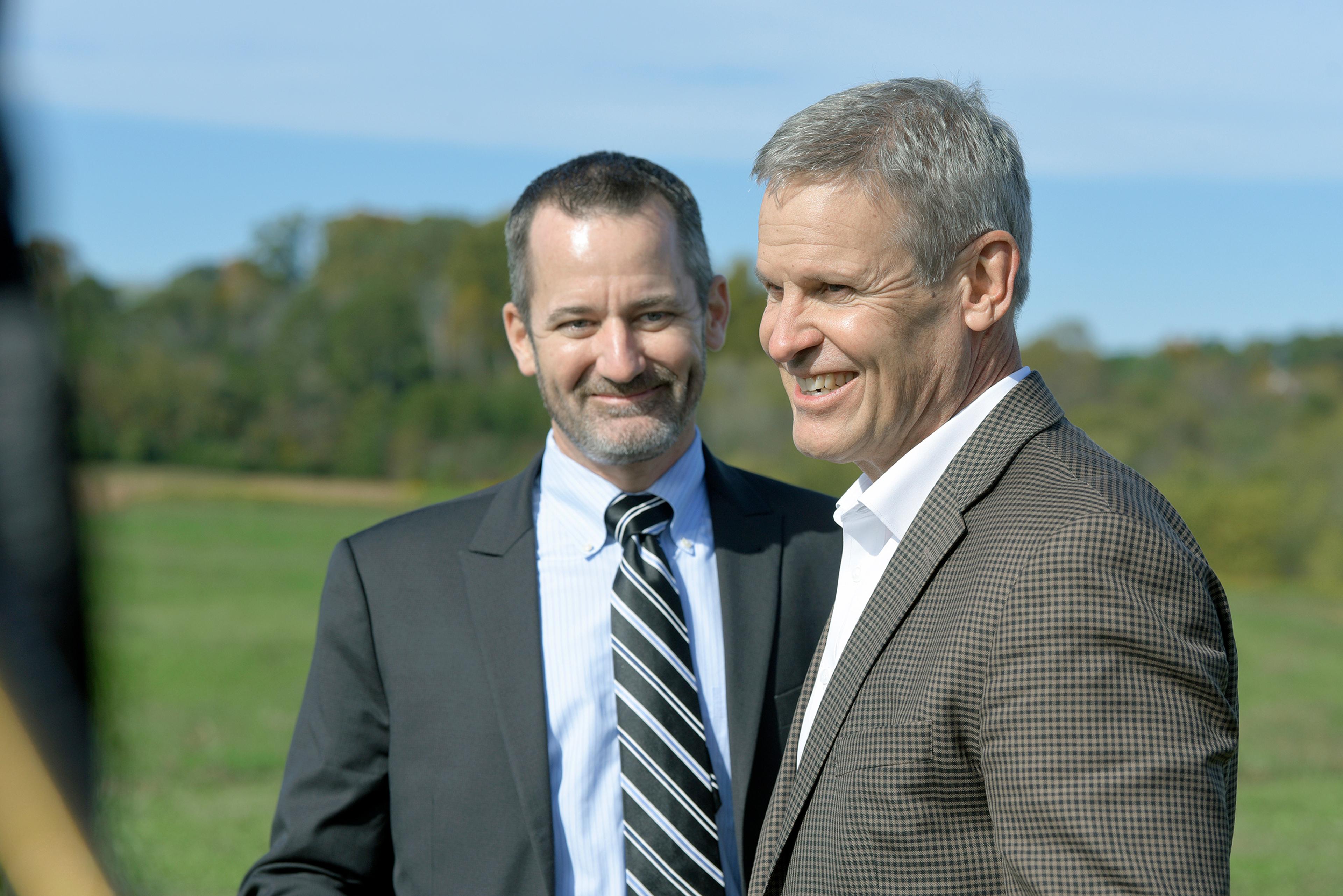
Smith and Wesson President and CEO Mark Smith, left, and Tennessee Governor Bill Lee prepare for a ground breaking ceremony for the new Tennessee location for the firearms manufacturer, November 2021 in Alcoa, Tenn. Scott Keller—The Daily Times/AP
Until recently, business had been good for gun manufacturers, including Smith & Wesson. Although it just reported a large drop in sales for the quarter, it’s coming off a bumper season. In the first year of the pandemic, Smith & Wesson’s revenues increased by 27%. For the fiscal year that ended in April, the company had $875 million in sales, it says, with a gross profit margin of 43%. And the board is clearly happy with its new-ish CEO. Since he was appointed in 2020, Smith has had a 77% raise in his base salary, according to ISS, which, with other incentives, has taken his earnings to $2.8 million.
The vote at Ruger took place shortly after 19 elementary school students and two teachers were killed in Uvalde, and it’s unclear if, in the absence of such a tragedy, shareholders felt as motivated to call on the gun companies to reexamine their role. It’s also unclear if such a non-binding proposal is worth the investment the shareholders have put in. Byron believes it is and says that the ICCR is planning a strategy session at their fall meeting at the end of September. In 2020, according to the CDC, there were more than 45,000 firearm-related deaths in the U.S.—about 124 people a day. That’s about 12% more Americans than died from car crashes, and half as many as died from drug overdoses. More than half of those gun deaths were suicides and more than 40% were homicides. “We have 400 million guns [in America] now,” she says. “It’s gonna take more than my lifetime to change this, but you know, we just have to do something.”
Sept. 13: This story has been updated to reflect the results of the shareholder meeting.