


President Donald Trump announced on Tuesday that the U.S. will extend its cease-fire with Iran, hours before the two-week agreement was set to expire.
Trump said the decision was made following a request from Pakistan, which is mediating peace talks between the two countries.
Pakistan’s army chief, Field Marshal Asim Munir, and Prime Minister Shehbaz Sharif asked the U.S. to “hold our attack on the country of Iran until such time as their leaders and representatives can come up with a unified proposal," the President explained.
Trump also claimed that his decision was “based on the fact that the government of Iran is seriously fractured, not unexpectedly so.”
He added that the U.S. will continue its naval blockade of the Strait of Hormuz, and that the American military will “remain ready and able… until such time as [Iran’s] proposal is submitted, and discussions are concluded, one way or the other.”
Sharif thanked Trump “for graciously accepting our request to extend the cease-fire to allow ongoing diplomatic efforts to take their course,” following the announcement. “With the trust and confidence reposed in, Pakistan shall continue its earnest efforts for negotiated settlement of conflict,” he added.
In an interview earlier on Tuesday, Trump had said that he did not want to extend the cease-fire.
“We don't have that much time,” he told CNBC, insisting that the U.S. was in a strong negotiating position and would likely emerge with a “great” deal.
Trump also warned at the time that the U.S. would resume its assault of Iran if talks did not progress.
"I expect to be bombing because I think that's a better attitude to go in with. But we're ready to go. I mean, the military is raring to go," he said.
But with Iran insisting it will “not negotiate under threat and force,” it remains uncertain if Tehran will return to the table in Islamabad, Pakistan, for peace talks with Washington.
Esmail Baghaei, spokesperson for the Iranian Foreign Ministry, told state television Tuesday that "no final decision” had been made on whether Iran will attend talks, citing the uncertainty was due to "contradictory messages" from Washington.
“The reason for this is not indecision; it is the contradictory messages, contradictory behaviors, and unacceptable actions of the American side,” he argued.
The stalemate between the U.S. and Iran comes amid an escalating struggle over the Strait of Hormuz.
The U.S. Navy seized an Iranian ship in the Gulf of Oman over the weekend after it attempted to bypass the U.S. blockade. Iran argues both acts—the seizing of the cargo ship and the blockade itself—are violations of the cease-fire.
Iran’s ambassador to the United Nations said in a letter Tuesday that the country "unequivocally rejects and condemns” the U.S. action and called upon the U.N. to “take an immediate, firm, and principled position” by condemning the seizure of the ship, “ensuring full accountability for those responsible,” and demanding the “immediate and unconditional release of the vessel, its crew and their families.”
The U.S., in turn, has accused Iran of violating the cease-fire by firing bullets in the Strait, which Tehran has had a chokehold over, crippling global trade, since the start of the war.
“Iran has violated the cease-fire numerous times,” Trump said Tuesday morning.
With the prospect of further active fighting looming, Iranian parliament speaker Mohammad-Bagher Ghalibaf had warned that his country was “prepared to reveal new cards on the battlefield.”
Echoing the sentiments of other Tehran officials, he insisted Iran does not “accept negotiations under the shadow of threats.”
Elsewhere, Ali Abdollahi, commander of Iran’s Khatam al-Anbiya Central Headquarters, said that the “management and control of the Strait of Hormuz” would not be “exploited by the lying and delusional U.S. President.”
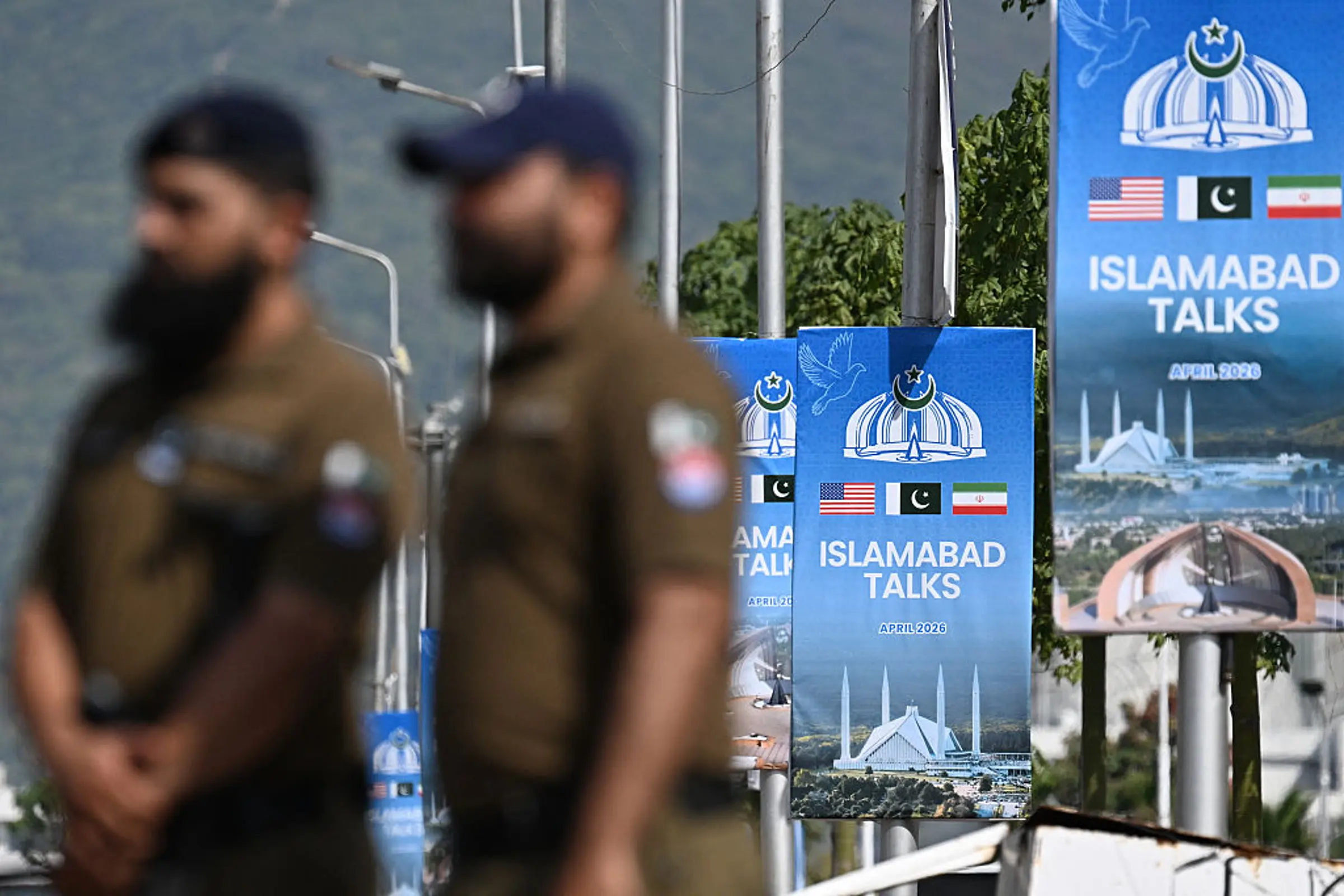
Security personnel stand guard at a checkpoint near the Serena Hotel at the Red Zone area in Islamabad on April 21, 2026, amid heightened security measures ahead of anticipated U.S.-Iran peace talks. Aamir Qureshi—Getty Images
U.S.-Iran peace talks remain uncertain
A U.S. delegation—once again led by Vice President J.D. Vance—was expected in Pakistan this week, but a White House official, following Trump’s announcement of the cease-fire extension, said that Vance would not be traveling to Pakistan on Tuesday and that “any further updates on in-person meetings will be announced by the White House.”
Iran has not confirmed whether it will attend a second round of talks.
A previous marathon 21-hour negotiating session on April 11 notably ended without an agreement.
Despite the lack of official confirmation, Pakistan has moved to increase security in Islamabad ahead of the planned discussions.
World leaders seek resolution and full reopening of Strait of Hormuz
The full and toll-free reopening of the Strait of Hormuz, a crucial passage between the Persian Gulf and the Gulf of Oman through which around a fifth of global oil production flows, remains a key priority among global leaders.
U.K. Prime Minister Keir Starmer and French President Emmanuel Macron—who previously resisted Trump’s calls to send warships to the waterway—led an international summit in Paris last week, aimed at supporting freedom of navigation in the Strait.
The leaders have since confirmed they will establish a defensive multinational mission to protect merchant vessels and conduct mine clearance operations. Per a statement shared after the summit, this will only be enacted “as soon as conditions permit following a sustainable cease-fire agreement” as the mission will be “strictly defensive.”
Chinese President Xi Jinping, meanwhile, has called for “an immediate and comprehensive” cease-fire to ensure normal passage via the key trade passage.
Iran's long-standing chokehold on the transit of oil and gas has upended the global economy, causing major instability to energy prices around the world. From fuel shortages resulting in more expensive airline tickets to consumers feeling the pinch at gas pumps, the impact of the Strait being used as leverage continues to be felt far and wide.
Fatih Birol, the head of the International Energy Agency (IEA), on Tuesday said the Iran war has resulted in the "biggest" energy crisis in history. He noted that the disruption caused by the Middle East conflict is compounded with the negative impacts of Russia's war with Ukraine.
"The crisis is already huge, if you combine the effects of the petrol crisis and the gas crisis with Russia," he said.
E.U. countries have agreed to widen sanctions against Iran to “also target those responsible for breaches to freedom of navigation.”
“Freedom of navigation is non-negotiable,” said the European Union’s chief of foreign affairs Kaja Kallas. “Daily U-turns, whether the Strait of Hormuz is open or closed, are reckless. Transit through the Strait must remain free of charge.”