


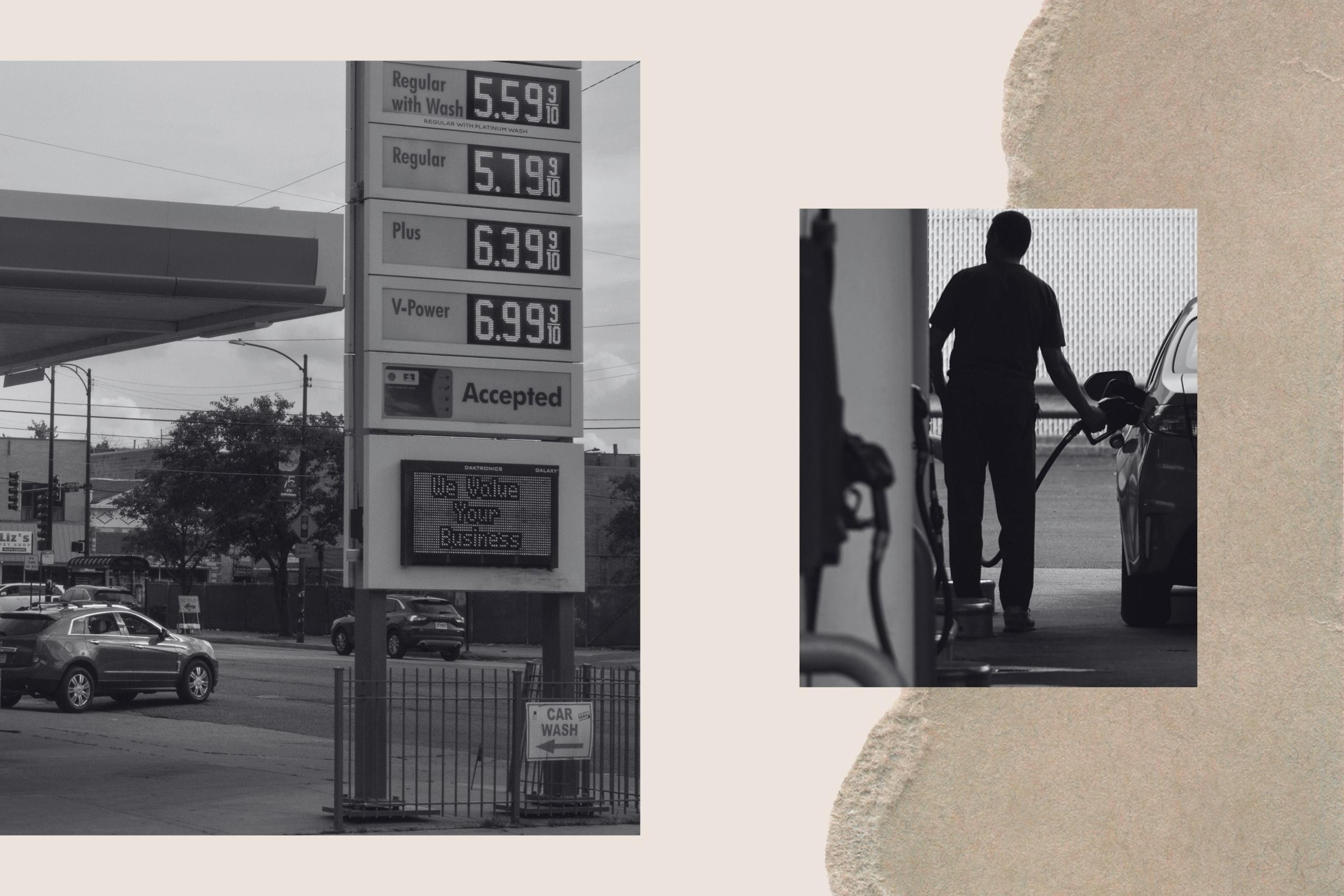
There is no other price like it. Gasoline is at the same time both the most visible and also the most political price in America. It is the only price that Americans confront every day in large numbers on elevated signage along streets across the country. It is also the one that receives the most attention politically, as is the case today.
The months-long disruption of the Strait of Hormuz sent gas prices shooting up, creating pain at the pump for American motorists. It also sent political shocks across the country. Prices have come down over the past week with the recently signed agreement to end the war in Iran, reopen the Strait, and begin a 60-day negotiation period. But uncertainty over what happens in the weeks ahead, as well as the complexity of unscrambling the blockage created by the closure of the strait, will continue to affect gasoline prices.
As it is, the average price across the country is down from the recent $4.50 a gallon to about $4—almost a dollar higher than this time last year. But that is an average, with wide disparities among states. The cheapest gasoline is in the very well-supplied states of Indiana and Texas at about $3.40. The most expensive remains California, at about $5.60: the result of policies and regulations that have forced refiners to shut down and California to import a substantial amount of its gasoline from Asia, which is, in turn, refined from Middle East oil.
To be sure, gas prices are continually variable—influenced by geopolitics abroad and simultaneously by the shifting balance of supply and demand in crude oil prices worldwide. Because of this, while the cost of oil can mirror inflation, it does not accurately reflect the state of the U.S. economy. Plus, America is both producing more oil than ever and driving more efficient cars. So why do gas prices continue to be the go-to metric to measure American economic anxiety? And what do current prices tell us about America’s role in the world?
The lasting legacy of oil prices
Oil’s spotlight on the stage of political controversy is hardly new. The price of gasoline has weighed on people’s wallets and the national mind for over a century. At the beginning of the 20th century, pioneering motorists went to their local general store to buy gasoline, which arrived packed in tin cans. That changed as Americans wholeheartedly embraced the automobile and a new innovation—the drive-in gasoline station—proliferated at an astonishing rate across the country. Gasoline quickly became an essential part of the fabric of American life.
This advance was celebrated in the 1920s by advertising man Bruce Barton, who had already achieved fame as the author of a number-one bestseller that described Jesus as “the founder of modern business.” Barton exhorted gas station owners that they were more than merely purveyors of “bad smelling liquid at so many cents a gallon.” Rather, he said that, in enabling mobility, they were selling “the fountain of youth” that has “worked miracles” in people’s lives
But Barton had also acknowledged a hard fact: gasoline could become “a hated expense.” At least that's what happens when prices spiral up. And when that does happen, gasoline becomes a flammable political issue. In my own research, the earliest Congressional hearing on gasoline prices I have found was one held in 1923 at a time when prices were high. The chairman of the Senate committee, Robert “Fighting Bob” LaFollette, warned that oil companies’ ability to “manipulate oil prices” would send prices shooting up to as much as $1 a gallon—about $20 in today’s dollars. As it happened, a flood of discoveries of new oil fields led to a tide of oversupply, and soon enough gasoline prices collapsed to about a tenth of what Fighting Bob had prophesied.
But that hearing established a pattern that has held true across the decades. It became axiomatic that whenever prices went up, public anger would rise as well. When headlines are filled with the fluctuations of gas prices, various branches of the federal government undertake rancorous investigations. The targets are typically the same: oil companies, charged with collusion and manipulation. Eventually, however, it turns out that the fundamental forces of supply and demand are what drive crude oil and, thus, gasoline prices.
The process had become so ritualized that in 2008, The New York Times described one such episode as “the sweet, indelible signs of summer. Baseball. Backyard barbecues. And dramatic Congressional hearings over the rising price of gasoline.”
I was called to testify at one such hearing in July 2008. With prices hitting $4.10 a gallon, concern was so high that two committees had merged to hold a combined session in a cavernous hearing room. Witnesses described the difficulties and pain these prices were causing motorists, as well as the pressure on family budgets. Senators were thunderous in their criticism. The hearing room resounded with charges of manipulation and urgent calls for action.
But again, supply and demand would intervene. Within four months, the price of a gallon would fall to half of what it had been that July. Moreover, although virtually unseen at the time, technological advances were beginning to unlock the oil lodged in very dense shale rocks, something that petroleum textbooks had previously said was commercially impossible. An extraordinary transformation followed. The United States went from being the world’s largest importer of oil to the largest producer of oil, far larger than the previous leaders, Saudi Arabia and Russia.
Prices at the pump
That being the case, why did gasoline prices soar 50% over the last few months? The answer can be found in the Middle East.
In March, Iran closed the Strait of Hormuz. Through it had passed about 20% of the world's oil, along with many other commodities, ranging from natural gas and fertilizer to helium. Before the Iran War, 70 tankers a day crossed through the Strait, 21 miles at its narrowest. By May, just five ships a day managed to slip through. The result has been the largest disruption of world oil supplies since World War II. More recently, more tankers had been able to sneak through, in part protected by the U.S. military, while countries were simultaneously releasing oil from stockpiles.
To be sure, Tehran pays close attention to American politics and, in particular, what happens at the gas station. “Enjoy the current pump figure,” was the message Iranian Speaker of the Parliament, Mohammed-Baqer Qalibaf, sent to Americans in April. “Soon you’ll be nostalgic for $4 to $5 gas.”
The closure hit Asia the hardest, since 80% of Persian Gulf oil flowed in that direction, and because the continent, as well as the developing world, is struggling with an energy crisis. Across Asia, various governments told people to work from home, rationed fuel, and prioritized which class of customers could receive the limited supplies available. Businesses are shuttered because they can’t get energy, or it’s too expensive. And some farmers can’t plant this season because they don’t have diesel fuel for their equipment or sufficient fertilizer (one-third of the world’s traded fertilizer passes through the Strait). The impact also reached Europe, which has depended on the Gulf for jet fuel. As a result, European airlines raised air fares to cover the high cost of jet fuel and canceled flights.
The United States, with its abundant resources, faced no physical shortage. But the oil market is global, and high oil prices feed back into U.S. markets as customers around the world compete for barrels to offset the loss from the Gulf. In this way, gas prices reveal that domestic policies can’t insulate America from the rest of the world—no matter how hard it might try.
Gas going forward
The future course of prices hinges on what happens to the Strait of Hormuz. With the announcement of Trump’s deal with Iran, crude oil prices have ticked down, and thus so have gasoline prices. But a reopening of the Strait does not mean an instant return to normal. As a result of the closure and the cessation of exports, the world is missing 1.2 billion barrels of oil. Drained inventories have to be refilled.
S&P Global measures over a hundred tankers that have been sitting in the Gulf laden with oil, 120 other tankers carrying various petroleum products like jet fuel, and more than a thousand other stranded ships. All of them will exit as fast as they can. But they all can’t leave at once. And they have to be very careful because of all the mines that Iran laid in the waters around the Strait.
Once the backlog is cleared, tankers will need to go in the opposite direction through the Strait and enter the Gulf to pick up oil. But that will be done more slowly. One tanker operator told me this week that he will aim to get his stranded tankers out as fast as possible, but will be cautious about sending tankers back into the Gulf in case the negotiations go awry and tankers get stranded again. Moreover, Iranian drones and missiles have damaged operating facilities in the Arab Gulf countries.
Even assuming the agreement with Iran holds—and the Strait remains open and the negotiations proceed as hoped—U.S. gas prices, though down from the highest, can be expected to be above what they were last year.
What the crisis has demonstrated is that motorists only have so many ways to respond to what’s happening at the pump. They can change their behavior: drive less, carpool, or drive around in the hope of finding a station selling cheaper gas. Or they can buy a new car. It could be one that gets more miles to the gallon. It could also be an electric car. As my colleague Jeff Meyer has written, this is “the first oil crisis of the EV age”.
Indeed, last year, according to S&P Global data, one in four cars sold worldwide was an electric vehicle (EV), most of them Chinese-made. But it’s a very different story in the United States, where the EV share of new car sales has dropped from a high point of about 12% before the Trump administration canceled tax credits for EVs to around 7% today. Overall, 97% of the entire U.S. car fleet runs on oil.
So when Americans fill up their cars, they are not just looking at the price as it ticks up on the pump. They are also looking at a reflection of America’s role in the world and the changes in global politics. For gasoline is not only a commodity governed by normal supply and demand—it can also be caught up in momentous world events.
What ultimately happens in the Persian Gulf—whether the Strait of Hormuz is restored to its status as an international waterway as a result of the deal announced this week, with freedom of navigation, or, if the deal somehow fails to lead to a long-term agreement, it till remains under the sway of Iran—will determine gasoline prices over the summer. Whichever, American motorists and those around the world will be paying the price.