











Christopher Nolan’s Trojan Horse isn’t a towering colossus looming over the coast of Troy. It’s sinking. Half-submerged, it looks less like a monument than a mistake, an offering to the gods already being claimed by the sea. Inside, filthy soldiers press up against the wood. They breathe through straws as the water rises, waiting in silence for the Trojans to drag the horse through their city’s impenetrable walls. It’s an audacious image, even for Nolan, the filmmaker who has most successfully fused artistic vision with commercial appeal in the modern era.
“If the horse were sinking into the sand and about to be swept away by the tide, the Trojans would never believe there could be anybody in there,” says Nolan, pouring Earl Grey from a teapot wrapped in a geometric cozy at the bright but unassuming offices of his production company, Syncopy. “They would be rescuing this thing from the waves and dragging it into the city as a prize. It wouldn’t be on wheels, like a roller skate.”
He dreamed up this fallen horse not for his adaptation of Homer’s The Odyssey but for another film entirely. Nolan was in talks to direct 2004’s Troy based on Homer’s other epic, The Iliad. That fell through. But for more than 20 years, Nolan carried this vision through Gotham, through outer space, through Los Alamos. In 2023, Oppenheimer, his three-hour biopic about a physicist in existential crisis over the atomic bomb, grossed nearly $1 billion and won seven Oscars. “That gave me options,” says Nolan. “And what had never really been done is a cinematic telling of The Odyssey with all of the capacity of a large-scale Hollywood studio production. It’s an odd gap in movie history.”

Arriving on July 17, The Odyssey follows the Greek hero behind the Trojan Horse on his 10-year journey home from war. Odysseus encounters a cyclops, sea monsters, and a sorceress who transforms men into animals, all rendered with minimal CGI and maximum ambition. It’s the first feature-length film shot entirely on IMAX, and the scale is awe-inspiring. But it’s ultimately a character study: It would have been enough to strap Matt Damon, who plays Odysseus, to a real ship’s mast and sail him past sirens. In Nolan’s version, Damon also has to perform an existential crisis as those sirens psycho-analyze him through song. Like the Trojan Horse, The Odyssey can be enjoyed as pure spectacle—or it can be cracked open to reveal something deeply human. “The script was very specific in what he was doing,” Damon says. “He’s very faithful to Homer because that’s not somebody you rewrite. But thematically, what he looked at was really interesting.”
Hollywood is in a precarious place. Movie theaters have been struggling to recover since the pandemic, and superheroes aren’t performing like they used to. But directors like Ryan Coogler, Greta Gerwig, Jordan Peele, and Denis Villeneuve are proving that they can be as much of a draw as movie stars. Even among them, Nolan’s films have achieved a rare, can’t-miss-event status. Like his peers, he delivers clever narratives, stunning visuals, and A-list casts. But he also builds intricate plots with hidden details engineered to lure audiences back to the theater again and again. As the president of the Directors Guild, he champions the theatrical experience in an era when Hollywood has increasingly invested in streaming.
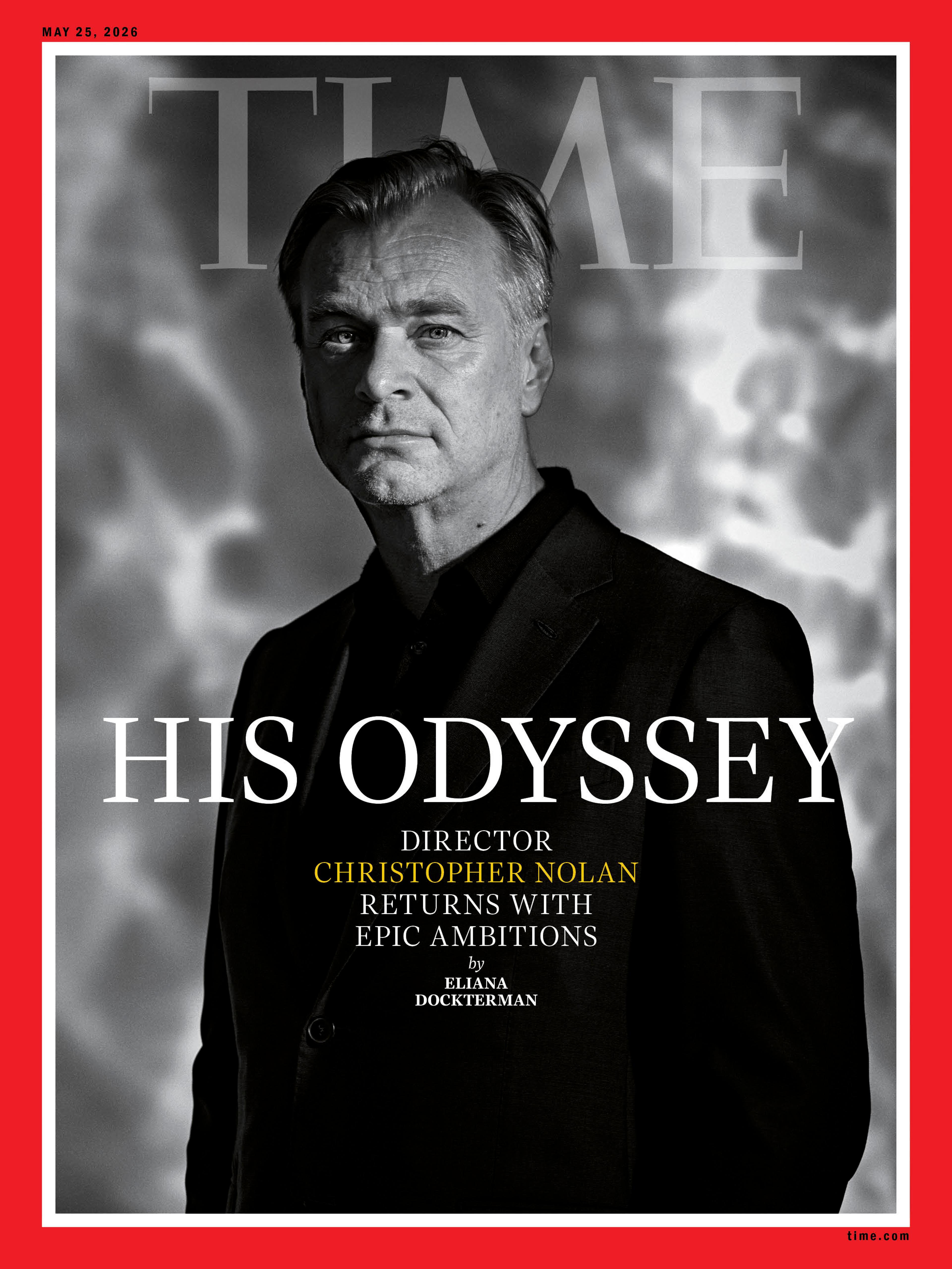
The first posters for The Odyssey don’t feature photos of the film’s many stars, just Nolan’s name in bold letters. “There are a few directors working right now who demand the audience’s attention in terms of going to see their films in the cinema,” says NBCUniversal chair Donna Langley, who greenlighted the movie. “Chris has spent his career making films pushing the boundaries of cinema.”
Photograph by Devin Yalkin for TIME
It’s why the ship carrying Odysseus and his crew had to be genuinely seaworthy—not only to withstand the chop of the Mediterranean in early spring, but also to sail from Morocco to Greece to Italy as production moved location. It’s why cinematographer Hoyte van Hoytema rigged hundreds of portable LEDs to mimic the precise color temperature of firelight so Nolan could shoot in any direction during the midnight raid of Troy. It’s why actor Bill Irwin, who voiced and puppeteered the robot in Interstellar, was hired to guide the performance of the mythical cyclops.
For Damon, it was the most rewarding experience of his career. “Movies like this are not getting made anymore. To do this without a green screen, the way that David Lean would have done it, I don’t know anybody, with the exception of Chris, that’s even trying to do that,” he says. “There aren’t a lot of people in their mid-50s as protagonists in these epics. I looked at this like the last movie I’d ever do.” It won’t be. But you can forgive the dramatics. It’s difficult to imagine him—or any movie star—making an old-school film of this magnitude ever again.
Nolan, by reputation, is a solemn figure—a no-nonsense puzzle-box auteur in a crisp waistcoat, a flask of tea tucked into his jacket pocket. Maybe it’s his movies, with their intricate, sometimes confounding plots. Maybe it’s because he operates with intimidating efficiency on set. Maybe it’s that he’s notoriously private. (I’ve been asked not to describe Syncopy’s offices. What I can say is the Nolan family dog nuzzles visitors if they are suspected of carrying food.) Yet over nearly two hours and three steaming mugs of tea, the spoiler-averse director is unexpectedly forthcoming. When I edge into territory I fear might trigger prickliness, he shrugs, says, “Fair enough,” and delves earnestly into production decisions that have launched a thousand Reddit posts. Every time my cup runs low, he ferries a refill from the tea cart. When I spill, he reassures me as he blots up.
Comparing Emily Wilson, E.V. Rieu, and Robert Fagles translations of The Odyssey, I feel less like I’m interviewing a director than sitting in office hours with a particularly approachable professor. He has studied the period, and the film is aware of its historical moment: the Trojan War marks the end of the Bronze Age, and Greece is about to plunge into a dark age of fallen kingdoms and lost literacy.
He has also studied the text and made several striking adaptation choices. Argos, Odysseus’ loyal dog, has been promoted from a cameo to a bit player. Odysseus and his son Telemachus (Tom Holland)—burdened by the legend of a father he doesn’t remember—are given more time together. Circe, an archetype in Homer’s version, gets a humanizing update thanks to Samantha Morton’s unsettling yet sympathetic performance. And the reunion between Odysseus’ fellow king Menelaus (Jon Bernthal) and his wife Helen (Lupita Nyong’o)—the most beautiful woman in the world, blamed for starting the war after a Trojan prince spirited her away—has always felt too neatly resolved in the poem. Nolan complicates it. And in a twist, Nyong’o also plays Helen’s sister, Clytemnestra, whose marriage to Menelaus’ brother Agamemnon (Benny Safdie) is, to put it mildly, acrimonious.
Nolan’s attentiveness to his characters extends beyond the page. He famously forgoes a director’s chair, preferring to stay close to his actors. “When you’re uncomfortable—and you are most of the time, physically, just by nature of what’s required to get these shots—if you turn and look over your shoulder, he’s no more than five feet away and doing the same thing without complaint,” says Damon. “There’s something really nice about being a soldier in the foxhole and looking over and the general is right next to you.”
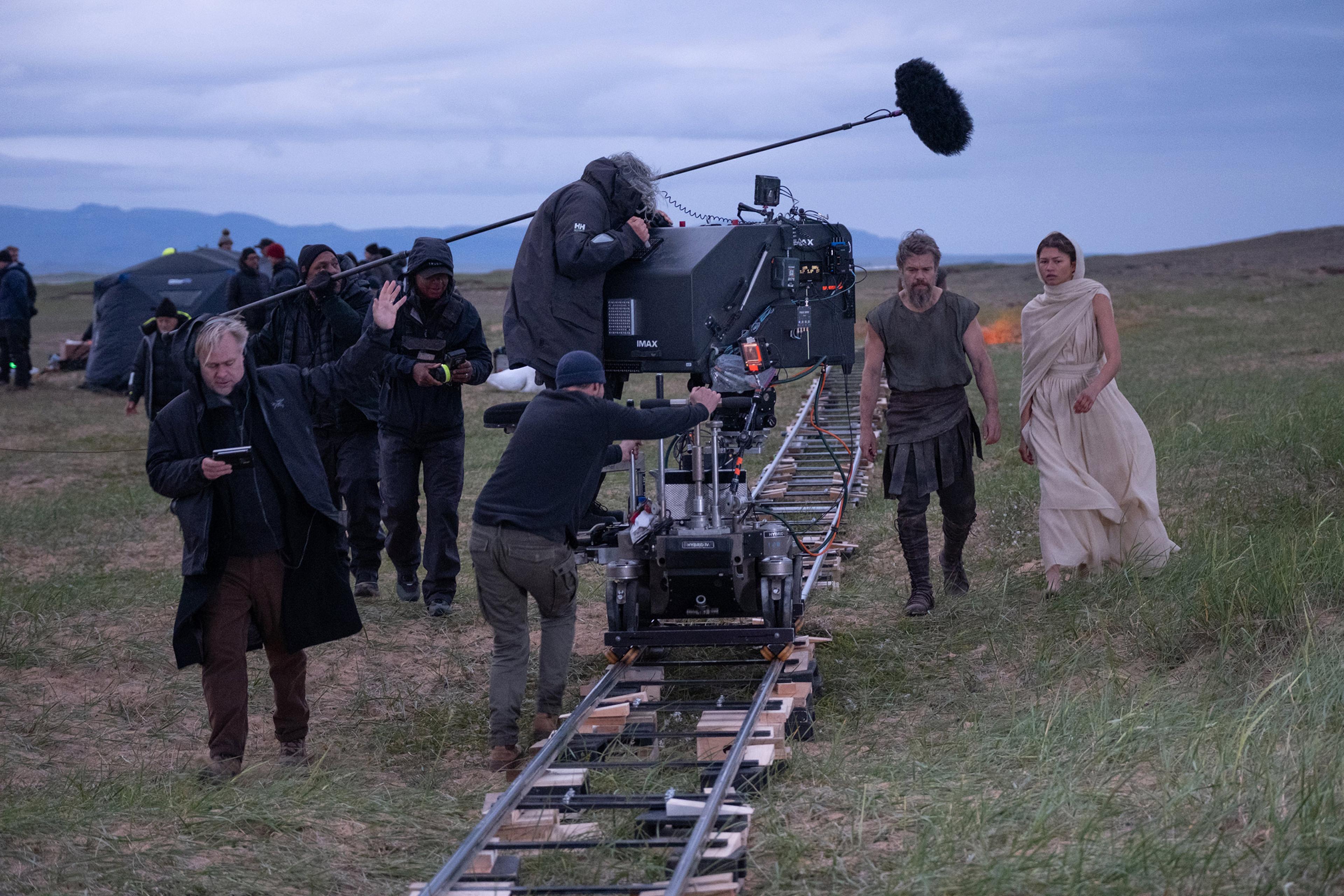
Damon endured the shoot’s most punishing conditions: blasted with hoses, hiking to the Castle of Santa Caterina daily in Sicily, soaked by rain while filming the Hades scenes during Iceland’s white nights. “The joke was, at each location you’d think, well, the next location is going to be easier because normally on every movie there’s a moment where it lets up. It just didn’t. It was relentless,” he says. He was relieved to reach a beach in Morocco for his final scenes—the sandy paradise where Odysseus encounters the nymph Calypso (Charlize Theron). “It turned out to be, like, the kitesurfing capital of the world,” he says. “It was so windy. The sand was just ripping into our eyes. And there was absolutely nothing we could do to block the sand.”
Nolan could have faked it on a soundstage. “I’ve developed a reputation for not liking visual effects. But, you know, my films have won three Oscars for visual effects,” he says, with a laugh. “I know a lot about it, and I’m really fascinated by it. But I like to make films with a very grounded tone.” That instinct took root early. Nolan was born in 1970 to an English advertising executive father and an American mother who was a flight attendant and English teacher. He split his early years between British boarding school and Evanston, Ill., and fell in love with IMAX watching documentaries in the Chicago Museum of Science and Industry’s five-story wrap-around movie theater. His younger brother Jonathan became a collaborator on scripts like Memento, The Prestige, and The Dark Knight.
Nolan met Emma Thomas on his first day at University College London. They ran the film society together and, after graduating, made his first feature, Following, out of pocket on a minuscule budget. Nolan demonstrated an early knack for problem-solving: he shot near windows because he couldn’t afford lighting; he gave his killer a hammer because he didn’t think prop guns looked realistic. His ambition only grew. “When we went on our honeymoon, he was talking about shooting on IMAX,” says Thomas in a rare interview. “And over time, he’s gone from shooting one shot in The Prestige on IMAX just to try it out to sequences in The Dark Knight and expanding and expanding.”
The Dark Knight redefined what a superhero film could be, eschewing camp for a gritty crime drama whose cool color palette, brooding hero, and anarchic villain cast a shadow over the genre for decades. Nolan attributes much of his success to his frequent collaborators. The most visible are actors like Damon and Anne Hathaway, who plays Odysseus’ crafty wife Penelope in this film. But behind the scenes much of his core team has been there since the early days. Thomas, who shares four children with Nolan, has produced each of his films. “Emma, who is a wonderful friend who’s constantly throwing baby showers for people where she bakes all of the goods herself, and is the most phenomenally committed parent—every idea that Chris has, she’s the person who makes sure that it can be made a reality,” says Hathaway. Thomas admits she “frets a little bit” when she reads harrowing scenes at sea but assures me, “When he asks for the world and we can’t deliver the world, he always has a backup plan.”
The director has also worked with van Hoytema on five of his 13 films. “Every production we look at each other and we say, ‘Wouldn’t it be wonderful if we do this entirely on IMAX?’” van Hoytema says. “On the last film, I think we cracked the code.” They did that by working with IMAX to solve three problems. The camera is deafening—Damon has likened it to trying to act with a blender next to your face—so they invented a casing around the camera called the blimp to muffle the noise during intimate, dialogue-heavy scenes. The camera’s short magazines require frequent reloading, so they developed a protocol in which the entire set remained silent so the actors could, in van Hoytema’s words, “stay in the zone.” And the camera had grown so large that actors couldn’t see around it. “Which is, of course, terrible for an actor that you cannot play against the person you’re supposed to see,” says van Hoytema. Their solution: a set of mirrors that allowed the actors to make eye contact.
A helicopter was required to hoist that 400-lb. camera and blimp up craggy mountainsides. “This was a very ambitious production,” says Langley. “They were up against the weather and the elements.” And catastrophe nearly struck when Scottish customs agents opened IMAX film cans, potentially exposing the unused film. (Luckily, it was safe.) “In large part, it all did go right,” says Langley. “Chris is a very responsible filmmaker ... He minimizes risk and prepares appropriately and hires a team that can execute at the highest level.”
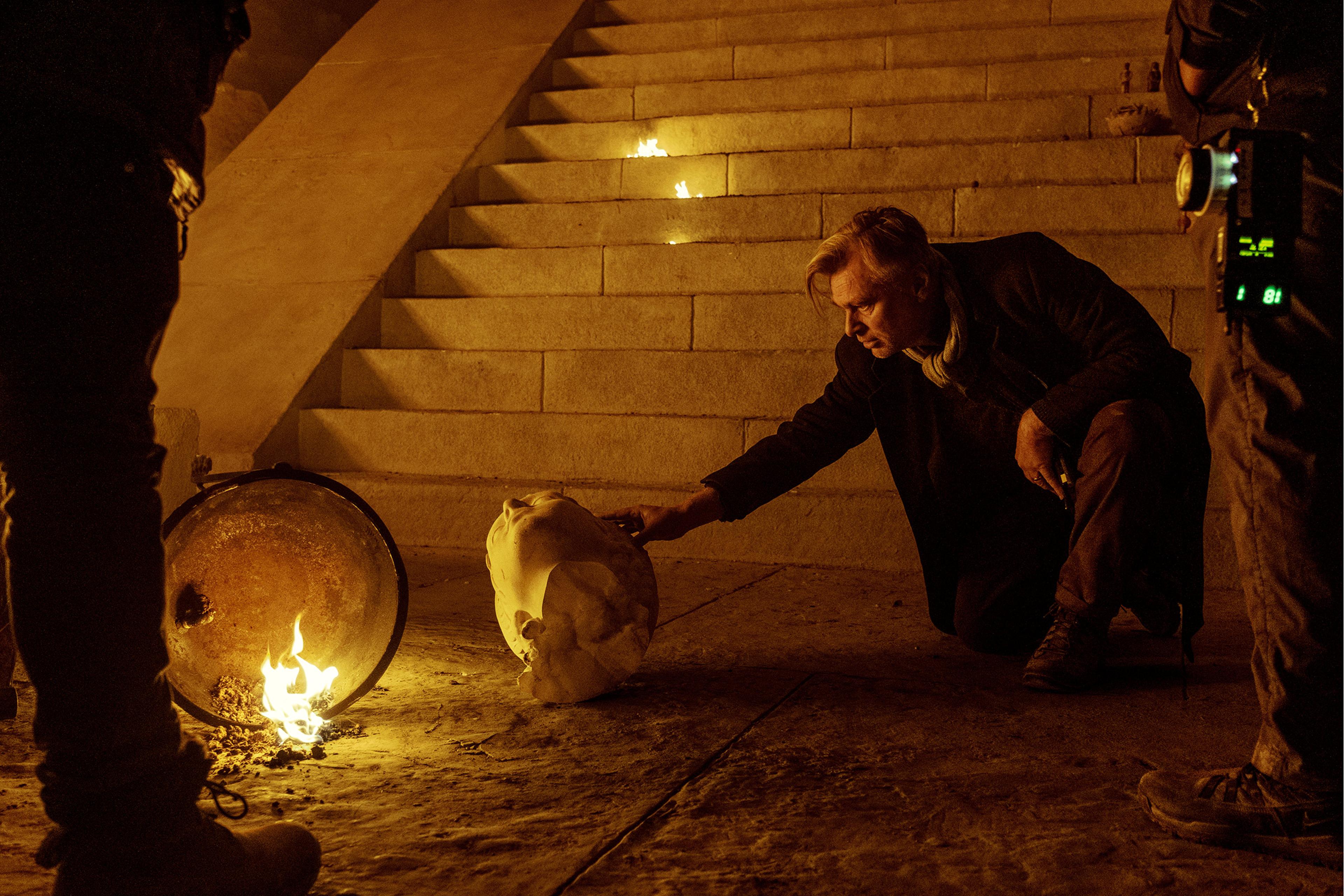
The punishing conditions were the point. Nolan considered casting actors to play gods throwing thunderbolts from Mount Olympus but settled on something more primal. “I became more interested in the idea that to people in that period, evidence of gods was everywhere,” he says. In Bronze Age Greece, thunder, rain, and the sun rising didn’t have scientific explanations—they represented the will of the immortals. “The wonderful thing about cinema, and IMAX in particular, is that you can take an audience to a place of immersion, feeling close to events like storms, turbulent seas, high winds. You want the audience to be on the boat with them fearing the ocean, fearing the wrath of Poseidon, the way the characters do. That to me is so much more powerful than any individual image you can have [of a god].”
Despite his reputation as a visionary, Nolan still takes notes from the studio. “I think the day we don’t take notes anymore is the day we make a crappy movie,” says Thomas. “There is the creative benefit of having people question you and to really make you justify what it is you’re doing. We also want the studio to be invested in our movie. They have to sell it.” Nolan has never run over schedule or budget, including on this film, which he shot in just 91 days, nine days ahead of schedule. “He’s kind of a machine when it comes to shooting,” says Thomas. “It’s very funny: when he’s writing, we’ll go for a hike, and he’ll say, ‘Stop going so fast.’ The minute we start shooting, his heartbeat speeds up. He’s suddenly a different person completely. He just moves fast.”
Hathaway insists Nolan’s economy never comes at the expense of a performance. It does come at the expense of ego. “They save the money for the screen,” she says. “You’ve got Tom Holland, Robert Pattinson, a slew of other very fine actors, me, and we’re all staying in budget accommodation on a small island in Sicily because there’s no indulgent nonsense. It’s just about the work, and we’re all so happy to be there.”
In the corner of three-time Academy Award–winning composer Ludwig Göransson’s studio sits a lyre nearly the size of a grown man, one room over from a ping-pong table that, at the push of a button, disappears into the floor. For Göransson and Nolan, the ancient and the modern are not so far apart.
Nolan instructed Göransson not to use an orchestra in the score, if only to subvert expectations for a swords-and-sandals film. “It’s not like the orchestra existed back then,” says Göransson. “It was a challenge and also an opening to try to make something unique.” Instead, Göransson rented 35 bronze gongs of varying sizes, experimented, recorded them with synths, and began sending the director songs. Nolan also put rapper Travis Scott in the film as a bard. “I cast him because I wanted to nod towards the idea that this story has been handed down as oral poetry, which is analogous to rap,” says Nolan. Even the string instrument plays a surprising role. “Chris had this idea of the sound of the lyre being the pluck of Odysseus’ bow,” says Göransson.
Nolan speaks with pride about the level of research that went into the production from all departments, especially considering our Bronze Age knowledge is based on “very fragmentary archeological records.” When the trailer dropped, classics buffs complained about Agamemnon’s armor—dark, shiny, and reminiscent of Nolan’s Batsuit. But what struck some as fantastical Nolan defends as feasible. “There are Mycenaean daggers that are blackened bronze. The theory is they probably could have blackened bronze in those days. You take bronze, you add more gold and silver to it and then use sulfur,” says Nolan. “With Agamemnon, Ellen [Mirojnick], our costume designer, is trying to communicate how elevated he is relative to everyone else. You do that through materials that would be very expensive.”
Nolan offers equally thorough explanations for every production choice, from the boats to the weapons, all of which draw on both the Bronze Age and Homer’s era, hundreds of years later. “The oldest depictions of Homeric characters tend to be depicted in the manner of people living in Homer’s time,” he says. “So there’s a pretty strong case there for portraying things that way because that’s the way the first audience received the story.”
He’s obsessive about veracity. In 2014, he told this magazine what it took to get Interstellar’s physics right. He brought a similar ethos to The Odyssey. “For Interstellar, you’re looking at, ‘What is the best speculation of the future?’ When you’re looking at the ancient past, it’s actually the same thing. ‘What is the best speculation and how can I use that to create a world?’” He knows the approach won’t satisfy every classicist. “Hopefully they’ll enjoy the film, even if they don’t agree with everything,” he says. “We had a lot of scientists complain about Interstellar. But you just don’t want people to think that you took it on frivolously.”
Whatever experts may have thought of Interstellar, Damon has never cried harder reading a screenplay. “Chris and I are the same age and we have kids roughly around the same age,” he says. “When I read it, I was away from my children making a movie. It’s about a father who misses the entire childhood of his kids. I called him after, and I said, ‘What is it with you and this [idea]?’” Nolan, he says, “kind of chuckled.”
In the film Damon portrays a celebrated astronaut who, stranded and desperate, nearly sacrifices humanity to save himself. “He doesn’t play a liar or a cheat,” says Nolan. “He plays someone who really believes in what they’re doing. Matt can just take the audience into that point of view and go on the journey with that character and make mistakes with that character and not judge that character.”
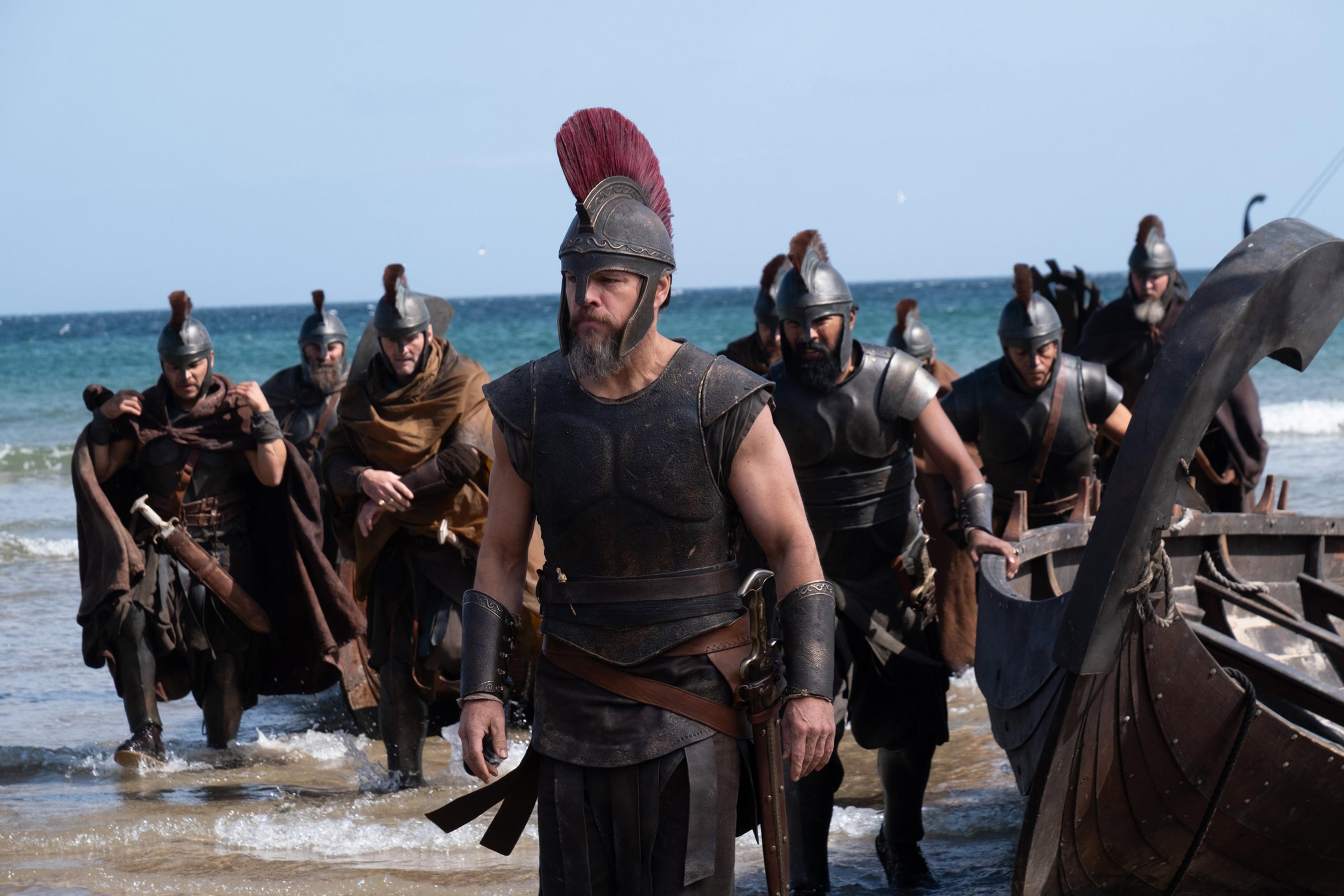
That, Nolan thought, was perfect for Odysseus. The Homeric hero most of us remember from high school is the crafty guy behind the Trojan Horse. But he’s also arrogant and duplicitous. A line in Emily Wilson’s translation sums him up: “Lying Odysseus replied, ‘I will tell you the truth completely.’” For Nolan, one of the hardest things about adapting The Odyssey is that in The Iliad, Odysseus has a relatively minor role. “A lot of the characteristics of Odysseus that can be really admirable in a supporting character, like being a bit clever, being a bit slick, when your hero is like that, it doesn’t always work,” he says. “There’s a reason that in Star Wars, you’ve got Han Solo, but you’ve also got Luke Skywalker, a heroic figure that’s a little more pure and transparent. So the challenge was to be true to the complexity of Odysseus but make him relatable for the audience.”
What compels Odysseus—and compels audiences to root for him—is his love for his wife. Penelope waits 20 years for a husband everybody else thinks is dead. She manages to repeatedly outwit the 108 suitors plotting to court her, murder her son, and usurp Odysseus’ throne. Hathaway was pleasantly surprised when she read Nolan’s script and saw that the queen doesn’t just sit around and weep.
“There’s this impression of Penelope that she’s kind of the picture of modesty. She’s the picture of patience,” says Hathaway. “And I said, ‘Chris, if I’m not mistaken, you’ve written someone who is full of fury and you seem to be implying that she’s actually Odysseus’ equal.’” This Penelope matches her husband not just in intellect but in passion. “I found her to be this volcano of a human that was always simmering. It was really fun when she finally exploded.”
Hathaway and Damon committed to the notion that The Odyssey is a love story. “Matt’s married to the love of his life, and I’m married to the love of my life, and I think we both look at our relationships with a certain degree of wonder and gratitude because for most people, they don’t find that kind of happiness in a marriage, let alone two actors,” says Hathaway. “So we came to the Odysseus-Penelope relationship with the understanding that yeah, sometimes you meet your soulmate.”
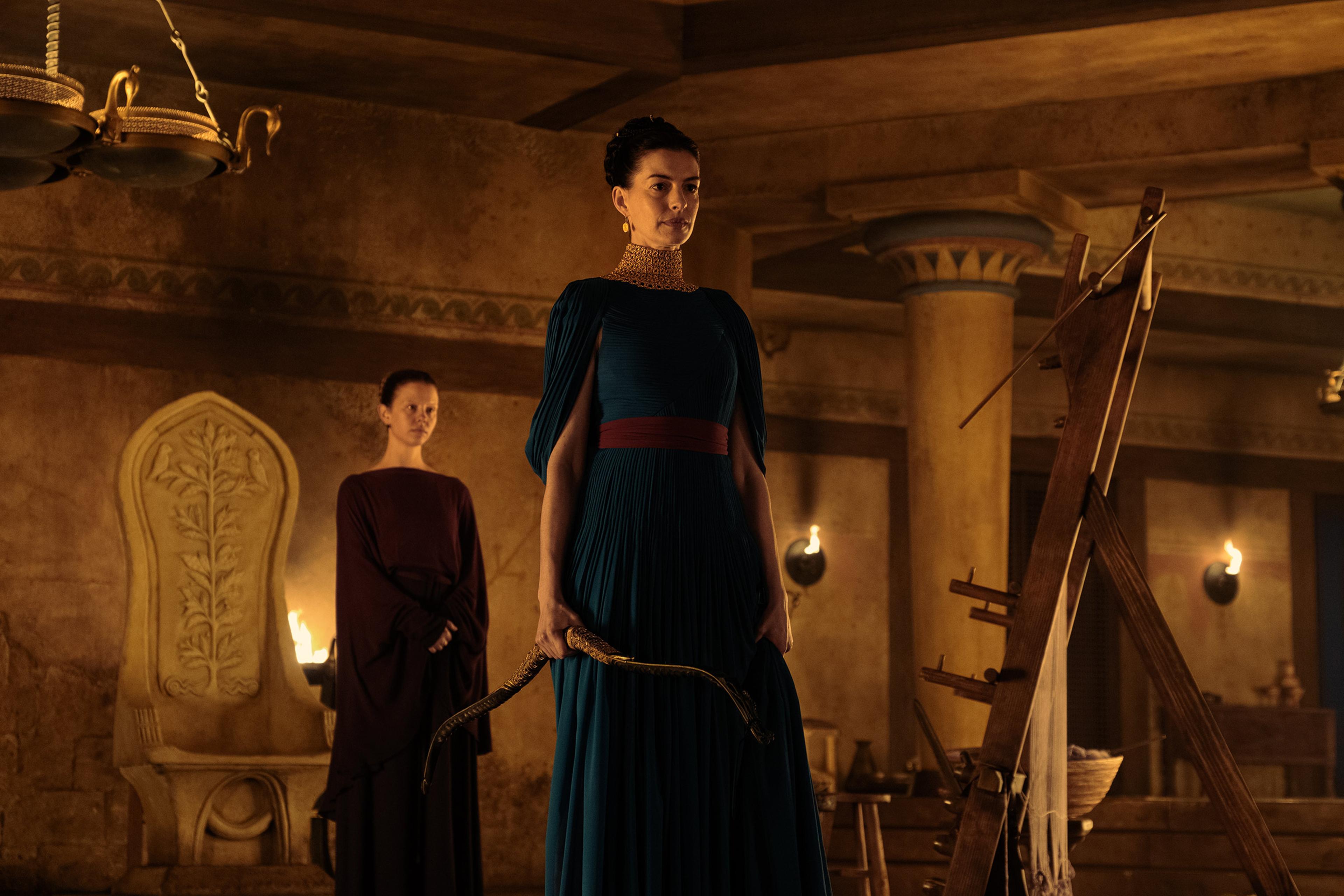
Damon knew a handful of scenes that he and Hathaway shot in Los Angeles would be crucial to the audience’s investment in their relationship. “When we wrapped in L.A., Chris said to me, ‘It’s ours to lose now,’” says Damon. “We still had to go shoot in Iceland and Scotland and the Calypso stuff on a desert beach. But we knew we had the emotional center.”
Nolan doesn’t love promoting his movies; he compares discussing the plot in advance to sneaking a peek at a Christmas present. In his ideal world, “directors would be anonymous” so the work could speak for itself. And yet once he starts talking about The Odyssey, he can’t seem to stop, happily chatting long over our allotted time.
The Odyssey is arguably the biggest film of Nolan’s career—though, despite what has previously been reported, Thomas says, “It’s not our most expensive movie, but the film is enormous.” It may also be the summer blockbuster the struggling entertainment industry needs right now. “It is a global story that has existed for thousands of years,” says Langley. “That, coupled with Christopher Nolan’s name and what that means for cinema, which we know means a lot, and an all-star cast, it makes for a very worthy and solid commercial bet.”
But the film also feels like a culmination. Nolan is aware that he makes a lot of movies about brilliant men trying to get home to their families. When I ask whether he worries about fan response to repeating certain tropes, he pauses and sighs. Despite the fact that he doesn’t carry a smartphone, the internet has found him. “You have to be comfortable with repeating yourself, if it’s right for the project,” he says. “If you’re paying too much attention to what people are pointing out in your work, you’d be paralyzed.”
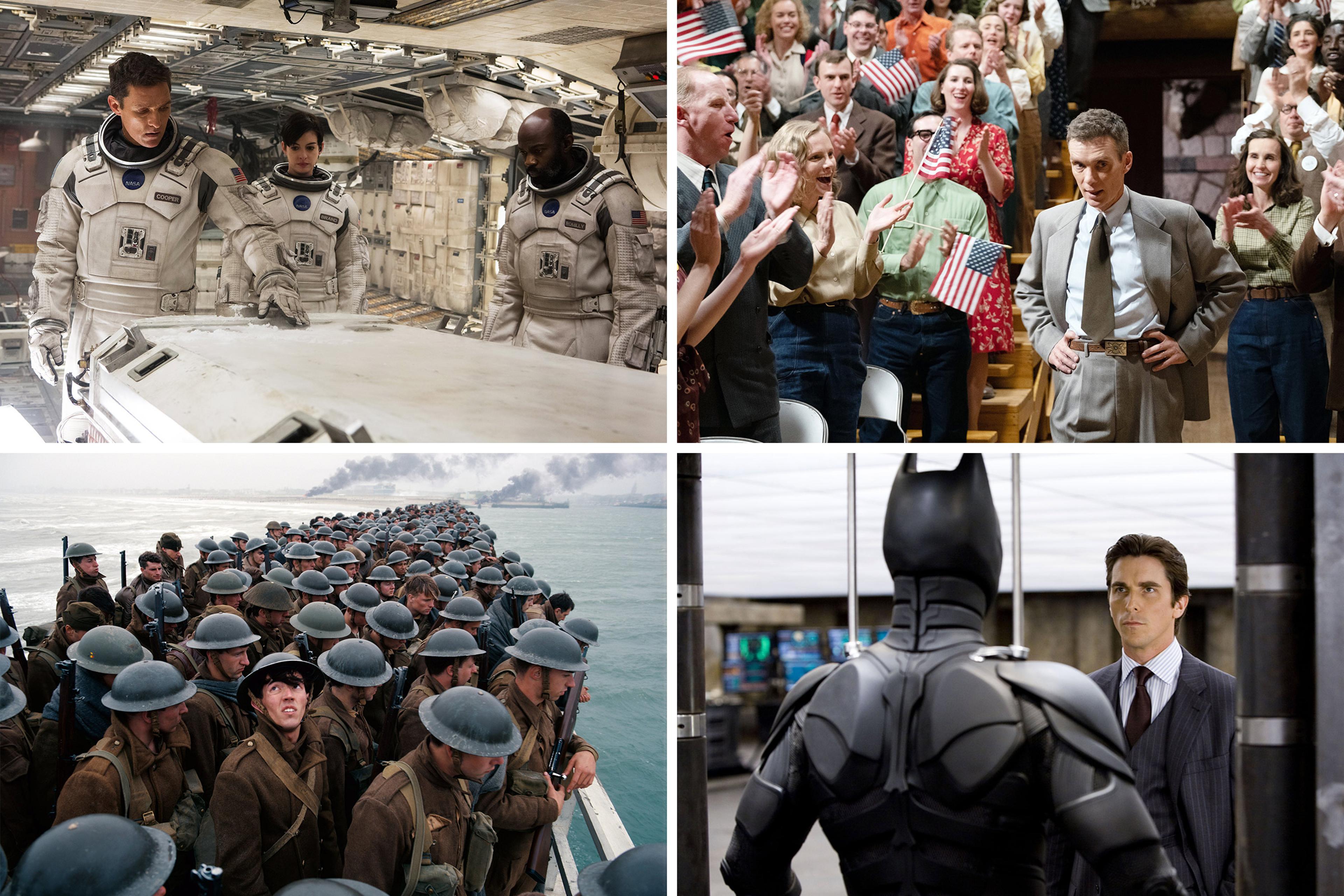
Once you know that Nolan’s been dreaming about a Homeric epic for decades, it’s hard not to notice that Odysseus’ journey has haunted all of the movies he’s written and directed: Men recruited to make personal sacrifices for a greater cause (Batman Begins, Interstellar, Dunkirk, Tenet, Oppenheimer); men yearning to return to their children (The Prestige, Inception, Interstellar); narrative structures that fracture and loop through time (all his movies). Even certain scenes look, in retrospect, like rehearsals: Bruce Wayne, presumed dead, slips back into Gotham in Batman Begins just as Odysseus sneaks into Ithaca; silent soldiers crammed into a deserted boat in Dunkirk as German bullets pierce the hull an echo of the Greeks holding their breath inside the Trojan Horse as a spear is thrust into the wood. Homer describes Odysseus as a man of twists and turns. Nolan’s films are nothing if not that.
In the lead-up to the film’s release, Nolan has been making the same regular stroll: past the Margaritaville and Bubba Gump Shrimp on Universal CityWalk into the IMAX theater where he screens his film on the scale he always dreamed of. “I think when I signed up to do Troy way back when, I was in a little over my head,” Nolan says. “The Odyssey is a sweeping story ... I think I needed to build on what I learned doing large-scale films to be able to make this film.” Like our hero, Nolan took 20 years to find his way back.
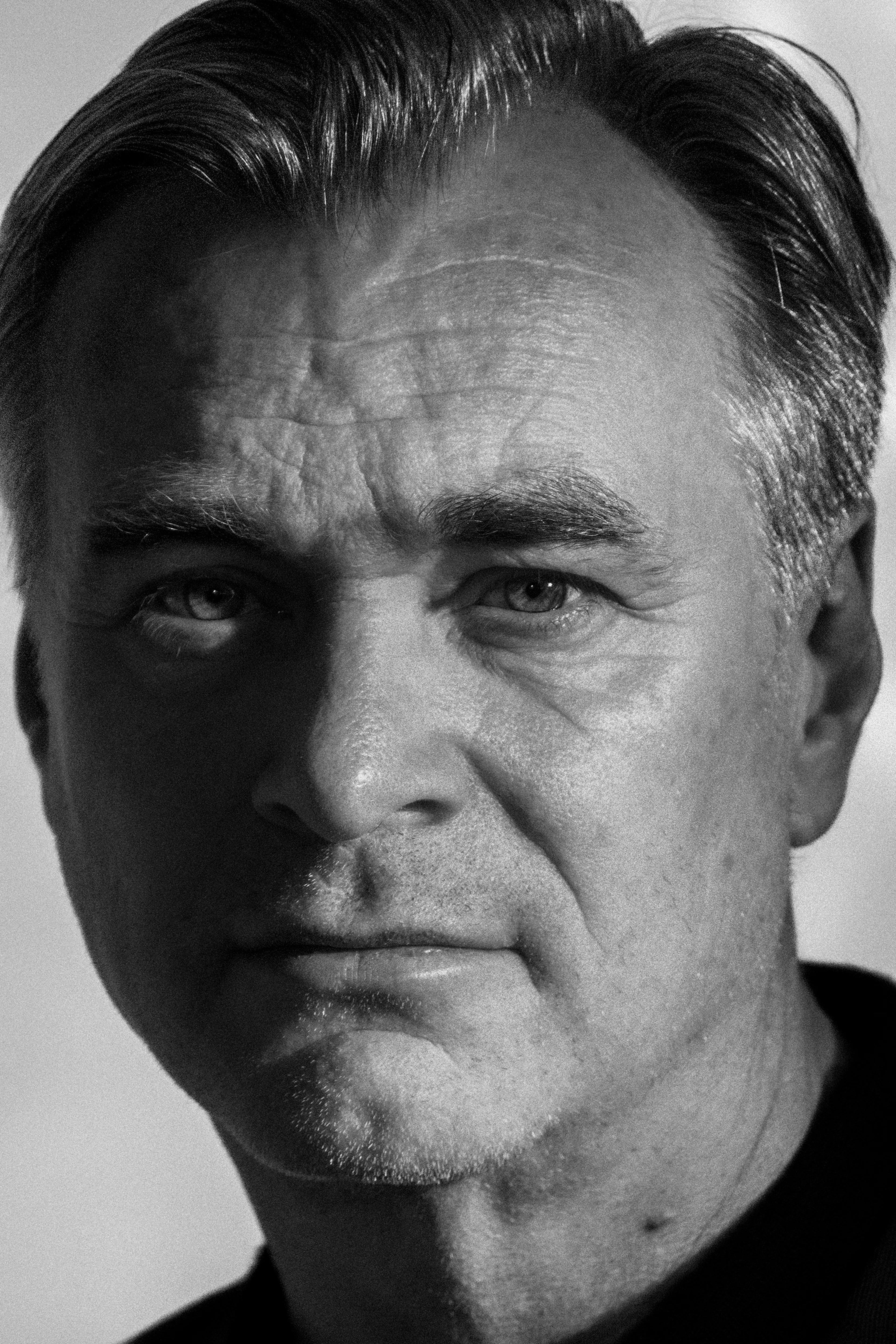
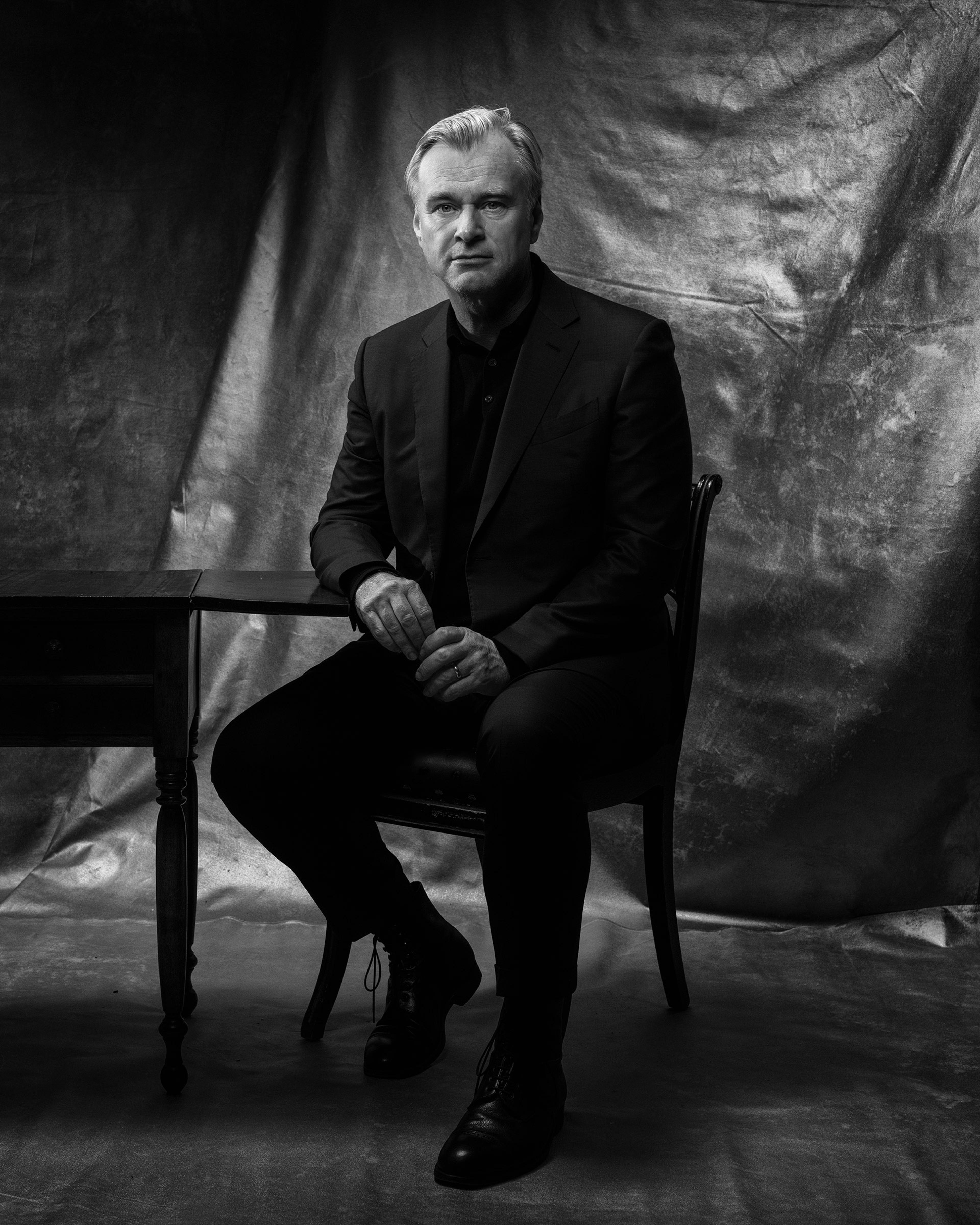
Nolan in Los Angeles on April 17, 2026. Devin Yalkin for TIME
Set Design by Ali Gallagher, Art Department by Zoran Radanovich