






“Leaving the European Union was a catastrophic mistake,” he insisted over the weekend. “It's left us less wealthy, less powerful, and less in control than at any point before the industrial revolution.”
Condemning the Brexit referendum of 2016, he continued: “We can no longer afford to be silent about it. We must remake the argument… We need a new special relationship with the E.U., because Britain’s future lies with Europe and one day back in the European Union.”
Streeting urged Britain to band together amid growing geopolitical instability, pointing to “Russian aggression” and what he described as "the retreat of America first."
The former Health Secretary made the bold remarks at the Labour Party’s progress conference, during which he also expressed his intent to run in any leadership challenge against Starmer, who has been urged to resign or set a timeline for his departure by dozens of lawmakers.
Despite being a lead contender to replace the Prime Minister, Streeting has said it isn’t “in the party's interest [or the] national interest” to have a leadership contest before Andy Burnham, the Mayor of Manchester, has had the chance to return to Westminster and throw his own hat in the ring.
Burnham, often referred to as the “King of the North,” has previously expressed support for Britain rejoining the E.U., but he distanced himself from Streeting’s rhetoric on Monday.
Speaking at the Great North Summit, Burnham said that Brexit, in his view, has been “damaging,” but insisted “the last thing we should do right now is re-run those arguments.”
"I am not proposing that the U.K. considers rejoining the E.U. I respect the decision that was made at the referendum," he said. “It's going to undermine everything I've said about strengthening democracy if we don't respect that vote.
Burnham is seeking a seat in a by-election in Makerfield—where nearly 65% voted to leave the E.U. in 2016.
Despite Burnham’s efforts to redirect the focus away from Brexit, Streeting’s strong stance has spurred much debate.
Culture Secretary Lisa Nandy referred to his Brexit argument as "odd."
Reflecting on Labour's heavy losses in the local elections on May 7, Nandy said: “If rejoining the E.U. is the answer, essentially what we're saying to people is: 'Life was fine in 2015. We just need to go back there.' The answer has to be bigger.”
Labour lawmaker Dan Carden issued a similarly critical response, insisting: “Working class communities don’t want to be told they got Brexit wrong. They were sending a message, and Labour still hasn’t properly heard it.”
The divide has been noted by Kemi Badenoch, the leader of the Conservative Party, who argued the discourse is a sign the Labour Party “does not have a plan for the country” as they want to “go back and re-fight wars which were settled a long time ago.”
When asked to comment on the discourse, Stamer—who has doubled down on resisting calls to resign—did not reject the possibility of the U.K. one day rejoining the bloc, but refused to get drawn into something that may happen “years down the line.”
Instead, Starmer said he remains “grounded” in his job, making sure the U.K. is “closer to the E.U.” as “it’s in our [best] national interest.”
With the Brexit debate once again dividing Labour and prompting cross-party discussion amid the lingering Westminster crisis, here’s what to know about the U.K.’s journey out of the E.U.—and how it could potentially find its way back.
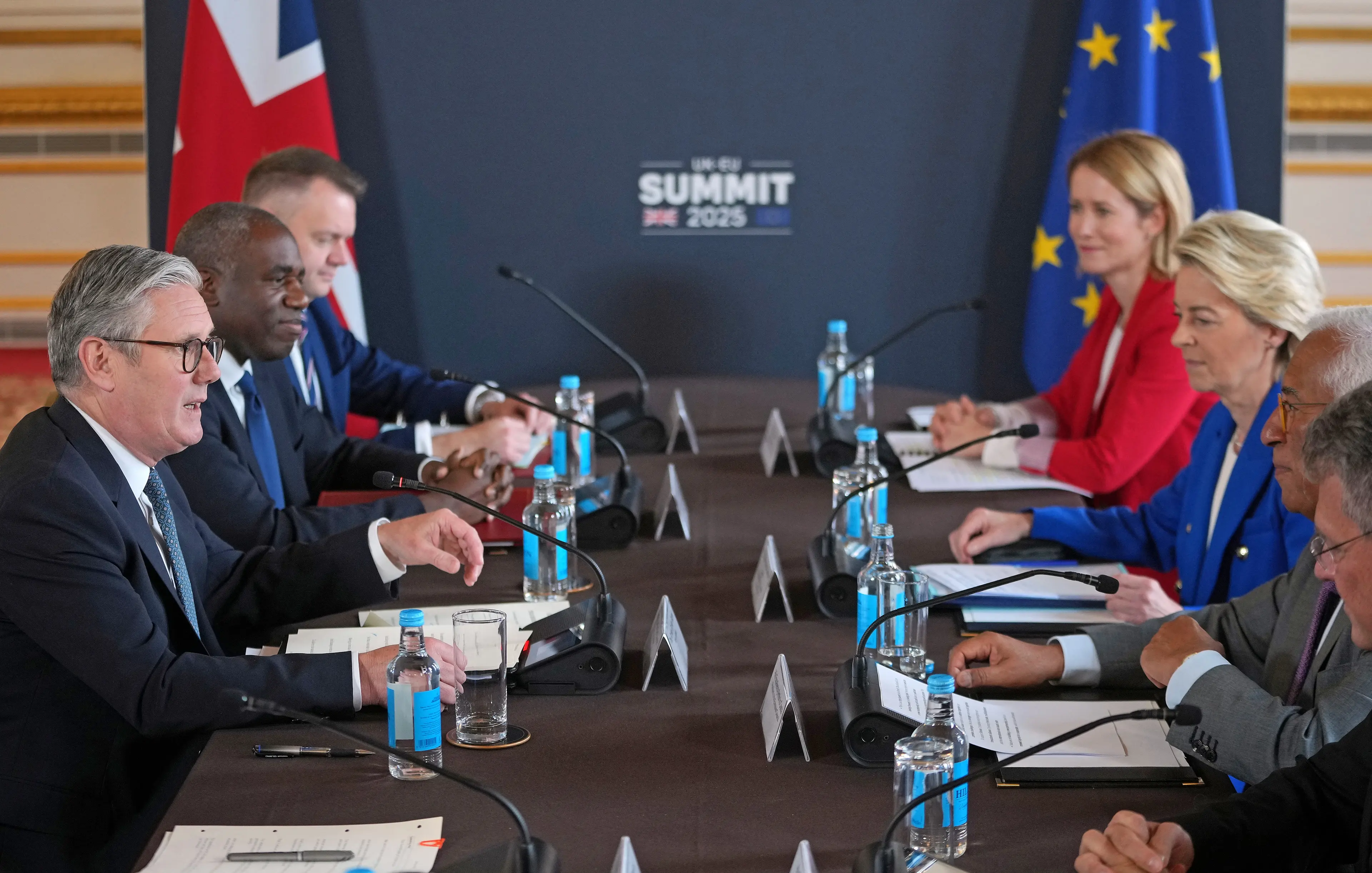
Britain's Prime Minister Keir Starmer and European Commission president Ursula von der Leyen lead the U.K.-E.U. Summit at Lancaster House in London on May 19, 2025. Kin Cheung—Getty Images
When did the U.K. leave the E.U.?
In a referendum held on June 23, 2016, a slim majority of British voters backed leaving the European Union, with 51.9% voting Leave and 48.1% voting Remain.
The European Council formally triggered the process for Britain’s withdrawal from the E.U.,commonly referred to as “Brexit,” in March 2017.
It was “an incredibly traumatic process both for the U.K. and the E.U.,” Mujtaba Rahman, managing director for Europe at the Eurasia Group, tells TIME. “The Europeans lost access to one of the world's most important financial centers, a diplomatic heavy hitter and nuclear power. The U.K. lost access to one of the world's most important markets.”
The withdrawal process proved politically difficult, ultimately leading to Conservative Prime Minister Theresa May announcing her resignation in May 2019 after repeated failed attempts to pass a Brexit agreement that satisfied her own party.
Rahman says one of the central problems was that the original referendum campaign never clearly defined what Brexit would actually look like in-practice.
“The divorce was acrimonious because the Brexit referendum didn't make at all clear what the terms of the decoupling would be, and that needed to be negotiated and that was a very difficult process,” he says.
Former Prime Minister Boris Johnson later won a parliamentary majority promising to “get Brexit done.”
The European Union Withdrawal Agreement Act 2020 entered into force in the first few weeks of 2020, with the U.K. formally leaving the E.U. before exiting the single market and customs union at the end of that year.
Catherine Barnard, a professor of European Law at Cambridge University, describes the agreement as sitting at “the most brutal end of Brexit,” despite preserving tariff-free trade on all goods that comply with the appropriate rules of origin.
“It generated a very large amount of paperwork, and so what you've seen is that only large exporters have continued to export from the U.K. to the E.U.,” she says, adding that many smaller exporters stopped because they can't justify the costs of filling out the paperwork.”
How is the current relationship between the U.K. and E.U.?
Communications between Britain and the E.U. have improved under Starmer, experts say, after Labour pledged to “reset” relations with Brussels upon winning the general election in 2024.
“The goal of Starmer was to improve diplomacy and the political relationship between the two sides,” Rahman says. “Then slowly begin to also reduce some of the economic barriers and the trade barriers that have come into place since the U.K. left.”
At the May 19, 2025 E.U.-U.K. summit, London and Brussels adopted a joint statement, where they agreed on a shared “Security and Defence Partnership.”
Barnard says one of the key sticking points remains financial contributions and how much it would cost the U.K. to “sign up to any of these agreements.”
In the initial aftermath of Labour’s losses in the May 7 local elections, Starmer reaffirmed his desire to place Britain “at the heart of Europe” following Labour’s losses in the local elections.
Barnard argues that position remains constrained by Labour’s current policy red lines.
“We can't be at the heart of Europe, so long as the Labour Party has got its red lines of not joining the customs union or not rejoining the single market,” she says.
Discourse continues over the financial implications of Brexit.
The U.K. in a Changing Europe think tank estimates that as of 2025, Brexit had cost the British economy anywhere around from 6% to 8% of its GDP growth.
The Office for Budget Responsibility, an executive non-departmental public body sponsored by the Treasury, projected in July 2025 that in regards to trade, both exports and imports will be around 15% lower in the long-run than if the U.K. had remained in the E.U.
How would the U.K. potentially rejoin the E.U.?
While Britain could rejoin the E.U., the process would be politically and legally complex.
Barnard explains that any future application would proceed under the standard Article 49 of the Treaty on European Union, which governs how any external state applies for membership.
She notes that Britain would begin from a comparatively strong position because it already has many institutional structures required by the E.U., including an independent judiciary.
However, the process would still require unanimous approval from all member states, which “may be harder to come by,” she adds, noting that France, for example, could potentially end up having a nationwide referendum of its own before approving the readmission of the U.K.
The British public—who voted for the U.K. to leave the E.U.—would also likely need to be given a say.
“It could be a central part of the next Labour manifesto,” says Rahman. “That would mean, in turn, that it's a de-facto referendum, and if Labour were to win a majority, it will be seen as a mandate for the government to then do what the manifesto says.”
How has the bloc responded to the current discussion?
The office of Kaja Kallas, the E.U. high representative for foreign affairs and security policy, declined to comment when contacted by TIME.
The European Commission’s chief spokesperson Paula Pinho, when asked about the prospect of the U.K. rejoining the bloc at a press briefing on Monday, said she would “not take any conclusions at this stage” and pointed to the upcoming U.K.-E.U. summit where discussions such as this can take place.
German lawmaker Knut Abraham has reportedly expressed support for the potential reunion. “Europe would certainly welcome Britain back. Such a step [an application to rejoin the E.U.] would be a win-win situation, especially at a time when the threats from outside are growing,” he’s quoted as saying.
Spanish Prime Minister Pedro Sánchez indicated earlier this year that Spain would “absolutely” support Britain rejoining. “We miss the U.K,” he said.
Still, Barnard predicts many European leaders would likely remain prudent given the current turmoil in Westminster.
“I think they [E.U.] would not want to go anywhere near negotiations with the U.K. until they know that there is a clear settled view on U.K. accession,” she says. “They are very mindful of the fact that our politics are back into a complicated place, and there is the possibility of a Reform [UK] government in 2029, which will want to go nowhere near the E.U., so the E.U. will be treating us with great caution.”
According to a YouGov poll published in April 2026, 55% of Britons support rejoining the E.U.
However, that signaled support should not be overstated, experts warn.
“I think there is a widespread recognition that Brexit has been certainly bad for the U.K. economically, but that doesn't necessarily translate into people thinking that they want to rejoin the E.U.,” says Barnard.