


Iran’s new Supreme Leader Mojtaba Khamenei defied U.S. President Donald Trump’s warnings and vowed to keep the Strait of Hormuz closed amid global trade disruption and surging oil prices.
“The leverage of blocking the Strait of Hormuz must continue to be used,” said Khamenei Thursday, in his first public statement since succeeding his father.
His remarks were broadcast via state media, but Khamenei did not appear on camera.
As well as encouraging the disruption of the Strait, a narrow passage between the Persian Gulf and the Gulf of Oman through which around a fifth of global oil production flows, Khamenei called on Gulf states to “shut down” U.S. bases.
“I recommend that they shut down those bases as soon as possible, because by now they must have realized that the United States’ claims of providing security and peace have been nothing more than a lie,” he claimed.
Khamenei also vowed to avenge the deaths of those killed in the Iran war.
“I assure everyone that we will not refrain from avenging the blood of your martyrs,” he said. “A limited portion of this retaliation has already taken tangible form, but until it is fully achieved, this file will remain open above other cases.”
A major aspect of Iran’s "retaliation" thus far has been targeting the global supply of oil and liquified natural gas, with at least six tankers being hit in the Gulf and Strait of Hormuz in the past two days alone.
The U.K. Maritime Trade Operations (UKMTO), which monitors strikes and threats to vessels in the Middle East and Indian Ocean regions, reported three separate strikes on vessels overnight. Two of those were struck by “unknown projectiles” just five nautical miles from the port of Basra in southern Iraq.
German maritime transport company Hapag-Lloyd confirmed to TIME that one of its charter ships, Source Blessing, was hit by projectile shrapnel on Thursday morning. A spokesperson said the fire on the ship was quickly extinguished and the crew have been marked as safe.
On Wednesday morning, the Thai-owned Mayuree Naree container vessel was targeted in strikes 13 miles north of Oman in the Strait of Hormuz, according to the Omani Maritime Security Center. The Omani navy said it rescued 20 workers from the container ship after a fire broke out as a result of the strikes.
Amid the chaos on the waters, the price of crude oil has once again spiked.
On Thursday morning as global markets opened, crude oil reached prices of more than $100 per barrel before dropping slightly down.
This week has seen turbulent prices, with heights reaching $117 on Monday before dropping later in the week and then rising again.
Trump addressed the upheaval Thursday morning and how it impacts the U.S.
“The United States is the largest oil producer in the world, by far, so when oil prices go up, we make a lot of money,” he said. “But of far greater interest and importance to me, as President, is stopping an evil empire, Iran, from having nuclear weapons, and destroying the Middle East and, indeed, the world. I won’t ever let that happen."
U.S. Energy Secretary Chris Wright said that, despite circulating reports, the U.S. is “not ready” to escort tanker vessels through the Strait to ensure safe passage.
“It’ll happen relatively soon but it can’t happen now. We’re simply not ready. All of our military assets right now are focused on destroying Iran’s offensive capabilities and the manufacturing industry that supplies their offensive capabilities,” he told CNBC Thursday.
Wright appeared to have previously claimed, in a now-deleted social media post, that the U.S. had successfully escorted a tanker in the region on Tuesday.
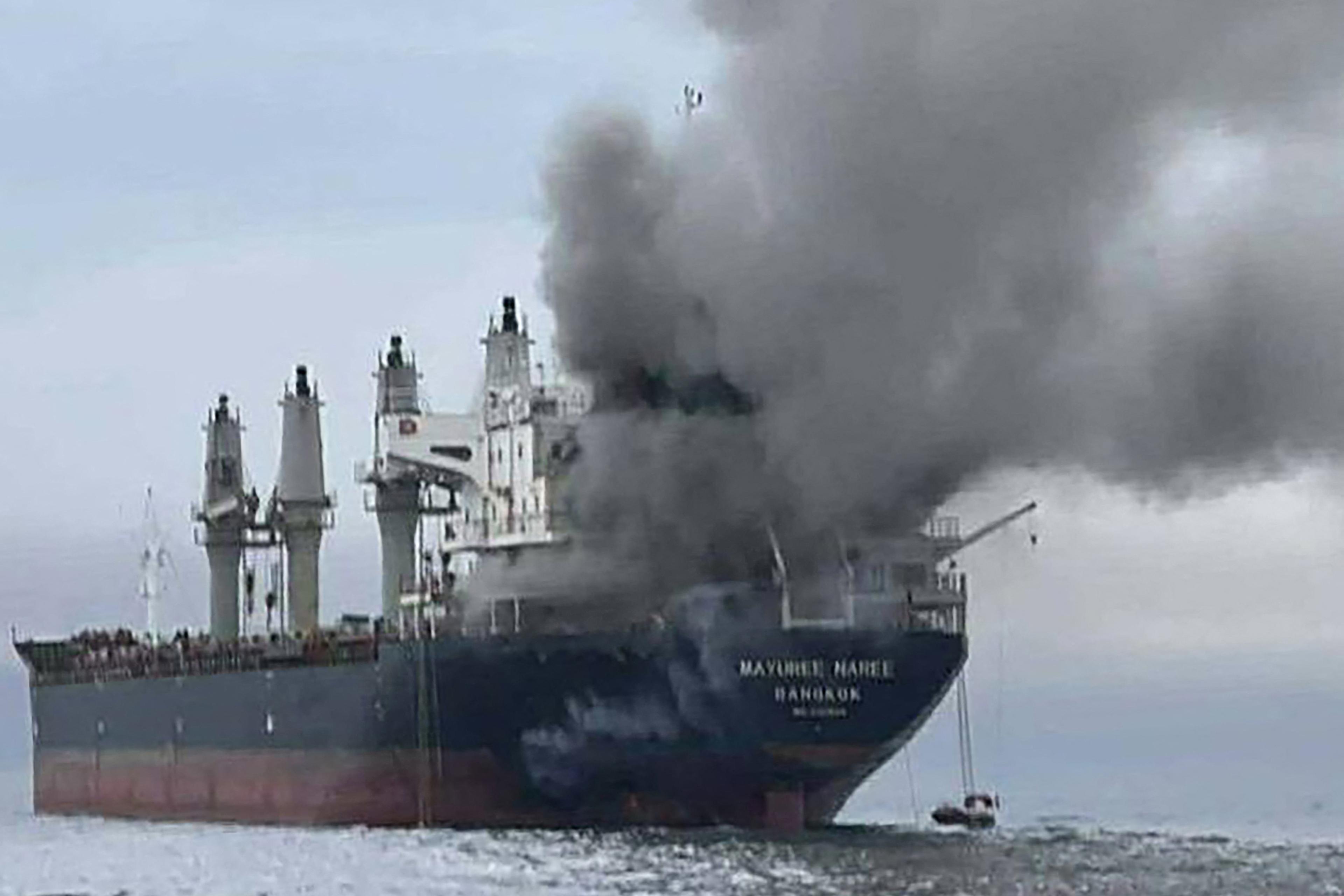
This handout photo taken on March 11, 2026, and released by the Royal Thai Navy shows smoke rising from the Thai bulk carrier 'Mayuree Naree' near the Strait of Hormuz after an attack. AFP—Getty Images
Earlier in the week, Trump vowed the U.S. would hit Iran “twenty times harder” than it already has if the country did anything to block the flow of oil through the Strait of Hormuz.
Trump also warned that if “for any reason, mines were placed” along the passage, the “military consequences to Iran will be at a level never seen before.” He later announced that the U.S. had hit and “completely destroyed 10 inactive mine laying boats and/or ships.”
Meanwhile, following meetings between finance ministers from G7 countries, the International Energy Agency (IEA) announced Wednesday that its 32 member countries, the U.S. among them, have agreed to release 400 million barrels of oil from their emergency reserves.
The emergency stocks will be made available to the market “over a timeframe that is appropriate to the national circumstances of each member country and will be supplemented by additional emergency measures by some countries.”
According to the IEA, export volumes of crude and refined products are currently operating at less than 10% of pre-conflict levels.
“What we are seeing right now in the Strait of Hormuz is severe disruption,” Noam Raydan, a senior fellow at The Washington Institute for Near East Policy, told TIME in early March.
“The region right now is not the region that it was before the war.”