
惯性聚合 高效追踪和阅读你感兴趣的博客、新闻、科技资讯
阅读原文 在惯性聚合中打开

推荐订阅源

V
Visual Studio Blog
T
The Exploit Database - CXSecurity.com
Cyberwarzone
Cyberwarzone
C
CXSECURITY Database RSS Feed - CXSecurity.com
E
Exploit-DB.com RSS Feed
S
Security @ Cisco Blogs
Scott Helme
Scott Helme
H
Hacker News: Front Page
I
Intezer
N
News and Events Feed by Topic
V
V2EX - 技术
L
LINUX DO - 热门话题
Threat Intelligence Blog | Flashpoint
L
LINUX DO - 最新话题
K
Kaspersky official blog
S
Securelist
Latest news
Latest news
P
Proofpoint News Feed
C
Cisco Blogs
T
Troy Hunt's Blog
The Register - Security
V
Vulnerabilities – Threatpost
T
Threat Research - Cisco Blogs
Microsoft Azure Blog
L
LangChain Blog
B
Blog RSS Feed
小众软件
小众软件
T
Tenable Blog
P
Proofpoint News Feed
MyScale Blog
MyScale Blog
SecWiki News
SecWiki News
Jina AI
Jina AI
Know Your Adversary
Know Your Adversary
Recorded Future
Recorded Future
Google Online Security Blog
D
Docker
W
WeLiveSecurity
Attack and Defense Labs
T
Tor Project blog
A
About on SuperTechFans
U
Unit 42
S
Security Archives - TechRepublic
cs.CV updates on arXiv.org
O
OpenAI News
NISL@THU
NISL@THU
雷峰网
雷峰网
Vercel News
Vercel News
AWS News Blog
AWS News Blog
L
Lohrmann on Cybersecurity
Google DeepMind News

KrASIA

Pony.ai raises 2026 robotaxi targets as revenue growth accelerates Middle East weekly: Jetour opens UAE service center, Dubai launches second stimulus package, Aramco deploys Saudi Arabia’s first quantum computer, and more AISpeech targets Star Market IPO as demand for conversational AI grows Why world models must do more than simulate: Pony.ai CTO Index providers reshape Asian financial markets with exacting standards Why AI shopping can finally move from recommendations to checkout Lenovo’s “AI factory” approach starts to show results Huawei proposes “Tau scaling law” to extend chip advances beyond Moore’s law Deals in brief: Secai Marche raises fresh funding, Singapore’s K25.ai secures at least USD 2 million, five China investments, and more Zendure aims to lead in AI-driven home energy management systems China's investment in Europe hits seven-year high, still far from peak Alibaba Cloud lifts MaaS revenue with deeper focus on AI coding Xiaomi widens YU7 lineup to take on more of China’s EV market Alibaba’s Hujing sees longform IP as a counterweight to short-form content Malaysia, Singapore exports surge on AI boom, defying Middle East shock Sonavox makes a loud case for audio as part of the smart cabin stack China investor takes over 120-year-old German knitting machine maker ZKH’s Q1 GMV growth accelerates as efficiency push lifts profit YMTC moves toward A-share listing amid memory chip supercycle iMotion revenue jumps as product volume triples on new OEM nominations China chipmaker CXMT logs 1,688% profit surge amid global memory crunch China's Leapmotor woos Germans with USD 57 monthly EV lease Li Auto uses the Li L9 Livis to make its case as a technology company Tencent is putting AI into everything, but when will it pay off? Vbot’s home robotics push starts with a quadruped bot and RMB 500 million in funding After crossing 10,000 stores, Nowwa Coffee faces the hard part Has Alibaba’s AI bets started to meet the revenue test? Li Auto plays its hand with the new Li L9, starting at RMB 459,800 Can industrial AI companies carry Hong Kong’s next IPO wave? Middle East weekly: Dubai Business Forum returns to China, HK webinar explores Qatar opportunities, Saudi Arabia raises film rebates, and more AI can decentralize film and TV production for the better, iQiyi CEO says GLP’s potential IPO could give Vanke a much-needed exit window Baidu wants daily active agents to become AI’s next value metric China loves food deliveries, and restaurants are starving as a result Deals in brief: FusionAP raises pre-seed funding, SeaX Ventures backs US-based Melazyme, seven China investments, and more Four years after ChatGPT, Xiaohongshu’s AI restraint gives way to urgency The AI space race: US and China bet big on orbital data centers Jinlux emerges as a dark horse in China’s high-end jewelry market Remaking Hanoi: Vietnam bets on colossal capital renewal to drive growth Mixue Bingcheng takes page from Labubu with Snow King merch WeRide posts record quarterly revenue as robotaxi rollout gains pace Chinese automaker Chery to launch EV brand with Japan's Autobacs Seven JD.com beats quarterly expectations, but food delivery keeps margins under pressure Alibaba’s AI cloud gains ask investors to look past profit decline Tencent’s AI push gets harder to price after muted first quarter Amid AI shift, Chinese e-commerce sellers look east to Russia and the CIS China's EcoFlow to sell solar panels in British supermarkets soon Singapore's Sea logs drop in e-commerce profit as competition intensifies "Huawei Inside" and everywhere at China's car show China's Huayou to buy Africa-focused Australian miner in lithium rush Middle East weekly: Chinese firms gain ground in the Gulf, Saudi PIF opens second China office, and more How ByteDance’s Volcano Engine holds nearly half of China’s MaaS market Deals in brief: JustCo files for SGX listing; Thailand’s Konvy raises Series B funding; 12 China investments; and more Senasic clears HKEX hearing as CATL-backed chip platform eyes IPO Airseekers unveils Tron Ultra lawn mowers after Series A+ round eVTOL maker Vision Aero targets certification after three funding rounds StepFun nears USD 2.5 billion pre-IPO round as industrial investors join Tencent’s rumored Plaud deal points to looming AI hardware contest Premium skincare brand Forest Cabin will study L’Oreal, but not copy it: CEO interview ASEAN states boost oil imports from Brunei, Libya, and US Are smart driving companies heading for a “physical AI” reckoning? Hong Kong's new listing pipeline remains undeterred by Iran war volatility China targets 70% advanced domestic silicon wafer use by 2026 Huawei’s MatePad Pro Max leads Bangkok launch as tablets, wearables take focus Robotics companies like MagicLab turn to synthetic data in the embodied intelligence race Moody's readies stablecoin ratings as Asian market takes shape Chinese firms suspend US expansion as business climate worsens US carmakers' China balance: Cooperate abroad, protect turf at home Taocheche files for Hong Kong IPO as China’s leading used car trading platform ByteDance explores AI monetization for Doubao with paid subscription tiers Style3D’s fashion tech offers unexpected answer to a tough robotics problem Global drugmakers eye more China biotech deals after record year Making sense of Dreame’s rocket-boosted car and automotive ambitions Triple-color laser opens a new window for Sonnoc’s projector ambitions Deals in brief: Vertex Ventures backs ReN3 and Formas.ai; Featherless and SiamDL raise Series A funding; latest China investments, and more Dreame’s next act stretches from robot vacuums to rocket-boosted cars How do industry professionals in China view DeepSeek V4’s strengths and limits? Middle East weekly: Li Auto expands UAE, Saudi footprint; UAE launches industrial fund; Qatar rolls out business measures; and more Pop Mart announces upgrade to Beijing theme park Pop Land Deep Robotics completes IPO tutoring, moving closer to Star Market listing Southeast Asia's deep tech startups look to Japan for growth China's carmakers surge past Japan, European peers with AI, battery tech Reconova targets embodied intelligence with robots deployed in airports Willand reaches one million units, expands production in China and Malaysia Asia's great disconnect: Markets boom as Iran war fuels cost of living crisis After a breakout year, can Laopu Gold become China’s answer to Hermes? Lightelligence debuts in Hong Kong as optoelectronic computing gains traction Tech Week Shanghai set to convene global and Chinese tech players After mass production, Agibot shifts focus to architecture and ecosystem From VW to Nissan, automakers bet on "in China, for global" strategies Deals in brief: Cube and PvX Partners raise Series A funding; Singapore’s MPA backs six firms; eight China investments; and more Honor sees phones as key to on-device AI, even if they are not the endgame Dubai open for business, as economic head cites Oman "green corridor" China snaps up US chip tools via Southeast Asia amid supply chain shift Auntie AI: China's chatbot makers cultivate senior users With new funding, can Elegoo close the gap with Bambu Lab in 3D printing? What does the fate of Wuchang: Fallen Feathers reveal about China’s game industry? TikTok, Sea, Alibaba-owned e-commerce corner ASEAN markets DeepWay draws global investors as pre-IPO round exceeds USD 310 million Nasn moves closer to Hong Kong listing after CSRC filing
Geespace’s next test is building a business case for satellite infrastructure
Cheng Zi · 2026-05-28 · via KrASIA

2026 marks the 70th anniversary of China’s space program.

70 years ago, China began building its space capabilities. In 1970, its first artificial Earth satellite, Dongfanghong-1, was successfully launched from Jiuquan, making China the fifth country in the world, after the now-defunct Soviet Union, the US, France, and Japan, to independently develop and launch an artificial satellite.

China’s space sector has since moved toward a future defined by interconnected satellite networks. Its development model has also changed, from concentrating national resources on major missions to one shaped by both state guidance and market-driven innovation.

This year, satellite internet was incorporated into China’s five-year plan and included in the national system of 109 major engineering projects.

More importantly, China’s commercial space sector is now at a turning point, shifting from investment-driven growth to revenue-driven growth.

China has become one of the world’s largest commercial space economies, ranking among global leaders in launch scale, satellite constellation deployment, and industry chain capabilities. The next test is commercial delivery.

What is the value of space infrastructure?

“Commercial space is, by nature, an infrastructure industry. And all infrastructure industries inevitably go through three stages: capability building, scale building, and value realization,” Geespace CEO Tony Wang told 36Kr.

In Wang’s view, the dividing line in commercial space is not the number of satellites in orbit, or whether a constellation has completed deployment. It is whether the constellation has entered a cycle of value realization.
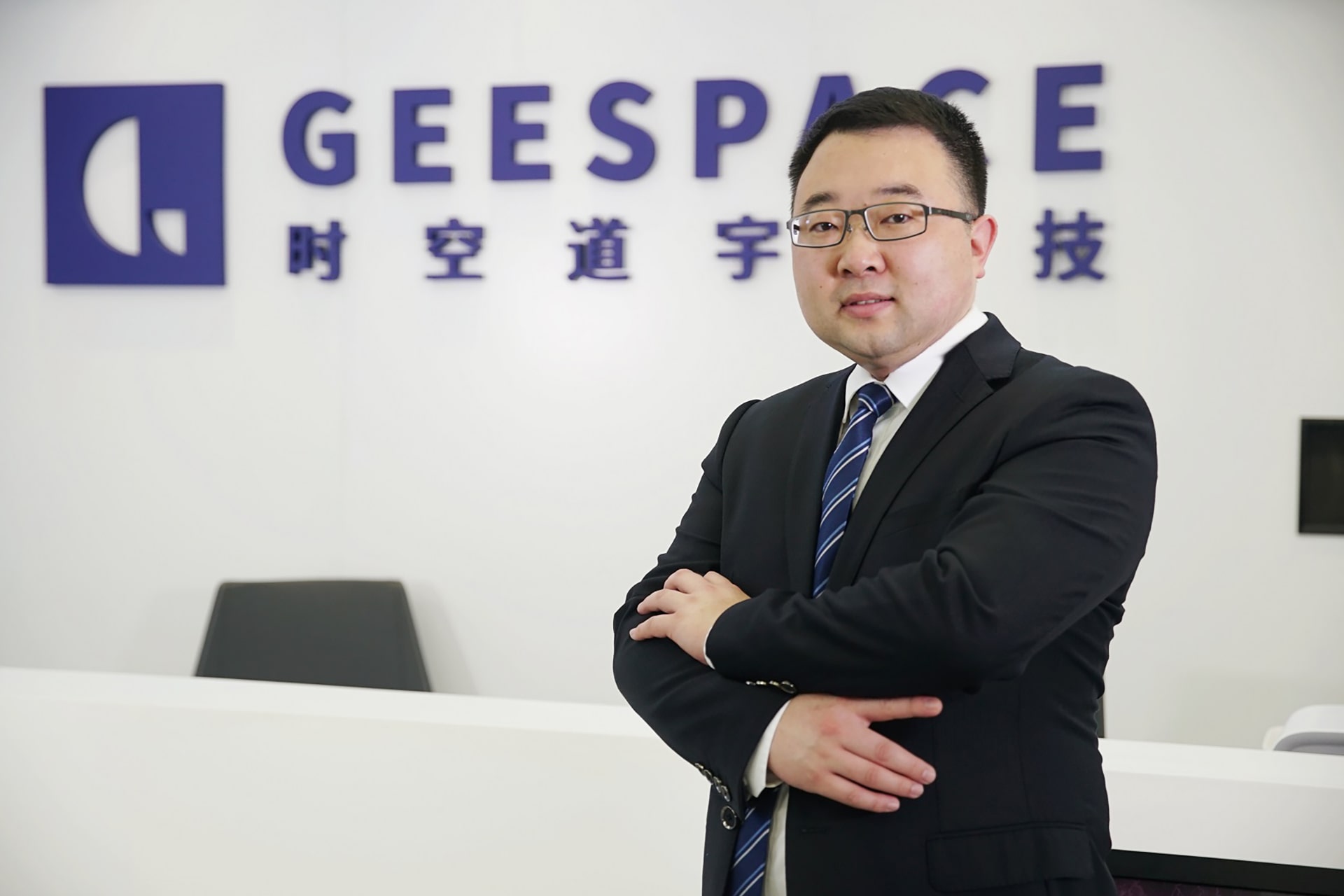
Photo of Tony Wang, founder and CEO of Geespace.
Photo of Tony Wang, founder and CEO of Geespace. Photo courtesy of the company.

Take commercial satellites as an example.

Capability building solves the problem of moving from zero to one, with a focus on technical breakthroughs and engineering validation.

Scale building solves the coverage problem, moving from basic existence to broad deployment. The focus is improving satellite production efficiency while reducing satellite launch costs and service application costs.

Value realization is the destination of all infrastructure industries. It marks the point at which earlier investment begins to translate into sustainable commercial returns and social benefits. It is also the route through which infrastructure industries generate their own cash flow and enter a virtuous cycle. Space infrastructure is no exception.

The same applies to individual companies. Only when a company completes the transition from capability building to value realization can its technology be said to have passed market validation, found paying scenarios, and begun to form a positive business loop that can support high growth.

Geespace is one of the few commercial space companies that has completed the first two stages and begun entering the value realization stage.

In terms of scaled service, Geespace completed deployment of its 64-satellite constellation in September 2025. Its Geesatcom system then became China’s first low Earth orbit (LEO) satellite constellation with global scaled service capability. It can support about 340 million communication sessions per day, serve 20 million users globally, and provide real-time communication coverage anywhere on Earth’s surface, excluding the polar regions.

More importantly, while much of the industry remains focused on constellation deployment, Geespace is also working to validate its commercialization capabilities.

Wang told 36Kr that Geespace has established commercial partnerships with telecommunications operators in more than 20 countries, promoting local services through its LEO satellite constellation. The company has obtained intended orders in several markets, including the Middle East and South America, and plans to push these orders toward delivery in 2026. This signals a shift from project-based delivery to a recurring service revenue model.

Compared with most players in commercial space, Geespace is somewhat unusual. In the industry’s early stage, when many companies were focused on speed, Wang led his team onto a less common path.

Geespace’s infrastructure route

In 2014, China’s State Council issued guidelines on innovation investment and financing mechanisms in key areas, explicitly encouraging private capital to participate in national civil space infrastructure construction for the first time. This marked the beginning of China’s commercial space sector.

That same year, Wang, who had long worked within the aerospace system and participated in multiple major national space missions, started a business while retaining his official position and temporarily leaving his post. He founded Space Ok, becoming part of China’s first generation of commercial satellite entrepreneurs.

In 2018, guided by the idea of “letting satellite technology serve the public,” Wang founded Geespace and turned his attention to the broader field of commercial LEO satellite constellations.

Unlike the industry’s common focus on high-speed, high-bandwidth consumer services, Geespace chose a medium- and low-speed LEO satellite path. This market has more concentrated users, stronger willingness to pay, and steadier demand, with revenue closer to long-term infrastructure service income. In effect, Wang chose an infrastructure subscription business.

At its core, a LEO constellation can serve as space infrastructure for the internet-of-things era. It does not pursue extreme transmission speed. Instead, it emphasizes long satellite life in orbit, seamless global coverage, and stable, reliable communications. This differentiated path can shorten the payback period compared with LEO high-speed communications constellations, while leaving room for sustained profitability.

To secure that long-term value, companies must embed themselves deeply in ecosystems involving national operators and industry customers. That places high demands on strategic resolve and long-term technical accumulation.

Once the infrastructure is built, however, it can form barriers and generate stable returns. That creates the basis for moving from cash burn to self-sustaining cash generation.

In 2023, five years after its founding, Geespace completed the first automotive-grade R&D and mass production application of satellite communications technology. Working with Zeekr, it integrated in-vehicle satellite communications terminals and services into the Zeekr 001 FR, marking the formal entry of satellite communications technology into automotive use and showing that it had begun to acquire industrial-grade implementation capability.

China sells more than 30 million vehicles each year, making automotive connectivity a large potential market for satellite communications.

More broadly, Geespace has completed commercial validation tests in China with more than 20 companies across industries. It has promoted satellite integration and innovation in construction machinery, marine fisheries, emergency communications, energy and water conservancy, logistics and transportation, low-altitude mobility, and other fields.

The question is why Geespace.

What advantages does Geespace have?

Geespace’s path to value realization did not happen overnight. Wang described it as the result of accumulated capabilities that produced qualitative change over time. These capabilities have become five advantages that could help Geespace endure industry cycles and enter the value realization stage earlier than many peers:

  1. Autonomy and reliability through in-house development: Geespace has built independent R&D and mass production capabilities across the satellite industry chain. This covers satellite design, assembly, integration and testing, constellation measurement, operation and control, and the development of core chips, modules, and terminals. This reduces reliance on external technologies and helps protect service performance from the source. Geespace says its in-orbit satellites have achieved 100% reliability. Its three-location, three-center disaster recovery backup system also supports round-the-clock service, laying the foundation for scaled implementation.
  2. Security through communications architecture and proprietary protocol: Geespace has built its own technical route and communications security framework. Its user link has strong anti-jamming capability, helping ensure the stable transmission of critical commands in complex electromagnetic environments. This is especially valuable in high-security scenarios such as government, energy, and transportation.
  3. Always-on connectivity: While much of the industry competes on bandwidth, Geespace has focused on ultrahigh-frequency and very high-frequency bands. Their diffraction characteristics help support a signal network that remains reliable and always online under uncertain conditions. In many critical scenarios, uninterrupted connectivity matters more than high speed.
  4. Positioning as an ultimate backup network: In industries such as maritime, aviation, energy, and remote infrastructure, an independent backup network is needed to reduce the risk of data interruption in extreme environments. This demand for redundancy is driven by global safety norms and industry standards. Geespace’s IoT communications service can provide basic communications support in extreme situations, making it a natural backup link.
  5. Scalability through mini, low-power terminals: By making terminals lightweight and energy efficient, Geespace allows satellite services to be embedded in large numbers of small IoT devices for long-term use. In remote, unmanned, and hard-to-maintain areas, its solution can be one of the few practical options. Stable long-term connectivity supports a business model based on sticky users and recurring payments, expanding the potential for scaled implementation.

The effect of this combined approach is now accelerating. Wang told 36Kr that Geespace will continue launching satellites this year and complete the full deployment of 72 satellites in its first phase. At that point, the system’s daily communication capacity is expected to rise to 450 million sessions. Over the next three years, Geespace aims to reach two million connected users, further opening the global LEO satellite constellation market.

According to Counterpoint Research, global satellite IoT connections are expected to rise from 3.6 million in 2020 to 41 million in 2030, representing a compound annual growth rate of 28%.

Commercial space looks for growth confirmation in 2026

In 2026, China’s commercial space sector is entering a faster and more certain stage of growth.

Capital has already signaled confidence. According to a 2026 report by Bestla Analysis, China’s commercial space companies completed 193 primary market financing events from 2025 to the first quarter of 2026, with disclosed financing reaching RMB 21.968 billion (USD 3.2 billion). The IPO processes of several leading companies have also accelerated.

The combination of industrial implementation and capital enthusiasm shows that China’s commercial space sector is moving from early technical validation into a more certain growth phase built around scaled commercial implementation.

Unlike in the US, where space ventures are largely led by private companies and develop more freely through the market, the certainty of China’s commercial space sector is closely tied to national growth strategies.

The space domain has become another field of technological competition. China’s progress will help determine whether it can define standards and gain a say in resource allocation for next-generation space infrastructure. This is one reason capital continues to commit to the long-cycle, asset-heavy space sector.

This is also where Geespace’s deeper value lies. Low- and medium-speed satellites are not meant to let every user watch short videos on their phone in the mountains or the desert. Their value lies in stable, reliable, and secure global data assurance: keeping smart vehicles connected, keeping cargo ships on course, and supporting real-time safety monitoring for cross-border energy pipelines. The aim is to become a stabilizing layer in national infrastructure strategy.

Within this system, Geespace’s role is not only that of a constellation operator, but also that of a global satellite communications service provider. Its real value lies in becoming part of the foundation for global critical infrastructure.

KrASIA features translated and adapted content that was originally published by 36Kr. This article was written by Xiao Xi for 36Kr.

Note: RMB figures are converted to USD at rates of RMB 6.79 = USD 1 based on estimates as of May 28, 2026, unless otherwise stated. USD conversions are presented for ease of reference and may not fully match prevailing exchange rates.