



In China, gaming is approaching a subtle watershed.
On one side, market leaders such as Tencent and NetEase are using capital, global production networks, and long in-house development cycles to push into AAA single-player games, the industry’s label for large-budget, high-production-value titles. On the other, mid-tier players represented by 4399 and Baioo are defending their profit bases in segments where they have long been entrenched, relying on proven gameplay models and refined operations.
At this year’s Summer Game Fest (SGF), dozens of the world’s top game companies took turns onstage, releasing updates on more than 50 new titles.
As major overseas studios leaned on established IP, remakes, and sequels, Tencent and NetEase both presented AAA single-player titles, appearing side by side under the spotlight at one of the world’s major gaming showcases.
The split is clear. Giants want to use AAA games to tell Chinese stories and build global brand moats. Mid-tier studios are still working the existing market. One side is betting upward on higher production value, while the other is digging deeper into proven commercial terrain. The two paths appear to diverge, but they share the same starting point: growth in the old model has become harder.
At SGF, Tencent played two very different cards: Crossfire and Swords of Legends.
Crossfire is being co-developed by That’s No Moon, a studio whose core team includes veterans of Naughty Dog and Infinity Ward, and Smilegate. Tencent’s Team K1 and Smilegate are jointly handling global publishing.
The game features what has been described as an “adaptive cover” system. Under this system, cover is no longer a set of fixed points drawn onto the map. Instead, it is generated in real time by the player’s surroundings and actions. A broken wall, a trench, or even a mound of earth can become part of the tactical equation. That means each encounter unfolds in a dynamic space, where victory depends not only on reaction speed, but also on strategy and spatial judgment. This kind of interaction shift requires more design confidence than simply increasing visual fidelity.
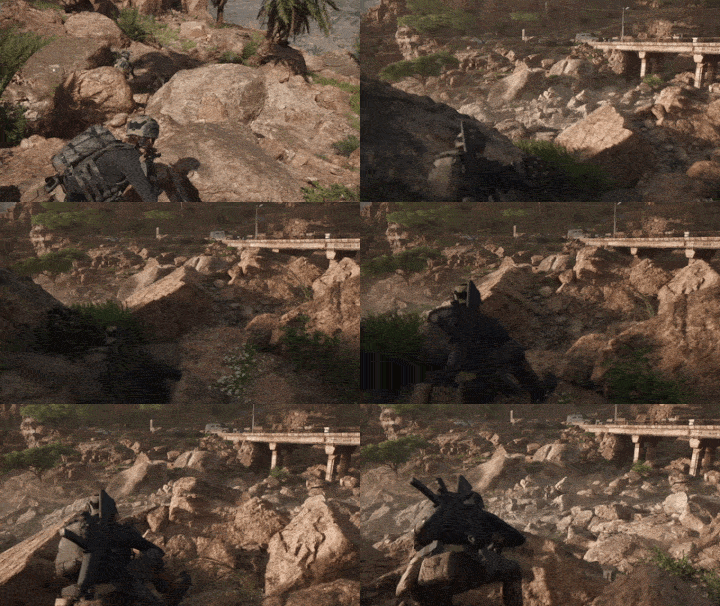
Tencent is using capital to integrate global resources at scale and make AAA development more predictable.
Its other bet, Swords of Legends, follows a different route. Developed by Aurogon Shanghai, the title continues the Chinese fantasy setting of the Swords of Legends series and runs in parallel with Tencent’s global resource integration model.
The project has not brought in overseas creative leads. Instead, it relies on Aurogon’s accumulated R&D capabilities. Judging from the gameplay preview, the studio has maintained a recognizable art style. The trickster magician Kongkongzi uses attack movements that incorporate gestures and techniques from traditional Chinese magic and Chinese opera. The boss design centers on magic tricks, illusion, and stage performance. Whether this design can support enough gameplay depth is still difficult to judge based on the footage currently available.
Even putting gameplay aside, Swords of Legends already has a relatively rare cultural position. In China’s domestic market, there are not many high-specification products deeply tied to traditional culture. Players’ expectations for such products, and their tolerance of them, are often higher than for games that resemble European or US blockbusters.
But without the support of a mature external production ecosystem, the coordination costs and validation cycle for in-house AAA development are both higher. How much Tencent’s publishing strength and capital can contribute to this project remains to be seen.
Crossfire and Swords of Legends are only part of Tencent’s larger strategy. More notable is its broader approach, from investing in proven development studios such as Remedy and Larian Studios, to taking a stake in Ubisoft, and becoming deeply involved in Phantom Blade Zero and Tides of Annihilation.
Tencent is hedging its bets by building a distributed, multicenter game production network. The advantage of this model is speed. It can assemble a top-tier development lineup quickly, reuse mature gameplay frameworks, and reduce the exploration cost of any single project. The concern is equally clear: when creative power remains scattered externally, can the resulting games still carry Chinese cultural narratives in a meaningful way?
NetEase’s Blood Message offers a different answer: use an in-house team to gradually polish an original IP. The product is personally overseen by NetEase executive vice president Hu Zhipeng, has been in development for more than five years, and has chosen the adventure category rather than the action role-playing format that has already been largely validated in China.
Its business logic is not hard to understand. After Naraka: Bladepoint validated a hybrid model of premium purchase and live-service operations, NetEase needed a higher-specification product to elevate its brand positioning and show the market that it is not only a mobile game company.
However, NetEase has repeatedly shifted its messaging in recent years. The change in Naraka: Bladepoint’s payment model and the repositioning of Where Winds Meet from single-player to massively multiplayer online (MMO) format each arguably eroded player trust. Before SGF, Blood Message quietly deleted an old post suggesting that games marketed as single-player “cannot possibly be a mobile game.” Parts of the player community reacted negatively, though the response may reflect NetEase’s history of shifting commitments more than the post itself. Blood Message therefore must not only meet expectations as a product, but also absorb an additional credibility cost.
Judging from the gameplay demo, its stealth, combat, and parkour modules have reached an international second-tier standard. But the adventure category has already been pushed far by works such as Uncharted, leaving limited room for differentiation. If the game undergoes another format shift at launch, such as moving from single-player to live service, or from PC to mobile, NetEase’s AAA narrative will lose much of its credibility.
The two leading companies are taking different paths, but they face the same structural problem. Neither a globalized production network nor a long in-house development cycle has yet proven capable of consistently producing AAA games with both commercial returns and cultural distinctiveness. Crossfire may have creative leads with Naughty Dog lineage, but shifting from fast-paced multiplayer competition to single-player mechanics and cinematic storytelling remains difficult. Blood Message’s wuxia stealth and combat will inevitably be compared with mature works such as Ghost of Tsushima.
At present, many traditional overseas AAA studios are relying on sequels, remakes, and familiar gameplay formulas. That appears to have opened a window for Chinese companies. The real question is whether China’s leading developers can use this window to build a reusable and genuinely differentiated AAA production model. Otherwise, what awaits may not be recognition, but the harder judgment of costly imitation.
The leading companies have deep capital reserves and mature industrial capabilities. With the current market window in place, they have chosen to challenge AAA from above. The survival logic for mid-tier studios is just as clear. They do not have the capital depth of Tencent or NetEase, but in the segments they have cultivated for years, they can generate predictable and stable profits.
This proposition holds because the industrialization level of China’s game development industry has broadly improved. In the past, mid-tier studios had limited R&D capabilities and could only generate revenue in already validated categories with lower costs, faster development, and more refined operations. Today, development routes have matured, cross-platform tools have become widespread, and publishing has become more precise. Some mid-tier studios can now produce games whose quality approaches first-tier products, while often being more flexible than the giants in operating efficiency.
4399, which rose during the browser game era, recorded revenue of RMB 8.89 billion (USD 1.3 billion) in 2025. Its model is to validate games domestically before publishing versions overseas. Typically, this means releasing multiple mini game products on WeChat, screening for outliers at low cost, and then replicating the formula overseas once the data meets expectations.
After Legend of Mushroom worked in China, its overseas version brought in nearly USD 400 million in 2024, ranking among the top 20 mobile games globally by revenue. In early 2025, its single-month overseas revenue surpassed USD 48 million. 4399’s overall overseas gross billings approached RMB 5 billion (USD 736.7 million), supporting annual revenue of more than RMB 8 billion (USD 1.2 billion).
The playbook is straightforward: use controllable R&D costs to validate user acceptance in China, replicate a market-tested gameplay model overseas, and keep margins predictable and risks manageable. It does not require betting on one blockbuster. It requires building a standardized product factory. The tradeoff is also clear. Products become highly homogenized, and once path dependency hardens, user fatigue can arrive faster.
Baioo holds multiple IPs, including Aobi Island, Legend of Aoqi, Aola Star, and The Tale of Food. Several of its products once generated monthly gross billings of more than RMB 100 million (USD 14.7 million). In 2025, Baioo’s full-year revenue reached RMB 610 million (USD 89.9 million), up 11.9% year over year. It maintained growth despite having no revenue contribution from new products and continuing to increase R&D investment. The reason was refined operations around existing IP.
What has drawn more attention from outsiders is Baioo’s move into new categories. Its new female-oriented title Reign of Nightfall positions itself as a narrative-driven strategy card game built around Italian-inspired romance and a cast of villains, differentiating itself from the conventional romance narratives of traditional female-oriented games. Another title, Color Clash, reached the top of the iOS free download chart with eight-figure RMB R&D costs and seven-figure RMB marketing expenses, and once climbed to 19th place on the top-grossing chart.
Organizationally, Baioo has built several business units. Baitian is responsible for classic browser games, Tianti handles mobile game publishing, and Ubeejoy handles overseas publishing. The company is gradually moving from reliance on a single IP toward multi-category expansion. Unlike 4399, Baioo’s moat is not the speed of gameplay reuse, but user stickiness and spending depth derived from accumulated IP. It has a higher profit margin ceiling in niche segments such as female-oriented games and pet-raising games. The challenge is equally clear: whether its new games can launch on schedule and meet market expectations will determine whether it can grow further.
Baioo and 4399 have different strategies, but they share a similar tactic: use mature gameplay frameworks, make targeted innovations, refine user acquisition, and monetize aggressively. They do not need to define new categories. They only need to follow gameplay already validated by others, then use better traffic operations and stronger monetization design to win users incrementally.
These categories also share several characteristics: long user life cycles, deep spending potential, slow gameplay iteration, and low technical barriers. Once the model works, it can become a stable revenue source. But today’s safe zone is built on highly homogenized product matrices that continue to drain the vitality of specific categories. Once user fatigue crosses a threshold, the segment could decline quickly.
In this picture, giants are using capital and industrial accumulation to challenge from above, seeking brand moats and a stronger voice in the global market. Mid-tier studios are using deeper excavation of the existing market and differentiated tactics to hold a stable commercial base. The two paths appear to diverge, but they depend on each other.
User growth has plateaued, user acquisition costs have doubled, and return volatility has increased. That has turned competition for the existing market among top-tier companies into inefficient internal friction. Mid-tier companies pay more attention to near-term returns, run more flexible operations, and control costs more tightly. On the same battlefield, giants are becoming more passive. But with sufficient capital and industrial capability, top-tier companies can choose to enter areas that mid-tier companies cannot yet reach, occupying a higher position in the value chain. AAA single-player games are the most visible entry point into that territory.
The risks that come with this choice cannot be ignored. The first is cost overrun and uncertain returns. Global development costs for AAA titles have surged to USD 200–400 million, making profitability difficult. Chinese companies lack accumulated IP and global channel advantages, so their probability of failure is higher. The failure of one AAA title could mean billions of RMB in sunk costs.
The second risk is latecomer disadvantage in product form. The themes, gameplay, and narrative paradigms of most domestic AAA games have not yet broken out of frameworks already established by US and European developers. When players can choose mature products such as God of War and Elden Ring, why should they choose a Chinese equivalent? If derivative productions cannot offer enough differentiation, they may become expensive imitations.
The comfort zone of mid-tier studios also carries risk. Innovation means uncertainty, and in a low-margin environment, uncertainty becomes a luxury. When the market becomes highly homogenized, user fatigue accumulates faster. Today’s safe zone could narrow quickly.
The division of labor between giants and mid-tier studios looks like a rational market choice: each guards its own section and earns its own money.
But that division could bring two negative consequences:
The larger question is what Chinese companies are really trying to prove when they make AAA games. Are they creating a distinctive game language and aesthetic, or are they following a path that European and US counterparts have already taken? Are they proving that they can make the same thing, or that they can make something different?
KrASIA features translated and adapted content that was originally published by 36Kr. This article was written by Xiao Kui for 36Kr.
Note: RMB figures are converted to USD at rates of RMB 6.79 = USD 1 based on estimates as of June 23, 2026, unless otherwise stated. USD conversions are presented for ease of reference and may not fully match prevailing exchange rates.
此内容由惯性聚合(RSS阅读器)自动聚合整理,仅供阅读参考。 原文来自 — 版权归原作者所有。