
惯性聚合 高效追踪和阅读你感兴趣的博客、新闻、科技资讯
阅读原文 在惯性聚合中打开

推荐订阅源

P
Proofpoint News Feed
云风的 BLOG
云风的 BLOG
Apple Machine Learning Research
Hugging Face - Blog
Hugging Face - Blog
OSCHINA 社区最新新闻
OSCHINA 社区最新新闻
Google DeepMind News
钛媒体:引领未来商业与生活新知
钛媒体:引领未来商业与生活新知
让小产品的独立变现更简单 - ezindie.com
雷峰网
雷峰网
B
Blog
月光博客
月光博客
博客园 - 【当耐特】
WordPress大学
WordPress大学
Microsoft Azure Blog
I
InfoQ
The GitHub Blog
The GitHub Blog
Engineering at Meta
Engineering at Meta
Jina AI
Jina AI
博客园 - Franky
MyScale Blog
MyScale Blog
H
Hackread – Cybersecurity News, Data Breaches, AI and More
Last Week in AI
Last Week in AI
B
Blog RSS Feed
H
Help Net Security

Semafor

US inflation jumps, though long-term war impact yet to be seen Hospitals consider replacing some radiologists with AI Amazon takes a jab at Nvidia over chips shift VCs step in to fund university upstarts Exclusive: Anthropic is gaining on OpenAI’s revenue, but hasn’t yet eclipsed it Exclusive: AI powerhouses threaten data processing firms A South African artist is changing the way viewers understand Picasso’s Guernica Airbnb faces familiar battle in Cape Town First look at war-related inflation sparks political jostling View: China’s state businesses are reshaping markets in Africa US issues Nigeria travel warning over terrorism, kidnapping FirstRand exits UK business after regulatory hit Afreximbank’s $800M answer to Fitch Exclusive: Navy takes nuclear-powered sub offline after $800 million cost run-up Cuba leader says he will not step down Fed, Treasury summon Wall Street chiefs over AI fears How Bluesky earned its reputation — and why it could be the way of the future China eyes stronger Taiwan influence Orbán slams Hungary’s opposition as he trails in polls Iran war reshapes air travel, perhaps for the long term Tehran residents embrace calm amid tenuous truce Countries lack fiscal capacity to handle war fallout Higher producer prices ease China deflation fears Trump ‘optimistic’ on Iran peace talks Inside the five-year succession plan at a $130B warehouse giant Georges Elhedery on HSBC’s big bets on the Gulf and Asia Warsh’s Fed hearing slips past next week Moore takes on the Sun’s ‘MAGA billionaire’ and more Debatable: AI titans influencing regulation Americans still think taxes are too high, poll finds
View: The Iran war’s ‘lag effect’ on Africa’s economies
Yinka Adegok · 2026-04-23 · via Semafor

Sub-Saharan Africa entered 2026 with its fastest economic growth in a decade but that momentum has been upended by the disruption in fuel supply caused by the US and Israeli war with Iran.

Last week the International Monetary Fund trimmed its 2026 outlook for Africa to 4.3%, 30 basis points down from its earlier forecast. The downgrade is modest on paper but the sharper signal lies in the risks: In a prolonged conflict scenario, the Fund warned that output could contract by twice as much across the region, as the “lag effect” of higher energy, fertilizer, and shipping costs ripple through already fragile economies.

“I think the GDP impact could be deeper as the war becomes protracted,” Standard Chartered Bank’s Africa CEO Dalu Ajene told me. He’s concerned that the drag on growth could worsen and hit unevenly across countries if the war persists. The varying impact of what he calls “imported inflation” is already visible: Oil exporters may enjoy a temporary windfall, but most African economies, still heavily reliant on imported fuel, are reeling.
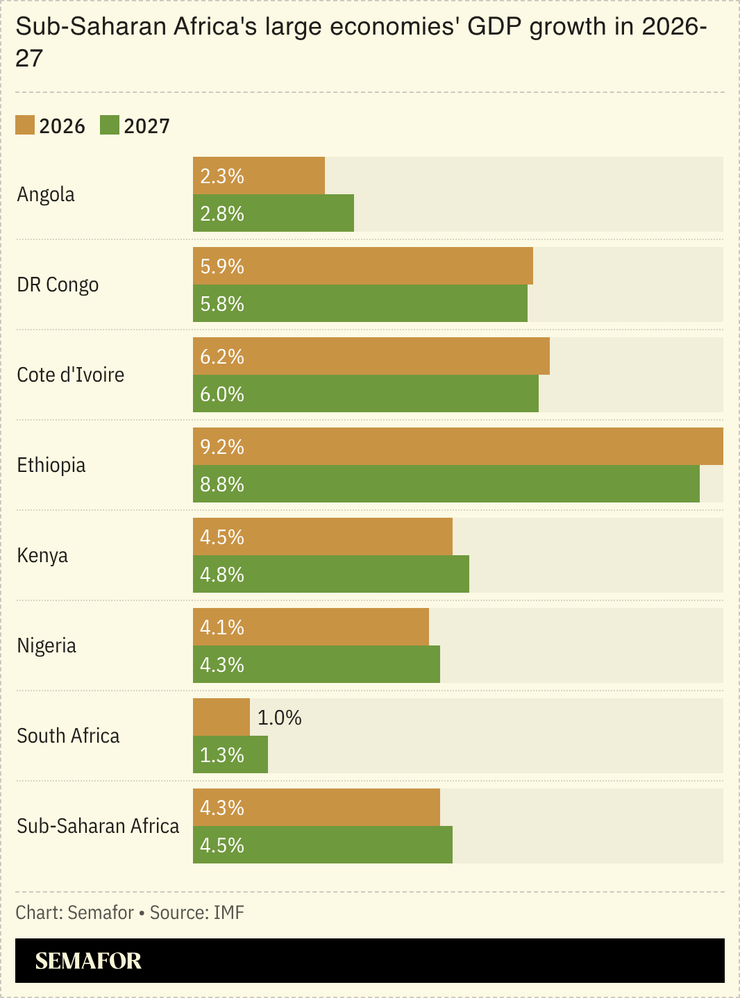
African finance ministers in Washington last week for the IMF and World Bank meetings were scrambling to secure financing as conditions tightened. In Ethiopia, Prime Minister Abiy Ahmed has urged citizens to ration fuel, an early sign of how quickly the shock is feeding into domestic economies. South Africa’s President Cyril Ramaphosa has called on the international community to “redouble efforts” toward restraint and adherence to international law, diplomatic phrasing that masks deeper economic anxiety.

The gains of 2025 were real and “hard won,” as the IMF noted. But what this moment reminds us is how quickly external shocks can overwhelm domestic progress. For sub-Saharan Africa, resilience is no longer just a policy goal — like with the COVID-19 pandemic and the fallout from Russia’s ongoing war in Ukraine, it is once again an urgent test.