
惯性聚合 高效追踪和阅读你感兴趣的博客、新闻、科技资讯
阅读原文 在惯性聚合中打开

推荐订阅源

雷峰网
雷峰网
奇客Solidot–传递最新科技情报
奇客Solidot–传递最新科技情报
博客园 - 三生石上(FineUI控件)
博客园 - 聂微东
OSCHINA 社区最新新闻
OSCHINA 社区最新新闻
Hugging Face - Blog
Hugging Face - Blog
Apple Machine Learning Research
博客园 - Franky
MyScale Blog
MyScale Blog
A
About on SuperTechFans
博客园_首页
B
Blog RSS Feed
Martin Fowler
Martin Fowler
大猫的无限游戏
大猫的无限游戏
Cyber Security Advisories - MS-ISAC
Vercel News
Vercel News
C
Check Point Blog
H
Hackread – Cybersecurity News, Data Breaches, AI and More
博客园 - 【当耐特】
M
MIT News - Artificial intelligence
宝玉的分享
宝玉的分享
T
Tailwind CSS Blog
I
InfoQ
罗磊的独立博客

Semafor

US inflation jumps, though long-term war impact yet to be seen Hospitals consider replacing some radiologists with AI Amazon takes a jab at Nvidia over chips shift VCs step in to fund university upstarts Exclusive: Anthropic is gaining on OpenAI’s revenue, but hasn’t yet eclipsed it Exclusive: AI powerhouses threaten data processing firms A South African artist is changing the way viewers understand Picasso’s Guernica Airbnb faces familiar battle in Cape Town First look at war-related inflation sparks political jostling View: China’s state businesses are reshaping markets in Africa US issues Nigeria travel warning over terrorism, kidnapping FirstRand exits UK business after regulatory hit Afreximbank’s $800M answer to Fitch Exclusive: Navy takes nuclear-powered sub offline after $800 million cost run-up Cuba leader says he will not step down Fed, Treasury summon Wall Street chiefs over AI fears How Bluesky earned its reputation — and why it could be the way of the future China eyes stronger Taiwan influence Orbán slams Hungary’s opposition as he trails in polls Iran war reshapes air travel, perhaps for the long term Tehran residents embrace calm amid tenuous truce Countries lack fiscal capacity to handle war fallout Higher producer prices ease China deflation fears Trump ‘optimistic’ on Iran peace talks Inside the five-year succession plan at a $130B warehouse giant Georges Elhedery on HSBC’s big bets on the Gulf and Asia Warsh’s Fed hearing slips past next week Moore takes on the Sun’s ‘MAGA billionaire’ and more Debatable: AI titans influencing regulation Americans still think taxes are too high, poll finds
View: We’re making assumptions about the economy
2026-04-09 · via Semafor

“Things that were previously held to be sort of unassailable truths are now coming into question,” a16z partner David Ulevitch told me last month. He was making the point that previously uninvestable sectors — like hardware, long ignored by venture capital firms — were becoming attractive because of underlying technological shifts. But the last few weeks have shown that the gloomier inverse is also true.

A generation of kids who learned to code are being supplanted before they’ve even hit their 20s. Enterprise software was the most durable business model of all time, until AI arrived. Loans to those companies were underwritten on the basis of revenue with the assumption that profits would materialize; they didn’t and cans were kicked. In 2007, the thinking was that a mortgage in Montana didn’t have anything to do with a mortgage in Maine; oops.

Here’s another one to watch: The fastest-growing type of bank lending over the past decade has been loans to private-credit firms, secured by the value of those firms’ own loans. That $1.3 trillion pot is, as Advent’s managing partner neatly told me a while back, “leverage on leverage.”
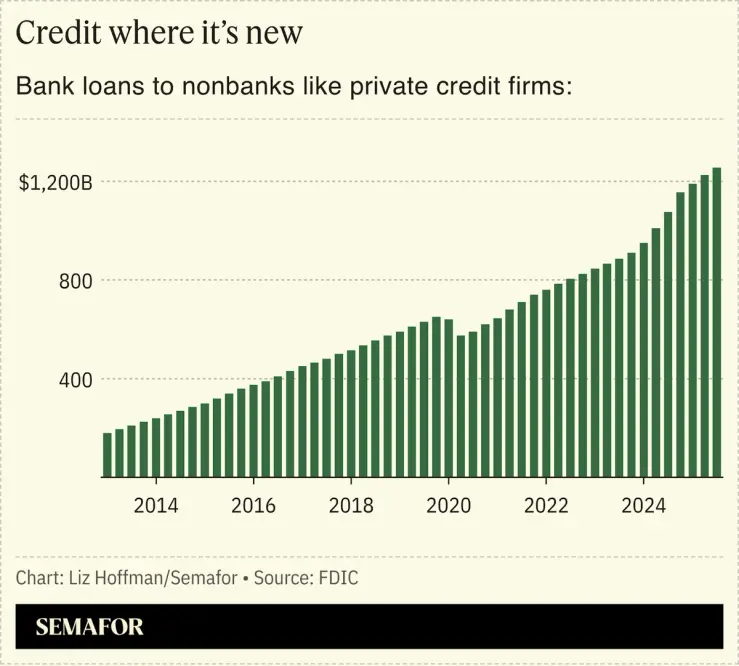
Bank loans to nonbanks like private credit firms.

The portfolios are diversified, and banks lend 40 or 50 cents on the dollar, which leaves some room for things to go badly before they lose money. But that’s what lenders said about mortgage bonds in the run-up to 2008. They built creaky securities to withstand losses of 10% or so, then watched prices fall by twice that or more.

For the moment, concerns about liquidity in private credit — retail investors want their locked-up money out — have obscured the more important question: are some of the underlying loans bad?

We’ll ask them and hundreds of other CEOs next week about assumptions we’re making today that could prove disastrously wrong. Risk underwriting has the same problem as AI models: garbage in, garbage out.