

惯性聚合 高效追踪和阅读你感兴趣的博客、新闻、科技资讯
阅读原文 在惯性聚合中打开

推荐订阅源

博客园 - 三生石上(FineUI控件)
Martin Fowler
Martin Fowler
月光博客
月光博客
AI
AI
B
Blog
钛媒体:引领未来商业与生活新知
钛媒体:引领未来商业与生活新知
C
CXSECURITY Database RSS Feed - CXSecurity.com
WordPress大学
WordPress大学
GbyAI
GbyAI
L
Lohrmann on Cybersecurity
O
OpenAI News
Schneier on Security
P
Palo Alto Networks Blog
Cyber Security Advisories - MS-ISAC
T
Troy Hunt's Blog
V2EX - 技术
V2EX - 技术
W
WeLiveSecurity
L
LINUX DO - 最新话题
人人都是产品经理
人人都是产品经理
S
Security Affairs
OSCHINA 社区最新新闻
OSCHINA 社区最新新闻
A
Arctic Wolf
Recorded Future
Recorded Future
Microsoft Security Blog
Threat Intelligence Blog | Flashpoint
G
GRAHAM CLULEY
N
Netflix TechBlog - Medium
TaoSecurity Blog
TaoSecurity Blog
C
Check Point Blog
Scott Helme
Scott Helme
cs.CV updates on arXiv.org
Apple Machine Learning Research
PCI Perspectives
PCI Perspectives
www.infosecurity-magazine.com
Vercel News
Vercel News
The Hacker News
The Hacker News
Y
Y Combinator Blog
Latest news
Latest news
SecWiki News
SecWiki News
Hugging Face - Blog
Hugging Face - Blog
cs.AI updates on arXiv.org
Google Online Security Blog
Webroot Blog
Webroot Blog
Google DeepMind News
Recent Commits to openclaw:main
C
Cisco Blogs
博客园_首页
H
Hackread – Cybersecurity News, Data Breaches, AI and More
宝玉的分享
宝玉的分享
L
LINUX DO - 热门话题

Semafor

US inflation jumps, though long-term war impact yet to be seen Hospitals consider replacing some radiologists with AI Amazon takes a jab at Nvidia over chips shift VCs step in to fund university upstarts Exclusive: Anthropic is gaining on OpenAI’s revenue, but hasn’t yet eclipsed it Exclusive: AI powerhouses threaten data processing firms A South African artist is changing the way viewers understand Picasso’s Guernica Airbnb faces familiar battle in Cape Town First look at war-related inflation sparks political jostling View: China’s state businesses are reshaping markets in Africa US issues Nigeria travel warning over terrorism, kidnapping FirstRand exits UK business after regulatory hit Afreximbank’s $800M answer to Fitch Exclusive: Navy takes nuclear-powered sub offline after $800 million cost run-up Cuba leader says he will not step down Fed, Treasury summon Wall Street chiefs over AI fears How Bluesky earned its reputation — and why it could be the way of the future China eyes stronger Taiwan influence Orbán slams Hungary’s opposition as he trails in polls Iran war reshapes air travel, perhaps for the long term Tehran residents embrace calm amid tenuous truce Countries lack fiscal capacity to handle war fallout Higher producer prices ease China deflation fears Trump ‘optimistic’ on Iran peace talks Inside the five-year succession plan at a $130B warehouse giant Georges Elhedery on HSBC’s big bets on the Gulf and Asia Warsh’s Fed hearing slips past next week Moore takes on the Sun’s ‘MAGA billionaire’ and more Debatable: AI titans influencing regulation Americans still think taxes are too high, poll finds Lawmakers await Pentagon’s mystery funding request Semafor convenes largest US CEO gathering next week in Washington American Gen Zers are growing more uneasy about AI Amazon defends high AI spending AI turbocharges Chinese microdrama industry OpenAI pauses UK Stargate project UK rejects Iran’s Hormuz toll plan Israel, Lebanon to hold direct talks Republicans fight among themselves over their long pre-election to-do list Exclusive: Gulf sovereigns quadruple private credit portfolios Abu Dhabi’s Mubadala soars after dealmaking spree View: Ceasefire offers respite, but no quick rebound for the Gulf A Saudi oil magazine is publishing some of the best writing about the Islamic world Exclusive: SpaceX bankers game plan to blunt post-IPO selling tsunami Exclusive: Hormuz closure turns truckers into logistics saviors View: As Republicans embrace AI in campaigning, Democrats bet on a backlash Oil prices remain high despite Iran ceasefire Ancient philosopher text unearthed Panama pushes back against China in canal row China’s yuan set to strengthen due to Middle East war View: Ceasefire shows the power of Iran’s energy weapon EU faces ‘stagflation’ over war, economy official warns Trump slams NATO again Iran war support Iran maintains firm grip on Hormuz traffic Israel’s attacks in Lebanon threaten Iran war truce VP Vance to lead Iran truce talks in Pakistan Exclusive: Democrats pressure Pentagon over new media restrictions Exclusive: Ex-diplomat says war has permanently harmed Qatar-Iran ties Israel’s Netanyahu says Iran ceasefire is not ‘end of the war’ Iran truce already in doubt Exclusive: Saudi’s $100 billion electronics fund removes head, drops chip ambitions Trump administration expected to keep waiving Russian oil sanctions as Iran call looms Democrats to force Iran vote next week View: Why OpenAI’s slowdown isn’t as bad as it looks AI research foundation releases test that will warn when AGI arrives Data-center proponents targeted by shooter Exclusive: Microsoft says AI voice command needs more work Anthropic’s Mythos won’t solve the cybersecurity crisis View: Africa begins to feel economic pain of Iran war Gulf countries push nationals to take private sector jobs Türkiye’s chance to take on the Gulf as a haven for business Gulf stocks surge and oil falls after ceasefire deal Lagos celebrates Afro-Brazilian legacy through carnival Ghana hands major gold mine to local operator Zambia-Lobito rail link to cost up to $5 billion Afreximbank unveils $10B support plan for Africa to ease Iran war impact Dangote refinery increases exports amid Iran war supply shocks Global shipping disruption rocks Kenyan economy Democracy improves globally though gains are uneven, report says Cuba launches new banknotes to help ease transactions China’s graft drive ‘has not worked,’ analysts say UK Navy deploys anti-drone weapons amid global scramble All eyes on Hormuz traffic after ceasefire unveiled What Sharpton wants to hear from 2028’s Democratic contenders Iran ceasefire is a diplomatic triumph for Pakistan Oil drops on Iran-US ceasefire news Iran, US agree to two-week ceasefire Fewer in US, Canada see good job opportunities, report finds Exclusive: OpenAI goes after Ari Emanuel’s WME in Musk legal drama Trump agrees to suspend Iran attacks for two weeks Trump backs off threat to annihilate Iran Indian business delegation visits China in sign of bilateral thaw US AI firms team up in bid to counter Chinese ‘distillation’ More airlines cut flights, raise costs Global hedge funds respond to war shocks US targets pillars of Iran economy View: AI is testing the oldest debate in business: Who’s the customer? Bill Ackman tries again with $60B Universal Music Group bid Exclusive: Gulf conferences at risk from Iran war Why Oura is running toward Washington oversight
View: Egypt’s crisis playbook is improving. The risks are the same.
2026-04-02 · via Semafor

The way Egypt is handling the economic fallout of the Third Gulf War suggests that the country has learned from past mistakes. Unfortunately, that may not be enough.

The conflict, by my count, is the fourth man-made shock to hit the economy since the Arab Spring 15 years ago. Those crises required two large IMF deals supported by tens of billions of dollars in Gulf aid and investments, reflecting a long-standing view among Gulf capitals that stability in the most populous Arab country is key to preventing wider turmoil. In 2023, the UAE alone pledged more than $30 billion as part of an IMF-backed global bailout.

A month into the Iran war, Egypt finds itself one of the economies most exposed to the war outside the Gulf. A net energy importer, it has been hit by higher prices and a suspension of Israeli gas supplies, adding to pressure from hot money outflows. The pound was among the world’s worst performers against the dollar in March.
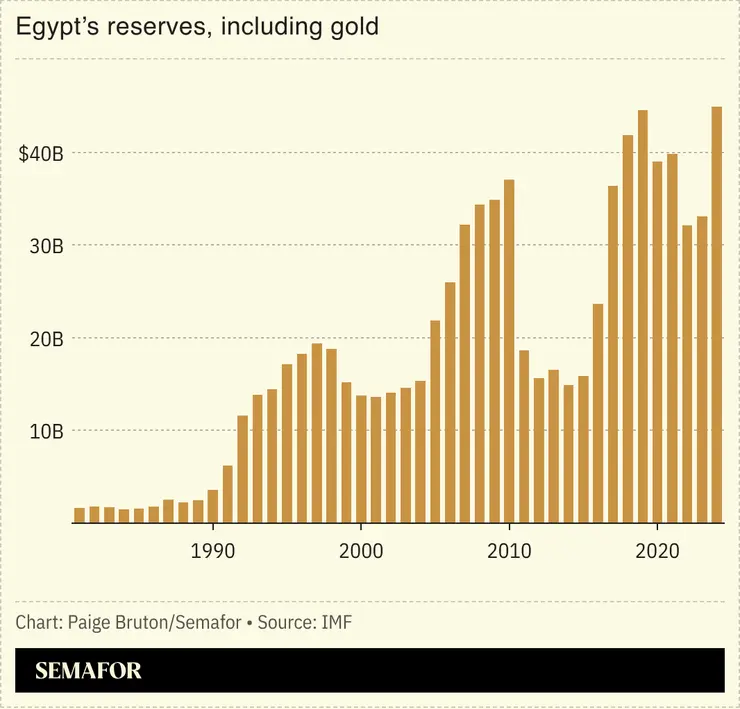
A chart of Egypt’s reserves, including gold, in billions of dollars.

Still, allowing the currency to act as the first shock absorber marked a departure from the usual script — one that in past crises made matters much worse. The pattern was familiar: burning through buffers in a futile defense of the currency, leading to crippling dollar shortages and a spike in inflation. Delaying unpopular policies only made the eventual adjustment much more painful.

When the US and Israel attacked Iran, policymakers in Cairo were in the final stretch of an IMF program expanded after the Gaza war. Inflation had eased, public finances were improving and foreigners had parked more than $30 billion in Egypt’s debt market. Remittances boomed as the diaspora regained trust in the system.

Authorities resisted the temptation to use record foreign reserves to defend the pound, even as the conflict sparked a sell-off across emerging markets. The government also moved quickly to slash fuel subsidies. These measures earned Egypt praise from the IMF and global investors.

“You could see that investors took note of the change,″⁣ said Mohammed Abu Basha, head of macroeconomic analysis at regional investment bank EFG-Hermes. Even though around a third of “hot money” left during March, he said it could have been worse. “The attitude is different,” he added.

There are other reasons to stay positive. Unlike past crises, there are virtually no signs of a black market for dollars. Goldman Sachs doesn’t expect domestic confidence in the Egyptian currency to be shaken anytime soon. In a recent note, the bank said even under its most severe downside scenario, Egypt’s financial buffers were not expected to approach the lows that followed Russia’s invasion of Ukraine.

And yet, the war has — once again — exposed long-standing structural weaknesses in Egypt’s external balance, notably the struggle to develop enough stable sources of foreign income.

Tourism revenue had rebounded before war broke out. In real terms, however, it hasn’t moved decisively beyond its pre-2011 peak, an unimpressive feat for a country with Egypt’s potential. Steep currency devaluations over the past decade have not produced the kind of durable export booms policymakers hope for, reflecting difficulties in developing competitive sectors. Add Egypt’s food import bill, and its shift from being a net oil exporter to an importer, and the result is a chronic trade balance deficit.

Not all of this can be fixed through policy. Attacks by the Iran-backed Houthi rebels in Yemen in 2023 significantly curtailed Red Sea shipping, slashing Egypt’s revenue from the Suez Canal. Political turmoil can also partly explain tourism volatility, but not why Egypt has been repeatedly taken to arbitration by international investors.

Left unaddressed, these vulnerabilities risk turning every geopolitical shock into a perfect storm.

In 2017, a year after securing a $12 billion IMF bailout, a former government official privately predicted Egypt would be a repeat customer soon enough. When I asked why, he said that while Egypt had mastered the mechanics of monetary and fiscal reforms, anything beyond that remained elusive. He was proven right six years later.

What does this mean in terms of the impact of the Iran war? Much depends on its duration. Having to go back for another IMF-funded program due to an external shock would be unlucky, but not entirely surprising.

Alaa Shahine Salha is a senior executive at Saudi Research & Media Group and an economics contributor for Asharq Business with Bloomberg. He previously served as Bloomberg News managing editor for the Middle East and managing editor for economics in Europe.