








Late last week I found myself wondering: What is Larry Summers thinking?
Not about that!
Rather, about the topic on which the economist, former treasury secretary and former Harvard president has been so irritatingly correct in recent years: the state of the American economy.
He infuriated his own party in the Biden years by predicting in early 2021 that the $1.9 trillion American Rescue Plan would overheat the economy, and then by rejecting the Federal Reserve’s insistence that inflation would be “transitory.” Under President Donald Trump, he warned that DOGE wouldn’t actually save money, and that tariffs could push toward stagflation.
One of Summers’ least-loved observations came in the summer of 2023, when he posted a chart showing that the decline in inflation exactly tracked a similar dip in the mid-1970s — just before a second spike. Critics howled that the image constituted a “chart crime,” a random coincidence passing as a correlation. After all, that second spike had been driven by a specific historical event: the Iranian revolution.
But since then the chart has continued to track inflation’s stubborn permanence. In a particularly strange historical echo, a US conflict with Iran has re-familiarized Americans who weren’t buying gas in the ’70s with the Strait of Hormuz.
Summers has been keeping a low profile since he was defenestrated from Harvard over Jeffrey Epstein emails, and declined to give me an on-the-record interview.
I did get a hold of an updated version the economist has been circulating of his 2023 chart, however, with a dotted line representing what he sees as the market-implied inflation forecast. It tracks the 1979 inflation spike.
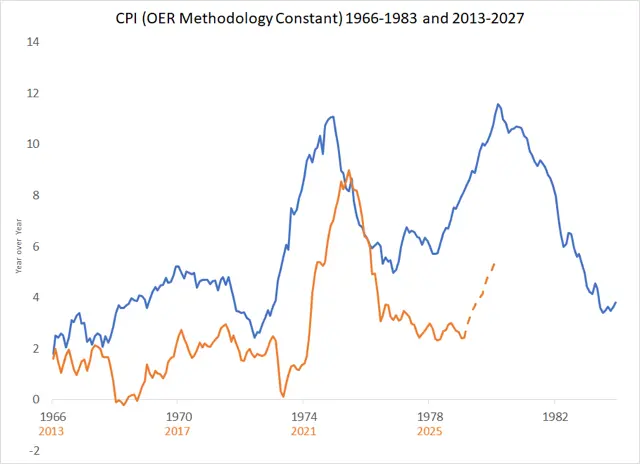
Summers, I’m told, has shared with associates his view that the American fiscal and economic situations would be worryingly fragile, and on the brink of a crisis, even without a war. And he believes many analysts are misreading the situation. For instance, the Fed is treating the neutral interest rate — the rate that balances full employment and manageable inflation — as 3%; the Trump appointee Stephen Miran has said it’s at 2.5 to 2.75%. Summers thinks it’s 4.5%.
Summers isn’t historically one of Washington’s great deficit hawks, but he and other voices, like the deficit monitors at the Committee for a Responsible Federal Budget, are growing increasingly alarmed at a series of factors that are making federal borrowing unsustainable.
The US is a heavily indebted country whose populist policies, and growing hostility to tax enforcement, mean it can’t effectively raise taxes to close its deficits. Global investors see this, and they’re edging away from Treasury bonds. The failure of DOGE’s ax-wielders to put a dent in spending shows the gap won’t be fixed on that side of the ledger, either, and indeed, the country is scrambling to raise its national security spending.
And against that backdrop, AI euphoria is driving a boom in public stock markets even as the giant new private lending systems are showing signs of strain.
If these worries are justified, the Fed right now thinks it’s tapping the breaks by keeping interest rates steady — but it is actually hitting the gas, and speeding the US toward another bad bout of inflation.
There’s an observation known as Dornbusch’s Law, after a Summers collaborator: Financial crises take longer than you expect to arrive, but then happen faster than you thought possible. You never really find out that you’re Liz Truss until it’s too late.
Correction: An earlier version of this article misstated Stephen Miran’s assessment of the neutral interest rate.
此内容由惯性聚合(RSS阅读器)自动聚合整理,仅供阅读参考。 原文来自 — 版权归原作者所有。