




惯性聚合 高效追踪和阅读你感兴趣的博客、新闻、科技资讯
阅读原文 在惯性聚合中打开

推荐订阅源

S
SegmentFault 最新的问题
Jina AI
Jina AI
罗磊的独立博客
V
Visual Studio Blog
freeCodeCamp Programming Tutorials: Python, JavaScript, Git & More
J
Java Code Geeks
U
Unit 42
Microsoft Azure Blog
B
Blog RSS Feed
爱范儿
爱范儿
酷 壳 – CoolShell
酷 壳 – CoolShell
Last Week in AI
Last Week in AI
T
The Blog of Author Tim Ferriss
腾讯CDC
Hugging Face - Blog
Hugging Face - Blog
T
Tailwind CSS Blog
让小产品的独立变现更简单 - ezindie.com
I
InfoQ
月光博客
月光博客
博客园_首页
Vercel News
Vercel News
P
Proofpoint News Feed
GbyAI
GbyAI
Y
Y Combinator Blog

Semafor

US inflation jumps, though long-term war impact yet to be seen Hospitals consider replacing some radiologists with AI Amazon takes a jab at Nvidia over chips shift VCs step in to fund university upstarts Exclusive: Anthropic is gaining on OpenAI’s revenue, but hasn’t yet eclipsed it Exclusive: AI powerhouses threaten data processing firms A South African artist is changing the way viewers understand Picasso’s Guernica Airbnb faces familiar battle in Cape Town First look at war-related inflation sparks political jostling View: China’s state businesses are reshaping markets in Africa US issues Nigeria travel warning over terrorism, kidnapping FirstRand exits UK business after regulatory hit Afreximbank’s $800M answer to Fitch Exclusive: Navy takes nuclear-powered sub offline after $800 million cost run-up Cuba leader says he will not step down Fed, Treasury summon Wall Street chiefs over AI fears How Bluesky earned its reputation — and why it could be the way of the future China eyes stronger Taiwan influence Orbán slams Hungary’s opposition as he trails in polls Iran war reshapes air travel, perhaps for the long term Tehran residents embrace calm amid tenuous truce Countries lack fiscal capacity to handle war fallout Higher producer prices ease China deflation fears Trump ‘optimistic’ on Iran peace talks Inside the five-year succession plan at a $130B warehouse giant Georges Elhedery on HSBC’s big bets on the Gulf and Asia Warsh’s Fed hearing slips past next week Moore takes on the Sun’s ‘MAGA billionaire’ and more Debatable: AI titans influencing regulation Americans still think taxes are too high, poll finds
Saudi quarterly deficit highest since 2018
Matthew Mart · 2026-05-06 · via Semafor

Saudi Arabia recorded its biggest quarterly deficit since 2018 as the kingdom ramped up spending to offset the effects of the Iran war and a slowing domestic economy. Spending on new projects surged by more than 50% compared to a year earlier, with military and transport outlays also up significantly.

The kingdom has managed to divert most of its oil exports to ports on the west coast, helping to shore up declining government revenues. It has also taken steps to bolster its role as a logistics hub for the wider Gulf region, and support the flow of goods disrupted by the closure of the Strait of Hormuz.

Debt rose by the most in years as the government leaned on Saudi private lenders and didn’t touch its stock of foreign reserves. Most of the year’s financing needs were raised before the Iran war, but if the country needs to raise more it will likely continue to rely on local markets and private deals, the National Debt Management Office said.

Overall economic growth in the kingdom slowed in the first quarter. However, Saudi Arabia’s oil revenues are thought to be up by about 10% as a result of higher prices, outweighing the impact of the strait’s closure, according to Goldman Sachs.

Economists say the government may have been front-loading spending to support growth while the Public Investment Fund has been cancelling some contracts, and investing in preparation for hosting the Hajj pilgrimage in late May.

Tim Callen, the former IMF mission chief to Saudi Arabia, told Asharq Business that the increase in capital expenditure in the first quarter was notable because the kingdom rarely deploys that much spending so early in the year. He said he expects military spending to rise throughout the year, and that oil revenues may also get a boost, as higher prices will likely be more fully reflected in the next quarter because of the lag between crude exports and payments.
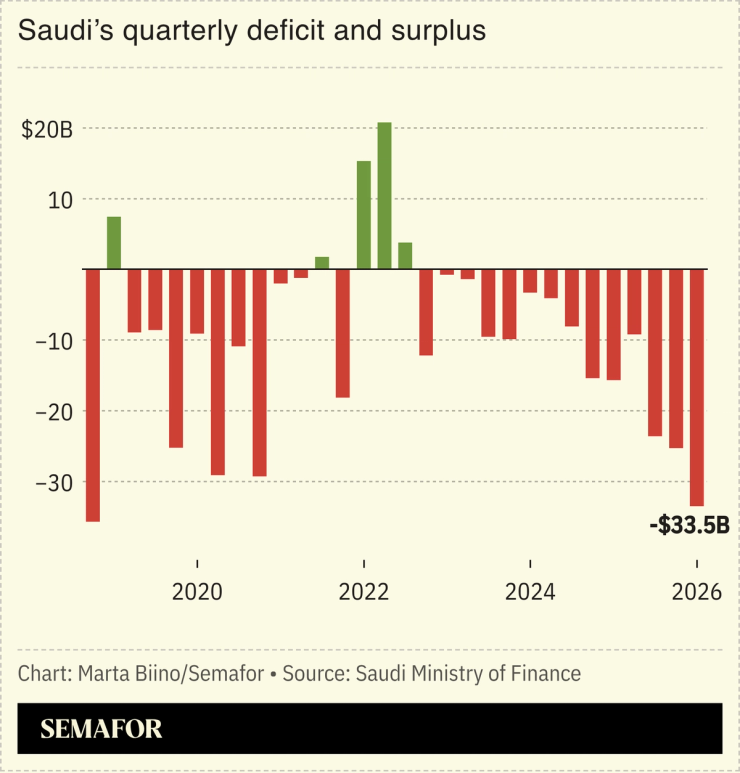
A chart showing Saudi Arabia’s quarterly deficit.