




惯性聚合 高效追踪和阅读你感兴趣的博客、新闻、科技资讯
阅读原文 在惯性聚合中打开

推荐订阅源

爱范儿
爱范儿
H
Help Net Security
Jina AI
Jina AI
T
The Blog of Author Tim Ferriss
宝玉的分享
宝玉的分享
博客园 - 叶小钗
Y
Y Combinator Blog
罗磊的独立博客
大猫的无限游戏
大猫的无限游戏
WordPress大学
WordPress大学
C
Check Point Blog
Recent Announcements
IT之家
IT之家
奇客Solidot–传递最新科技情报
奇客Solidot–传递最新科技情报
美团技术团队
云风的 BLOG
云风的 BLOG
雷峰网
雷峰网
H
Hackread – Cybersecurity News, Data Breaches, AI and More
S
SegmentFault 最新的问题
MyScale Blog
MyScale Blog
Apple Machine Learning Research
Microsoft Azure Blog
V
Visual Studio Blog
B
Blog

Semafor

US inflation jumps, though long-term war impact yet to be seen Hospitals consider replacing some radiologists with AI Amazon takes a jab at Nvidia over chips shift VCs step in to fund university upstarts Exclusive: Anthropic is gaining on OpenAI’s revenue, but hasn’t yet eclipsed it Exclusive: AI powerhouses threaten data processing firms A South African artist is changing the way viewers understand Picasso’s Guernica Airbnb faces familiar battle in Cape Town First look at war-related inflation sparks political jostling View: China’s state businesses are reshaping markets in Africa US issues Nigeria travel warning over terrorism, kidnapping FirstRand exits UK business after regulatory hit Afreximbank’s $800M answer to Fitch Exclusive: Navy takes nuclear-powered sub offline after $800 million cost run-up Cuba leader says he will not step down Fed, Treasury summon Wall Street chiefs over AI fears How Bluesky earned its reputation — and why it could be the way of the future China eyes stronger Taiwan influence Orbán slams Hungary’s opposition as he trails in polls Iran war reshapes air travel, perhaps for the long term Tehran residents embrace calm amid tenuous truce Countries lack fiscal capacity to handle war fallout Higher producer prices ease China deflation fears Trump ‘optimistic’ on Iran peace talks Inside the five-year succession plan at a $130B warehouse giant Georges Elhedery on HSBC’s big bets on the Gulf and Asia Warsh’s Fed hearing slips past next week Moore takes on the Sun’s ‘MAGA billionaire’ and more Debatable: AI titans influencing regulation Americans still think taxes are too high, poll finds
Expect more tech layoffs
Reed Albergo · 2026-04-25 · via Semafor

In the past, when tech companies laid off employees, the markets reacted approvingly.

Cutting costs means more profit. But in the upside-down world we live in, Microsoft and Meta both suffered on Wall Street Thursday after news of their layoffs broke. Microsoft closed down nearly 4%, while Meta lost more than 2% (though both were starting to recover Friday).

If you look at this like the layoffs were a desperate move to trade employees for data centers, you might argue the sell-off makes sense.

The truth is that Microsoft, Meta, and other tech giants aren’t really giving up other revenue opportunities when they jettison employees. What they are giving up is padding that makes recruiting a little less painful and expensive.

Tech companies had such rapid growth over the past decade that they were in constant battles for talent with one another. At one point, they even had a “no poaching” agreement in place so they could bring down costs and salaries of employees.

These were the absolute most profitable companies in human history. They had such high margins that they could afford to keep employees around, even if they weren’t really needed. And so they did. The market has yet to come to terms with how few employees tech companies actually need to keep the cash spigots flowing.

Elon Musk said he cut X’s staff by 80%, for instance, and it’s still humming along.

Cutting staff is just one lever tech companies can pull to pay for the $100 billion-per-year data center bills they’re now fielding.

We should expect to see more layoffs, and it’s a good thing for the tech ecosystem. Talent hoarding always had a negative impact. Some of those employees will found startups, and some of those that were laid off will go work for the startups. Big tech companies will be forced to innovate or face disruption — just the way it should be.
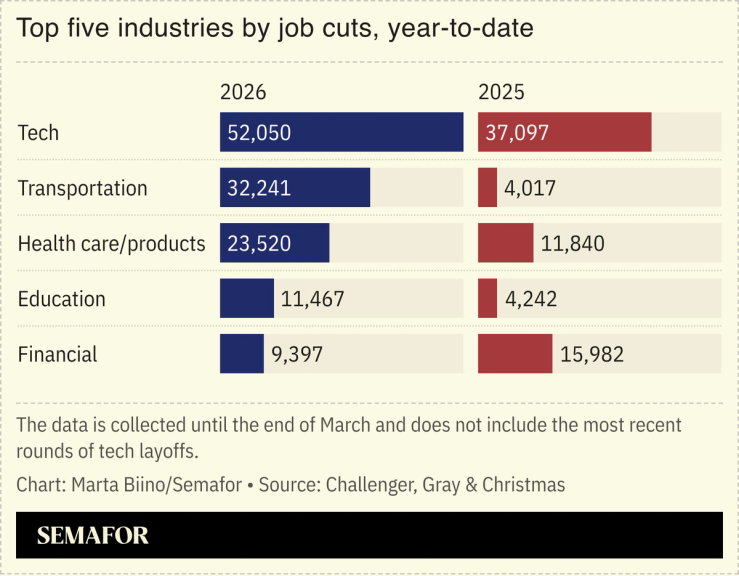
A chart showing a comparison of job cuts in 2026 vs 2025.