


Federal campaigns keep influencer spending secret, taking advantage of a gap between the authority of the Federal Trade Commission — which polices stealth advertising — and the barely functional Federal Elections Commission, which nominally polices political spending.
A wave of disclosures of Steyer’s influencer spending on social media and Substack appears to have been promoted by California’s strict campaign rules — and, perhaps, an embarrassing longread by The New York Times’s Ken Bensinger earlier this month. Now, these disclosures are offering the clearest window yet into how well-resourced modern political campaigns are deploying content creators.
Going into the race, Steyer’s team had a broadcast media plan backed up by a significant war chest. But the campaign believed that digital channels were going to be a very important piece of his campaign strategy, and not just due to changing media habits that have shifted TV eyeballs to phone screens. Steyer is 68, a liability in a post-Biden Democratic party, and is a hedge fund billionaire attempting to run on economic populism.
So the Steyer campaign and its advisers devised a series of outreach efforts to win over left-leaning influencers.
First, the campaign set up meet-and-greets with content creators to get to know Steyer personally, at one point inviting along a Washington Post reporter. Steyer’s campaign hired creator management agencies and Group Project Digital, its primary firm, to lead its strategic communications online. Group Project set up a marketplace on Side Shift, an open-market platform that connects digital content creators and brands and organizations looking to leverage creators for paid messaging.
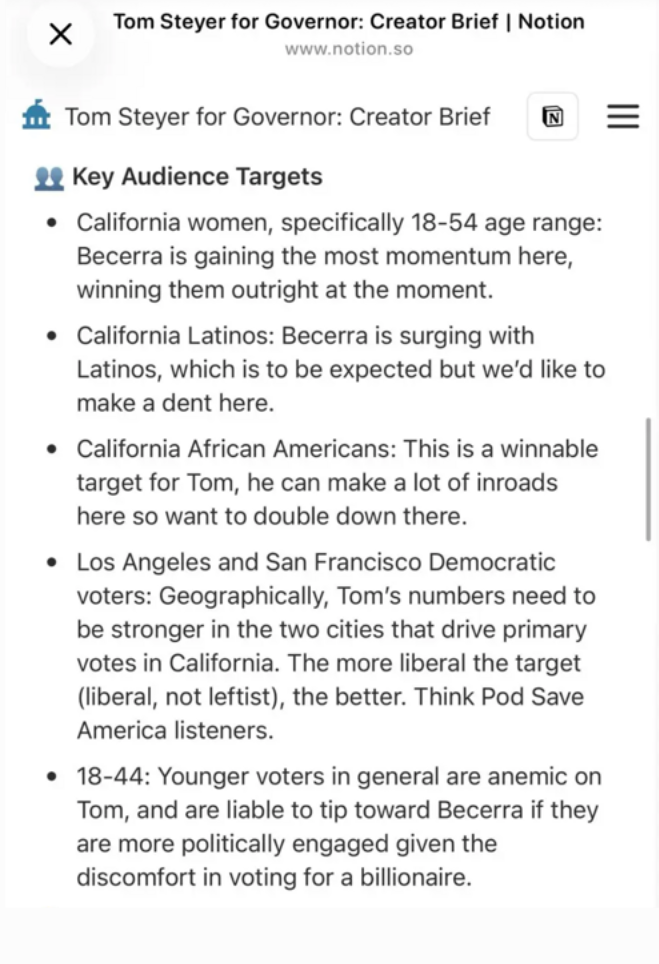
The campaign and its firms passed along guidance to the influencers. A brief shared with Semafor lists issues Steyer wanted creators to highlight, including his policy plans for taxes, housing, and combating federal immigration enforcement, among other issues. It also included sample content, and audiences he was hoping to reach. His key demos: primarily 18-54-year-old women, Black voters, liberals in the LA and San Francisco metro areas (“The more liberal the target - liberal, not leftist - the better. Think Pod Save America listeners,” the brief said), and young voters (who “in general are anemic toward Tom and are liable to tip toward [Xavier] Becerra if they are more politically engaged”).
In a bizarre twist, fake enthusiasm for Steyer has spread beyond direct payments to influencers. Engagement-farming social media accounts have sometimes scooped up pro-Steyer posts and reshared them as their own. The Foos Gone Wild pro-Steyer post was picked up and recirculated by a series of slop accounts across the world. A dozen Instagram accounts with millions of followers also simultaneously shared a different anti-Becerra meme/clip with slightly altered branding all at the same time.
Complaints about these posts sparked an investigation by California’s Fair Political Practices Commission into whether the Steyer campaign violated state transparency rules.
Steyer’s campaign has denied those accusations. A spokesperson told Semafor that influencers were told to include disclosures in their posts, and that the onus to disclose was on the content creators themselves.
It’s not clear that it matters whether the slop accounts that reshared pro-Steyer posts were paid or not. They may have just been farming engagement; they’re filled with a random assortment of content ranging from football memes to unchecked health claims clearly designed to go viral.
The Steyer campaign has sought to argue his main opponent is engaging in even more deceptive tactics. The campaign shared with Semafor a brief by a service that promises to identify fake accounts, Cyabra, suggesting there was a “cross-platform influence campaign” to target him and boost Becerra, synchronizing messaging from content creators and thousands of fake accounts to “artificially shape public discourse” against the billionaire candidate.
“Cyabra’s analysis indicates that the fake profiles involved in the anti-Steyer campaign were part of a broader recurring political influence network that had already operated together in previous U.S. political conversations,” a report from the Steyer campaign shared with Semafor said.
Payments to the real accounts Cyabra points to, however, do not appear on Becerra’s financial disclosure forms.
此内容由惯性聚合(RSS阅读器)自动聚合整理,仅供阅读参考。 原文来自 — 版权归原作者所有。