





Riyadh doesn’t feel like a city bracing for crisis.
Stuck in rush-hour traffic this week, it was easy to forget that the Gulf is in the middle of a conflict that has upended the world economy and the region’s own prospects. Malls are relatively busy. At one restaurant, a Western family sat at the next table. At another, it was a group of men from Qatar. Consumer spending has held up and inflation has barely budged, official data show. Bankers told me that money outflows have not been out of the ordinary.
That was the impression I left with after a week in Riyadh speaking with bankers, economists, and people familiar with the kingdom’s decision-making. A lot could still go wrong in the Iran war, but I’m more optimistic than I expected about how Saudi Arabia is navigating the war.
That resilience isn’t down to a single factor, though some are more important than others. A decade into Vision 2030, the Saudi economy is more diversified than in years past, but oil remains its key anchor. That’s why the kingdom’s ability to redirect the bulk of crude exports away from the Strait of Hormuz through the East-West pipeline has acted as a critical buffer — not just for its own economy, but for global markets. Authorities have also moved quickly to reinforce alternative supply routes through Red Sea ports, helping maintain the flow of goods into the kingdom and across parts of the Gulf.
That helps explain why downward revisions to Saudi growth outlook have been less pronounced than most Gulf economies. And despite limits to exports, higher oil prices are also working in Riyadh’s favor: The World Bank now expects Saudi Arabia’s budget deficit to narrow significantly to 3% of GDP this year.
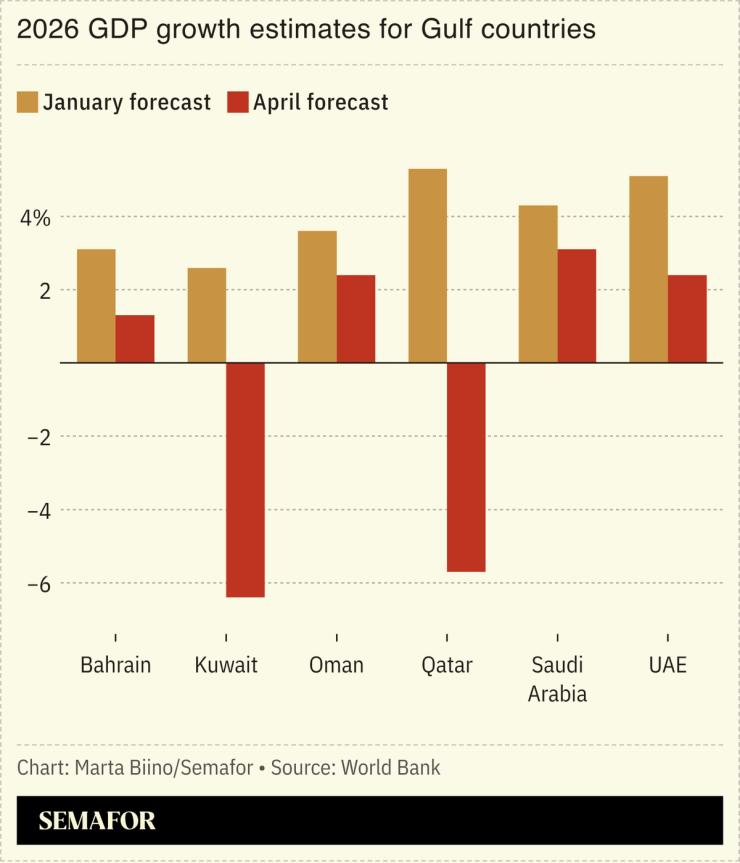
Still, there are signs of strain. Business leaders have understandably shifted into a wait-and-see mode. Purchasing managers’ data slipped into contraction last month for the first time since the pandemic. High-profile events have been delayed.
How long uncertainty will prevail depends on the war’s intensity and duration. An imminent resolution would leave Saudi Arabia well placed to recover faster than others, with the government having enough fiscal space to support non-oil activity if necessary. The risk of escalation, however, hasn’t gone away. And neither have concerns that US President Donald Trump could end the war without breaking Iran’s hold on the Strait of Hormuz, or ensuring Tehran can no longer pose security threats to its neighbors.
Managing those concerns has required a delicate balance between asserting priorities while setting a high bar for direct involvement. This explains why Riyadh has resisted calls to retaliate against Iranian attacks, focusing instead on using its close ties with US and Pakistan — the key mediator between Washington and Tehran — to influence any negotiated outcome. It has also activated its 2025 defense pact with Pakistan, the Muslim world’s only nuclear power.
At the same time, Saudi officials insist the conflict will not derail diversification. “The current disruption will not interrupt our plans,” Finance Minister Mohammed Al Jadaan said during the IMF’s annual meetings last week. “We are focused on making sure that our plans continue.”
The people I spoke with in Riyadh expect the kingdom to become more selective about where it spends its money, balancing national ambitions with fiscal constraints. The top priorities include AI, logistics, Expo 2030, and the FIFA men’s World Cup in 2034.
That logic was clear in Public Investment Fund’s new 2026-2030 strategy. The plan marks a transition from “rapid growth to sustained value creation.”
NEOM is a case in point. While it remains key to Vision 2030, the project is being restructured to focus on more commercially viable components. In an interview with Al Arabiya, PIF Governor Yasir Al-Rumayyan, said NEOM will prioritize things like the industrial city of Oxagon, which includes an operational port, at the expense of The Line, the project’s previous centerpiece. “Is it necessary to deliver The Line in 2030? I don’t think so,” he said.
The strategy also signals a deliberate effort to encourage foreign direct investment and more private capital. Bankers say liquidity pressures in the system are easing, raising hopes that businesses may invest because they see opportunity rather than wanting a contract from PIF.
That wasn’t going to be straightforward even before the war. Economists note that 2026 was always going to be a transitional year as the kingdom enters the final stretch of Vision 2030. The conflict has further clouded the outlook for private investments, which could make the adjustment tricker.
Officials, however, insist the broader strategy remains intact. Speaking in Washington, Al Jadaan also confirmed what I saw in Riyadh. “If one ignores a lot of the noise, you see what’s happening in day-to-day life,” he said. “If you go to people in Riyadh, they largely didn’t feel that there was a war.”
Alaa Shahine Salha is a senior executive at Saudi Research & Media Group and an economics contributor for Asharq Business with Bloomberg. He previously served as Bloomberg News managing editor for the Middle East and managing editor for economics in Europe.
此内容由惯性聚合(RSS阅读器)自动聚合整理,仅供阅读参考。 原文来自 — 版权归原作者所有。