






Acer Inc. is a Taiwanese multinational corporation founded in 1976, globally recognized for its vast PC-related portfolio. For gamers, Acer maintains strong market presence in laptops, monitors, and gaming peripherals under the Predator brand. Nonetheless, the company has not previously ventured into power supply manufacturing. The Predator GX850 represents Acer's first PSU offering, demonstrating a willingness to diversify into every segment of the market and provide holistic solutions to gamers and enthusiasts.
This review examines the Predator GX850 to see if how it ranks among best power supplies in the market today. It is an 850W SFX PSU primarily released to complement Acer’s one and only Predator MI900 case. The unit delivers substantial power output from the standard 100mm SFX form factor, representing impressive power density through established circuit topology and maintaining compatibility with any SFX-compliant case. It is an ATX 3.0 certified product, ensuring compatibility with modern graphics cards which Acer also markets under their own brand.
Specifications and Design
Swipe to scroll horizontally
RAIL | +3.3V | +5V | +12V | +5Vsb | -12V |
MAX OUTPUT | 20A | 20A | 70.83A | 2.5A | 0.3A |
| Row 2 - Cell 0 | 120W | 120W | 850W | 12.5W | 3.6W |
TOTAL | 850W | Row 3 - Cell 2 | Row 3 - Cell 3 | Row 3 - Cell 4 | Row 3 - Cell 5 |
AC INPUT | 100 - 240 VAC, 50 - 60 Hz | Row 4 - Cell 2 | Row 4 - Cell 3 | Row 4 - Cell 4 | Row 4 - Cell 5 |
MSRP | $150 | Row 5 - Cell 2 | Row 5 - Cell 3 | Row 5 - Cell 4 | Row 5 - Cell 5 |
In the Box
The Acer Predator GX850 arrives in sturdy cardboard packaging that could be mistaken for an ATX unit if not for the image dominating the front side. A predominantly black design with bluish accents establishes the brand identity. Protection proves adequate, with the PSU enclosed in a nylon bag and foam inserts providing shock absorption during transport.

The bundle is conservative but of appropriate scope for an SFX unit. Acer includes the essential AC power cable and mounting screws. An SFX to ATX mounting plate adapter enables installation in standard ATX chassis and a jump start testing adapter allows for power up verification. Note that the cables of this unit are short and may not reach the components in a very large ATX case.

All cables feature all-black aesthetics with black connectors and wires. Nearly all cables employ flat ribbon construction, reducing cable management challenges in confined spaces. Only the 12VHPWR cable receives individual sleeving treatment, which can be seen either as a highlight or a visual dissonance. The connector count proves conservative but not unwarranted for an SFX unit designed to feed powerful components rather than numerous peripherals. Users planning heavily populated systems may find the selection limiting though this rarely presents issues in genuine SFX chassis deployments.

Swipe to scroll horizontally
Connector type | Hardwired | Modular |
ATX 24 Pin | - | 1 |
EPS 4+4 Pin | - | 1 |
EPS 8 Pin | - | 1 |
PCI-E 5.0 | - | 1 |
PCI-E 8 Pin | - | 2 |
SATA | - | 5 |
Molex | - | 2 |
Floppy | - | - |
External Appearance
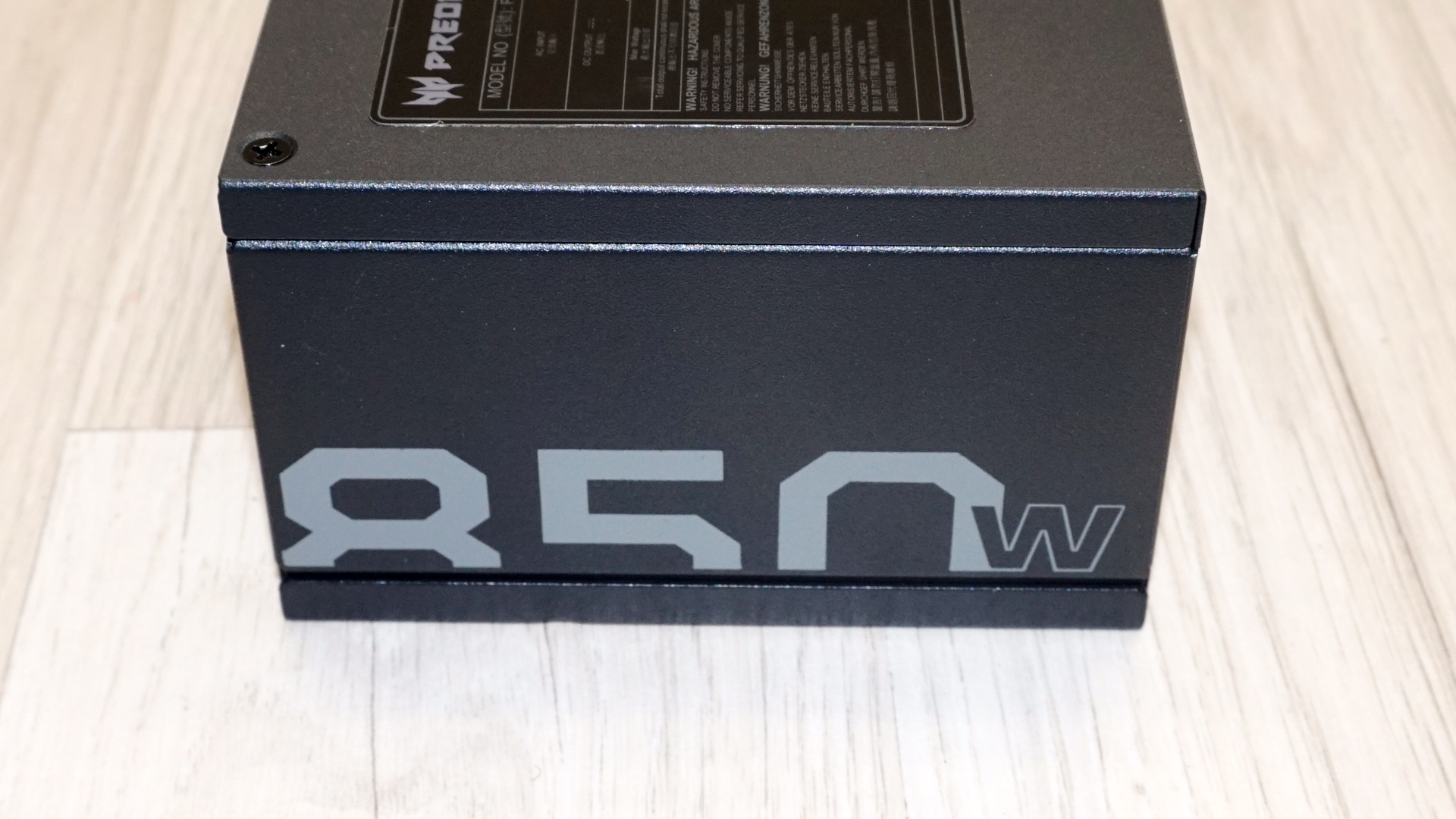
The Acer Predator GX850 measures precisely 100mm in length, conforming exactly to standard SFX specifications. This by the book sizing ensures universal compatibility with SFX cases while delivering impressive power density. The finish of the matte black chassis paint is excellent.

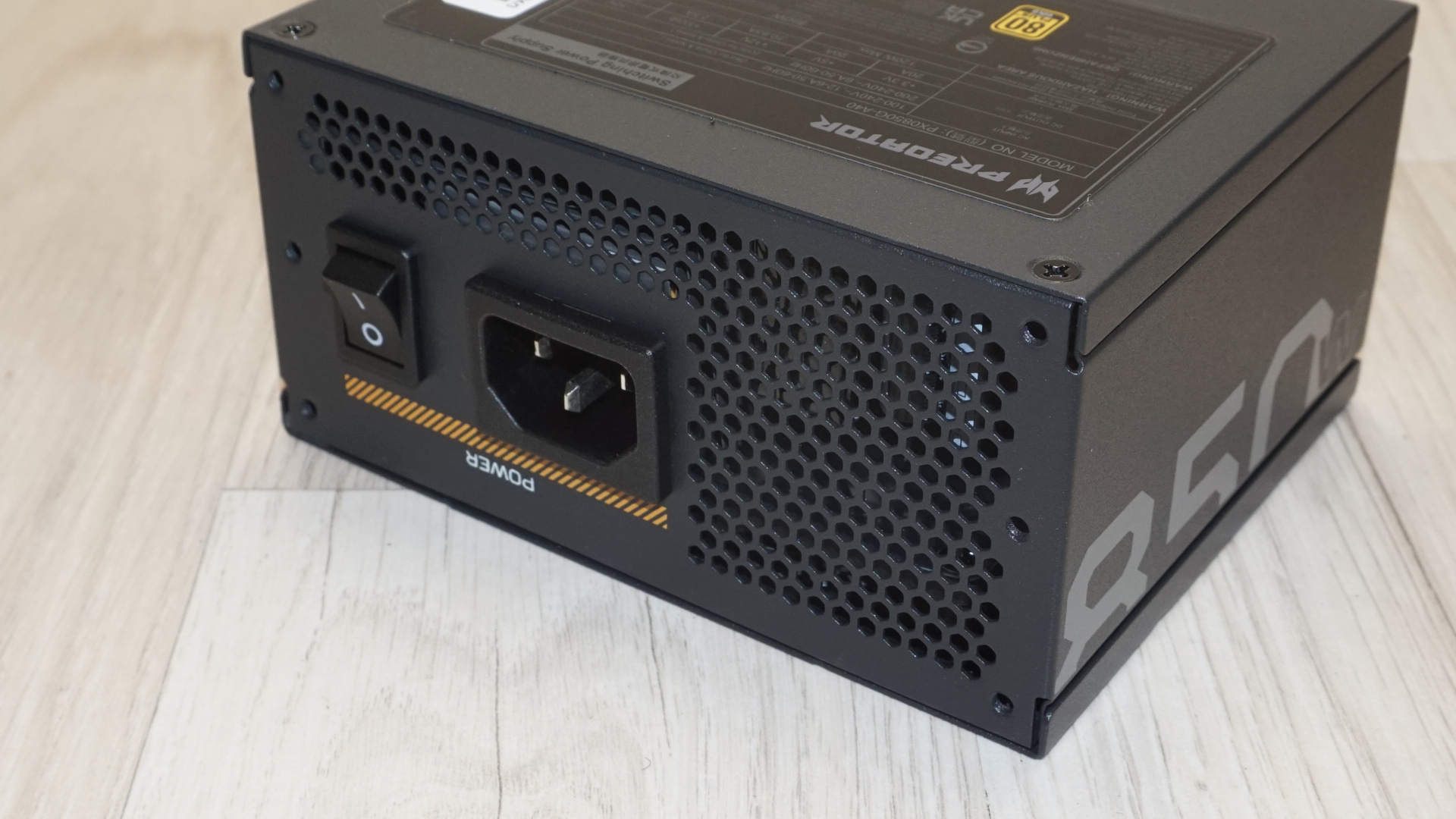
The design is utilitarian, forgoing substantial aesthetic modifications. A basic circular wire finger guard protects the 92mm intake fan. Etched or painted details including the series logo and wattage rating replace traditional stickers, improving aesthetics. A comprehensive electrical specifications sticker covers the top surface.
Image
1
of
2
The front hosts the standard IEC C14 power receptacle alongside a power switch. The rear is home to the modular cable connectors. If not for the painted accents and subtle legend, nothing would hint that this is a premium product from just looking at it.
Image
1
of
2
Internal Design
The Acer Predator GX850 employs a 92mm Power Logic fan utilizing double ball bearing construction. Double ball bearing designs prioritize longevity and high temperature operation over acoustic performance, which makes them a very reasonable choice for compact high-power units with lengthy warranties. The fan has an extremely high maximum speed of 3500 RPM.

FSP Group serves as OEM, bringing decades of power supply expertise to Acer's first product. The platform appears derived from FSP's Dagger series with modifications for ATX 3.0 compliance. Internal layout showcases remarkably dense component placement, pushing boundaries of what fits within SFX dimensions while maintaining 850W capability. Build quality proves very good with no noteworthy manufacturing imperfections evident despite extremely compact design.
Image
1
of
2
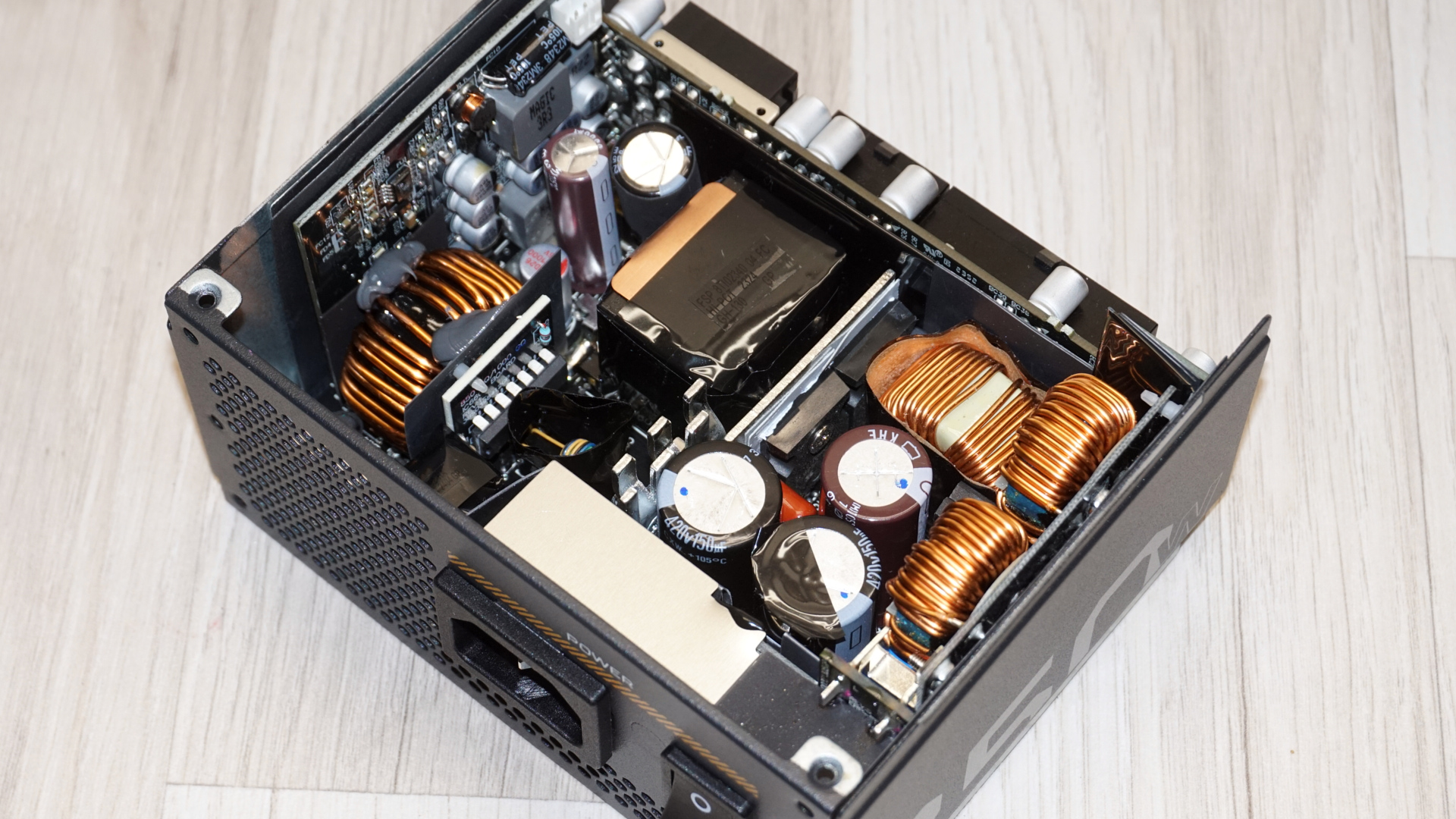
The input filtering stage provides adequate protection with two Y capacitors, two X capacitors, and three filtering inductors. FSP splits filtering components between the main PCB and a daughterboard mounted behind the AC receptacle, optimizing space utilization. Two rectifying bridges sit sandwiched together without dedicated heatsinking, primarily relying on ambient airflow.

The APFC circuitry employs two Vishay G120N60E MOSFETs positioned on a compact heatsink, paired with two diodes on the main board. One inductor and three capacitors comprise passive components: one Nippon Chemi-Con 120μF unit and two Rubycon 150μF capacitors. This configuration provides sufficient energy storage for the power level while maintaining compact dimensions.

The primary stage employs two Infineon 8R310CE MOSFETs plus a reset MOSFET, forming Active Clamp Reset Forward topology. These mount to a small heatsink positioned adjacent to APFC capacitors. ACRF topology offers advantages in efficiency and component stress reduction compared to traditional forward converter designs, particularly relevant in high power density applications where thermal management proves challenging.

The secondary stage utilizes six Toshiba TPH1R306PL MOSFETs on the main PCB, generating the 12V rail through synchronous rectification. These are using the body of the PSU itself as a heatsink. Absence of advanced cooling for these components indicates high efficiency characteristics, as low resistance devices generate minimal heat even under full load. Separate DC to DC converter circuits derive 3.3V and 5V rails from primary 12V output, standard approach in modern PSU designs.

Capacitor selection demonstrates quality awareness. Nippon Chemi-Con and Rubycon, both premium Japanese manufacturers, supply all secondary side electrolytic capacitors. APAQ provides polymer capacitors, representing reputable Taiwanese manufacturer with solid reliability records. Acer's marketing emphasizes Japanese capacitors for optimal performance, though APAQ inclusion slightly contradicts this messaging. Nevertheless, APAQ produces quality parts that should perform reliably within specifications.
Cold Test Results
Cold Test Results (25°C Ambient)
For the testing of PSUs, we are using high precision electronic loads with a maximum power draw of 2700 Watts, a Rigol DS5042M 40 MHz oscilloscope, an Extech 380803 power analyzer, two high precision UNI-T UT-325 digital thermometers, an Extech HD600 SPL meter, a self-designed hotbox and various other bits and parts.
Image
1
of
5
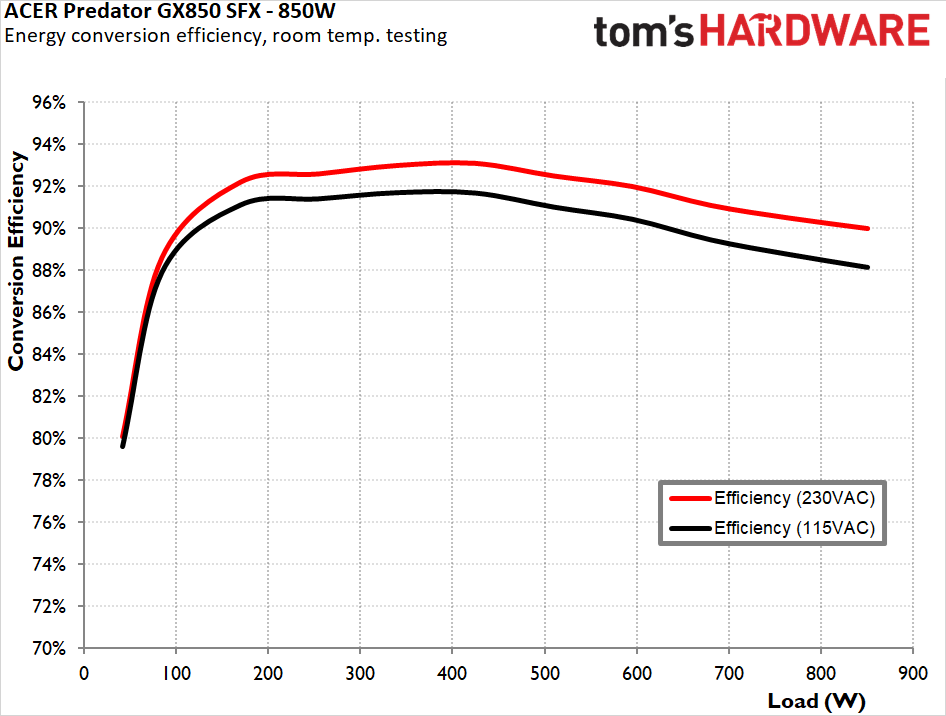
The Acer Predator GX850 achieves average nominal load efficiency of 90.1% with 115 VAC input and 91.6% with 230 VAC input, measured across the standard load range. These results satisfy 80 Plus Gold certification requirements with 115 VAC input. With 230 VAC input, the unit should receive the identical Gold certification as efficiency matches standard requirements. The unit lacks Cybenetics or PPLP certifications at review time, which seems puzzling given the strong average efficiency figures that would likely earn favorable ratings. Efficiency peaks at approximately 50% load and maintains relative stability across most operational ranges. Low load efficiency proves good.
The fan remains inactive until load exceeds approximately 220 watts, providing silent operation during light usage. Fan speed increases in distinct steps rather than smooth curves. First transition occurs at 450 to 500 watts, rendering the unit audible. Second step at 700 watts brings clearly noticeable noise levels. This stepped behavior suggests fan curve relies solely on internal temperature sensors without much of environmental awareness.
Hot Test Results
Hot Test Results (~45°C Ambient)
During elevated ambient temperature testing, the Acer Predator GX850 exhibits measurable but not excessive efficiency degradation. Average nominal load efficiency drops to 88.2% with 115 VAC input and 89.6% with 230 VAC input. Signs of thermal stress appear when the unit is heavily loaded. For an SFX unit operating in confined spaces with limited airflow, this thermal performance can be defined as acceptable.
Image
1
of
5
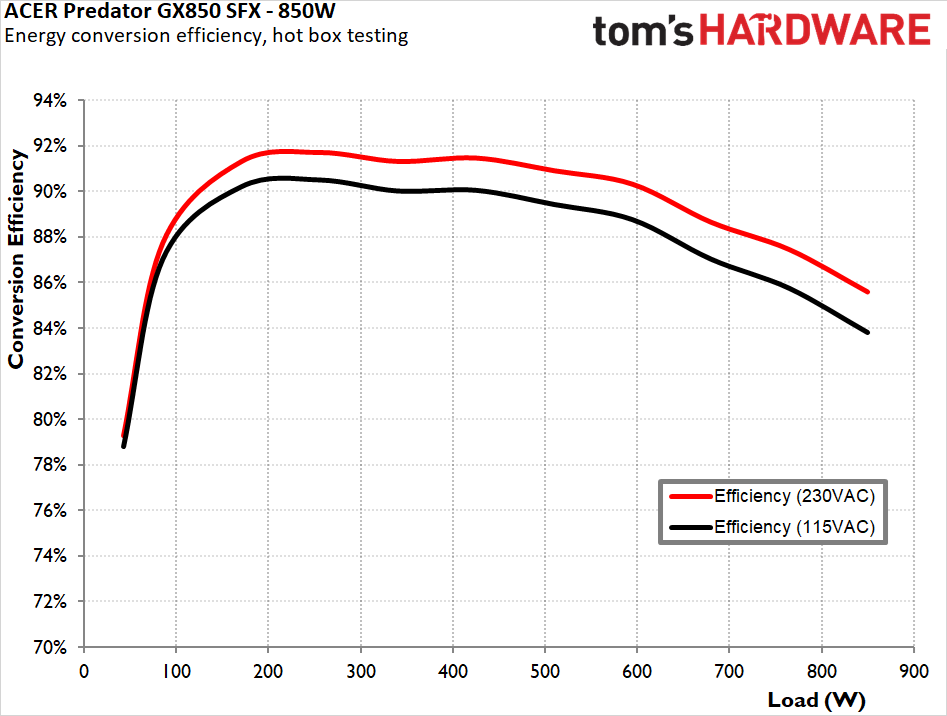
Fan behavior maintains the same stepped pattern as cold testing, as if entirely unaware of ambient conditions. However, the fan spins slightly faster at each step under elevated temperatures, making the unit somehow even louder than during ambient testing. Internal temperatures get high but remain within acceptable limits for a compact unit rated for 40°C operation.
PSU Quality and Bottom Line
Power Supply Quality
The Acer Predator GX850 demonstrates good power quality performance. Maximum ripple measured 40 mV on the 12V rail, 28 mV on the 5V rail, and 26 mV on the 3.3V rail. All values sit well below ATX specification limits. The platform exhibits characteristic FSP behavior of slightly elevated ripple under very light loads. Voltage regulation measures solidly across all rails. The 12V rail exhibits 1.0% regulation, while 5V and 3.3V rails register 1.2% and 1.1% respectively. These figures represent good performance though they fall slightly short of sub 1% regulation that characterizes top tier units. For practical applications, the difference is inconsequential. Overall power quality remains very good across the operating range.
During our thorough assessment, we evaluate the essential protection features of every power supply unit we review, including Over Current Protection (OCP), Over Voltage Protection (OVP), Over Power Protection (OPP), and Short Circuit Protection (SCP).
OCP activates at 144% on the 3.3V rail, 148% on the 5V rail, and 120% on the 12V rail. OPP triggers at 118% during hot testing. Protection circuit responses prove appropriate. The greatly relaxed limits on minor rails suggest their circuits carry some underrating margin.
Swipe to scroll horizontally
Load (Watts) | 173.15 W | 432.17 W | 643.35 W | 856.31 W | ||||
Load (Percent) | 20.37% | 50.84% | 75.69% | 100.74% | ||||
| Row 2 - Cell 0 | Amperes | Volts | Amperes | Volts | Amperes | Volts | Amperes | Volts |
3.3 V | 1.82 | 3.45 | 4.56 | 3.44 | 6.83 | 3.42 | 9.11 | 3.41 |
5 V | 1.82 | 5.15 | 4.56 | 5.14 | 6.83 | 5.1 | 9.11 | 5.09 |
12 V | 12.91 | 12.2 | 32.27 | 12.18 | 48.4 | 12.09 | 64.53 | 12.07 |
Swipe to scroll horizontally
Line | Regulation | Voltage Ripple (mV) | Header Cell - Column 3 | Header Cell - Column 4 | Header Cell - Column 5 | Header Cell - Column 6 | Header Cell - Column 7 |
|---|---|---|---|---|---|---|---|
| Row 0 - Cell 0 | (20% to 100% load) | 20% Load | 50% Load | 75% Load | 100% Load | CL 12V | CL2 3.3V + 5V |
3.3V | 1.10% | 14 | 16 | 22 | 26 | 16 | 26 |
5V | 1.20% | 14 | 18 | 22 | 28 | 16 | 26 |
12V | 1% | 30 | 22 | 28 | 40 | 32 | 34 |
Bottom Line
The Acer Predator GX850 represents competent entry into the power supply market, leveraging FSP's considerable engineering expertise to deliver 850 watts in challenging SFX form factor. The unit demonstrates solid electrical performance with good efficiency, good ripple suppression, and appropriate voltage regulation. Component selection emphasizes quality with premium capacitors and reliable active components. Build quality proves very good with no manufacturing imperfections evident despite extremely compact and densely populated internal design.

Although the table configuration is conservative, it is more than appropriate for SFX applications. The flat ribbon cables reduce cable management challenges though the individually sleeved 12VHPWR cable stands apart aesthetically. The SFX to ATX mounting bracket expands compatibility to standard ATX chassis though cable lengths suit only compact installations. Component selection demonstrates quality awareness. Vishay and Infineon MOSFETs represent established names with proven track records. Rubycon and Nippon Chemi-Con APFC and secondary capacitors confirm commitment to reliability, though APAQ polymer capacitor inclusion contradicts marketing emphasis on exclusively Japanese components. Nevertheless, APAQ produces very high quality parts. The ACRF topology represents modern design reducing component stress. Component selection supports reliable long term operation convincingly.
Electrical performance easily satisfies expectations for an 80Plus Gold unit but without reaching exceptional territory. Cold testing efficiency of 90.1% with 115 VAC and 91.6% with 230 VAC comfortably exceeds Gold-level requirements. Hot testing reveals a calculable efficiency degradation to 88.2% and 89.6% respectively, with subtle thermal stress signs appearing only at maximum load. Figures remain within acceptable parameters for a unit rated at 40°C.

Thermal management proves adequate for specification compliance though acoustic performance suffers during sustained moderate to high loads. The 100mm form factor paired with a 92mm fan operating at extremely high maximum speed creates inherent cooling challenges. The fan remains inactive until approximately 220 watts load, contributing to excellent low-load acoustics. The stepped fan control approach produces distinct acoustic transitions rather than gradual changes. Loads exceeding 700 watts produce clearly noticeable noise levels. Under elevated ambient temperatures, the pattern persists with slightly elevated speeds throughout. Internal temperatures prove high under maximum load hot testing conditions but remain manageable. For a gaming system that will be pushing 40-60% load most of the time while gaming, the Predator GX850 will work like a charm.
For a first-generation PSU from a company without previous power supply market presence, Acer delivers a competent and fundamentally sound product through partnership with FSP. The unit succeeds in delivering substantial power density without compromising electrical performance quality, demonstrating good engineering execution throughout. Pricing at approximately $150 positions it competitively within the SFX market, though established alternatives occasionally offer similar specifications at slightly lower prices. The product serves buyers seeking brand ecosystem cohesion, those valuing FSP's proven platform design, or builders requiring reliable 850W output in SFX form. Value assessment depends on brand preferences, current market pricing, and willingness to accept audible cooling during moderate to heavy loads, though the unit represents a solid choice for its intended application.
MORE: Best Power Supplies
MORE: How We Test Power Supplies
MORE: All Power Supply Content