


惯性聚合 高效追踪和阅读你感兴趣的博客、新闻、科技资讯
阅读原文 在惯性聚合中打开

推荐订阅源

Y
Y Combinator Blog
博客园_首页
雷峰网
雷峰网
V
V2EX
博客园 - 司徒正美
奇客Solidot–传递最新科技情报
奇客Solidot–传递最新科技情报
博客园 - Franky
月光博客
月光博客
Hugging Face - Blog
Hugging Face - Blog
WordPress大学
WordPress大学
T
Tailwind CSS Blog
小众软件
小众软件
博客园 - 叶小钗
美团技术团队
酷 壳 – CoolShell
酷 壳 – CoolShell
Apple Machine Learning Research
IT之家
IT之家
MyScale Blog
MyScale Blog
Blog — PlanetScale
Blog — PlanetScale
大猫的无限游戏
大猫的无限游戏
Jina AI
Jina AI
人人都是产品经理
人人都是产品经理
H
Help Net Security
OSCHINA 社区最新新闻
OSCHINA 社区最新新闻

Latest from Tom's Hardware

Our experts review your astonishing PC builds and setups in Rig Rundown — from wall-mounted setups to a system… News outlets are blocking Wayback Machine from archiving their pages — 23 outlets concerned AI companies might abuse fair use and use it to train their models Mark Zuckerberg reportedly working on AI clone of himself — Meta insiders claim 3D photoreal animated Zuck will be able to engage with employees on his behalf Score a massive $700 off this 4K-ready Lenovo gaming PC with an RTX 5070 Ti, now just $1,899 — epic Legion Tower 5i pre-built ships with a 20-core Intel CPU, 32GB DDR5 and a 2TB SSD Pay $1,349.99 for Gigabyte's Aero X16 laptop and save $300 on this 32GB beast with RTX 5070 graphics —… Veteran Windows dev shows off AI running on 47-year-old PDP11 with 6 MHz CPU and 64KB of RAM — 'gloriously absurd' project runs transformer model written in PDP-11 assembly language Half of all US employees now use artificial intelligence at work, crossing landmark threshold for first time — Gallup data shows daily and weekly usage hitting all-time high of 28% in Q1 2026, with 65% feeling positive about its impact on productivity China has spent 3.6 times more than the US on chipmaking subsidies over the past decade — $142 billion and counting, easily outweighs CHIPS Act FAA approves military use of drone-killing laser weapons in US airspace — decision comes after it was decided ‘systems do not present an increased risk to the flying public’ Nvidia says AI cuts 10-month, eight-engineer GPU design task to overnight job — company is still 'a long way' from AI designing chips without human input Small Missouri town ousts half its city council after $6 billion AI data center approval — petition calls for mayor's removal as frustration (and violence) over AI data centers mounts New tech can see a CPU's transistors in action — terahertz radiation can potentially steal data as a chip is… Intel's Nova Lake CPUs gear up to seize AMD’s 3D V-Cache gaming throne — early leak points to up to 52 cores, blazing DDR5-8000 support, and massive 175W TDP Acer Predator GX850 SFX power supply review: Solid electrical performance with good efficiency NZXT to cough up $3.45 million over 'predatory' Flex PC rental scheme in RICO class-action settlement — in-debt customers to get up to $5,000 of relief, eligible renters to be granted ownership Bulbous 15x fan PC case side panel dubbed the ‘Superdome’ lowers temps by 20 degrees —  $600 worth of Noctua fans arrayed in 3D-printed structure Approvals for Nvidia and AMD AI chip exports to China stall under government bottleneck —  20% staff turnover… Espresso Lite 15 Review: An entry-level portable monitor with a splash of color Save a massive $700 on this 4K-ready HP gaming PC with a 9800X3D and RTX 5070 Ti, now just $2,499 — discounted HP Omen 35L pre-built powerhouse ships with 32GB DDR5 RAM and a 1TB SSD 'CopprLink' destroys every eGPU standard in new test, achieves near-native-level performance with an RTX 5090 — setup requires $2,300 worth of additional hardware Website backup crippled by 1.6MB Friends GIF that was replicated 246,173 times, breaking Linux's EXT4 filesystem limit — Jennifer Aniston's 'happy dance' animation ate up 377 gigabytes of data due to security policy Why we spent 50+ hours retesting Intel’s Core Ultra 270K Plus and 250K Plus Just $284.99 for 32GB of Team T-Create Classic DDR5-6000 RAM is the cheapest going right now — this double-dipping… Grab MSI’s RTX 5080 gaming laptop for just over $2,000 — offers fast 240 Hz QHD+ display, dual storage slots, and expandable DDR5 memory Lenovo hikes Legion Go 2 handheld gaming PC to almost $3,000 for 2 TB model — Handheld now costs more than AMD's Strix Halo devices despite relatively weaker Z2 Extreme chip Iran's forced nationwide internet blackout becomes second-longest on record as it passes 1,000 hours offline — possessing Starlink terminals punishable by death, country using 'military-grade jamming' against service Tiny 3-inch cube PCs bring a splash of color to the passive PC market with red, orange, green and blue options — Intel Twin Lake-powered Kubb Mini PCs start at $500 Veteran Microsoft engineer says original Task Manager was only 80KB so it could run smoothly on 90s computers — original utility used a smart technique to determine whether it was the only running instance Tech enthusiast gets Doom to run on a 40-year-old printer controller — ancient Agfa Compugraphic 9000PS came with a Motorola 68020 onboard for fast processing Keychron Q6 Ultra 8K Review: 660 hours of battery life at 8 KHz
Linux 7.1 update includes new in-kernel NTFS driver — del...
Zak Killian · 2026-04-20 · via Latest from Tom's Hardware
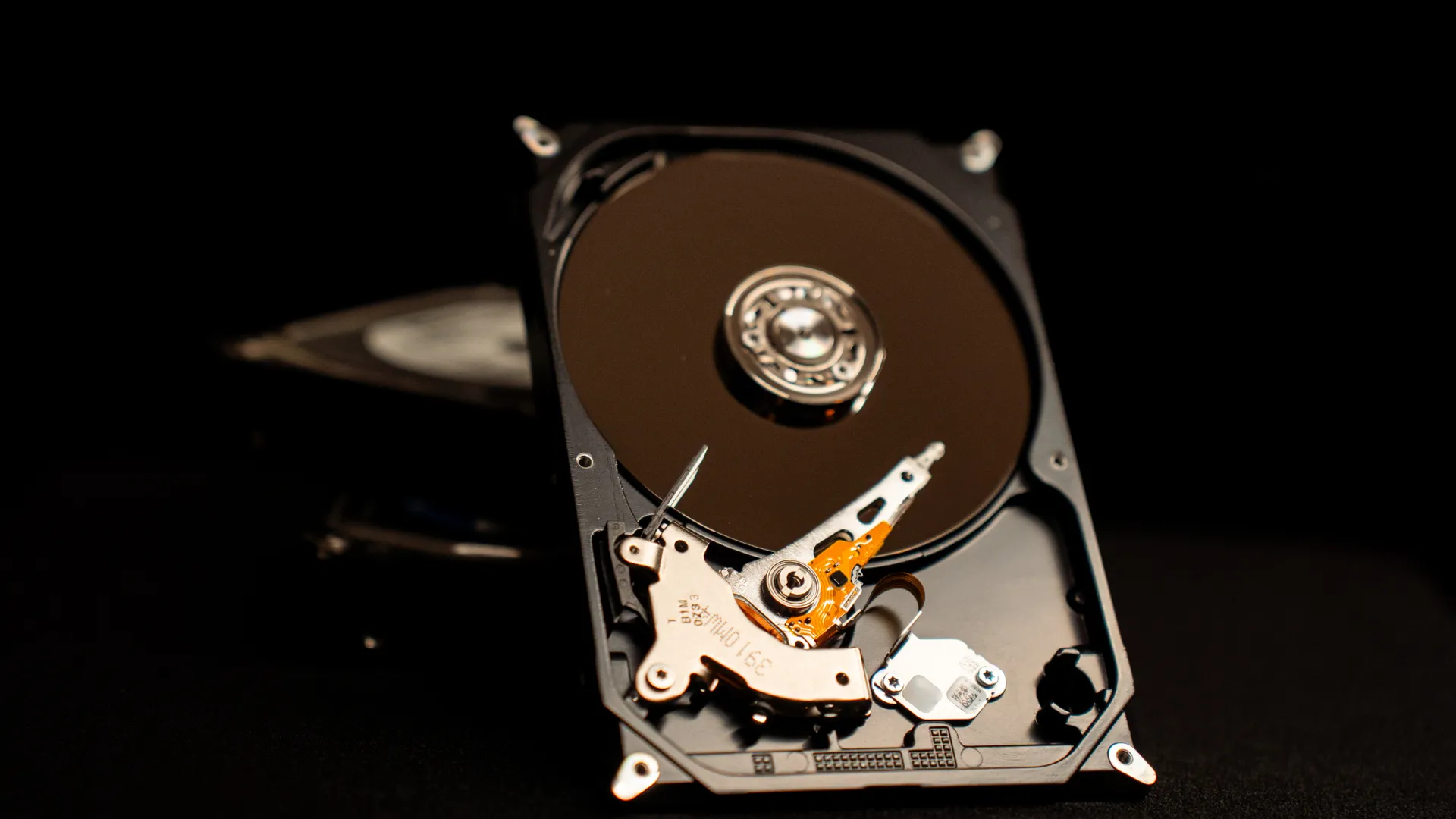
Hard drive
(Image credit: Getty Images / NurPhoto)

Linux 7.1 is bringing what might be the biggest under-the-radar storage change in years: a new in-kernel NTFS driver that finally treats Microsoft's filesystem like a native citizen instead of a tolerated guest. After years of half-solutions, including slow FUSE drivers and under-maintained kernel code, Linux users will finally get fast, reliable, and fully integrated NTFS support out of the box.

The headline feature under discussion here is a ground-up rework of NTFS support built directly into the kernel. Unlike the long-standing NTFS-3G driver, which runs in userspace via the "Filesystem in Userspace" (FUSE) module, or the more recent but somewhat neglected NTFS3 driver, this new implementation is designed around modern Linux filesystem infrastructure from day one.

That includes support for native in-kernel read/write operations, iomap (the same high-performance I/O path used by filesystems like XFS), folio-based memory management, removal of legacy buffer_head code, and delayed allocation for improved write efficiency. In practical terms, this isn't just "NTFS, but working again"; instead, it's Linux NTFS support rebuilt to behave like a contemporary Linux filesystem internally. It's a big philosophical shift from previous approaches that mostly treated NTFS support as a compatibility layer.

Microsoft's filesystem has always been unavoidable for Linux users in mixed environments; whether it's dual-boot setups, external drives, or just moving data between machines, support has existed, but it's never felt first-class. Historically, your options were the NTFS-3G driver, the newer NTFS3 driver, or the ancient kernel NTFS that was only capable of reading NTFS volumes, not writing them. NTFS-3G is stable, but it's slow due to userspace overhead, and the newer NTFS3 driver is faster, but has been largely unmaintained since it was added way back in Linux 5.15 in 2021.

The new driver in Linux 7.1 is actually based on that ancient NTFS kernel driver, but it's been fully rewritten from the ground up by developer Namjae Jeon, the very same genius behind the Linux exFAT driver. The original work was done under the name NTFSPlus before being merged simply as "ntfs" to replace the old driver. Thus, Linus Torvalds referred to the new driver as "NTFS resurrection" when announcing the merge.
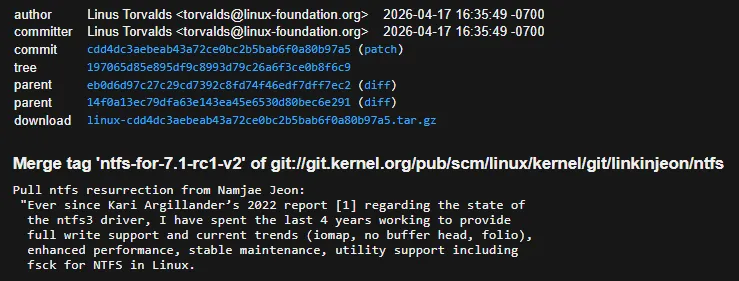
A screenshot of the Linux merge record adding the new Linux 7.1 ntfs driver to the kernel.

Linus Torvalds referred to Namjae Jeon's work as a "resurrection" of the old ntfs driver. (Image credit: Future)

If the new NTFS delivers, it removes one of the longest-standing friction points between Linux and Windows ecosystems. On paper, performance should improve, especially compared to NTFS-3G. Running in kernel space alone eliminates a lot of overhead from context switching, which has always been the Achilles' heel of FUSE-based filesystems. Add in iomap and newer memory handling, and the new driver should be noticeably better at large sequential reads and writes, with lower CPU overhead during file operations and more consistent throughput under load.

Compared to NTFS3, things are less clear-cut. The new driver is architecturally cleaner and more future-proof, but it's also new code, which means early releases may not immediately outperform NTFS3 in every scenario. However, the developer says single-threaded writes are 3-5% faster, while multi-threaded writes are between 35% and 110% faster. Mounting a 4TB drive apparently goes four times faster, too, which is promising.

Get Tom's Hardware's best news and in-depth reviews, straight to your inbox.

Of course, because it's new code, it comes with the usual risks. Edge cases, especially around less-commonly used NTFS features like advanced permissions, compression, or journaling quirks, may take time to fully stabilize. It's also worth noting that even with a perfect driver, NTFS itself isn't designed around Linux semantics, so while compatibility improves, it's not suddenly going to behave exactly like ext4 or XFS in every case. The new driver passes 326 xfstests, though, which is better than NTFS3's 273 passing results, so it's already more than reliable enough for most users.

Still, for years, NTFS on Linux has been in that awkward "good enough, but..." category. It worked, but it never felt clean. Linux 7.1 is the first time it looks like the kernel is taking NTFS seriously as something worth doing properly, rather than just supporting it out of necessity. If the new driver holds up and gets consistent maintenance, it could finally make NTFS a genuinely seamless bridge between Linux and Windows. If not, it risks becoming just another entry in the long history of "almost there" NTFS support on Linux.

Google Preferred Source

Follow Tom's Hardware on Google News, or add us as a preferred source, to get our latest news, analysis, & reviews in your feeds.

Zak is a freelance contributor to Tom's Hardware with decades of PC benchmarking experience who has also written for HotHardware and The Tech Report. A modern-day Renaissance man, he may not be an expert on anything, but he knows just a little about nearly everything.