

惯性聚合 高效追踪和阅读你感兴趣的博客、新闻、科技资讯
阅读原文 在惯性聚合中打开

推荐订阅源

Attack and Defense Labs
Threat Intelligence Blog | Flashpoint
The Hacker News
The Hacker News
C
Cyber Attacks, Cyber Crime and Cyber Security
A
Arctic Wolf
Recent Commits to openclaw:main
T
Troy Hunt's Blog
小众软件
小众软件
L
LangChain Blog
Schneier on Security
D
DataBreaches.Net
爱范儿
爱范儿
P
Proofpoint News Feed
博客园 - 聂微东
M
MIT News - Artificial intelligence
Hacker News: Ask HN
Hacker News: Ask HN
T
Tailwind CSS Blog
Vercel News
Vercel News
V
Visual Studio Blog
aimingoo的专栏
aimingoo的专栏
云风的 BLOG
云风的 BLOG
Jina AI
Jina AI
阮一峰的网络日志
阮一峰的网络日志
博客园 - 【当耐特】
博客园 - 三生石上(FineUI控件)
雷峰网
雷峰网
T
Threat Research - Cisco Blogs
Simon Willison's Weblog
月光博客
月光博客
Spread Privacy
Spread Privacy
C
Cisco Blogs
S
Securelist
量子位
S
Security @ Cisco Blogs
让小产品的独立变现更简单 - ezindie.com
T
Tenable Blog
WordPress大学
WordPress大学
T
The Exploit Database - CXSecurity.com
宝玉的分享
宝玉的分享
C
Cybersecurity and Infrastructure Security Agency CISA
Exploit-DB.com RSS Feed
MongoDB | Blog
MongoDB | Blog
C
CERT Recently Published Vulnerability Notes
Help Net Security
Help Net Security
酷 壳 – CoolShell
酷 壳 – CoolShell
博客园 - 司徒正美
B
Blog RSS Feed
博客园_首页
Security Archives - TechRepublic
cs.AI updates on arXiv.org

The Guardian

Rory McIlroy surges into six-shot Masters lead with stunning second-round flourish ‘That’ll be the end’: actor Sam Neill joins fight to stop controversial goldmine near his New Zealand vineyard Roberto De Zerbi targets ‘Ange-ball’ revival to save Spurs from relegation Bath hit back to reach semi-final after stunning Northampton in 11-try epic Secret Garden to Outcome: the week in rave reviews Zebras, wealth and power: Hungary’s election tests Orbán’s grip on power ‘TikTok effect’ brings sellout crowds and younger fans to Grand National meeting The war over Omagh’s gold: the £21bn mine plan tearing a community apart Britain’s shadow workforce is paid as little as 65p an hour. Who cares for the carers? From You, Me & Tuscany to Euphoria: your complete entertainment guide to the week ahead Six great reads: the man who let snakes bite him, masked heavy metal and the brutal reality for foreign students in the UK American Classic review – I defy you not to fall in love with Kevin Kline and Laura Linney’s tender comedy Cuba’s doctors were a lifeline for the world. Now the Caribbean is shamefully complicit in the US drive to expel them An environmental disaster in Moldova has Russia’s fingerprints all over it RMIT drops misconduct case against student who accused university of being ‘complicit in Gaza genocide’ Ichiro Suzuki statue unveiling goes awry as bronze bat snaps during ceremony Survivors of Epstein’s abuse accuse Melania Trump of ‘shifting burden’ on to victims European football: Real Madrid held at home by Girona to extend winless run Arne Slot insists he is ‘aligned’ with Liverpool board and fans as squad is rebuilt Kamala Harris ‘thinking about’ running for president again in 2028 JD Vance warns Iran against trying to ‘play’ the US in peace talks West Ham double up twice to thrash Wolves and put Spurs in relegation zone Trump administration releases new renderings of so-called ‘Arc de Trump’ Crispin Odey drops £79m libel claim against FT over sexual misconduct allegations Bafta apologises for events surrounding John Davidson’s Tourette’s outburst Cocktail of the week: Bar Shrimp’s la rosita – recipe New drug may extend survival in aggressive ovarian cancer, trial shows One dead and 27 injured after bus with British passengers crashes in Canary Islands Pope adds to Smith’s mass of Surrey runs with England woes a world away OpenAI CEO Sam Altman’s home targeted with molotov cocktail Reform UK local election candidate was twice disciplined by Tories over ‘racist comments’ Remaining in Nato is in best interests of US, says Keir Starmer Prince Harry sued for defamation by charity he co-founded Anthropic’s new AI tool has implications for us all – whether we can use it or not Concerns raised about motorbike tourist trail after death of British teenager in Vietnam The Guardian view on Trump’s civilisational threats: the words that fuel war must be condemned The Guardian view on dystopias for our times: the American nightmare Doctors’ leader claims new reduced pay offer killed chances of ending strikes in England Netanyahu-ism has achieved nothing for Israelis – and come at a monstrously high price Deborah Levy: ‘CS Lewis’s White Witch terrified me – but I wanted to meet her’ How I Shop with Michelle Ogundehin: ‘We grownups have enough stuff already’ Trump’s war and Melania’s Epstein statement, with US editor Betsy Reed – The Latest We have to stop killer motorists on Britain’s roads UK starts crackdown on EU citizens’ post-Brexit rights Londoners aren’t unfriendly – but don’t compare us to New Yorkers The religious right and the perversion of faith Artemis II images reignite moon mission memories Orbán and Magyar trade accusations in last days of Hungary election campaign Reckonwrong: How Long Has It Been? review | Safi Bugel's experimental album of the month Martin Rowson on Middle East peace talks – cartoon Masters magic, the Grand National and Premier League drama – follow with us Fears of UK and EU flight cancellations as airports warn of jet fuel shortages Reform’s petulance over slavery reparations shows it just doesn’t grasp Britain’s place in the modern world Peers vote to ban pornography depicting sex acts between stepfamily members Starbucks’s retail arm gets £13.7m tax credit even as sales increase Flyby review – interstellar musical is a voyage of epic strangeness Grand National preview: Jagwar can deny Irish cohort in Aintree classic Week in wildlife: an ostrich on the lam, a tortoise crossing a road and surfing seals Anger as swifts’ nesting holes in Derbyshire rail viaduct ‘blocked up’ Peter Mandelson faces fixed-penalty notice for urinating in public ‘There’s no shortage of terrifying technology’: how AI became TV drama’s new go-to villain ‘Fresher than anything in a shop’: the best recipe boxes and meal kits for time-poor foodies, tested Who was Hilma? Af Klint exhibition to highlight exclusion of women from abstract art Critics assemble! Here’s my list of the greatest superhero movies of all time US inflation soars in March as war on Iran drives economy into uncertainty Amazon to finally launch Leo satellite internet in ‘mid-2026’, says CEO Grand National 2026: horse-by-horse guide to all the runners Pete Hegseth’s holy war: the militant Christian theology animating the US attack on Iran Add to playlist: the beautifully dazed, countrified indie-rock of Tracey Nelson and the week’s best new tracks Not just about Gaza: the Muslim voters turning from Labour to the Greens ‘I’m worried there’s too much of me,’ says a birch: inside the interspecies council giving nature a voice Why is anyone surprised by the US and Israel’s latest war? It’s only what the world allowed them to do in Gaza Tori Amos review – fans hang on every note of this dramatic deep dive into her back catalogue Coachella 2026: Justin Bieber launches a major comeback in the desert Super Mario what?! The seven best obscure Mario games ‘An abomination’: the Lancashire town kicking up a stink over reopened landfill Pillion to Roofman: the seven best films to watch on TV this week Holly Humberstone: Cruel World review – Taylor Swift fave trades gothic melancholy for pop glow-up Thrash review – cursed shark thriller sinks like a stone on Netflix Gulf states rethink security in light of US-Israel war on Iran Go Gentle by Maria Semple review – a joyfully clever New York romcom Welcome to Y’all Street: bullish Dallas aims to steal New York’s financial crown Margo’s Got Money Troubles to Beef: the seven best shows to stream this week I baulked at the idea of ‘friction-maxxing’. But there’s more to it than meets the eye Reich: The Sextets album review – Colin Currie celebrates the minimalist master’s joy of six Benjamina Ebuehi’s sweet and salty chocolate chip cookies recipe Experience: my house was taken over by 70,000 bees Malcolm in the Middle: Life’s Still Unfair review – the TV magic they’ve created here is absolutely miraculous Lava bursts forth as Hawaii’s Kilauea volcano erupts Sonos review: Are these the best portable speakers that money can buy? I tested to find out Buy bread in the evening, hit the sales on a Tuesday: retail workers’ top tips to cut your shopping bill The best water flossers in the UK, tested for that dentist-clean feeling Where to start with: Muriel Spark You be the judge: should my girlfriend stop mixing gold and silver jewellery? The best carry-on luggage in the UK, tested on an assault course How games capture the awe and terror of cosmic isolation I never text back – and it’s ruining my relationships The pet I’ll never forget: Beau, the labrador who saved my life Life Is Strange: Reunion review – a decade-long story comes to an impassioned close Why is gaming becoming so expensive? The answer is found in AI
Three disasters in three years: Brazil’s deadly floods show women are ‘the first to die’ when extreme weather hits
Mariana Rose · 2026-04-24 · via The Guardian

The water mark on Naira Santa Rita’s wall told the story before she could find the words for it. High and brown, like a scar, it was the line left by the floodwater on 15 February 2022 – the night Petrópolis drowned.

Within minutes, the mountain city she called home became a war zone. From her window, she watched bodies float past in the streets below. More than 230 people died that night, in what was until then Brazil’s worst climate disaster.

But Santa Rita’s story extends far beyond that single tragedy. She is one among millions in a global crisis that remains largely invisible: climate displacement, a phenomenon that disproportionately destroys women’s lives.
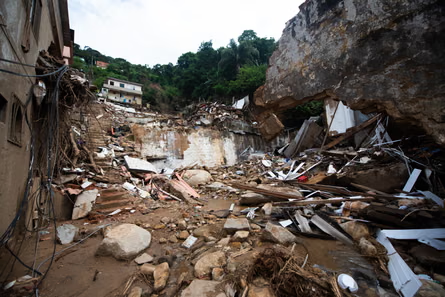
The aftermath of the devastating mudslide, showing mud and debris on a steep hillside between destroyed buildings.
The mudslide in Petrópolis in February 2022 killed 233 people, and displaced many more. Photograph: Mariana Rocha

The numbers are staggering. Over the past decade, climate-related disasters have displaced 250 million people globally – equivalent to 70,000 people forced from their homes every day.

According to the UN high commissioner for refugees (UNHCR), more than 120 million people worldwide are now forcibly displaced. Of these, about 90 million live in countries with high or extreme exposure to climate risks, and half exist in the brutal intersection of conflict zones and severe climate threats.

In Latin America and the Caribbean – the region most exposed to extreme climate events after Africa – an average of 2.4 million people a year have been displaced within their own country over the past decade. And the future looks even darker: by 2040, the number of countries facing extreme climate risks is expected to jump from three to 65. By 2050, most refugee camps will endure twice as many days of dangerous heat as they do today.

“With the intensification of climate change, a significant increase in cyclical and prolonged displacements is expected,” warns Sílvia Sander, protection officer at UNHCR. “Women who return to disaster-prone areas face successive displacements – being forced to move again and again – making life reconstruction difficult. Each new climate event destroys resources, increasing dependence on humanitarian aid.”
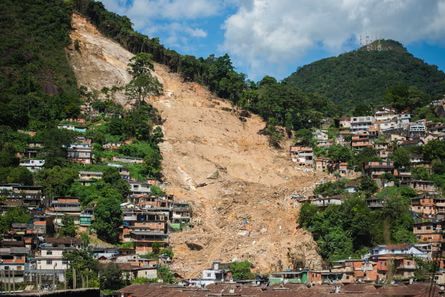
A wide swathe of mud cuts between houses on a steep hillside. Fragments of buildings can be seen among the dirt.
The Petrópolis mudslide was the first of three large climate-related disasters to hit Brazil in as many years. Photograph: Mariana Rocha

Brazil has become a laboratory for this accelerating crisis. Three disasters in three years trace an upward curve of devastation: Petrópolis in February 2022, which killed 233 people; Recife three months later in May, when 130 people died; and Rio Grande do Sul in May 2024 – the state’s largest natural disaster, affecting 2.4 million people across 478 municipalities, killing 183, and causing economic losses estimated in the billions of reais.


That February afternoon, Santa Rita, then 24, had cancelled her two-year-old son Cainã’s medical appointment. The rain was intensifying. “The city becomes chaotic when it rains,” she says. The decision saved their lives – two buses full of passengers were swept away in the city centre.

But even inside her social housing complex in Correias, 15 minutes from Serra dos Órgãos national park, concrete offered no protection. Within half an hour, the rain became a deluge.

Portrait of Naira Santa Rita wearing a red shirt and glasses.
Naira Santa Rita: ‘You think you’re safe in a building – you’re not.’ Photograph: João Damásio

“You think you’re safe in a building – you’re not; it’s an illusion,” Santa Rita recalls. “I saw water coming in, not through the drain, but through the walls. You can’t control water, tell it, ‘Stop, don’t come in.’ You see it, and everything’s already gone.”

With her mother, a kidney patient who had recently received a transplant, and young Cainã, Santa Rita grabbed only documents, medicines and their dog before climbing to safety. The morning after revealed total destruction: the fridge on the floor, everything ruined, with that damning water mark left high on the wall.

What came next illustrates what experts call the “layered vulnerabilities” of climate displacement. As a single mother and intern with an ailing mother to care for, Santa Rita faced disaster economics in action: rents jumped from R$1,500 to R$5,000 (approximately £210 to £700) as landlords exploited the emergency.

Her mother’s health deteriorated as Petrópolis had lost medical facilities for kidney patients. They had no choice but to leave for Juiz de Fora in the neighbouring state of Minas Gerais.

“The burden of domestic and care functions – looking after children, elderly relatives and people with disabilities – places women in a position of additional vulnerability during forced displacements,” Sander says.

“This multiple responsibility means women tend to prioritise the safety of others, which can delay their own escape and increase exposure to risks.”

The pattern repeats with brutal consistency, says the expert. “Factors such as poverty, race, informal work and single motherhood interact with the effects of climate change and create layers of interconnected vulnerability,” Sander says.

“In the context of structural racism – the systemic discrimination embedded in institutions and society – Black, Indigenous or other historically discriminated ethnic-racial women face additional barriers to accessing support.”
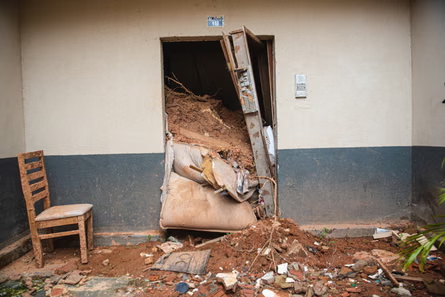
Mud pours through a doorway in an apartment room. The door has broken off its hinges and the dirt reaches almost as high as the door.
Rents more than trebled as landlords exploited the shortage of accommodation caused by the Petrópolis mudslide. Photograph: Mariana Rocha

Santa Rita, now a sustainability specialist who founded the Climate Institute (Instituto DuClima), has conducted a profiling of climate victims in Petrópolis. Since 1988, more than 600 people have died in extreme weather events.

“If you do the profiling, they’re Black women, they’re children. It’s a very specific group. This is environmental racism,” she says, using the term that describes how natural hazards disproportionately harm communities of colour and the poor.

“Women are the first to die when an extreme climate event happens,” Santa Rita says, “because they’ll save everyone before saving themselves.”


Three months after the Petrópolis floods, 500 miles (800km) away in Recife, the pattern was repeated. On 28 May 2022, Sônia’s house at the top of the Comunidade Sapo Nu hill – considered safe for decades – was engulfed by flood water. Her granddaughter, Eduarda Patrícia, sheltering below with two daughters aged seven and three, climbed to safety in the early hours. By 10am, water covered Sônia inside her home.
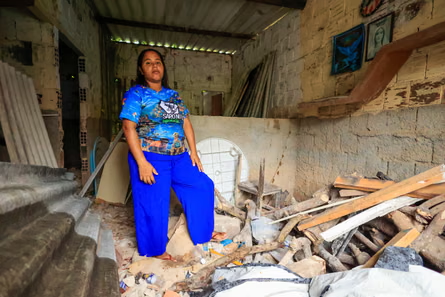
Eduarda Patrícia stands in a room filled with debris, broken planks of wood and furniture.
Eduarda Patrícia in the house in Recife where her grandmother lived, destroyed by flooding in 2022. Photograph: Arnaldo Sete/The Guardian

“The water was covering me inside my house,” Eduarda Patrícia recounts. Family members rescued them on plastic sheets pulled by ropes. “We just thought about God in that moment to save us.”

The aftermath revealed the state’s abandonment of victims: the family received R$2,500 (approximately £350) in aid – a single payment to rebuild everything they had lost – and have never received any psychological support.

Sônia, who had struggled with alcohol before the flood, needed rehabilitation after the trauma. The family moved her away from the flood-prone community – another forced displacement.

By May 2024, when the waters came for Rio Grande do Sul, the script was grimly familiar. Lake Guaíba’s level in Porto Alegre reached 5.37 metres, surpassing by more than 60cm the previous record set in 1941. Bianca Ramires, 49, a teacher in the Sarandi neighbourhood, trusted her neighbours’ decades of experience: this area never floods. She left with one backpack, expecting to return within days.
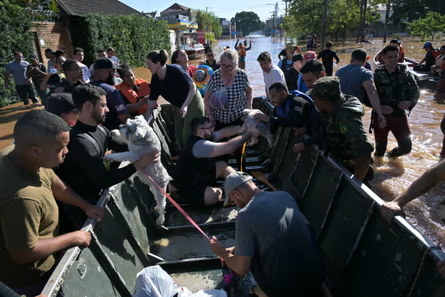
People wade down a flooded street towards a boat. People are getting into the boat and others are passing pet dogs into it.
People are rescued in boats by the Brazilian military after flooding caused by heavy rain in Porto Alegre, Rio Grande do Sul state, in May 2024. Photograph: Nelson Almeida/AFP/Getty Images

After 40 days, the washing machine had been swept into the living room, and the water’s force had scattered the furniture. “My graduation album, my diplomas, my certificates, my son’s childhood photos. Everything was gone.”

Yet the water’s retreat does not end the trauma. Júlia Louzada, a psychologist at the University of São Paulo’s laboratory of psychoanalysis, society and politics, who worked with survivors in Brumadinho, where a dam collapse killed 272 people, and Rio Grande do Sul, describes what she calls “psychic disorganisation” – the state in which the loss of home and community shakes the foundation of identity itself.

“Territory is this physical place, but it’s also a symbolic place, where memory is written, and where work networks, family, institutions are written,” she says.

“Many victims initially report shock, even anaesthesia. It’s a psychic defence. But it’s trauma inscribed in the body itself through sleep disturbances, tremors, sensory triggers. The sounds of rain take you back to that traumatic scene.”
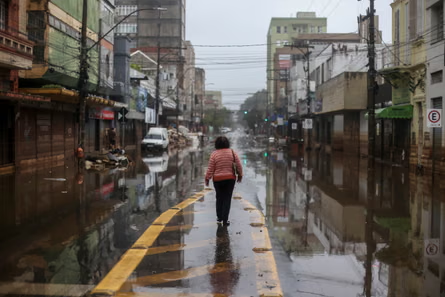
A woman walks along a flooded city street.
A flooded street in Porto Alegre, Rio Grande do Sul, Brazil, in May 2024. Torrential rains left more than 180 people dead and many more missing. Photograph: Anselmo Cunha/AFP/Getty Images

Ramires echoes this: “Every time it rains, it’s panic. My relationship with Porto Alegre changed completely. I no longer have pleasure being here.”

Yet Louzada notes a paradox: women bear the greatest burden but also lead reconstruction. “They’re historically linked to care work, reproductive labour – they’ll continue these tasks in shelters, in displacement. But they’re also the spearhead, the people at the front in processes of material and symbolic reconstruction of territory.”

Santa Rita’s experience drove her to action. She wrote what became Bill 1594, Brazil’s first legislative proposal for a national climate displacement policy. “If we manage to approve this policy,” she says, “we’ll set a precedent in world history.”