





The word “visionary” is done to death but the 17th-century Spanish painter Francisco de Zurbarán demands it: he paints supernatural things naturally and natural things supernaturally. Space becomes different in his world, melting distance and erasing the barrier between you and the picture. The very first painting in this dreamlike ecstasy of a show dissolves logic. A monk robed in white kneels before a living man hanging upside down, his hands and feet nailed to an inverted cross: it’s a vision as real and close to us as it is to the awestruck monk, held in a penumbra of bronze fire, a stream of smoky light from heaven.
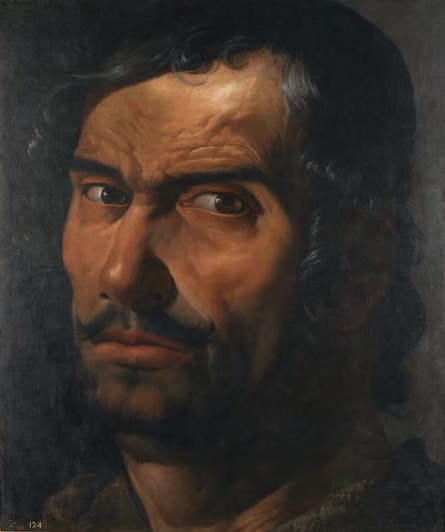
The Apparition of Saint Peter to Saint Peter Nolasco from 1629 has been lent by the Prado and depicts Nolasco receiving a vision of the original St Peter who asked to be crucified upside down so he would not imitate Christ. Nolasco couldn’t make the pilgrimage to Saint Peter’s shrine in Rome, so the church founder mystically appeared to him at home in Spain. You might think this is sentimental folk art, the stuff of prayer cards. But one thing’s for sure: Zurbarán believed it and paints it with such incandescent conviction it becomes sublimely real. You can see why Salvador Dalí loved this artist and imitated his still lifes and crucifixions: for Zurbarán is a primitive surrealist. Several newly attributed paintings in this show include a wall-filling mask of a giant, possibly painted for a stage set: it makes a mockery of proportion yet is beautifully detailed, full of character, weirdly alive.
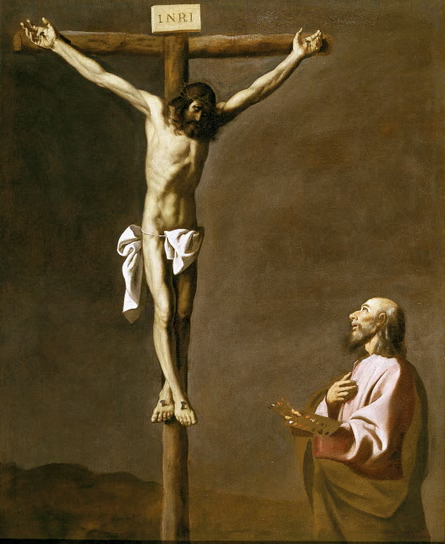
Zurbarán, who was born in 1598 and spent the greatest years of his career in Seville, worked in an age of Catholic revival, in Europe’s most fervently Catholic country: Spain’s militant faith had been ingrained by hundreds of years of religious warfare which gradually drove out Muslim rule. Seville, whose cathedral bell tower was originally built as a minaret, boasted among other Christian orders the Mercedarians, founded by Nolasco, who specialised in rescuing Christians captured by Muslims (both religions enslaved people of the opposing faith across the Mediterranean world). Yet the people of Seville were far from unsophisticated about art. Not only did this city, whose official painter Zurbarán became, have a legacy of Islamic design but it also produced the ironical portrait genius Diego Velázquez. Gold from the Americas flowed to Seville and that wealth helps explain Zurbarán’s ravishing aestheticism. No other artist has ever made loincloths so exquisite. The Crucified Christ towers above you, a pale body manifest in darkness, but over his groin dances a flower-like formation of pure white freshly laundered fabric.
Once you let yourself be entranced by this lavish loincloth you start to see Zurbarán’s eye for fabric everywhere. The whiteness of holy garments obsesses him. Saint Serapion, who was tortured to death on a Mercedarian mission to save Christians, has his beaten body hidden in a billowing white sail of a garment. Alongside acres of white cloth are the blue, silver, bronze and red garments of Saint Casilda of Toledo, a Muslim princess who (it was said) gave bread to Christian prisoners. When she was caught, the bread miraculously turned to flowers – which Zurbarán depicts with the same observational brilliance, turning this picture of a saint into a springtime celebration. It’s a truly popular painting – another reason this exhibition is so captivating. You are in the presence of great art for the masses, with a passion that must have touched the working people of 1600s Seville just as much as it will hit you.
Yet there’s a hard, lucid edge to Zurbarán. He’s a mesmerising paradox, a mystical Catholic artist who paints with scientific accuracy. He lived in the age of Galileo when the telescope was popularising a new idea of precise observation: yet he takes that science of reality and makes it metaphysical, turning natural observation into the revelation of cosmic mystery.
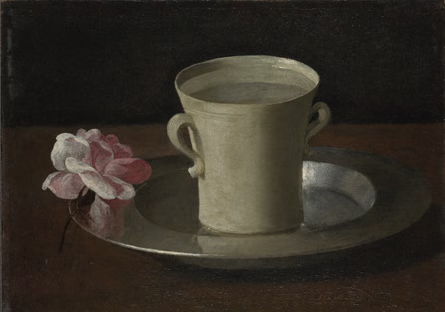
You see this clearly in his still life paintings. A superb room not only uncovers newly identified examples, but sets them tellingly against lovely paintings of fruit and flowers by his son Juan. While Juan de Zurbarán’s dusky grapes explore earthly lushness, his father’s still lifes ruthlessly isolate natural and fabricated things in highly conceptualised, metaphysical arrangements. Lemons, oranges and a pink rose that’s balanced on a reflective metal plate beside a cup of water are lined up, spaced apart against blackness. It’s tremendous, eerie, yet at the same time painted with mirror-like perceptiveness. It is in ordinary things, a cup of water, a rose, that you glimpse God’s mystery, Zurbarán says. They lived at opposite ends of Europe but you imagine he might have got on with John Donne: Zurbarán is a metaphysical poet in paint.
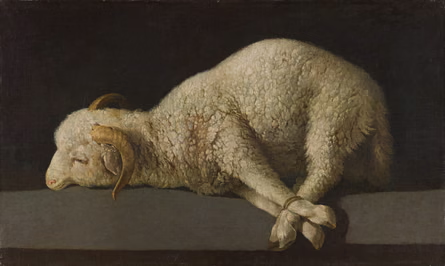
But what does such art have for the irreligious? A seriousness about life and death and the mystery of being that has few equals. In Zurbarán’s most moving “still life” a lamb lies trussed up for slaughter. You cannot see if it is already dead or passively awaiting its fate. Obviously Agnus Dei symbolises Christ, but it is also an actual lamb, a victim of human butchery, painted lifesize with such perfection it might be a specimen in a vitrine. Each fold and knot of its fleece is soft and thick enough to touch. Zurbarán drags you through the picture plane to pity its suffering. You cannot ask more of a work of art.