



惯性聚合 高效追踪和阅读你感兴趣的博客、新闻、科技资讯
阅读原文 在惯性聚合中打开

推荐订阅源

Stack Overflow Blog
Stack Overflow Blog
Vercel News
Vercel News
Cyber Security Advisories - MS-ISAC
J
Java Code Geeks
M
MIT News - Artificial intelligence
Microsoft Azure Blog
B
Blog RSS Feed
MongoDB | Blog
MongoDB | Blog
G
Google Developers Blog
Engineering at Meta
Engineering at Meta
量子位
S
SegmentFault 最新的问题
钛媒体:引领未来商业与生活新知
钛媒体:引领未来商业与生活新知
A
About on SuperTechFans
P
Proofpoint News Feed
Last Week in AI
Last Week in AI
Recent Announcements
腾讯CDC
I
InfoQ
F
Fortinet All Blogs
Hugging Face - Blog
Hugging Face - Blog
Blog — PlanetScale
Blog — PlanetScale
H
Help Net Security
爱范儿
爱范儿

The Guardian

Rory McIlroy surges into six-shot Masters lead with stunning second-round flourish ‘That’ll be the end’: actor Sam Neill joins fight to stop controversial goldmine near his New Zealand vineyard Roberto De Zerbi targets ‘Ange-ball’ revival to save Spurs from relegation Bath hit back to reach semi-final after stunning Northampton in 11-try epic Secret Garden to Outcome: the week in rave reviews Zebras, wealth and power: Hungary’s election tests Orbán’s grip on power ‘TikTok effect’ brings sellout crowds and younger fans to Grand National meeting The war over Omagh’s gold: the £21bn mine plan tearing a community apart Britain’s shadow workforce is paid as little as 65p an hour. Who cares for the carers? From You, Me & Tuscany to Euphoria: your complete entertainment guide to the week ahead Six great reads: the man who let snakes bite him, masked heavy metal and the brutal reality for foreign students in the UK American Classic review – I defy you not to fall in love with Kevin Kline and Laura Linney’s tender comedy Cuba’s doctors were a lifeline for the world. Now the Caribbean is shamefully complicit in the US drive to expel them An environmental disaster in Moldova has Russia’s fingerprints all over it RMIT drops misconduct case against student who accused university of being ‘complicit in Gaza genocide’ Ichiro Suzuki statue unveiling goes awry as bronze bat snaps during ceremony Survivors of Epstein’s abuse accuse Melania Trump of ‘shifting burden’ on to victims European football: Real Madrid held at home by Girona to extend winless run Arne Slot insists he is ‘aligned’ with Liverpool board and fans as squad is rebuilt Kamala Harris ‘thinking about’ running for president again in 2028 JD Vance warns Iran against trying to ‘play’ the US in peace talks West Ham double up twice to thrash Wolves and put Spurs in relegation zone Trump administration releases new renderings of so-called ‘Arc de Trump’ Crispin Odey drops £79m libel claim against FT over sexual misconduct allegations Bafta apologises for events surrounding John Davidson’s Tourette’s outburst Cocktail of the week: Bar Shrimp’s la rosita – recipe New drug may extend survival in aggressive ovarian cancer, trial shows One dead and 27 injured after bus with British passengers crashes in Canary Islands Pope adds to Smith’s mass of Surrey runs with England woes a world away OpenAI CEO Sam Altman’s home targeted with molotov cocktail
Worried Britons ‘prepping’ for major disruption with stas...
Rupert Jones · 2026-05-09 · via The Guardian

Millions of Britons are “prepping” for a potential “major disruptive event” by keeping a stash of cash at home, stockpiling tinned goods or ensuring they have a battery-powered torch close to hand, new data suggests.

With war raging in the Middle East and Ukraine, extreme weather becoming more frequent, and warnings that the UK’s critical infrastructure is at risk from cyber-attacks and power outages, many people feel the world has become a more dangerous and chaotic place.

While some are taking steps to make sure they are not left high and dry in the event of a bank IT failure, others are preparing for a possible natural disaster, or even a societal collapse. UK experts recently advised people to have an emergency store of food in their home in case something happens that causes shortages.

Link, the UK’s ATM network, tracks how people are using, and thinking about, cash and, for the first time, its researchers have asked the public about what “contingency planning” they are doing to prepare for an event that would cause “major disruption to normal services”.

Link’s suggestions include a power outage, IT failure, natural disaster or cyber attack. It did not explicitly mention war or conflict.

Asked what they thought they would do if something happened that meant card and mobile payments were not accepted in shops, 54% of those surveyed said they would withdraw cash from an ATM.

Meanwhile: 46% said they would use supplies, such as food, that they had at home; 41% said they would use cash they had on their person to pay for items; 36% said they would use cash they had at home; and 31% said they would shop online.

Notably, 15% said they would raid the supply of banknotes and coins that they had kept safe specifically for this type of scenario.

A Scrabble board spells out key words such as doom and bust
Money and access to it is a big issue for many in a crisis. Photograph: Tony Rolls/Alamy

The researchers then asked what people had already done, or were now doing, in preparation for a disruptive event. Almost half (49%) said they had battery-powered items at home, such as a torch, while 47% said they had a supply of tinned goods such as baked beans and canned fruit, and 37% said they kept a power bank in the house to keep their mobile phone charged.

One in five (20%) said they had access to a portable gas hob such as a camping stove, while 15% said they had an analogue radio. In terms of money, 17% said they had “a stash of cash at home”.

Just over a quarter (27%) of respondents had not done anything to prepare for an event of that type.
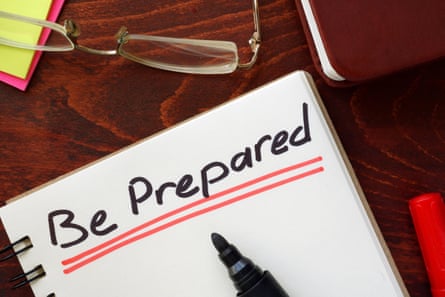
A note underlined in red reads: ‘be prepared’
As the world seems like a far more dangerous place our new red line is ‘be prepared’. Photograph: designer491/Alamy

Of those who had taken any of the above actions, 23% said they had done so recently: within the last three months.

Graham Mott, Link’s director of strategy, said the data demonstrated the growing role played by cash in people’s resilience planning.

“With rising public concern about threats like power outages, cyber-attacks and disruption to card payments, more people are prepping by keeping some emergency cash at home,” he added.

The UK government’s Prepare website outlines steps it says people should consider taking to prepare for emergencies, which include assembling a list of items at home that could include tinned food that does not need cooking, bottled water, a first aid kit, hand sanitiser, a battery-powered or wind-up torch and radio, a portable power bank for phone charging, and spare batteries.

Specialist “prepper” shops have become popular in the UK, with some reporting a boom in the aftermath of the Covid lockdowns.