


I like being a twin. It defines who I am,” Lavinia Osbourne tells me on the 49th birthday she shares with her sister, Michelle. “It’s amazing to have a twin and have a built-in friend for ever,” Michelle says. “I’ve been really blessed to go through this journey with someone else.”
Lavinia and Michelle know that those of us who haven’t shared a womb with a sibling can be fascinated by twins: their similarities, how they differ, whether there’s any kind of mysterious synergy between them.
“There’s twin magic. It does exist – it’s a thing,” Michelle says. “I can feel when she’s upset, and she can feel when I’m upset.” They have even felt each other’s physical pain, Lavinia says. “There was a time when she spilled hot water on her leg, and I felt it.”
Lavinia and Michelle aren’t identical twins. They share the same striking eyes, but the lower halves of their faces are different. Their personalities differ, too: Michelle describes herself as a “homebod”, an introvert who would prefer to mark her birthday with a candle on a sponge cake, whereas Lavinia, the self-proclaimed “exuberant” twin, wants to make a night of it at a Cuban cabaret show. They’re speaking to me separately from their homes in south London. They exchanged cards, gifts and hugs earlier this morning, when Michelle was on the school run with her son.
Twins can exist at different poles, Lavinia says. She went to live in Barcelona in her early 20s; Michelle moved to Iceland soon after. “I moved to a hot country, she moved to a cold one, but we still went more or less in the same timeframe.” They both started very different businesses within a few years of each other: Michelle has a sewing company (she was a contestant on the first series of The Great British Sewing Bee); Lavinia runs a platform for women who work in blockchain. “We do things that are parallel, but opposite,” Lavinia says.
Despite their differences, Michelle and Lavinia share two things that will bind them together for life. First, their precarious childhood, in which they were passed from home to home, school to school, carer to carer, and the only thing they knew for sure was that they had each other. And, second, the almost inconceivable circumstances that brought them into the world, and which only came to light four years ago, when they were 45 and both took DNA tests from the genealogy firm Ancestry.
Their results of those tests revealed something never before documented in British history. Lavinia and Michelle are twins who grew together in the same womb, were born from the same mother, and delivered within minutes of each other – but have different fathers.
Heteropaternal superfecundation – the vanishingly rare biological process to which Michelle and Lavinia owe their existence – is both a mouthful to say and a mind-boggling concept to grasp. It happens when a series of very unlikely events occur at precisely the right time. A woman has to release more than one egg during the same menstrual cycle. She has to have more than one partner during her fertile window. More than one egg must be successfully fertilised, with sperm from different men, and the resulting embryos need to survive long enough to become babies. Michelle and Lavinia are twins and half-sisters.
Fewer than 20 such cases have been documented worldwide. It’s impossible to know the actual total, because cases come to light only when both twins take DNA tests. Even non-identical twins can safely assume if one takes a test, the results will be almost the same for the other, because they should share the same proportion of maternal and paternal genes. Non-identical twins might take DNA tests for health reasons, to see if one is carrying a particular gene the other does not – or because they have doubts about their ancestry.
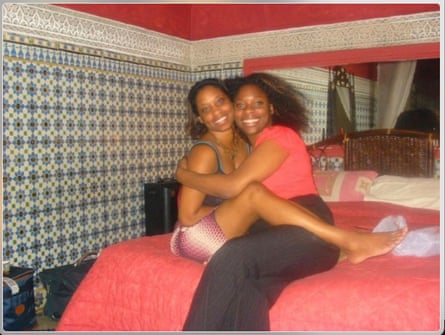
Lavinia and Michelle did not know it was possible for twins to have different fathers when they spat into their saliva collection tubes and sent their samples off to be analysed. They took the tests after Michelle became determined to find answers to questions that had troubled her all her adult life. Why did she have so little in common with the man their mother told them was their father? What made their mother so willing to be absent from their lives? Why were there so few photographs of her and Lavinia when they were little?
Their Ancestry results shattered everything they thought they knew about their shared identity, and raised more questions. What must have been going on in their mother’s life when they were conceived?
Lavinia and Michelle were born in 1976 in Nottingham to a 19-year-old single mother. They were delivered prematurely, via an emergency caesarean section. “I was supposed to be born first, but the umbilical cord was wrapped around Michelle’s neck, so she was pulled out first,” Lavinia says. “I’m actually a minute older,” Michelle explains, with a cheeky smile. “I’m glad – her being older would have been torture.”
Michelle says her mother told her when they were babies she used to nestle them in her jumper to keep them warm. “We’d just be two little heads underneath her jumper with her head in the middle. That sounds like love. But those stories were few and far between.”
When I ask Lavinia and Michelle to describe their lives growing up, the first word they both choose is “difficult”. “Today, my mother would be classed as a vulnerable young adult,” Michelle says. Part of the Windrush generation, she had arrived in the UK from Jamaica when she was five. “She suffered abuse at the hands of her stepfather and was in and out of foster care and children’s homes because it wasn’t safe for her to be at home.” Hers was a churchgoing family, and terminating any pregnancy was never an option. “Having two babies at 19 … I can’t imagine that was a good time for her.”
In her mid-20s – when her twins were about five – their mother got a place at university in London. “It gave her the ability to not have to be a mum,” Lavinia says. “Physically and emotionally, she was always out of reach. I missed my mum terribly.” When the moving van was parked outside their home ready to take their mother away to her new life in London, Lavinia threw her teddy bear – one of the few toys she possessed – into the back. “I thought, if the teddy bear is there, then I’m going with my mum.” But Lavinia and Michelle were left behind in Nottingham with their mother’s best friend’s mother – a woman they called Grandma.
“When you’re not blood relatives, you’re not always prioritised,” Michelle says, diplomatically. Lavinia is more forthright. “We were fully aware we were not her real grandchildren. There was this sense of lack, of unworthiness.” There were harsh words, and beatings, she says, and they were always hungry. “Even as a child, I knew putting water in your cereal was not normal.”
While Lavinia was distraught at being separated from their mother, Michelle was more pragmatic. “I was able to detach,” she says. “I was fine: I had my sister. It was her and me against the world.”
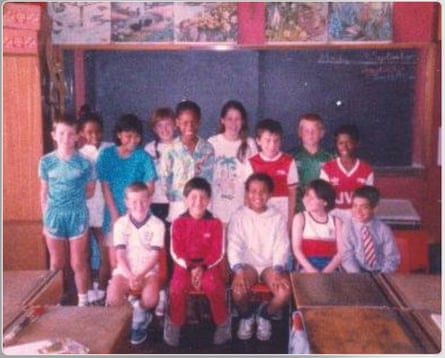
When they were about 10, their mother sent for them to join her in London: she was in a new relationship and had given birth to their half-sister. “That was a kind-of happy time, because Mummy had brought us back into the fold,” Michelle says. But it didn’t last. Their mother’s new partner refused to bring up another man’s children, so they were sent to live with one of her old foster carers. They went back and forth to Nottingham, living with different relatives or people from their mother’s church. “She was always trying to get rid of us,” Lavinia says. “That was hard. But I’d become accustomed to it, and as long as I was with Michelle, I was fine.”
Their mother had always told them their father was called James. “He was my mum’s boyfriend, I suppose,” Lavinia says. “From what I was told, when my mum got pregnant, he wasn’t happy.” They didn’t know him when they were little, but he came back into their lives when they were 14, albeit intermittently. “He always had one foot out the door,” Michelle says. “I think his mother used to whisper in his ear, ‘Those girls aren’t yours.’” James came to a few school plays, and put on an 18th birthday party for them, which Lavinia describes as “one of the worst birthdays of my life – it just was awkward”, but ultimately he drifted out of their lives.
Michelle says she always doubted James was their father, but Lavinia recognised herself in him. And when she asked for reassurance, their mother was always emphatic. “She would say, ‘Yes, he’s your dad. You walk just like him, and you’ve got a nose like him.’ And I’d be like, OK – that’s who our dad is.” It put Lavinia’s mind at ease, but Michelle was never convinced.
By 2010, Lavinia and her mother had become closer. “As an adult, looking back and understanding her circumstances, I could forgive her. We were in a good place. I was starting to have the relationship with her I really wanted – it wasn’t perfect, but it was good.” She pauses. “Then she got sick, and I lost her again.” At 54, their mother showed signs of early onset dementia.
“When Mummy became unwell and wasn’t able to formulate any sensible responses to my questions, I saw a picture of James,” Michelle tells me. “I hadn’t seen him for a very long time. And I just thought, you don’t look anything like me. There’s no similarity there. I’m not going to have this. So I bought myself a kit.”
On Boxing Day 2021, Michelle took an Ancestry DNA test. It never occurred to her that, in taking a test for herself, she would also be finding out answers for Lavinia. “I wasn’t thinking about anyone else. I was, like, I want to dispose of this whole concept that this man is my father because, deep down, I don’t believe he is. And then it occurred to me that Lavinia will also learn this man isn’t our father. And she wants him to be.”
Lavinia was with Michelle as she spat into the plastic vial. At first she had been intrigued by what Michelle’s DNA might reveal: what percentage of this or that ancestry they might have. But then Michelle explained that she was taking the test because she didn’t believe James was their father. “I was irritated by it,” Lavinia says. “Why are we going to dispute what our mother said? I think also part of me didn’t want to go down that rabbit hole because we knew there was sexual abuse in my mother’s childhood. And she was dying.”
On 14 February 2022, their half-sister rang to say their mother had died. The twins went over to see her. “I stood over her, and kissed her hand, and took it all in. Then my phone beeped,” Michelle says. Only hours after her mother’s death, her DNA test results had arrived.
Michelle went into the hallway, fully aware today was a day for letting family members know the sad news about her mother, not for revelations about her father, but was unable to resist looking. In her results, she could see the names of other people who had taken Ancestry tests and shared DNA with her. She immediately saw James’s last name didn’t feature in her paternal line. But the name that did was very close to that of their mother’s stepfather – the man who had abused her mother.
“Sometimes people change surnames or spellings when they move from one country to another. The similarity between the names was something I couldn’t ignore,” Michelle says. “Things were swirling around my head. Oh my God. Am I really the product of this?’”
At this point, Lavinia still had every reason to believe she and Michelle shared the same father. She wanted to believe their mother had told them the truth – that James was their dad – so tried to rationalise what she saw, and didn’t see, in Michelle’s results. “Maybe he hasn’t done a DNA test. Maybe none of the family have. If they’re not in the system, how can you find them?” She smiles. “Little did I know what was to come.”
Michelle became engrossed in unravelling her results so her worst fears could be confirmed or denied. The Ancestry app showed the proportion of DNA she shared with other people who’d taken a test. She found a female relative on her paternal side who looked as if she must be an aunt, but she didn’t respond when Michelle messaged her through the app. She found a picture of the woman on Facebook; she goes by the nickname Makeda.
“We learned from other family members that Mummy and Makeda were good friends. Makeda used to have Rastafarian parties at her house in Leeds and Mummy would run away from the children’s home when she was 18 and go to them. It must have been really nice for someone who grew up in homes to go into this family network of West Indian people.” If Makeda was her aunt, one of her brothers had to be Michelle’s dad.
Michelle managed to speak to Makeda’s daughter – her biological cousin – who told her Makeda has two brothers: Anthony and Alex. Anthony’s daughter, Olivine, agreed to take an Ancestry test. It revealed that she and Michelle were cousins, not sisters, which meant Anthony was not her father. “The only other man left was Alex. Alex is the winner.”
Her newfound biological family had a warning for Michelle: Alex was not in a good place, and hadn’t been for decades. “He’s got a really soft spot in everyone’s heart,” Michelle says, carefully. “He’s been ravaged by drugs and alcohol and vagrancy and homelessness and begging, and he’s not the man he used to be, so I should prepare myself when I meet him.”
Within a day or two of Olivine getting her results, Michele and Lavinia arranged to meet her in a restaurant in south London. More than three years on, Michelle still beams at the memory. “Our beautiful cousin, Olivine. This beautiful girl. I just knew she was blood.” She pauses. “Lavinia wasn’t so sure.”
“She was warm and giving and embracing,” Lavinia remembers. Olivine had brought them both a card and presents of potted plants. “I was shocked, because my experience of family had always been toxicity and rejection.” But then Olivine brought out photographs of her relatives. “I was looking at them and thinking, I don’t think these people are my family. A part of me was still hoping the person I thought was my dad was my dad.”
Michelle and Lavinia don’t agree on whose idea it was for Lavinia to do her own DNA test. Their memories, too, are not identical. “I never did it thinking it would give me a different result to her,” Lavinia says. But she had to do something about the doubts that were eating away at her. “Uncertainty and unknown, that’s worse in a way. I wasn’t curious. I just wanted confirmation.”
The kit sat on Lavinia’s shelf for months before she plucked up the courage to use it. “Maybe subconsciously I knew.” In the summer of 2022, Michelle had rented a holiday caravan, and Lavinia finally took her test there, with her twin. Less than three weeks later, she was at a concert at the Royal Albert Hall when she received the Ancestry results. She didn’t look until she got home.
Identical twins share virtually 100% of their DNA. Non-identical twins share roughly 50% – the same as any other full siblings. But in Lavinia’s results, Michelle shared only about 25% of her DNA. A half-sibling.
“Once I saw it, I knew it was possible. I knew it was true. I felt shocked, I felt sad, I felt angry. I was angry with Michelle for having me go through this, because I just didn’t want it – I didn’t want this reality.”
Lavinia immediately rang Michelle to tell her. But her twin wasn’t shocked. “I wasn’t surprised we had different dads. We’re so different,” Michelle says. They have the same date on their birth certificates, but they have different fathers. “I’m still in amazement that this can actually happen – it’s super weird, super odd, super rare – but, if I apply it to myself, it makes sense.”
“For about a month, I couldn’t stop crying.” Lavinia shakes her head. “She was the one thing that belonged to me. The one thing I was sure of. And then she wasn’t.”
Michelle tried to reassure Lavinia that they were still twins, that she still loved her, that nothing had changed. But Michelle could see that everything had changed for Lavinia. “She felt like the tether had been cut.”
Another of Lavinia’s tethers was cut by the truths contained in her DNA results: James – the man her mother had said was her dad – didn’t appear in them. Lavinia had no idea who her father was.
A few weeks after they learned they had different dads, the twins met Michelle’s father, Alex, for the first time. They had been invited to a wake for one of Michelle’s newfound cousins. Michelle had 10 new half-siblings to meet – most about the same age as her. Alex arrived late, after the speeches had begun.
“I saw this man skulk into the room. He was clearly under the influence of drugs, because he was sweating profusely. He didn’t have any teeth. Family members were propping him up, fixing his clothes, making him presentable. Obviously his family love him very much, have taken care of him, seen his weaknesses and compensated for them for many years. But all I saw was a very broken man.” Michelle went to give her father a hug, overcome with tears.
Her new relatives had told her troubling stories about Alex. “There were whispers in the back of my head about this negative connection he and my mum could have had that could have resulted in her falling pregnant and burying it so deep. Why Mum kept it a secret and never, ever went back to Leeds,” Michelle says.
Lavinia had heard the same rumours about Alex. But she had mixed feelings when she finally saw him. “It’s easy to make someone like that into the villain,” she says. “There was anger, but also – I don’t want to say pity, but I can’t hate someone like that. I wish we could sit down and have a conversation with him, but we knew that was never going to be the case.”
A conversation wouldn’t ever be possible. He might be her biological father, but he could never be anything more, Michelle tells me. “There’s no relationship to have. It wasn’t something I could continue with.”
Michelle had her answer – but Lavinia had no interest in finding hers. As soon as she worked out that James couldn’t be her father, she put her DNA results aside. She had become close with some of Michelle’s new family. “They accept me, so we’ll just move forward with that,” she remembers feeling. “I’m good here. This feels safe to me. I don’t need to find out anything more.”
Her twin had other ideas. Like so many people who have taken at-home DNA tests, Michelle had discovered a passion for genealogical investigation. Lavinia had given Michelle her Ancestry password so she could see the shattering truth in her results; Michelle used it to log on and work out who Lavinia’s father could be.
Why was she so determined to find out something Lavinia didn’t want to know? “She was stewing in not a great soup,” Michelle says. “The truth sets you free.”
There was a name in Lavinia’s test results, something to go on. But Michelle knew any inquiries had to be handled with care. “I wasn’t willing to share the information with lots of people because I don’t want people to make judgments about my mother,” she says. “I don’t want people to think that she was promiscuous. Even if she was, so what? But I don’t want people to have the wrong idea about her. My mother went through a lot.”
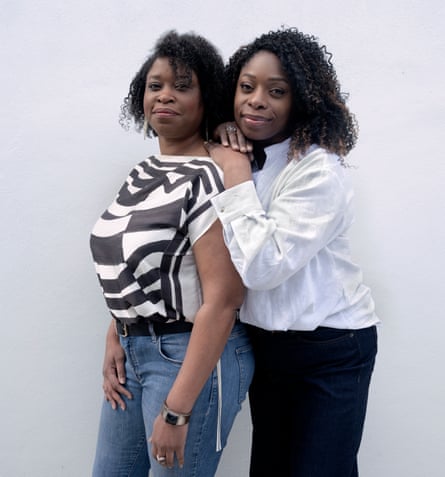
Michelle found herself sleuthing until 3am, cross-referencing Ancestry names with Facebook profiles. Lavinia was related to a 19-year-old woman from Leeds. Just after Christmas 2022, Michelle managed to reach Nadine, the woman’s mother. Over the phone, Michelle quizzed Nadine about her family history, and when Nadine mentioned that her father was called Arthur, Michelle felt a jolt of recognition: her mother’s best friend had mentioned their mother was once seeing someone called Arthur, also known as Moon Foot.
“Arthur Moon Foot?” Michelle asked. The phone went silent. Moon Foot was Nadine’s father’s nickname. Michelle had found Lavinia’s father. He was still alive, and living in London.
Nadine told Michelle she was coming down to London from Leeds the next day to meet her and Lavinia. “It’s that thing,” Michelle says. “When you find your kin, nothing can hold you back.”
But when Michelle rang Lavinia to tell her she had found her father, Lavinia was irate. “I don’t know why my sister has done this. I’m so pissed,” she remembers thinking. She softened once she spoke to Nadine on the phone. If her newfound half-sister was making the effort to come to London to introduce her to her father, then she would make the effort to meet them.
On 29 December 2022, Michelle and Lavinia drove to Arthur’s home in west London. They took the lift up to his floor, and when the door opened, her half-sister was waiting for her. “I could see me in her,” Lavinia says, her eyes wide. Then Lavinia saw Arthur, and learned he couldn’t see her: he has glaucoma and is blind. “It was surreal.” They had a meal together; Michelle did most of the talking, as Lavinia was in shock. “After the dinner – I don’t know why – I got up and gave my dad a kiss on his cheek,” Lavinia says. “I just felt compelled. In my head I was like, ‘It’s not his fault, Lavinia. He didn’t know about you.’” After the meeting, Lavinia’s half-sister took a DNA test which confirmed what they already knew: that Arthur was Lavinia’s father.
It was the beginning of the kind of relationship Lavinia had always dreamed of having with a parent. She sees Arthur every few weeks, and Michelle often joins them. He has told them both they can call him Dad. “My dad has 100% embraced me,” Lavinia tells me, with a huge smile. “I am my father’s daughter. He’s exuberant, entrepreneurial, a go-getter, larger than life.” Arthur earned the nickname Moon Foot because he was smooth on his feet like Michael Jackson; Lavinia has always been famed for her dance moves. “My dad’s very family oriented – once he knows you are his, that’s it.” Lavinia’s five new half-siblings and 15 nieces and nephews have welcomed both her and Michelle. “We said to both families, we come as one.”
In the space of a year, Lavinia had lost her mother and her status as a full sister to her twin. But she had gained so much. “When I think about my dad, I feel like I have found a place where I belong. I feel comfortable and safe, and I’m so grateful for that. Yes, it’s been hard but he is the reason that makes it OK.”
Michelle sees her biological father often, but in very different circumstances. “My business is based in Brixton, and he’s one of the men that beg in the market, looking for money to pay for drugs. So, yeah, I see my father all the time. But he doesn’t recognise me.”
Such cases may be exceptionally rare, but more are likely to come to light now testing your DNA is so unremarkable that home testing kits are go-to Christmas presents. So many extraordinary truths are being revealed because of the casual way we take these tests.
“I have this saying – all that’s done in the dark will come to light,” Michelle nods. “That’s through the help of Ancestry and all of these websites. These acts that are committed in the dark will come to light, one day.”
The twins don’t know for sure how they came to be conceived. Their mother is not here to answer that. “I know there are secrets around it, which leads me to believe it can’t have been a positive thing, but I won’t ever know,” Michelle says. When they asked Lavinia’s father, he told them when he was living in Leeds, their mother once knocked on his door in tears. “She said something bad had happened,” Michelle says. “She went to him because she wasn’t safe, and was in shock.”
Given how similar Lavinia is to Arthur, and how much Michelle says she looks like Alex, I wonder whether their mother knew they had different fathers.
“It must have driven her crazy,” Lavinia says, shaking her head. “She must have seen something, felt something, but just dismissed it, because it was like – how?”
“I feel like she saw our fathers’ faces in her babies – that’s why she was so neglectful and rejecting of us,” Michelle says. “That can be typical for stories when the conception isn’t always a positive one – at least that’s my take on the situation.” When their mother started showing signs of dementia, Michelle says, she couldn’t stop apologising. “She was saying sorry, profusely, over an 18-month period,” Michelle says. “I’d be saying, ‘Mummy, whatever has happened in the past, it’s OK: we’re all grown up and we’re fine. You don’t have to apologise.’ But no matter how many times I said it, she was feverish with the sorrys. So I think there was something there. In the back of her head, she knew.”
Do they regret taking the DNA tests?
“No,” Michelle replies, immediately. “I know a hundred per cent of who I am. I think Lavinia and I have both equally gained more than we could ever have thought of. I don’t feel like I’ve lost anything. Lavinia does.”
“I don’t regret finding my dad – I’m so happy I have a relationship with him,” Lavinia says. “I have forgiven my mum for everything. But she lied to me about something that’s very, very important. I find out that Michelle is my half-sister, then I find out the person I thought was my dad isn’t my dad … It’s a lot.”
When they first discovered they were half-sisters, it brought them closer, Lavinia says. But the differences between them can feel starker now. “Sometimes I just want to be with my sister, but I feel like she doesn’t have the time, or she doesn’t see it as important as it is for me. That has caused some friction between us.”
“It has created a divide and I’m so sorry for that,” Michelle says. “I love my twin, though. I love her like I’ve loved her from the minute I knew she was there. She’s my twin sister, and nothing takes away from that.”
Michelle and Lavinia know that the chances of them both existing at all are infinitesimal. “We’re miracles. We are special. And our mother is special as well.” Lavinia smiles. “We know this situation is very unique. And because of that uniqueness, and what we went through, and the fact that we are twins – we are always going to have a closeness that can’t be broken.”