







Family reunions in European arthouse cinema are almost always unhappy events, on a scale of strife that ranges from simmering resentment (Louis Malle’s Milou in May) to spectacular score-settling (Thomas Vinterberg’s Festen). There are still splatters of bad blood on the Sunday best in the films of Carla Simón, but the Spanish director has a rare gift: she makes you leave the cinema with renewed faith that having relatives and keeping in touch with them may actually be a wonderful thing.
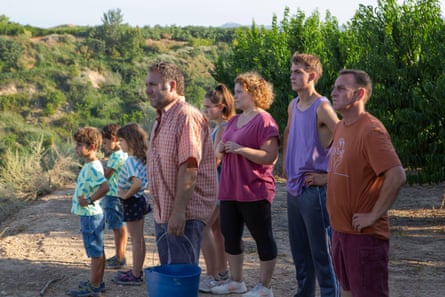
Indeed no film-maker working in Europe now is as capable of turning birthday gatherings, garden parties or poolside barbecues into thrillingly sprawling canvases of human virtue and vice as this 39-year-old rising star. From a riotous water fight in the Berlinale Golden Bear-winning farming drama Alcarràs to a foul-mouthed dinner table singalong in her new film Romería, Simón directs kinship meetings with the attention to detail that other film-makers may invest in action sequences or dance routines.
Among the tricks Simón employs, she explains, is to ensure her actors only read the script once before the camera starts rolling, so they have to improvise to fill the gaps. She takes her casts to parties, for walks and on shopping trips, and if there are disagreements on the way, so much the better. The ultimate secret sauce, though, is to ignore WC Fields’s notorious advice and always work with children and animals.
“I never get bored of working with kids,” she says. “When you are only working with adult actors, shooting becomes more like executing an idea that you have in your mind, and I think that is not interesting. With children, you always have this feeling that that things are going to happen in front of the camera by chance. It keeps things alive.”
Simón’s fascination with freewheeling scenes of family life was undoubtedly honed through her own biography. Born in Barcelona in 1986, her father died when she was three and her mother when she was six. Both of them succumbed to Aids. She was 12 when her adoptive mother told her that her parents had been infected with the autoimmune disease through their use of drugs.
All of her first three films have been strongly autobiographical: Summer 1993, released in 2017, tells the story of a six-year-old girl who moves to an unspecified location countryside to live with her aunt after the death of her mother, while 2022’s Alcarràs is specifically set in the Catalan peach-growing community of her adoptive family. Her third, Romería, meaning “pilgrimage” in Spanish, dives deeper into the story of the biological parents she barely got to know. Eighteen-year-old Marina travels to her relatives in Vigo, in north-western Galicia, purportedly to find the death certificate of her biological father, which she needs to study film-making in Barcelona. The initial reaction is warm, but family is a room with dark corners and locked closets. “Why you only coming to see us now?”, her stern grandmother admonishes her. “You don’t look like your mother.” Her father, she soon learns, died five years later than she had previously been told – what happened in the period shrouded in silence?
The film is broadly based on trips Simón took to meet relatives in Madrid, Barcelona and Galicia. “I wanted to do this journey out of curiosity, not out of resentment or anger,” she says. “Many films or stories about looking for your roots come out of feeling abandoned – I didn’t want that, because I have had the family thing through my adoptive parents. But this feeling of being uncomfortable because you are with these people who are supposed to be your family but you don’t feel it, that’s similar to what I’ve had.”
In the film, a cache of letters written by her late mother opens up a portal to the time when her parents met and discovered love – for each other, the Atlantic Ocean and drugs. The letters, Simón explains, are real. “She wrote to her friends and family while she lived in Vigo. Her Catalan is full of mistakes, because teaching Catalan was banned under the Franco regime. But they are the most important thing that I have from my mother, because suddenly I can hear her talking.”
Spanish cinema has a track record in making films where child actors take centre stage: Ana Torrent’s spell-binding turn as a young girl obsessed with the Frankenstein tale in Víctor Erice’s 1973 film The Spirit of the Beehive is considered an all-time great performance by a minor, and Simón describes it as “a very, very important film for me”. But if that film was a veiled allegory about a nation haunted by the monster-like general who ruled over Spain until 1975, Romería investigates the secondary traumas that accumulated after Franco’s fall, at the time of la Transición española.
During the transition period, Madrid gave birth to la movida, a countercultural movement that celebrated lifestyles that had been banned under military rule. “All these kids who were raised under Franco and religious oppression, suddenly freedom arrived and they embraced it”, Simón says. “They didn’t think much about the future or the consequences of what they were experimenting with. And then the drugs came in.” If the Aids epidemic in many countries around the world was framed as a problem of queer communities, in Spain it was intrinsically linked to a nationwide heroin epidemic. Especially affected were the Basque Country, where terrorist group Eta was engaged in smuggling the drug, and Galicia, with its difficult-to-control coastline serving as an entry point. “When we talk about this generation in Spain, people sometimes use words like shame and blame, but I feel that’s really unfair: people like my parents just had bad luck.”
Halfway through Romería there is a stylistic shift, from the Eurorealism she favoured in her previous works toward something more magical-realist: there is a mysterious cat you might expect to encounter in a Miyazaki film, and an unforgettable dance number set to Vigo punk rocker’s Siniestro Total’s song Bailaré Sobre Tu Tumba (“I’ll Dance on Your Grave”). “These three films I’ve made are kind of a cycle, because they all talk about my family, adoptive and biological. But since I became a mother a few years ago, I feel that my place in the family changed. When you have kids you feel it’s a new period in your life, so I feel like maybe doing something that has nothing to do with my family.” Her next film, she confides, is going to be a flamenco musical.