




惯性聚合 高效追踪和阅读你感兴趣的博客、新闻、科技资讯
阅读原文 在惯性聚合中打开

推荐订阅源

WordPress大学
WordPress大学
T
Threatpost
IT之家
IT之家
腾讯CDC
博客园 - 【当耐特】
博客园 - 聂微东
月光博客
月光博客
小众软件
小众软件
博客园 - 三生石上(FineUI控件)
让小产品的独立变现更简单 - ezindie.com
酷 壳 – CoolShell
酷 壳 – CoolShell
奇客Solidot–传递最新科技情报
奇客Solidot–传递最新科技情报
博客园 - Franky
博客园 - 叶小钗
S
Security @ Cisco Blogs
雷峰网
雷峰网
N
News and Events Feed by Topic
Attack and Defense Labs
Forbes - Security
Forbes - Security
Application and Cybersecurity Blog
S
SegmentFault 最新的问题
NISL@THU
NISL@THU
Exploit-DB.com RSS Feed
L
Lohrmann on Cybersecurity
Project Zero
Project Zero
www.infosecurity-magazine.com
宝玉的分享
宝玉的分享
阮一峰的网络日志
阮一峰的网络日志
The Last Watchdog
The Last Watchdog
Apple Machine Learning Research
W
WeLiveSecurity
C
Cisco Blogs
T
Tenable Blog
Schneier on Security
爱范儿
爱范儿
美团技术团队
V2EX - 技术
V2EX - 技术
V
V2EX
Google Online Security Blog
Last Week in AI
Last Week in AI
Security Archives - TechRepublic
The Hacker News
The Hacker News
Recent Commits to openclaw:main
S
Schneier on Security
T
The Exploit Database - CXSecurity.com
博客园_首页
H
Hacker News: Front Page
量子位
N
News | PayPal Newsroom
大猫的无限游戏
大猫的无限游戏

The Guardian

Rory McIlroy surges into six-shot Masters lead with stunning second-round flourish ‘That’ll be the end’: actor Sam Neill joins fight to stop controversial goldmine near his New Zealand vineyard Roberto De Zerbi targets ‘Ange-ball’ revival to save Spurs from relegation Bath hit back to reach semi-final after stunning Northampton in 11-try epic Secret Garden to Outcome: the week in rave reviews Zebras, wealth and power: Hungary’s election tests Orbán’s grip on power ‘TikTok effect’ brings sellout crowds and younger fans to Grand National meeting The war over Omagh’s gold: the £21bn mine plan tearing a community apart Britain’s shadow workforce is paid as little as 65p an hour. Who cares for the carers? From You, Me & Tuscany to Euphoria: your complete entertainment guide to the week ahead Six great reads: the man who let snakes bite him, masked heavy metal and the brutal reality for foreign students in the UK American Classic review – I defy you not to fall in love with Kevin Kline and Laura Linney’s tender comedy Cuba’s doctors were a lifeline for the world. Now the Caribbean is shamefully complicit in the US drive to expel them An environmental disaster in Moldova has Russia’s fingerprints all over it RMIT drops misconduct case against student who accused university of being ‘complicit in Gaza genocide’ Ichiro Suzuki statue unveiling goes awry as bronze bat snaps during ceremony Survivors of Epstein’s abuse accuse Melania Trump of ‘shifting burden’ on to victims European football: Real Madrid held at home by Girona to extend winless run Arne Slot insists he is ‘aligned’ with Liverpool board and fans as squad is rebuilt Kamala Harris ‘thinking about’ running for president again in 2028 JD Vance warns Iran against trying to ‘play’ the US in peace talks West Ham double up twice to thrash Wolves and put Spurs in relegation zone Trump administration releases new renderings of so-called ‘Arc de Trump’ Crispin Odey drops £79m libel claim against FT over sexual misconduct allegations Bafta apologises for events surrounding John Davidson’s Tourette’s outburst Cocktail of the week: Bar Shrimp’s la rosita – recipe New drug may extend survival in aggressive ovarian cancer, trial shows One dead and 27 injured after bus with British passengers crashes in Canary Islands Pope adds to Smith’s mass of Surrey runs with England woes a world away OpenAI CEO Sam Altman’s home targeted with molotov cocktail Reform UK local election candidate was twice disciplined by Tories over ‘racist comments’ Remaining in Nato is in best interests of US, says Keir Starmer Prince Harry sued for defamation by charity he co-founded Anthropic’s new AI tool has implications for us all – whether we can use it or not Concerns raised about motorbike tourist trail after death of British teenager in Vietnam The Guardian view on Trump’s civilisational threats: the words that fuel war must be condemned The Guardian view on dystopias for our times: the American nightmare Doctors’ leader claims new reduced pay offer killed chances of ending strikes in England Netanyahu-ism has achieved nothing for Israelis – and come at a monstrously high price Deborah Levy: ‘CS Lewis’s White Witch terrified me – but I wanted to meet her’ How I Shop with Michelle Ogundehin: ‘We grownups have enough stuff already’ Trump’s war and Melania’s Epstein statement, with US editor Betsy Reed – The Latest We have to stop killer motorists on Britain’s roads UK starts crackdown on EU citizens’ post-Brexit rights Londoners aren’t unfriendly – but don’t compare us to New Yorkers The religious right and the perversion of faith Artemis II images reignite moon mission memories Orbán and Magyar trade accusations in last days of Hungary election campaign Reckonwrong: How Long Has It Been? review | Safi Bugel's experimental album of the month Martin Rowson on Middle East peace talks – cartoon Masters magic, the Grand National and Premier League drama – follow with us Fears of UK and EU flight cancellations as airports warn of jet fuel shortages Reform’s petulance over slavery reparations shows it just doesn’t grasp Britain’s place in the modern world Peers vote to ban pornography depicting sex acts between stepfamily members Starbucks’s retail arm gets £13.7m tax credit even as sales increase Flyby review – interstellar musical is a voyage of epic strangeness Grand National preview: Jagwar can deny Irish cohort in Aintree classic Week in wildlife: an ostrich on the lam, a tortoise crossing a road and surfing seals Anger as swifts’ nesting holes in Derbyshire rail viaduct ‘blocked up’ Peter Mandelson faces fixed-penalty notice for urinating in public ‘There’s no shortage of terrifying technology’: how AI became TV drama’s new go-to villain ‘Fresher than anything in a shop’: the best recipe boxes and meal kits for time-poor foodies, tested Who was Hilma? Af Klint exhibition to highlight exclusion of women from abstract art Critics assemble! Here’s my list of the greatest superhero movies of all time US inflation soars in March as war on Iran drives economy into uncertainty Amazon to finally launch Leo satellite internet in ‘mid-2026’, says CEO Grand National 2026: horse-by-horse guide to all the runners Pete Hegseth’s holy war: the militant Christian theology animating the US attack on Iran Add to playlist: the beautifully dazed, countrified indie-rock of Tracey Nelson and the week’s best new tracks Not just about Gaza: the Muslim voters turning from Labour to the Greens ‘I’m worried there’s too much of me,’ says a birch: inside the interspecies council giving nature a voice Why is anyone surprised by the US and Israel’s latest war? It’s only what the world allowed them to do in Gaza Tori Amos review – fans hang on every note of this dramatic deep dive into her back catalogue Coachella 2026: Justin Bieber launches a major comeback in the desert Super Mario what?! The seven best obscure Mario games ‘An abomination’: the Lancashire town kicking up a stink over reopened landfill Pillion to Roofman: the seven best films to watch on TV this week Holly Humberstone: Cruel World review – Taylor Swift fave trades gothic melancholy for pop glow-up Thrash review – cursed shark thriller sinks like a stone on Netflix Gulf states rethink security in light of US-Israel war on Iran Go Gentle by Maria Semple review – a joyfully clever New York romcom Welcome to Y’all Street: bullish Dallas aims to steal New York’s financial crown Margo’s Got Money Troubles to Beef: the seven best shows to stream this week I baulked at the idea of ‘friction-maxxing’. But there’s more to it than meets the eye Reich: The Sextets album review – Colin Currie celebrates the minimalist master’s joy of six Benjamina Ebuehi’s sweet and salty chocolate chip cookies recipe Experience: my house was taken over by 70,000 bees Malcolm in the Middle: Life’s Still Unfair review – the TV magic they’ve created here is absolutely miraculous Lava bursts forth as Hawaii’s Kilauea volcano erupts Sonos review: Are these the best portable speakers that money can buy? I tested to find out Buy bread in the evening, hit the sales on a Tuesday: retail workers’ top tips to cut your shopping bill The best water flossers in the UK, tested for that dentist-clean feeling Where to start with: Muriel Spark You be the judge: should my girlfriend stop mixing gold and silver jewellery? The best carry-on luggage in the UK, tested on an assault course How games capture the awe and terror of cosmic isolation I never text back – and it’s ruining my relationships The pet I’ll never forget: Beau, the labrador who saved my life Life Is Strange: Reunion review – a decade-long story comes to an impassioned close Why is gaming becoming so expensive? The answer is found in AI
And did those feet in ancient time: walking Britain’s oldest paths
Nicholas Cra · 2026-05-14 · via The Guardian

How often do you look down and wonder who created the path your feet are following? Or ask the cause of its curves and dips? Formed over thousands of years, paths form an “internet of feet” – a web of bridleways and hollow ways, drove roads and ridgeways, coffin tracks, pilgrimage trails and city pavements. Whether you’re hiking a National Trail or pottering along a National Trust footpath, there’s a good chance you’re following ancestral steps.

It’s thoughts like these that led me on a journey to track the evolution of British paths for my book, The Path More Travelled. Eleven thousand years ago ice age hunter-gatherers arrived from Europe’s heartlands, moving through the wilderness along broad “routeways”, that later widened to tracks when horses and then wheels were adopted in the bronze age. For more than 2,000 years, traffic moved no faster than the speed of a horse, until the internal combustion engine drove pedestrians off the road just over a century ago.

In search of the capillaries that gave life to every community in Britain, I revisited coast paths, tramped shepherds’ trails and followed the serpentine curls of rivers. Here are a few of my favourite paths that bring history to life.

Sweet Track, Somerset Levels

Path made of planks through reeds and trees
A replica of the neolithic Sweet Track though wetland at Shapwick Heath national nature reserve. Photograph: Craig Joiner Photography/Alamy

The hunt for prehistoric paths took me deep into the wetlands of the Somerset Levels, where the Sweet Track was discovered in 1970. Built nearly 6,000 years ago (3806BC) by early farmers who needed access to an island, the collapsed boardwalk was preserved in peat. But a short walk from the Avalon Marshes centre (with an excellent cafe and open-air museum), woodland paths explore Shapwick Heath nature reserve, where a replica section of the Sweet Track teeters through the reeds. Visitors can walk in single file along this narrow, timber causeway and imagine the world of the Neolithic pioneers who colonised Somerset’s reflective waterways long before they were drained and converted to farmland. For modern versions of the Sweet Track, visit the Norfolk Broads and Norfolk coast path, where stilted, planked boardwalks wend their way through reedbeds, salt marshes and swamp woodland known locally as alder carr.

Street of the Dead, Iona

Path leading to ancient church
The coffin road leading to Iona Abbey. Photograph: Charles Hutchison/Alamy

Writing this book led me to the far west of Scotland and the tiny island of Iona, where, after decades of tramping Britain’s paths, I walked for the first time along Sràid nam Marbh, the Street of the Dead. Across Britain, coffin roads, or corpse ways, were used by remote communities to convey their dead to cemeteries. Iona’s is no more than a few hundred metres in length, and most of it takes the form of a narrow, kinking lane leading from the ancient landing beach of Port nam Mairtear (Martyr’s Bay) to the site of a monastery founded in 563. Along this ancient road came the bodies of great Gaelic lords, bound for burial close to the monastery. For many, it’s a “thin place”, where the space between this world and the next narrows. You pass the ruins of an Augustinian nunnery established in around 1200, and the MacLean’s Cross, whose intricately carved floral and animal motifs and outstretched Christ captivated pilgrims. Then the abbey appears and the Street of the Dead, angling across the grass, the final section a short avenue of red granite slabs, sunken by the weight of time into the turf of the abbey precinct. There are very few roads in Britain where you can place your feet on to slabs that have been trodden by so many generations.

Bure Valley Path, Norfolk

Miniature steam train on single track and path through flat rural landscape
The Bure Valley Path runs next to a vintage steam train line. Photograph: David Chapman/Alamy


One of my favourite walks traces the banks of the River Bure between the market town of Aylsham and the railway village of Hoveton. It’s a typical, gentle Norfolk valley of slow meanders, cascading willows, kingfishers and herons. It was like this 100 years ago, when huge timber sailing barges, wherries, used to glide silently upriver to Aylsham’s mills. Close to the river ran a steam railway line linking Hoveton and Aylsham. Today, the nine-mile Bure Valley Path is a shared walking and cycling route that follows the course of the old railway, now relaid as a narrow-gauge steam line, the Bure Valley Railway. Cycling the path is fun, but a superb walk awaits those who take the steam train from Hoveton to Aylsham then walk back towards Hoveton on the Bure Valley Path for about two miles, where a footpath on the left drops down to the waterside church of St Mary’s in Burgh-next-Aylsham. From here, riverside footpaths head downstream past white-painted watermills and old navigation locks while occasional steam locomotives contribute to the sylvan backdrop. At Coltishall, you can rehydrate at The Rising Sun, stroll along Anchor Street where wherries were built, and then return to the Bure Valley Path for the final two miles back to Hoveton. I know of no other walk so closely related to the eras of wind and steam.

The Ridgeway, Hertfordshire to Wiltshire
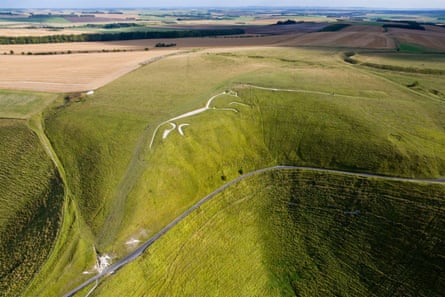
Chalk white horse on round green hills
The Uffington White Horse. Photograph: John Henshall/Alamy

The Ridgeway runs for 87 miles from Ivinghoe Beacon high in the Chiltern Hills to the prehistoric stone circle at Avebury in deepest Wiltshire. On its rolling heights, you can walk back to the iron age, when formidable hill forts commanded the vales. The ghosts of warrior-farmers can be sensed most powerfully on the western end of the Ridgeway, where the chalky trail climbs past the ramparts of Uffington, whose banks and ditches – once braced with timber and chalk rubble – enclose an area twice the size of a football pitch. Right beside the fort, a 110-metre long white horse gallops across the down, cut deep into the turf during the late bronze age or early iron age. One mile to the west, the Ridgeway passes the chambered long barrow known as Wayland’s Smithy, which once contained the remains of 14 people dated to between 3590 and 3550BC. The Ridgeway’s knack of time travel has long appealed to writers and photographers, from Thomas Hardy and Richard Jefferies, to Richard Mabey and Fay Godwin, whose book The Oldest Road: The Ridgeway (1975), unravelled the path connecting deep history with a modern national trail.

Holloways, Surrey Hills
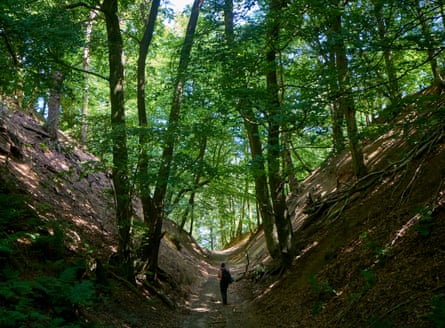
Woman hiking in Surrey Hills on a holloway type path
A holloway path at Holmbury St Mary in the Surrey Hills, near Leith Hill. Photograph: Matt Mawson/Getty Images

A holloway is a sunken path, an old way worn into the land by centuries of feet and hooves. Holloway walls can be almost vertical, cut back to raw rock and roots. Some are like ravines. Others are virtual tunnels, roofed with living trees. Some appear unexpectedly as gentle troughs in the landscape. They occur most dramatically in softer geologies like chalk, sandstone and greensand. Most are just a few minutes’ walk in length, but there are parts of the country where exploration will produce some very enjoyable clusters. There are three modest holloways right beside the White Horse of Uffington on the Ridgeway, cut perhaps in prehistoric times by cattle being moved from their winter quarters in the vale to the summer grasses of the high downs. In Holloway (2012), Robert Macfarlane wrote poetically of a buried path in the Chideock valley of south Dorset that it’s become a cause of pilgrimage for those of us who look for these places. The Surrey Hills are laced with secretive holloways. Among my favourites are the sunken tracks on the greensand of Leith Hill and farther west, the old holloways of Hascombe Hill and Hydon’s Ball. It’s along these semi-subterranean trackways that you’re most likely to detect the steady plod of Saxon cattle. Or Hobbits.


The Mass Trespass Walk, Derbyshire
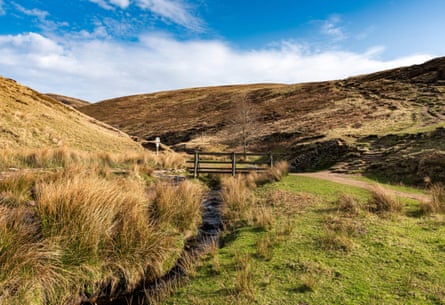
A path and a small stream running down upland moors
The path up William Clough on the Kinder Scout Mass Trespass walk. Photograph: Acorn 1/Alamy

The story of countryside access is written in the grit of Kinder Scout, whose frowning sandstone forms the highest point in the Peak District. In April, 1932, an excited gaggle of hikers climbed the footpath from the Derbyshire village of Hayfield up towards the brow of Kinder Scout, where they clashed with squads of gamekeepers intent on preventing public access to the moorland. Legislation followed and today the path up William Clough is described on the National Trust website as the Kinder Scout Mass Trespass Walk. A vigorous eight-mile loop along the crags and back down to Hayfield, it offers the full Pennine repertoire in a single outing, from glittering reservoir to whispering moorland and monumental rocks. It includes Kinder Downfall cascade and a section of the Pennine Way, the earliest of Britain’s national trails. I walked the trail one blustery December day, ambushed by snow flurries and sunshine that spotlit Manchester like spilt crystals on the dark plain. I’ve climbed Kinder from many directions, but this is the route that tells the best story.

Nicholas Crane’s new book, The Path More Travelled, The Secret History of Britain’s Footpaths, is published by Weidenfeld & Nicolson (£25). To support the Guardian, order your copy at guardianbookshop.com. Delivery charges may apply.