


As the camera pulls back from Bongeziwe Mabandla in the video for his recent single Yalwa, the true stars of the show reveal themselves: two women, dressed in a mix of crisp white and black traditional isiXhosa umbhaco garments and chic designer wear. Sure, Mabandla himself strikes a compelling figure in the centre of the frame in his own traditional apparel; the herd of cattle grazing around them are resplendent; and the forested ridges of South Africa’s Eastern Cape remain rapturous. But those stoic, confident, badass women! “Yeah, that’s my mom and aunt,” Mabandla says with a chuckle. The song, he says, is “all about heritage, going back and celebrating women in my lineage and in my family”.
Keeping that connection alive has become especially important to Mabandla now that the singer-songwriter – an indie icon in Johannesburg – has been living far away from them for the first time. After years of finding particular acclaim in France (including a nomination for the prestigious Radio France Internationale award early in his career), Mabandla has been settled in Paris for six months amid bouts of touring and travelling through Europe. “I’m everywhere these days, living between two countries,” he says, laughing again. “I wanted to see what doors would open for me living in a different culture, especially in a big place like Paris. It’s been life-changing, but I’ve been very careful I don’t abandon my South African side.”
There should be little risk of that: Mabandla’s roots run deep in his home country. Moulding elements of his region’s traditional music with his own modern indie electropop, his songs are largely delivered in isiXhosa – a magnetic language with distinctive click sounds native to South Africa – though his emotive delivery brings the storytelling into the heart, even for those unfamiliar with the language. There’s something soothing in the way he writes, the Xhosa storytelling elongated and lithe, but full of clicked pops of excitement. Now with five albums under his belt, Mabandla is starting to feel that passage of time even if his vibrant music refuses to show it. He demurs when I ask his age. “I’m old enough,” he grins. “Frame me as an uncle.”
The title of Mabandla’s new album Ndingubani translates to “who am I,” which he points out comes without a question mark – the phrase functioning both as an existential question and a statement of selfhood, depending on which angle you’re looking from. Mabandla has been sharing his inner self through song for a decade and a half – and is now documenting his struggles with addiction and depression – though he has been performing for anyone who would listen since childhood.
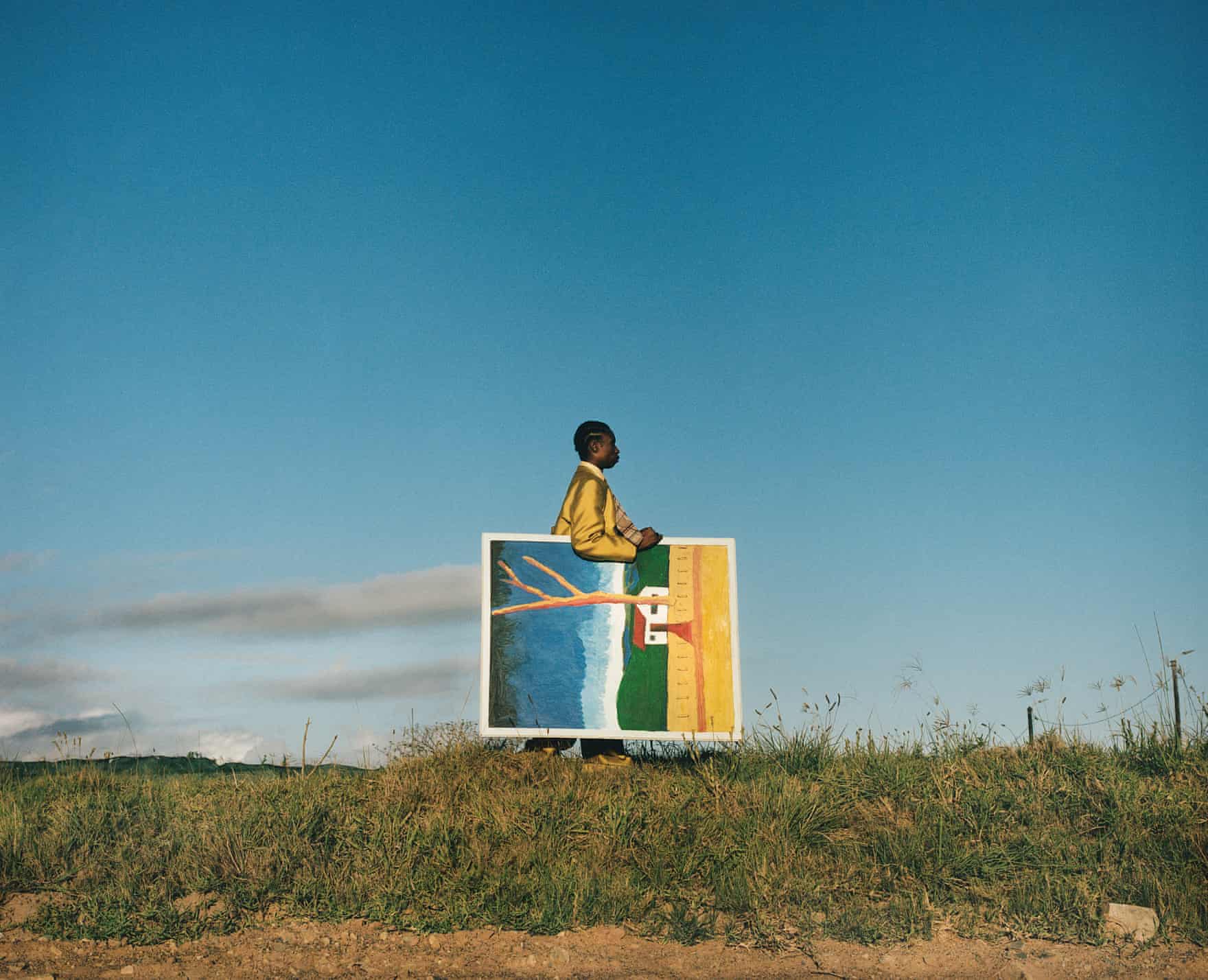
He grew up in Tsolo, a rural town about two hours drive inland from the southeast coast of South Africa. The youngest of his siblings (and the only one at home as he grew older), Mabandla had a deep connection with his mother and his home, and recounts seeing the white house and its red roof appearing in the distance as he walked home from school. “Every time I draw a house, I can’t help but draw that house,” he says. On the cover of Ndingubani, Mabandla walks through a scrub field, carrying a painting he’d done of that same house. “It had a big stoop and a dramatic arch, great for performing and imagining I was in a concert,” he says serenely. “I’d sing for friends, for family. I would perform for the trees sometimes.” He’d obsessively listen to and memorise songs by everyone from Tracy Chapman to Whitney Houston to South African pop legend Brenda Fassie. While he never imagined growing that obsession into a career, he attended a boarding school for the arts and started exploring the opportunity, eventually releasing his debut album Umlilo in 2012.
Follow-ups such as iiMini and amaXesha were poignant, diaristic accumulations of love stories and memories; for Ndingubani, “the circumstances wrote the album for me,” Mabandla says. In 2023 he cancelled touring in North America due to a cancer scare: luckily, the tumour turned out to be benign, but it greatly shifted his perspective. “On my first album I had a song called Isizathu, where I asked myself, ‘Where is the reason?’” he says. “Back then I was looking for a purpose to live, a purpose for my career. I wanted to make music. But now I’ve found my people, my audience, my dream.”
Written after receiving good medical news, the radiant Kude comes complete with swaggering rhythm section, shimmering keyboard and a saxophone solo – the sound of Mabandla celebrating life and its fullest potential. The propulsive Libambe Lingatshoni is meanwhile based on a Xhosa phrase that Mabandla loves: “It means you need to hold the sun before it falls down, so it doesn’t disappear,” he says. To hold on, therefore, to life before it ends.
But for every moment where his voice is regal and soaring there’s another where it’s whisper-close and pained. On the icy Mpendulo, Mabandla recalls a difficult incident where he was betrayed by a friend. “I put my trust in some wrong people. There was backstabbing, lying,” he says. But other friends remain a centering, cherished force in his life: “I’m the clown in the group chat,” he laughs – and the glowing Mngan’wam (or My Friend) was written for those who stood by him in difficult times.
“I’ve lived a lot in a way that was new and dark, and that really scared me,” he says. The choral and haunting AML takes on his struggles with alcohol and addiction, and searching for a way out – sung in English, as if even escaping his language can help escape unhealthy attachments. “In the darkest of my days, I found myself inside the pain,” he sighs on the track. The Auto-Tune-drenched Ndikhulule takes on depression even more directly, its titular call to be set free ringing through twitchy percussion and acoustic plucking. He seems reluctant to dwell too heavily on this darkness in our conversation, but acknowledges: “I’ve always been a person who has dark moments, but I love that I didn’t really run away from it [in music]. I wanted to explain all sides of myself.”
Much of Ndingubani was recorded at home, a first for Mabandla, but the album balances that intimacy with an aurora borealis of synth tone and layered vocals – like a little red-roofed house under a giant sky. When his life “was almost taken away, it made me want to go back and recommit, determined to do more,” Mabandla says. “That’s what I wanted the album to be about. There are these struggles, but also there’s resilience in the human spirit and in myself. I wanted to inspire a sense of strength, a revived hope.”