






Tucked away among hedgerows on a large field between a motorway and the River Ray, one of the UK’s largest community-owned solar parks is hard to spot from the surrounding country lanes.
But the nearly 36,000 solar panels installed on the site are literally a shining example of what can be achieved when a renewable energy project is co-owned by local people.
Ray Valley Solar, south of Bicester in Oxfordshire, generates enough clean electricity to power about 7,000 homes for a year, and uses its profits to provide grants to community initiatives that help reduce carbon emissions and make homes, schools and businesses across Oxfordshire more energy efficient.
Now, plans to install battery storage at the site with investment from members of the public – the first community-owned battery at a renewable energy project in the UK – will, it is hoped, give the project a big boost.
On very sunny days, Ray Valley Solar – which uses efficient double-sided solar panels that can capture sunlight that bounces back from the ground at the rear of the panels – produces more clean electricity than the local grid can take, resulting in some energy being wasted.
Storage is a critical challenge for the young technology around renewable energy. But plans to install a battery here mean the project will capture surplus solar power during the day and store it until it can be released during the peaks of demand in the evening, when the grid is more carbon intensive and electricity more expensive.
“This will allow the community solar park to generate more power and therefore to earn more money, which is reinvested into local sustainability and emission-cutting projects,” said Barbara Hammond, the chief executive of the Low Carbon Hub, one of the biggest community energy organisations in the country, which set up the solar park in 2022.
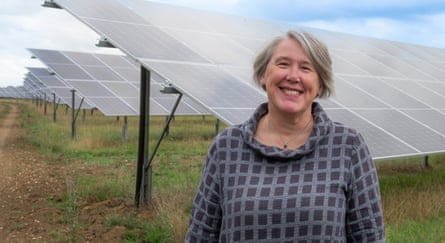
With capacity to store 12 megawatt hours of electricity every day, the battery is expected to save enough electricity to power an additional 300 homes a year. By selling the electricity for a higher price during the evening peak, Low Carbon Hub estimates it can increase its community benefit contribution to £1m over the battery’s 15-year lifetime.
Batteries, however, are still extremely expensive, although the race is on globally to find cheaper ways to produce them. In order to finance the installation of this particular lithium-ion battery, planned for October, the Low Carbon Hub is seeking to raise between £500,000 and £1.3m. People and organisations can buy shares between £100 and £100,000 in the hub’s Community Energy Fund via the investing platform Ethex until late June, with investors forecast to receive up to 5% return on their investment.
The hub, which has more than 2,000 shareholders in its fund so far, has successfully raised large amounts of money to fund community energy projects before, including £3m to establish Ray Valley Solar.
“All I remember is going into it with my stomach in knots, thinking: ‘How are we ever going to raise this much?’ But in the end, we had to stop it because we didn’t need the money. It was just amazing,” said Hammond.
Despite the global energy crisis brought on by the war in Iran and concerns about the cost of living, early interest in the battery investment round has been strong.
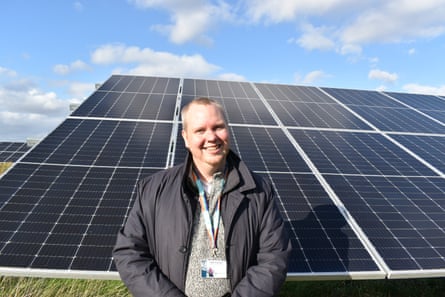
Dale Hoyland, 41, from Banbury, invested in Ray Valley Solar and has done so again to support the battery installation.
A team leader in the climate action service at Oxfordshire county council, Hoyland said he wanted to use his salary to “do more good out in the world”. With a teenage daughter and large mortgage, he does not have much to spare, but believes the community ownership model empowers everyone to do something to address the climate crisis, even with a small contribution.
“For the sake of a few hundred quid, I can take a share in the delight of making this all happen,” he said, describing the resulting benefits to the community as the key to “unlock positive climate action … greater than the sum of its parts”.
Eleanor Watts, an investor in her 70s, is an active member of a volunteer environmental group in south-east Oxford, which has received grants from Low Carbon Hub to install solar panels on schools and social housing blocks, showcase energy-saving retrofits and upgrades in homes, and run free cycle-repair workshops.
The group recently received £5,000 to help people in fuel poverty cut their energy bills by providing advice, identifying sources of financial support, and carrying out free thermal imaging to make homes draughtproof and minimise the risk of damp and mould.
“Even if the shares don’t do so well in the future, I will feel happy that my money has done a little bit to combat the climate emergency,” Watts said.
The project has attracted huge interest from other community energy groups around the UK keen to learn from the experience, said Hammond, whose top tip is to find “really good” consultants to provide technical advice.
Low Carbon Hub runs 56 community-owned renewable energy projects across Oxfordshire, from rooftop solar to hydroelectric plants on the Thames, and supports 50 community groups to develop carbon-cutting projects and share best practices to cut energy use and bills.
“We’re focused on getting the best out of everything we do,” said Hammond, who described the hub’s impact as “fractal”.
The UK government has pledged to spend up to £1bn on community-owned green energy schemes to combat growing resistance to renewable energy projects and ensure that communities hosting projects directly benefit from the energy they produce.
But more is needed to ensure everyone can benefit from the shift to clean energy, said Hammond. “There’s lots of really great words about including everybody, but not a lot of policy.” That’s something the hub can help to change, she said.