
惯性聚合 高效追踪和阅读你感兴趣的博客、新闻、科技资讯
阅读原文 在惯性聚合中打开

推荐订阅源

D
Docker
cs.AI updates on arXiv.org
C
Cisco Blogs
Scott Helme
Scott Helme
Know Your Adversary
Know Your Adversary
NISL@THU
NISL@THU
C
Cyber Attacks, Cyber Crime and Cyber Security
D
Darknet – Hacking Tools, Hacker News & Cyber Security
C
CXSECURITY Database RSS Feed - CXSecurity.com
S
Schneier on Security
I
Intezer
Spread Privacy
Spread Privacy
AWS News Blog
AWS News Blog
V
Vulnerabilities – Threatpost
Cloudbric
Cloudbric
V2EX - 技术
V2EX - 技术
Google Online Security Blog
L
Lohrmann on Cybersecurity
Recent Commits to openclaw:main
L
LINUX DO - 热门话题
S
Secure Thoughts
T
The Exploit Database - CXSecurity.com
博客园 - 【当耐特】
Recent Announcements
Security Archives - TechRepublic
Stack Overflow Blog
Stack Overflow Blog
罗磊的独立博客
OSCHINA 社区最新新闻
OSCHINA 社区最新新闻
K
Kaspersky official blog
阮一峰的网络日志
阮一峰的网络日志
博客园_首页
Latest news
Latest news
B
Blog
F
Full Disclosure
大猫的无限游戏
大猫的无限游戏
博客园 - 叶小钗
L
LangChain Blog
GbyAI
GbyAI
Last Week in AI
Last Week in AI
S
Security Affairs
Apple Machine Learning Research
N
Netflix TechBlog - Medium
Security Latest
Security Latest
Vercel News
Vercel News
Y
Y Combinator Blog
G
GRAHAM CLULEY
S
Securelist
T
Troy Hunt's Blog
Hacker News - Newest:
Hacker News - Newest: "LLM"
雷峰网
雷峰网

The Guardian

Rory McIlroy surges into six-shot Masters lead with stunning second-round flourish ‘That’ll be the end’: actor Sam Neill joins fight to stop controversial goldmine near his New Zealand vineyard Roberto De Zerbi targets ‘Ange-ball’ revival to save Spurs from relegation Bath hit back to reach semi-final after stunning Northampton in 11-try epic Secret Garden to Outcome: the week in rave reviews Zebras, wealth and power: Hungary’s election tests Orbán’s grip on power ‘TikTok effect’ brings sellout crowds and younger fans to Grand National meeting The war over Omagh’s gold: the £21bn mine plan tearing a community apart Britain’s shadow workforce is paid as little as 65p an hour. Who cares for the carers? From You, Me & Tuscany to Euphoria: your complete entertainment guide to the week ahead Six great reads: the man who let snakes bite him, masked heavy metal and the brutal reality for foreign students in the UK American Classic review – I defy you not to fall in love with Kevin Kline and Laura Linney’s tender comedy Cuba’s doctors were a lifeline for the world. Now the Caribbean is shamefully complicit in the US drive to expel them An environmental disaster in Moldova has Russia’s fingerprints all over it RMIT drops misconduct case against student who accused university of being ‘complicit in Gaza genocide’ Ichiro Suzuki statue unveiling goes awry as bronze bat snaps during ceremony Survivors of Epstein’s abuse accuse Melania Trump of ‘shifting burden’ on to victims European football: Real Madrid held at home by Girona to extend winless run Arne Slot insists he is ‘aligned’ with Liverpool board and fans as squad is rebuilt Kamala Harris ‘thinking about’ running for president again in 2028 JD Vance warns Iran against trying to ‘play’ the US in peace talks West Ham double up twice to thrash Wolves and put Spurs in relegation zone Trump administration releases new renderings of so-called ‘Arc de Trump’ Crispin Odey drops £79m libel claim against FT over sexual misconduct allegations Bafta apologises for events surrounding John Davidson’s Tourette’s outburst Cocktail of the week: Bar Shrimp’s la rosita – recipe New drug may extend survival in aggressive ovarian cancer, trial shows One dead and 27 injured after bus with British passengers crashes in Canary Islands Pope adds to Smith’s mass of Surrey runs with England woes a world away OpenAI CEO Sam Altman’s home targeted with molotov cocktail Reform UK local election candidate was twice disciplined by Tories over ‘racist comments’ Remaining in Nato is in best interests of US, says Keir Starmer Prince Harry sued for defamation by charity he co-founded Anthropic’s new AI tool has implications for us all – whether we can use it or not Concerns raised about motorbike tourist trail after death of British teenager in Vietnam The Guardian view on Trump’s civilisational threats: the words that fuel war must be condemned The Guardian view on dystopias for our times: the American nightmare Doctors’ leader claims new reduced pay offer killed chances of ending strikes in England Netanyahu-ism has achieved nothing for Israelis – and come at a monstrously high price Deborah Levy: ‘CS Lewis’s White Witch terrified me – but I wanted to meet her’ How I Shop with Michelle Ogundehin: ‘We grownups have enough stuff already’ Trump’s war and Melania’s Epstein statement, with US editor Betsy Reed – The Latest We have to stop killer motorists on Britain’s roads UK starts crackdown on EU citizens’ post-Brexit rights Londoners aren’t unfriendly – but don’t compare us to New Yorkers The religious right and the perversion of faith Artemis II images reignite moon mission memories Orbán and Magyar trade accusations in last days of Hungary election campaign Reckonwrong: How Long Has It Been? review | Safi Bugel's experimental album of the month Martin Rowson on Middle East peace talks – cartoon Masters magic, the Grand National and Premier League drama – follow with us Fears of UK and EU flight cancellations as airports warn of jet fuel shortages Reform’s petulance over slavery reparations shows it just doesn’t grasp Britain’s place in the modern world Peers vote to ban pornography depicting sex acts between stepfamily members Starbucks’s retail arm gets £13.7m tax credit even as sales increase Flyby review – interstellar musical is a voyage of epic strangeness Grand National preview: Jagwar can deny Irish cohort in Aintree classic Week in wildlife: an ostrich on the lam, a tortoise crossing a road and surfing seals Anger as swifts’ nesting holes in Derbyshire rail viaduct ‘blocked up’ Peter Mandelson faces fixed-penalty notice for urinating in public ‘There’s no shortage of terrifying technology’: how AI became TV drama’s new go-to villain ‘Fresher than anything in a shop’: the best recipe boxes and meal kits for time-poor foodies, tested Who was Hilma? Af Klint exhibition to highlight exclusion of women from abstract art Critics assemble! Here’s my list of the greatest superhero movies of all time US inflation soars in March as war on Iran drives economy into uncertainty Amazon to finally launch Leo satellite internet in ‘mid-2026’, says CEO Grand National 2026: horse-by-horse guide to all the runners Pete Hegseth’s holy war: the militant Christian theology animating the US attack on Iran Add to playlist: the beautifully dazed, countrified indie-rock of Tracey Nelson and the week’s best new tracks Not just about Gaza: the Muslim voters turning from Labour to the Greens Why is anyone surprised by the US and Israel’s latest war? It’s only what the world allowed them to do in Gaza Tori Amos review – fans hang on every note of this dramatic deep dive into her back catalogue Coachella 2026: Justin Bieber launches a major comeback in the desert Super Mario what?! The seven best obscure Mario games ‘An abomination’: the Lancashire town kicking up a stink over reopened landfill Pillion to Roofman: the seven best films to watch on TV this week Holly Humberstone: Cruel World review – Taylor Swift fave trades gothic melancholy for pop glow-up Thrash review – cursed shark thriller sinks like a stone on Netflix Gulf states rethink security in light of US-Israel war on Iran Go Gentle by Maria Semple review – a joyfully clever New York romcom Welcome to Y’all Street: bullish Dallas aims to steal New York’s financial crown Margo’s Got Money Troubles to Beef: the seven best shows to stream this week I baulked at the idea of ‘friction-maxxing’. But there’s more to it than meets the eye Reich: The Sextets album review – Colin Currie celebrates the minimalist master’s joy of six Benjamina Ebuehi’s sweet and salty chocolate chip cookies recipe Experience: my house was taken over by 70,000 bees Malcolm in the Middle: Life’s Still Unfair review – the TV magic they’ve created here is absolutely miraculous Lava bursts forth as Hawaii’s Kilauea volcano erupts Sonos review: Are these the best portable speakers that money can buy? I tested to find out Buy bread in the evening, hit the sales on a Tuesday: retail workers’ top tips to cut your shopping bill The best water flossers in the UK, tested for that dentist-clean feeling Where to start with: Muriel Spark You be the judge: should my girlfriend stop mixing gold and silver jewellery? The best carry-on luggage in the UK, tested on an assault course How games capture the awe and terror of cosmic isolation I never text back – and it’s ruining my relationships The pet I’ll never forget: Beau, the labrador who saved my life When Suzuki met Suzuki: why a Tokyo dating agency is matching couples with the same name Life Is Strange: Reunion review – a decade-long story comes to an impassioned close Why is gaming becoming so expensive? The answer is found in AI
‘I’m worried there’s too much of me,’ says a birch: inside the interspecies council giving nature a voice
2026-04-10 · via The Guardian

“My ask of humans is quite large,” says the northern bat to a room of reindeer, wolf lichen, bog, and other beings. “It’s a shift of consciousness, and an understanding that … we are a relation.”

The scene could come from a sci-fi novel imagining a more-than-human uprising. In fact, it’s from a recent “interspecies council” in Oppdal, Norway, in which non-humans – spoken for by humans – convened to discuss the region’s future.

In the 1980s, the environmentalists John Seed and Joanna Macy developed the Council of All Beings: a practice in which humans embody and represent other species in a ceremonial council.

The scientist and “moral imagination” activist Phoebe Tickell was a mentee of Macy’s. Together they imagined integrating the practice into governance structures. This inspired Tickell to develop the interspecies council, which she describes as a “decision-making methodology that expands who has voice and representation in governance beyond humans alone”.
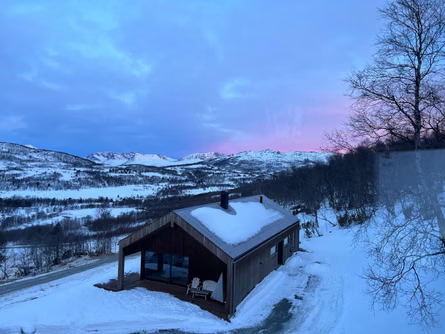
A snow-laden chalet in Norway overlooking a mountain range; in the distance, bare trees and an evening sky with clouds turning pink at the horizon
The location in Oppdall where the Interspecies Council convened Photograph: Bhuvana Nanaiah

Interspecies councils address a specific issue. Facilitators and ecologists identify multispecies stakeholders, then assign and brief human representatives (chosen randomly or based on expertise). Councils produce an output, like a decision or manifesto, and the process concludes with an impact evaluation. The term “multispecies assembly” is sometimes used more broadly, to encompass artistic variations.

The practice is part of a growing international movement establishing nature rights and governance power. In the UK, 13 councils have recognised river rights since 2023. A nature’s rights bill is building support. A coalition of artists, ecologists, lawyers, scientists, urbanists, fishers, and policymakers is exploring the possibilities of interspecies biodiversity governance around the North Sea. Organisations are increasingly applying “nature-centric governance” techniques such as nature charters and appointing nature to boards.

Interspecies councils are also taking root in policy settings. They have been used to reimagine stewardship around London’s River Roding, and to generate a multispecies response to a governmental consultation on land use. And now they’ve gone international.

Oppdal is a mountain village in central Norway’s Drivdalen valley, between the Dovrefjell and Trollheimen ranges. Beyond the patchwork of valley-floor farmland, wildness reigns. “People live here with their shoulders lower,” says Oppdal’s mayor, Elisabeth Hals.

Map

In winter Oppdal’s population balloons from 5,000 to 30,000 or more. Many visitors retreat to private cabins, or hytter, which symbolise nature connection in the Norwegian psyche and have proliferated, especially since Covid. This spring the municipality is also expected to approve plans for apartments accommodating another 1,000 tourists by 2035 – part of a strategic repositioning of Oppdal as a year-round destination to mitigate against warming winters.

Against a global backdrop of environmental crisis, Oppdal’s transitional moment has created ongoing debate about how to balance economic development with ecological health. Margrete Vognild Blokhus, who facilitates dialogue between stakeholders, says discussions are animated by a shared sense of stewardship, not conflict. Nevertheless, tensions persist over how to allocate land between farming, tourism and conservation.

The architect Katerine Chada is part of Common Ground, a multidisciplinary research project exploring integrated land management in Oppdal. After seeing Tickell talk at the University of Cambridge in 2025, she pitched her colleagues an Oppdal interspecies council.

They were sceptical. Would people engage? “Are we going to go on this weird trip?” Patricia Schneider-Marin, a fellow architect, remembers thinking. But they supported giving nature a voice, and were curious about whether a council could cut through conflict and enable more ecological decisions. They agreed to try.

On the morning of the council, 38 representatives gathered at Bjerkeløkkja conference centre – all local people, all new to this. Floor-to-ceiling windows framed conifer forest and snow-dusted foothills. Chada was there representing a spider. Schneider-Marin was a Norwegian spruce, Vognild Blokhus a purple saxifrage flower. The mayor would arrive later, as a cloudberry.

The day began with a briefing, then icebreakers. When asked whose great grandparents lived in Oppdal, about half the room stood. An invitation to embody their beings elicited the odd squawk, wing flap and lumbering stride.
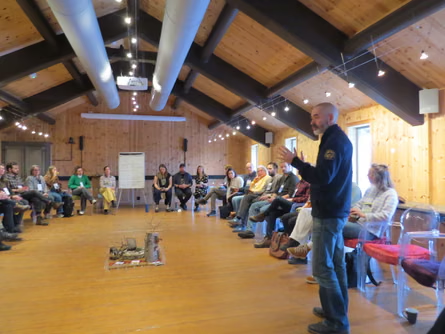
A hall with chairs ringing the outside, many occupied by members of the Interspecies Council; one member, standing up, is leading the discussion
The members of the council enter into discussion on behalf of the species they are representing. Photograph: Bhuvana Nanaiah

The council centred around a series of discussions about beings’ needs, challenges and ideas for Oppdal. Ritualistic touches, such as beings bowing in introduction, added ceremony.

A rockfoil flower wished that humans would slow down and listen “to where nature can tolerate more human activity and where it needs space”. “I’m worried there’s too much of me,” said a birch. “I thrive in open spaces, but I can take over.”

“I’ve just been seen as a resource, and not even acknowledged for how much I’ve given this landscape,” lamented the River Driva, voice cracking with emotion. “I hate when humans make me fit in and be smaller than I am.”

“I like him!” exclaimed a fox, pointing at a wader.

Interspecies councils are not primarily about unearthing data. “I work a lot with numbers,” says Schneider-Marin. “We know the numbers.”

Rather, they aim to cultivate interspecies empathy – to help dissolve the illusory human-nature divide. “To take care of nature, we have to know it and feel it and think like it,” says Vognild Blokhus.

Thinking and feeling differently does not mean pretending to know other species’ minds. Speaking for a tree without sight, smell, hearing or taste was “a bit of a brain-twister”, says Schneider-Marin. “But I think that’s a healthy point.”
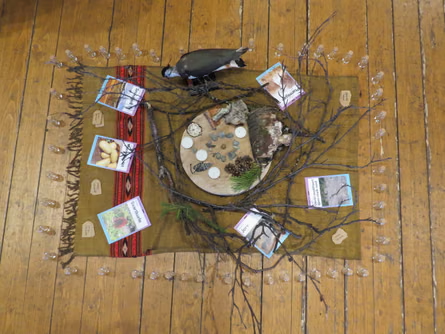
A mat is decorated with branches and other items, a bird and ID cards representing various species whose needs and challenges are discussed by the council
A collection of items to represent the various species of flora and fauna whose needs and challenges are discussed by the council Photograph: Bhuvana Nanaiah

For Tickell, imperfect representation beats exclusion. “Is it sillier to ask someone to imaginatively inhabit the perspective of a different species for an hour, or to continue running governance systems that have driven a 70% collapse in wildlife populations in 50 years?”

Interacting as non-humans can also disrupt human relationships. The council created an unusually “fantastic atmosphere of listening”, says Chada.

For Schneider-Marin, this helped “people to hear concerns without feeling offended, because they could be like: ‘OK, wait, I’m a species.’”

The hope is that these positive experiences will translate into long-term empathy gains. An evaluation is tracking Oppdal participants’ connectedness to nature and openness to non-human perspectives from before the council to six months after.

Oppdal’s beings drafted principles for human governance which will be published as a manifesto. Human discussions to close the council also generated governance ideas, including a six-monthly interspecies council, and the formation of a höringsgruppe, or hearing group, for listening to Oppdal’s non-humans. Participants will gather in June to discuss implementation.

The core challenge is establishing what Tickell calls “institutional trace”: meaningful decision-making power grounded in robust methodologies, accountable protocols and longitudinal research. She envisions a world where interspecies councils are a requirement “as unremarkable as environmental impact assessments”. Interspecies councils will have failed, she says, if they “become sophisticated greenwashing or window-dressing”.

The future of interspecies councils will unfold in Oppdal and beyond. For Oppdal’s participants, shared scepticism has become a sense that they represent, as Vognild Blokhus puts it, one of the “little seeds that we have to plant to make sure that in the end, maybe, we have a change”.