







The US-Israel war on Iran has brought into sharp focus our reliance on petroleum and natural gas. Petrochemicals are the cheap, ubiquitous feedstocks for so much we consume: the raw materials for our digital devices, cosmetics and detergents, plastic packaging, our medical supplies and fertilisers. There are greener alternatives, of course, but for now the world’s economy is hopelessly dependent.
Many of us have been avoiding filling up at the bowser to alleviate the oil and gas crunch, but the pressures are no longer just about transport costs. This left me wondering, in this global economy, could I last 24 hours avoiding petrochemicals altogether?
I awake having failed. My sheets are made of organic bamboo with natural dyes and my bed base is wooden, but I am lying on a mattress that is essentially a large block of crude oil (polyurethane foam is produced through the same process used to make petroleum).
I am also clutching a stuffed Ikea monkey. “Do you have petrochemicals?” I ask his vacant eyes.
“Caity,” my partner says, lying beside me. “I have to tell you something. I’m filled with petrochemicals.”
The head of the University of Sydney’s advanced carbon research lab, Prof Yuan Chen, is not surprised I have stumbled so early. He tells me his first thought about my experiment is that “it is impossible” and “not scientifically correct”.
“The concept is misaligned with the scientific understanding of how the petrochemical has changed our society,” he says. “For example, almost all the medical consumables we’re using in the hospital come from petrochemical products.”
Do I want to avoid healthcare? Probably not.
I get out of bed and fail again. Our apartment is carpeted and the majority of carpets are manufactured from synthetic fibres such as nylon and polyester derived from petroleum.
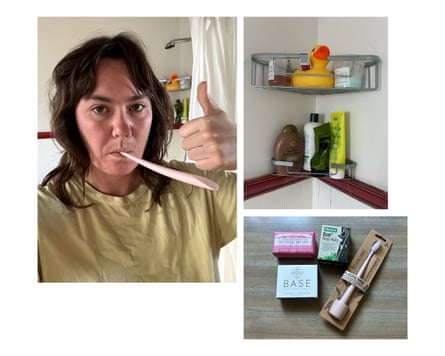
Absent being carried around like a rag doll and touching nothing, I have no choice but to succumb. I head to the bathroom and grab my biodegradable cornstarch toothbrush and toothpaste pellets, ditching my usual electric variety. The pellets taste like grass.
Next, it’s shower time, and I’m relieved to discover our towels are 100% cotton. I use a hemp soap with paper packaging and shampoo bar made from organic oils.
But Chen tells me even my towels are flawed. “In order to efficiently grow cotton, you need a lot of fertiliser,” he says. “Without fertiliser, without pesticide, they won’t grow so well. So in order to have such a large bio-based raw material, we also need assistance from petrochemical products.”
Standing in my acrylic bathtub, the hot water pouring out of my shower head in a process largely mysterious to me, I feel a pang of guilt over the abundance of plastic in my midst – my rubber duck, my bottles of cleansers and creams. How did it get to this?
I can’t use my plastic hairbrush or blow drier, so I whip my hair back and forth several times to encourage drying. My chemical-filled deodorant is also out of the question, so I rub coconut oil on to my armpits. It feels terrible.
Getting dressed is harder than I anticipated. Everything seems to have plastic buttons or elastic or zips. I opt for a bamboo T-shirt, hand-knitted jumper, recycled hemp skirt and Twoobs sandals – made of plants, recycled plastics and sugarcane.
Most of my items are secondhand, which feels like a tick given about 1.5bn items of new clothing were bought in Australia last year – equivalent to 55 garments per person – and it avoids the petrochemicals used in manufacturing, packaging and transporting new items.
Chen agrees. He says opting for secondhand clothes is “basically recycling”, and bamboo products are “really renewable” and a “sustainable fibre material”.
I head out to walk the dog, armed with a cotton tote bag, a mug I found on the street, a premium leather and brass lead and paper towel.
The park is safe, or so I imagined. I have ditched tennis balls today – a minefield of synthetic rubber, nylon, and industrial adhesives – and am scavenging for sticks, or, as I call them, “nature’s dog toys”.
After finding a good one, my Labrador leaps up and accidentally bites my hand, which gushes blood. I head to a nearby pool for antiseptic and Band-Aids – which, as Chen has attested, rely on petrochemicals. How easy it is to waver when your health is on the line.
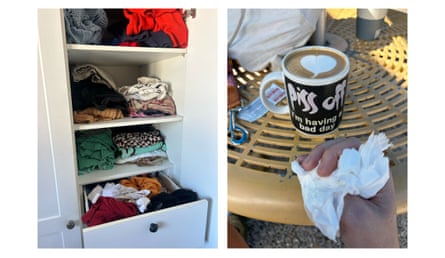
To recover, I order an oat latte and feel comforted that my mug reads: “Piss off, I’m having a bad day”. The coffee machine was probably plastic-laden and the beans transported on an oil-guzzling ship, but can I personally do anything in response? Grow my own beans and grind them with a mortar and pestle? Buy and milk my own cow? But where would I keep it? And what about the emissions?
I’ve got supermarket supplies to grab, and feel instantly overwhelmed by how saturated the local shopping centre is with petrochemical-derived waste. The food court is a graveyard of coffee cups, takeaway containers and plastic water bottles. Trolleys pass by packed with single-use packaging.
Even at the organic supermarket, many of the fruit and vegetables are sealed behind layers of plastic. I buy capers and anchovies in glass jars. They’re imported from Italy.
The issue, Chen says, is that single-use plastic is “so cheap”.
“That’s why people started to overuse or abuse it, so we no longer reuse and recycle.
“Bio-based material can be two or three times more expensive. And then if you look very carefully, they are also using petrochemical products in their making.
“In order for material to stand the moisture, the oxygen environment, so you can preserve the food for long enough, they have to mix with some of the petrochemical product.”
On the way home, my dog stops to poo and I pick it up with paper towel. A woman grimaces at me as I carry the steaming pile of shit to the bin.
I sit on the floor with my partner for brunch, which is organic eggs, kale and herbs from my garden and sourdough that I picked up at the farmers’ market. We’re avoiding chairs, because they’re covered in a plastic sheen. I have wooden utensils and a pan made from cast-iron and stainless steel, so I’m calling this a pass.
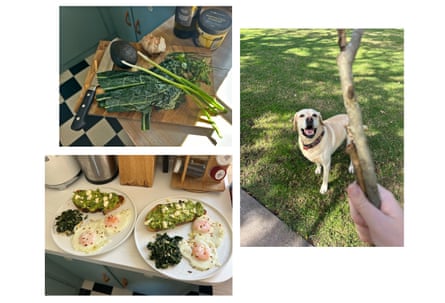
I can’t help the fact that in a rental property, we don’t have the choice to install solar panels, and my alternative to cooking on the stove – heating everything on my fire pit like a hunter gatherer – fells impractical.
I am riding my Lekker ebike to work, which is made from aluminium but was imported from the Netherlands and obviously requires charging. My helmet was manufactured in China from polystyrene foam and polycarbonate. Still, it’s using fewer petrochemicals than driving.
I am only using my iPhone to take photos of the experiment, given it is not only coated in plastic but also contains resins, polyethylene and synthetic rubbers.
I often ride to work, but never without my phone. Not only because I am pathetically dependent on GPS but also because I use transiting to catch up on depressing news podcasts. Today, though, I am delightfully unencumbered.
I take several wrong turns yet feel serene. I am noticing everything around me, the way light hits a tree, dogs in the park, how many people have taken up vaping.
Chen applauds my cycling, but says even opting for a train instead of a bus is much more environmentally friendly. He also advises me that if I need to travel by plane, I should choose an economy seat instead of first class, which emits “five or six times more emissions”. It’s nice he thinks first class is within my budget.
I enter the office with my hair unbrushed and my mind clear like a pond. I am a journalist on a work day and I haven’t checked emails or the news. Unfortunately, to get in I have to use my plastic pass and take the lift.
The whole building is a petrochemical minefield: computer monitors and keyboards and plastic pens. I use a wooden stool in place of my office chair and avoid the screens, asking my colleague every so often for the time.
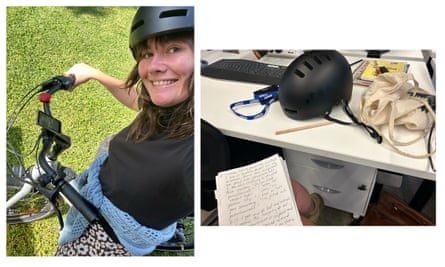
I am writing my article hunched over my stool with a charcoal pencil and recycled paper, and it doesn’t take long for my hands to blister and ache. One of my editors says I should have walked or ridden a penny farthing to work.
This experiment is meant to be as close as possible to reality, though, and I don’t have infinite time to stroll the streets of Sydney like a member of the nobility.
I cycle home via the library, where I plan to do some fact-gathering on petrochemicals like in the olden days (pre-2000). Sadly, not using my phone means I have no idea it is closed.
I get home as the sun is setting and tend to my plants for a while. Before dinner, I would usually mindlessly watch television but instead I lay a cotton cloth on the floor and enjoy an 1897 edition of Jane Eyre lent by a colleague.
I have hundreds of books but didn’t realise most paperbacks made after 1900 use adhesives and plastic laminate, unlike the good old days of animal-based glue and wheat starch paste.
Dinner is puttanesca pasta on the floor with tuna fillets in paper packaging, produce from the farmers’ market and pasta, also encased in paper. The room is lit up by beeswax candlelight, and it feels both cozy and impractical. By the end of the day, I haven’t put anything in my waste bin, haven’t checked a single phone notification and I’m tired like a baby.

I feel scarily dependent on our global economy and disgusted by all the things we consume. It’s not just about plastic waste. According to the UN, in 2019, plastics generated 1.8bn tonnes of greenhouse gas emissions which is 3.4% of total global emissions. I couldn’t even last a day without it.
I could sleep under the stars, but instead I lay my head on my synthetic memory foam pillow and drift asleep to the sounds of passing planes and traffic.
Not all hope is lost, though. Chen says my dependence on petrochemicals isn’t necessarily a bad thing.
“In the next five or 10 years’ time, there will be a dramatic shift of how the world is using petrochemical products,” he says. “We can see the shift, which is a shift to a more electrical-powered solutions, EVs, trains, and maybe in the future airplanes.
“Because electricity, you cannot just generate from the petrochemical, you can also generate from solar, from wind, from many, many renewable sources.”
I just have to avoid first class air fares.
This article was written by hand and transcribed on to a computer.
此内容由惯性聚合(RSS阅读器)自动聚合整理,仅供阅读参考。 原文来自 — 版权归原作者所有。