








Waiting for men’s broadcast picks, dodging local fun runs and even having to avoid clashing with nearby comedy gigs: welcome to the quagmire of trying to arrange the Women’s Super League and WSL 2 schedule.
The fixture list is often a bone of contention for supporters, and organisers face a painstaking task in trying to organise games in venues where other teams get first dibs.
“Stadium availability is led by the men’s game and then broadcast is led by the men’s game, so it can be really hard,” Zarah Al-Kudcy, chief revenue officer at WSL Football, says. “Some of the reasons we are given as to why fixtures have to change, you just have to laugh or you’d cry.”
The issue has come into sharp focus with Arsenal two games into a run of seven matches in 20 days, and with Saturday’s Women’s Champions League semi-final – which prompted the rearrangements of multiple league fixtures – clashing with a tantalising final day of the WSL 2 season, but work began on this season’s schedule 18 months ago.
Even releasing the fixture list to supporters each summer presents a series of hurdles. Dates are locked into the international calendar first by Fifa – which has confirmed its match windows up to 2030 – then by Uefa, which inserts European club competitions dates. Then WSL Football and the Football Association undergo “very friendly negotiation” over which of the vacant slots will be reserved for cup ties.
Conversations typically begin the December before the season but, for 2027-28, they will start shortly because of the “added complexity” of January 2028’s Club World Cup, says the WSL’s chief operating officer, Holly Murdoch, who says the new, longer, three-game Fifa windows that each use two full weekends of the calendar are problematic. The WSL has 20 guaranteed available weekends a year compared with 33 in the Premier League.
Once round dates are agreed, women’s football has to wait, wait and wait some more. The Premier League decides its fixture list, the EFL follows and the WSL even waits for the men’s National League, because two WSL clubs, West Ham and Crystal Palace, are tenants of National League grounds at Dagenham & Redbridge and Sutton respectively.
“Across five games, no club should have [more than] three home and two away or the other way around,” Murdoch says. “In May we will write to all of our clubs ahead of 2026-27 and ask them to fill out our fixture questionnaire, including about stadium availability and constraints. There might be major events – such as the Women’s Rugby World Cup this season – or road closures due to runs.”
Last summer three clubs requested to play at home in their main stadiums on the opening weekend. Others will request a home or local away fixture straight after European matchweeks. Ideally, all clubs’ men’s and women’s teams who share venues might alternate home match weekends but Al-Kudcy says: “That’s easier in the first half of the season. Where it becomes really difficult is in the latter rounds of the men’s cup competitions, as that’s when we don’t know which men’s teams might be at home.” That challenge has been exacerbated by nine English men’s sides qualifying for Europe.
Then a computer, run by the IT company Atos, is asked to compile the fixtures. “I’ve sat in meetings where we’ve re-run it through the computer maybe eight or nine times,” says Murdoch. Then comes phase two of the complications: kick-off times and broadcast picks.
For a typical gameweek, Premier League broadcast picks come first, followed by the EFL. Then Sky Sports, which has most WSL first picks, will make its selection, before the BBC comes in. Then clubs check if it works for them. This season, midday Sunday games have become commonplace after a Football Supporters’ Association questionnaire suggested fans found it hard to know when WSL games were on.
Al-Kudcy says: “We gave that feedback to Sky and [that’s] how we landed on that midday slot. Clubs also said they didn’t want 6.30pm kick-offs on a Sunday because they said it was affecting ticket sales, so we listened to that.”
Firm decisions have not been made about kick-off slots for next season but the league is taking onboard fan feedback and reviewing data, including the volume of food and merchandise sold pre-match depending on the kick-off time. In a sport trying to become financially sustainable, every detail counts.
Sometimes wider factors affect kick-off slots. Manchester United share the Leigh Sports Village ground with rugby league’s Leigh Leopards. Broadcasters’ other commitments – such as the BBC’s coverage of this season’s Winter Olympics – can add to the complexity.
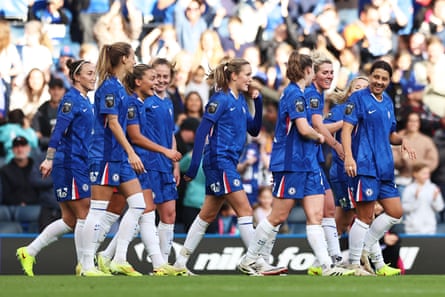
That challenge will grow next term with the WSL top tier’s expansion from 12 to 14 teams. More clubs moving to play at their men’s stadium– most recently Chelsea – is welcomed by the league but leads to clashes. Even when a team has their own women’s stadium, as with Manchester City, it does not mean they can play whenever they like. A John Bishop standup gig at the neighbouring Co-op Live venue was a factor for a City WSL game last year. TfL must be consulted about women’s games at Stamford Bridge when Fulham’s men are playing at Craven Cottage. “I know the perception can be that we’re not being fan-friendly but we’re doing the best we can with the structure we’ve got,” Al-Kudcy says.
When it comes to broadcast viewership, Friday night games have done well. Attendances are a different matter, but after just 27 Friday matches there is perhaps not enough data to make grand conclusions, and Friday nights have brought some success stories, such as the 32,970 who watched Chelsea face Arsenal at Stamford Bridge in the 2023-24 season.
These are challenges faced the world over by women’s leagues, and Wednesday’s announcement by the American NWSL that it will continue until 2030 with a spring-autumn calendar – instead of switching to western Europe’s September-May calendar – shows big-picture questions are being posed all around the sport.