
惯性聚合 高效追踪和阅读你感兴趣的博客、新闻、科技资讯
阅读原文 在惯性聚合中打开

推荐订阅源

N
Netflix TechBlog - Medium
罗磊的独立博客
H
Help Net Security
I
Intezer
G
Google Developers Blog
CTFtime.org: upcoming CTF events
T
Troy Hunt's Blog
让小产品的独立变现更简单 - ezindie.com
U
Unit 42
cs.AI updates on arXiv.org
freeCodeCamp Programming Tutorials: Python, JavaScript, Git & More
钛媒体:引领未来商业与生活新知
钛媒体:引领未来商业与生活新知
N
News and Events Feed by Topic
J
Java Code Geeks
S
Security Affairs
T
The Blog of Author Tim Ferriss
Recent Commits to openclaw:main
cs.CV updates on arXiv.org
D
Docker
The GitHub Blog
The GitHub Blog
F
Full Disclosure
N
News and Events Feed by Topic
Webroot Blog
Webroot Blog
S
Security @ Cisco Blogs
腾讯CDC
人人都是产品经理
人人都是产品经理
M
MIT News - Artificial intelligence
Blog — PlanetScale
Blog — PlanetScale
T
Threatpost
D
DataBreaches.Net
Recent Announcements
博客园 - 三生石上(FineUI控件)
MongoDB | Blog
MongoDB | Blog
博客园 - 【当耐特】
L
LINUX DO - 最新话题
Google Online Security Blog
S
Schneier on Security
S
Securelist
奇客Solidot–传递最新科技情报
奇客Solidot–传递最新科技情报
Help Net Security
Help Net Security
P
Proofpoint News Feed
Project Zero
Project Zero
S
SegmentFault 最新的问题
H
Hackread – Cybersecurity News, Data Breaches, AI and More
MyScale Blog
MyScale Blog
Google DeepMind News
宝玉的分享
宝玉的分享
Y
Y Combinator Blog
C
CXSECURITY Database RSS Feed - CXSecurity.com
博客园 - 叶小钗

The Guardian

Rory McIlroy surges into six-shot Masters lead with stunning second-round flourish ‘That’ll be the end’: actor Sam Neill joins fight to stop controversial goldmine near his New Zealand vineyard Roberto De Zerbi targets ‘Ange-ball’ revival to save Spurs from relegation Bath hit back to reach semi-final after stunning Northampton in 11-try epic Secret Garden to Outcome: the week in rave reviews Zebras, wealth and power: Hungary’s election tests Orbán’s grip on power ‘TikTok effect’ brings sellout crowds and younger fans to Grand National meeting The war over Omagh’s gold: the £21bn mine plan tearing a community apart Britain’s shadow workforce is paid as little as 65p an hour. Who cares for the carers? From You, Me & Tuscany to Euphoria: your complete entertainment guide to the week ahead Six great reads: the man who let snakes bite him, masked heavy metal and the brutal reality for foreign students in the UK American Classic review – I defy you not to fall in love with Kevin Kline and Laura Linney’s tender comedy Cuba’s doctors were a lifeline for the world. Now the Caribbean is shamefully complicit in the US drive to expel them An environmental disaster in Moldova has Russia’s fingerprints all over it RMIT drops misconduct case against student who accused university of being ‘complicit in Gaza genocide’ Ichiro Suzuki statue unveiling goes awry as bronze bat snaps during ceremony Survivors of Epstein’s abuse accuse Melania Trump of ‘shifting burden’ on to victims European football: Real Madrid held at home by Girona to extend winless run Arne Slot insists he is ‘aligned’ with Liverpool board and fans as squad is rebuilt Kamala Harris ‘thinking about’ running for president again in 2028 JD Vance warns Iran against trying to ‘play’ the US in peace talks West Ham double up twice to thrash Wolves and put Spurs in relegation zone Trump administration releases new renderings of so-called ‘Arc de Trump’ Crispin Odey drops £79m libel claim against FT over sexual misconduct allegations Bafta apologises for events surrounding John Davidson’s Tourette’s outburst Cocktail of the week: Bar Shrimp’s la rosita – recipe New drug may extend survival in aggressive ovarian cancer, trial shows One dead and 27 injured after bus with British passengers crashes in Canary Islands Pope adds to Smith’s mass of Surrey runs with England woes a world away OpenAI CEO Sam Altman’s home targeted with molotov cocktail Reform UK local election candidate was twice disciplined by Tories over ‘racist comments’ Remaining in Nato is in best interests of US, says Keir Starmer Prince Harry sued for defamation by charity he co-founded Anthropic’s new AI tool has implications for us all – whether we can use it or not Concerns raised about motorbike tourist trail after death of British teenager in Vietnam The Guardian view on Trump’s civilisational threats: the words that fuel war must be condemned The Guardian view on dystopias for our times: the American nightmare Doctors’ leader claims new reduced pay offer killed chances of ending strikes in England Netanyahu-ism has achieved nothing for Israelis – and come at a monstrously high price Deborah Levy: ‘CS Lewis’s White Witch terrified me – but I wanted to meet her’ How I Shop with Michelle Ogundehin: ‘We grownups have enough stuff already’ Trump’s war and Melania’s Epstein statement, with US editor Betsy Reed – The Latest We have to stop killer motorists on Britain’s roads UK starts crackdown on EU citizens’ post-Brexit rights Londoners aren’t unfriendly – but don’t compare us to New Yorkers The religious right and the perversion of faith Artemis II images reignite moon mission memories Orbán and Magyar trade accusations in last days of Hungary election campaign Reckonwrong: How Long Has It Been? review | Safi Bugel's experimental album of the month Martin Rowson on Middle East peace talks – cartoon Masters magic, the Grand National and Premier League drama – follow with us Fears of UK and EU flight cancellations as airports warn of jet fuel shortages Reform’s petulance over slavery reparations shows it just doesn’t grasp Britain’s place in the modern world Peers vote to ban pornography depicting sex acts between stepfamily members Starbucks’s retail arm gets £13.7m tax credit even as sales increase Flyby review – interstellar musical is a voyage of epic strangeness Grand National preview: Jagwar can deny Irish cohort in Aintree classic Week in wildlife: an ostrich on the lam, a tortoise crossing a road and surfing seals Anger as swifts’ nesting holes in Derbyshire rail viaduct ‘blocked up’ Peter Mandelson faces fixed-penalty notice for urinating in public ‘There’s no shortage of terrifying technology’: how AI became TV drama’s new go-to villain ‘Fresher than anything in a shop’: the best recipe boxes and meal kits for time-poor foodies, tested Who was Hilma? Af Klint exhibition to highlight exclusion of women from abstract art Critics assemble! Here’s my list of the greatest superhero movies of all time US inflation soars in March as war on Iran drives economy into uncertainty Amazon to finally launch Leo satellite internet in ‘mid-2026’, says CEO Grand National 2026: horse-by-horse guide to all the runners Pete Hegseth’s holy war: the militant Christian theology animating the US attack on Iran Add to playlist: the beautifully dazed, countrified indie-rock of Tracey Nelson and the week’s best new tracks Not just about Gaza: the Muslim voters turning from Labour to the Greens ‘I’m worried there’s too much of me,’ says a birch: inside the interspecies council giving nature a voice Why is anyone surprised by the US and Israel’s latest war? It’s only what the world allowed them to do in Gaza Tori Amos review – fans hang on every note of this dramatic deep dive into her back catalogue Coachella 2026: Justin Bieber launches a major comeback in the desert Super Mario what?! The seven best obscure Mario games ‘An abomination’: the Lancashire town kicking up a stink over reopened landfill Pillion to Roofman: the seven best films to watch on TV this week Holly Humberstone: Cruel World review – Taylor Swift fave trades gothic melancholy for pop glow-up Thrash review – cursed shark thriller sinks like a stone on Netflix Gulf states rethink security in light of US-Israel war on Iran Go Gentle by Maria Semple review – a joyfully clever New York romcom Welcome to Y’all Street: bullish Dallas aims to steal New York’s financial crown Margo’s Got Money Troubles to Beef: the seven best shows to stream this week I baulked at the idea of ‘friction-maxxing’. But there’s more to it than meets the eye Reich: The Sextets album review – Colin Currie celebrates the minimalist master’s joy of six Benjamina Ebuehi’s sweet and salty chocolate chip cookies recipe Experience: my house was taken over by 70,000 bees Malcolm in the Middle: Life’s Still Unfair review – the TV magic they’ve created here is absolutely miraculous Lava bursts forth as Hawaii’s Kilauea volcano erupts Sonos review: Are these the best portable speakers that money can buy? I tested to find out Buy bread in the evening, hit the sales on a Tuesday: retail workers’ top tips to cut your shopping bill The best water flossers in the UK, tested for that dentist-clean feeling Where to start with: Muriel Spark You be the judge: should my girlfriend stop mixing gold and silver jewellery? The best carry-on luggage in the UK, tested on an assault course How games capture the awe and terror of cosmic isolation I never text back – and it’s ruining my relationships The pet I’ll never forget: Beau, the labrador who saved my life Life Is Strange: Reunion review – a decade-long story comes to an impassioned close Why is gaming becoming so expensive? The answer is found in AI
Forced disappearances and torture: Ecuador’s war on drugs is brutal – and backed by US troops
Harriet Barb · 2026-05-20 · via The Guardian

The raid began at 4am. As the children slept, soldiers charged into the family home, rifles raised. “They said they were entering under the emergency powers,” says Rosa*, the family’s matriarch, whose name has been changed for fear of retaliation. “They pointed their guns at us. I thought they were going to kill us all.”

The soldiers quickly singled out her son, 16-year-old Jairo Damián Tapia Álvarez, and her nephew, 17-year-old Jostin Elian Álvarez Chávez, she says, separating the boys from the family.

“They said they were taking them in for an ongoing investigation and that, if we resisted, we would all be teargassed,” she says.

For days, the family searched frantically for the boys – at prosecutors’ offices, police stations, hospitals, prisons, fields and even rubbish dumps.

Fifteen days later, Jostin reappeared. Bruised and scared, he said soldiers had tied up him and his cousin in a disused fire station, where they were beaten for information on people and criminal activities they knew nothing about. The soldiers threatened to kill the boys.

Then, a week after they were detained, the boys were driven to a cornfield. Jairo and another detainee were taken from the van; the soldiers carried guns and shovels. Moments later, Jostin heard two gunshots.

“We killed your cousin. Are you sad?”, the soldiers asked him repeatedly in the days afterwards, Jostin said. Eventually, he managed to escape the soldiers and return home, but weeks later, disappeared again. Friends who were with him at the time said the military had taken him.

“We haven’t heard anything since,” Rosa says. “We don’t know where the boys are. All these missing children – where are they?”

Composite photo of two smiling Latino boys
Jostin Elian Álvarez Chávez, 17, left, who escaped detention but has since disappeared again and Jairo Damián Tapia Álvarez, 16, allegedly shot dead by soldiers. Photograph: Handout

The Álvarez cousins, who went missing in September 2024, are among at least 51 people who are alleged to have been forcibly disappeared by security forces in Ecuador since President Daniel Noboa’s declaration of an “internal armed conflict” in early 2024, which sharply expanded the military’s role in domestic security.

The policy came in response to Ecuador’s growing role as a critical transit hub for cocaine – an estimated 70% of the drug produced in Colombia and Peru now moves through the country’s ports. In response to the escalating drug-trafficking crisis, western powers including the US, EU and Britain have expanded their support for Ecuador’s security apparatus through intelligence cooperation, military aid and counter-narcotics assistance.

But as troops have flooded Ecuador’s streets, reports of human rights abuses have increased.

“When the state of internal armed conflict began, everything changed,” Rosa says. “First the soldiers came, they were suddenly everywhere. Then they began attacking the people. It was never about protecting us; they only wanted to scare us.”

Fernando Bastias Robayo, a lawyer representing the victims’ families, says “nothing like this has ever happened in Ecuador before”. He adds: “There are dozens and dozens of forced disappearances, extrajudicial killings, torture – and none of it is being properly investigated.”

Dave Robin Loor Roca, 20, was also detained by soldiers in a raid in 2024, while riding his motorbike in Ventanas, Los Ríos province, to buy food. Video reviewed by the Guardian shows him raising his hands and being forced into a military truck. His mother rushed to the scene and saw him inside the vehicle. Roca has not been seen since.

Dave Robin Loor Roca being detained by the military in 2024. He has not been seen since then

His family say prosecutors initially refused to register Roca’s disappearance and acted only after legal pressure. An army report later confirmed he had been detained by a patrol, but claimed he was released the same evening – an account his relatives dispute.

“If he had been released, he would be with us,” says his aunt, who asked not to be named. “We don’t know what happened; we don’t know why they took him, where he is.”

The commander in charge of the patrol refused to give evidence. When the prosecutor’s office requested information from the armed forces, they replied that it was “classified”.
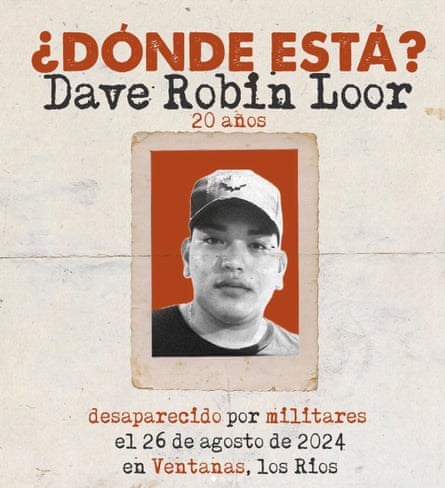
A poster with a photo of a young Latino man and wording in Spanish that says: ‘Where is Dave Robin Loor? 20 years old. Disappeared by the military on 26 August 2024 in Ventanas, Los Rios’
A flyer seeking information about Dave Robin Loor Roca, who was ‘disappeared’ by soldiers in 2024. Photograph: Handout

Camila Ruiz Segovia, a campaigner at Amnesty International, says that although the prosecutor’s office is attempting to investigate allegations of abuse, the defence ministry refuses to cooperate. “The army says the information is confidential and part of the security policy of the president,” she says.

Ecuador’s defence ministry did not respond to requests for comment.

Allegations of torture carried out under the state’s emergency powers have also emerged, including in operations directly supported by western allies.

In March, workers at a remote dairy farm near the northern border said they were detained and tortured during a military operation – carried out with support from US forces – which the Ecuadorian army said had targeted organised crime. However, people in the area say the community, made up of 27 farming families, has no connection to criminal groups.

“The soldiers said they were the Ecuadorian military and that we had to come out with our hands on our heads,” says one worker, who asked not to be named. “They started questioning us, but we did not know anything about what they were asking. That’s when the torture began.”

He said his arms and legs were bound before he was beaten, kicked and repeatedly submerged in a water tank. “They hit us and said they would kill us all,” he says. Later, at a military base, the abuse continued.

“They electrocuted me. I passed out twice,” the worker says. “What they’re doing is inhuman.”

Four of the workers were loaded on to a helicopter, and allege that while in the air, the soldiers told the men they were going to throw them out.

Another detainee, Jason Daniels Vargas, says: “They kept telling me I would be the first one they would kill. So many things happened there, it is hard to think about.”

María Espinosa, a lawyer with Ecuador’s Alliance for Human Rights, said the soldiers also set two homes in the village alight.
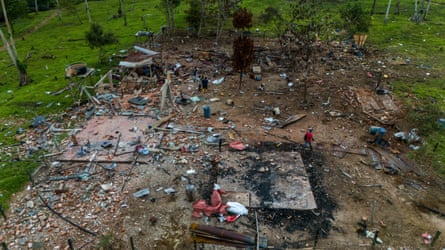
Aerial view of a bomb site, with debris strewn across a wide area
People pick through the bombed remains of a dairy farm in San Martín, which the US and Ecuador claimed was an armed group’s camp. Photograph: Federico Rios/NYT/Redux/eyevine

The US was involved in the attack on the dairy farm, with Donald Trump writing in a letter to Congress that action had been taken “in partnership with the government of the Republic of Ecuador”. While the president said US military personnel “did not come into contact with hostile forces”, he acknowledged they were “present for this partnered operation”.

In a Senate hearing, the US military’s southern command said that the US had moved to support Ecuadorian forces on a “very short timeline” after a phone call between Trump and Noboa. The US defense department did not respond to questions about its involvement in the operation.

After a New York Times investigation into the dairy farm operation, a group of US lawmakers on Wednesday called on the Pentagon to suspend joint military operations with Ecuadorian forces in the north immediately until the incidents had been fully investigated.

In a letter to the US defense secretary, Pete Hegseth, seen by the Guardian, the members of Congress said they were “deeply concerned” by reports of serious human rights violations and the bombing of “what appear to have been civilian facilities during joint US-Ecuador military operations”.

They also demanded an explanation of the legal basis for the US military’s involvement, saying Congress had not authorised it, and raised concerns about working with Noboa’s administration, saying it had been “credibly accused of widespread human rights abuses”.

Despite mounting allegations of abuses, however, Ecuador’s security strategy has been reinforced – not curtailed – by growing support from western allies.

The US has deepened military cooperation, launching joint operations and opening a FBI office in Ecuador. “There has been a qualitative change since September,” says Adam Isacson, of the Washington Office on Latin America, a human rights organisation. “It appears to go beyond intelligence sharing.”

Britain and the EU have also increased their support for Ecuador’s crackdown on organised crime, albeit less directly than the US. There is no evidence that they are supporting military operations on the ground. In May 2025, the British government signed a memorandum of understanding with Ecuador, “cementing” its cooperation against organised crime.
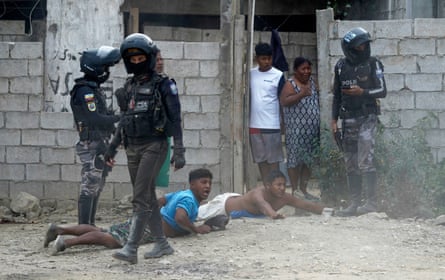
Two youths lie face down in the dirt outside a breezeblock house in a poor area as soldiers stand over them
A raid on a home in Guayaquil by soldiers and police in 2024. Despite the security crackdown, President Noboa has not been able to curb the violence in Ecuador. Photograph: César Muñoz/AP

The EU has also expanded its presence, opening an intelligence and coordination centre in Guayaquil backed by a $2.3m (£1.7m) programme intended to strengthen the sharing of intelligence, investigations and the fight against transnational criminal networks.

Experts broadly agree that international cooperation is necessary, given Ecuador’s prominent new role in global drug-trafficking networks. But they say that such help should be accompanied by very clear safeguards to ensure it does not support troops involved in rights abuses.

Martina Rapido Ragozzino, a researcher at Human Rights Watch, says: “The issue is when this cooperation does not come with clear requirements or benchmarks on how the government can use that support – and what it should not be doing.”

Critics say those safeguards around western governments’ support are lacking.

Anthony Smith, a French member of the Left group in the European parliament, says: “It’s not in the name of fighting drug trafficking that you set aside the rule of law or fundamental rights.”

Smith co-wrote a letter with other lawmakers raising concerns about the EU’s support for Ecuador, given the recent allegations of human rights abuses, but said it had been met with little response. The EU also did not respond to requests for comment from the Guardian.

The Foreign Office said all British support overseas was subject to rigorous assessment to ensure compliance with human rights obligations and international law.

Despite the security crackdown, however, Noboa has not been able to curb the violence plaguing Ecuador. The Andean nation recorded its highest homicide rate in decades last year, with 50.9 murders for every 100,000 people, according to the interior ministry – a 31% rise on 2024.
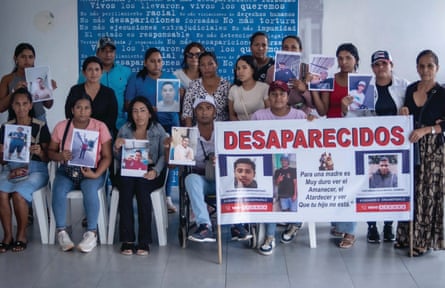
About 20 people, mostly women, hold up pictures of young men next to a big banner saying ‘Desaparecidos’
The Committee of Relatives of Disappeared Detainees of Ecuador display photos of their missing family members. At least 51 people, including children, have been ‘disappeared’. Photograph: CDH

Those working with family victims of forced disappearance say the impact of not knowing what happened is profound. “They are constantly asking: ‘Is he alive? Is he being tortured?’,” says Suelin Noriega, a psychosocial support worker who is helping to care for the families.

“It’s a permanent uncertainty,” she says. “It doesn’t allow them to mourn.”

As the families continue to wait for news of their children, there are growing demands for an end to Ecuador’s militarisation.

“The soldiers have the power and believe that no one can stand up to them because they are the ultimate authority,” says Roca’s aunt. “It needs to end now.”