







A lost copy of a poem composed in the seventh century by a Northumbrian cattle herder – the earliest surviving poem in the English language – has been discovered in Rome.
Scholars from Trinity College Dublin (TCD) uncovered the manuscript that contains Caedmon’s Hymn at the National Central Library of Rome.
Bede, the medieval theologian revered as the father of English history, recorded the nine-line poem in the eighth century. The Old English version discovered in Rome is believed to have been transcribed by a monk in northern Italy between AD800 and AD830.
“When we saw it we looked at each other and I said, ‘No one knows about this’,” said Elisabetta Magnanti, who discovered the manuscript with Mark Faulkner, from Trinity’s school of English. “To make sure I wasn’t dreaming I double-checked the catalogues and there was no mention of it. It was a huge surprise, a very good one.”
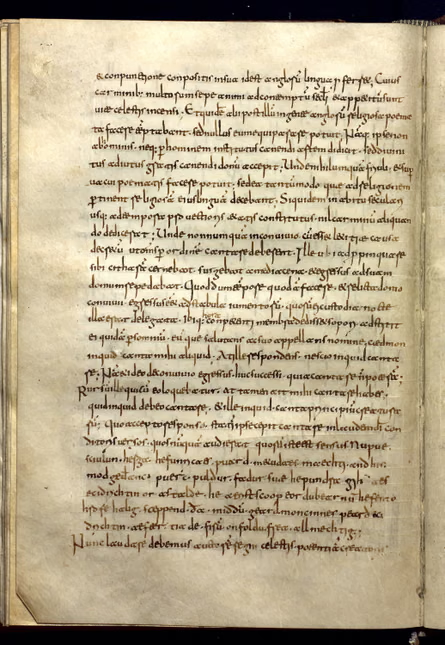
It is the third oldest surviving text of the poem, after older copies held at Cambridge and St Petersburg. Those other versions have the poem in Latin, with the Old English text added in the margin or at the end.
The Rome copy is significant because it contains the Old English version in the main body of the text, reflecting the language’s growing status in the ninth century, said Faulkner. “The absence of the poem would have been felt by the readers, I think, and so that’s why it goes in.”
The poem is punctuated with a full stop after every word, which shows that word spacing was a relatively new invention, said Faulkner. “It is part of the early development of ways of dividing words and shows text starting to come towards the presentation of English that we know today.”
The researchers have detailed their findings in Early Medieval England and its Neighbours, an open-access journal published by Cambridge University Press.
Caedmon is said to have been an illiterate cattle herder who worked at Whitby Abbey in North Yorkshire. According to Bede, he had a divine visitation that inspired him to compose and sing Hymn, which lauds God for creating the world.

Bede included a Latin translation in his landmark work, Ecclesiastical History of the English People, but omitted the original Old English version. However, within a century a monk at the abbey of Nonantola, in northern Italy, included the Old English version, said Faulkner. “It is a sign of how much early readers valued English poetry.”
There are at least 160 surviving copies of Bede’s history. Conflicting evidence about a copy in Rome prompted Magnanti, an expert in medieval manuscripts, to ask the National Central Library in Rome to check its archives. The institution located, digitised and emailed pages that included the poem. “This discovery is a testament to the power of libraries to facilitate new research by digitising their collections and making them freely available online,” she said.
Andrea Cappa, head of manuscripts and rare books at the Rome library, said the institution was digitising holdings from Italy’s National Centre for the Study of the Manuscript, which will give researchers access to more than 40m images.
Riccardo Fangarezzi, head of archives at the abbey in Nonantola, said he looked forward to further discoveries. “The present times may be rather dark, yet such intellectual contributions are genuine rays of sunlight: the continent is less isolated,” he said.
The poet Paul Muldoon translated Caedmon’s Hymn into contemporary English in a 2016 anthology of British poetry. The opening lines read:
“Now we must praise to the skies, the Keeper of the heavenly kingdom,
The might of the Measurer, all he has in mind,
The work of the Father of Glory, of all manner of marvel.”