


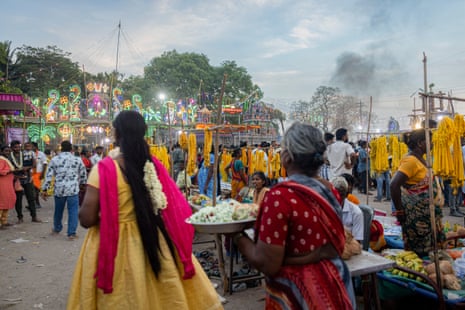
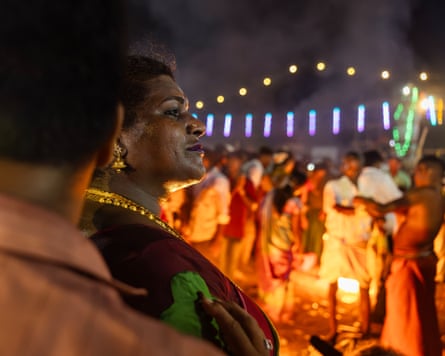
The summer air is thick with dust, sweat and the scent of jasmine. In Koovagam, in southern Tamil Nadu, more than 100,000 people have gathered for one of India’s most distinctive festivals. Transgender women from across India, arrive in bright silk saris and gold temple jewellery, their hair oiled and braided with flowers.
For nearly 18 days, the little town swells into a city of devotion, culminating in rituals that blur the boundaries between myth and reality.
-
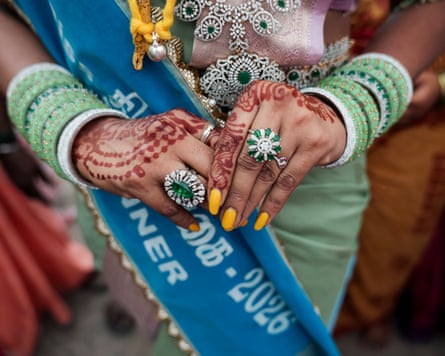
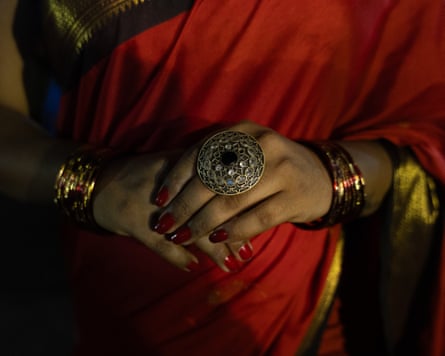
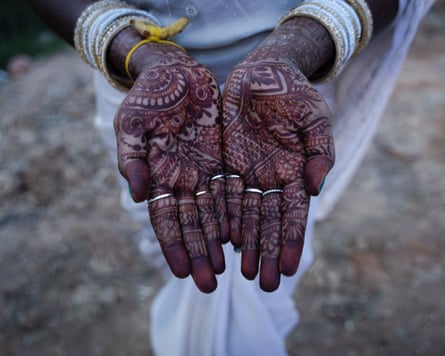
The Koovagam festival pageant winner displays her rings
The annual festival centres on the Koothandavar Temple and the story of Aravan, a figure from the Mahabharata, one of India’s most revered epic poems. According to the story, Aravan agrees to be sacrificed before a decisive battle, but asks for one final wish: to be married before he dies.
When no woman is willing to wed a man fated to die the next day, the god Krishna assumes the female form of Mohini to fulfil his desire. By morning, Aravan is sacrificed, and Mohini, now widowed, mourns him – her grief forming the core of the festival that unfolds each year in Koovagam.
This retelling has come to hold deep significance for trans women, who come to Koovagam to “marry Aravan” on the penultimate day of the festival. The next morning, the mourning is re-enacted: bangles are broken; vermilion powder wiped from hair partings; and white saris donned as they grieve his death.
-
For nearly 18 days, Koovagam swells into a temporary city of devotion as more than 100,000 people gather
-
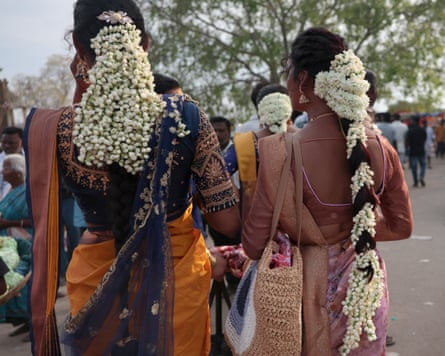
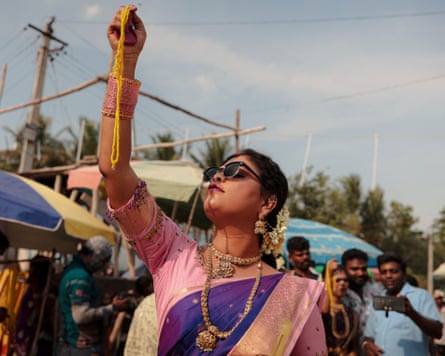
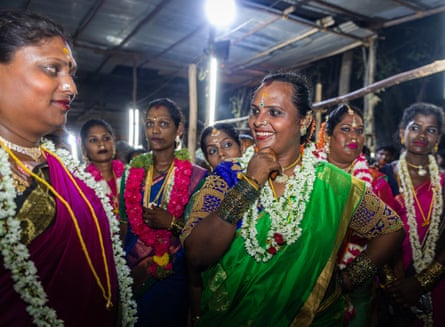
Devotees wear a sacred thread or thali (mangalasutra) dyed in turmeric that symbolises the marriage between transgender women and Aravan. Jasmine garlands are worn in participants’ hair to signify their status as ‘brides’
This year, the festival took place against the background of a shifting legal landscape in India. An amendment to the Transgender Persons (Protection of Rights) Act 2019, passed in March, has scrapped the right to self-identify gender and introduced medical scrutiny into the legal recognition process.
It also narrows the scope of who qualifies as “transgender”, privileging more fixed, state-recognisable categories while pushing trans men, and many non-binary identities, into a grey zone. Critics have called the new law regressive and an affront to human rights and dignity.
For the trans women who gathered in Koovagam, the festival offered a temporary escape from the scrutiny. The Guardian spoke to some of the attendees about their lives and asked what the festival meant to them.
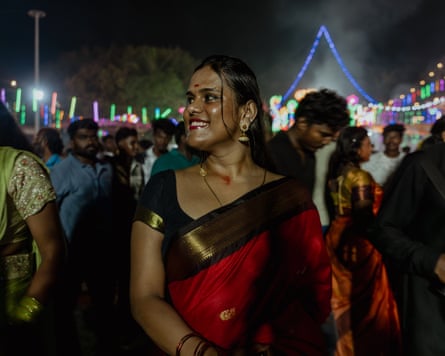
Prazzi, 26: ‘Without documents, you don’t exist’
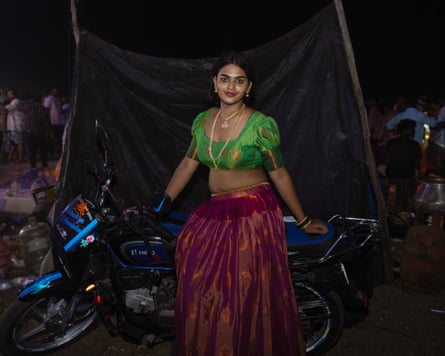
Prazzi adjusts her sari as she stands outside the Aravan temple. This is her second time at the festival, and the joyfulness, she says, has not dulled. “You know what this is?” she says. “This is the only time of the year when we are not a minority. It’s like a trans-Barbie world.”
A fashion designer and university tutor in Chennai, Tamil Nadu, Prazzi spends most of her year navigating spaces where she is, as she puts it, “a minuscule minority – someone whose presence or absence doesn’t even matter”.
“People assume fashion is inclusive. It’s not,” she says. “Queer people maybe, but trans women? We are still not welcomed.” In Koovagam, that sense of isolation disappears. “For once, we are the majority. We are everywhere – in the streets, in the shops, in each other’s lives. I can just exist with my trans sisters without explaining myself.”
-
The jewellery of Prazzi, a fashion designer
She had more than 50 rejections before securing her teaching position. “Your CV gets you in; your identity gets you rejected,” she says. “They call you for an interview because your work and portfolio is good. But the moment you walk in, everything changes. You can see it in their faces – they’ve already decided.”
What often goes unseen is how discrimination is built into paperwork. “They’ll say, ‘Your name doesn’t match across your ID proofs,’ or ‘you don’t have an address on your name. These become easy ways to exclude you,” she says. “It is not always said out loud, but you know why.”
Prazzi is concerned about how the new Transgender Act deepens this. “When the state itself questions your identity unless you fit into its narrow definitions of ‘trans’, the whole issue of documentation becomes even more fraught,” she says.
“It gives the state the power to decide – almost arbitrarily – whether to issue these documents to us or not. Without documents, you don’t exist,” she says. “And if you don’t exist, you can’t rent a house, you can’t move freely, work is even a distant possibility”
“For many trans women,” she says, these “rejections decide our entire life. Most are pushed into begging or sex work. I was lucky – I have a job that gives me some stability. But that is not the reality for most of us.”
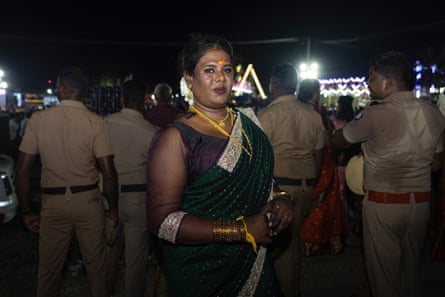
Akshaya, 29: ‘Our bodies are treated as illegal’
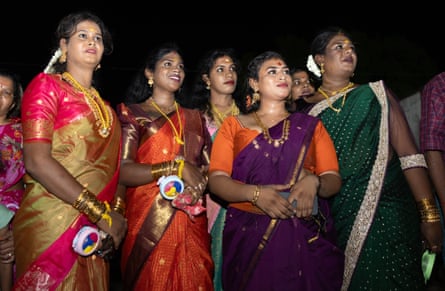
Akshaya is at the edge of a brightly lit stretch of mud road, scanning the crowd, as the Miss Koovagam pageant takes place on the stage. Around her, her six “daughters” and two “sisters” chat and laugh. “This is my family,” she says. “Not by blood – but this is who I live for.”
She has come to Koovagam to seek the blessings of Aravan, but her real wait, she says, is for the night.
On the evening of the ritual – after the symbolic marriage to Aravan – the village shifts. Men begin arriving from nearby towns and districts, moving through the crowds.
“They all have this lust in their eyes. We are here for sex too – but not for free,” says Akshaya, who has been doing sex work for nearly a decade, since she left her biological family.
For many, sex work is central to the festival – though in terms different to elsewhere. “Here, you’re not surveilled like in the outside world,” she says.
Outside Koovagam, sex work is fraught with threat. “Every day, just standing at a cruising spot, you don’t know what will happen,” she says. “Police will come, harass you – sometimes for money, sometimes otherwise. You learn to stay quiet, to manage.”
Sex work occupies a legal grey zone in India, but activities around it – soliciting, brothel-keeping, public presence – are often criminalised, leaving workers vulnerable to harassment and exploitation by police and public.
-
Akshaya with her ‘daughters’ and ‘sisters’ at Koovagam festival
In this precarious line of work, she says the law offers little protection. Basic safeguards including protection from rape do not fully extend to trans people. “We are already seen as less than a cis counterpart. Our bodies are treated as illegal,” she says, “so exploiting us doesn’t even feel like a violation in the eyes of the system.”
She is critical of the new legislation. “It doesn’t resolve anything for us. There is nothing about safer working conditions, nothing that actually protects us,” she says.
Instead, she feels, it adds another layer of scrutiny. “Now it becomes about who gets to be recognised as ‘trans’ and who doesn’t,” she says. “That power is not in our hands.” She fears is that this will deepen the vulnerability of trans women. “Even when we are not doing sex work, our bodies can still be questioned, even criminalised – just for existing.”
“But when the state looks away we take care of each other,” she adds. “Because outside, no one will.”
Kareena, 21: ‘I just want to live fully in my body’
Kareena has come to Koovagam with friends and her godmother. This year, her visit to the festival carries a particular weight. “I’ve come to make a wish,” she says, looking toward the temple of Aravan. “For courage.”
Three years ago, she underwent surgery. “I prayed for it here,” she says. “And it happened.” Since then, the festival has held a quiet certainty for her – a place where wishes, she believes, find their way. “Every year I come, something moves forward in my life,” she says.
This year, her wish is more daunting. Kareena is preparing for further surgery. “My biological family accepts me and can now help fund it,” she says. “But it’s about being ready in your mind.” She pauses. “I don’t know if I am ready. That’s why I am here.”
Accessing such care in India is difficult. Reliable doctors are few, costs are high and information is uneven. “You hear so many stories,” says Kareena. “Things going wrong, or people being cheated.”
What worries her more now is the broader climate around healthcare. She points to the implementation of the new trans law and the confusion it has created. “Doctors are scared,” she says. “They don’t want to take risks in providing surgical care to transgenders. Everything feels more controlled, more questioned by the government.”
Some interpretations of the law have raised fears around medical interventions, with practitioners wary of being accused of coercion, including through hormonal or surgical interventions.
“Even if I decide, will I find a doctor?” asks Kareena. “Will I be allowed to do this? I just want to live fully in my body,” she says. “That’s all I am asking for.”
Yashoda, 30: ‘We come here and can just be. No one is asking us to prove anything’
Yashoda and Zamir have been married for seven years. Her family, she says, has come around with time. His has not. A Muslim man married to a trans Hindu woman sits uneasily within the worlds they come from.
“In my home, they have accepted us,” Yashoda says. “But in his, it is still not possible. His family has no idea that he is already married to me.”
His secrecy is within the broader climate where such relationships are not just frowned upon but folded into larger anxieties – Muslim men are already under scrutiny in India’s political environment, and trans lives are persistently delegitimised.
“People already look at us in a certain way,” Zamir says. “So we don’t try to explain everything to everyone. What we have is love and that is enough for us.”
-
A devotee with intricate henna patterns on her hands
They are unsure whether acceptance will come, or whether the silences will harden. But for now, they continue to choose each other within the limits around them.
Among the thousands who gather at Koovagam, their relationship does not need to be explained.
“We come here and feel like we can just be,” Yashoda says. “No one is asking us to prove anything.”
Zamir nods. “We come here together – that is what matters,” he says. “Maybe next year, when we return, something will change. Or maybe nothing will. But we will still come.”
Karpakama, 51: ‘When families abandon us, we create our own’
Acceptance remains fragile for many trans people, often in the face of rejection from their own families. “Many are still disowned,” Karpakama says. “They are pushed out of their homes, left to find their own way.”
In Tirupur district, Karpakama has spent years sheltering trans women – offering not just a roof but a form of kinship that replaces family norms.
The guru-chela system – the tradition of trans women finding “mothers” and building chosen families – is central to the trans way of life. “We have been doing this for years. When families abandon us, we create our own.”
This support system feels threatened by ambiguities in the new trans legislation, which, she fears, could be misused. “These provisions can be wrongly used to criminalise people like us,” she says. “Anyone who offers shelter, or even helps someone during their transition, or someone who is simply running away from violence at home – this could all be questioned.
“It is like the state is trying to say that we do not exist, that we are not visible. But we are here. We have always been here since history. And our history cannot be erased simply.”
Coming here for the past 20 years, this time, arriving with her “daughters”, is a show of protest. “Our bodies go through so much in daily life,” she says. “We carry everything inside. We try to hold ourselves together – we don’t cry, we don’t break.”
“But when we mourn Aravan, we let go of all that weight,” Karpakama adds. “All that control that the state and society try to exercise on our bodies – we release it here.”
-
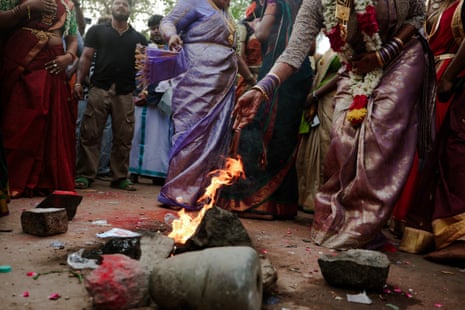
Offerings being made at Koovagam – the festival is steeped in ritual