


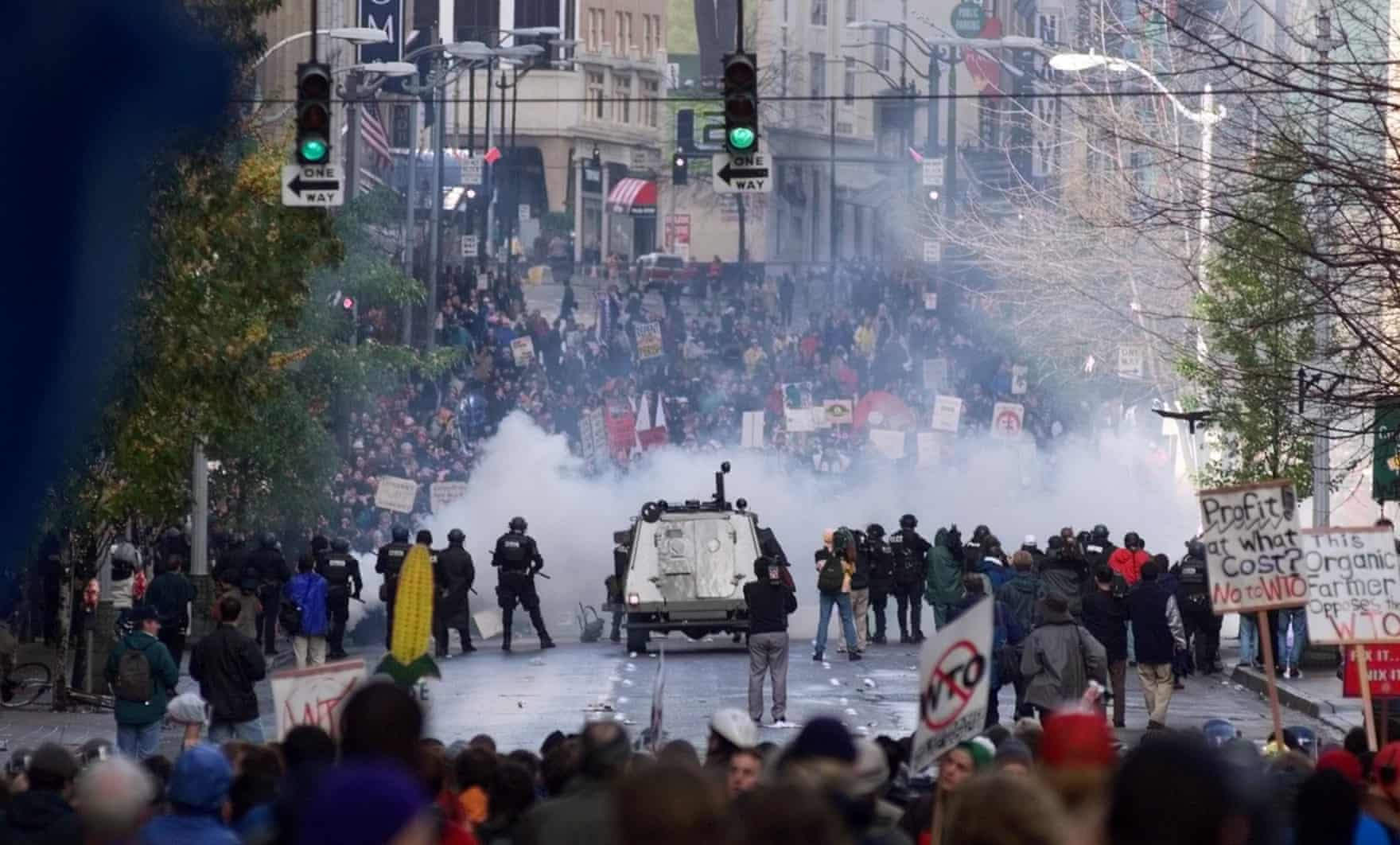
Back before 9/11 and the wars it precipitated, the big global focus for protest was globalisation itself. Things came to a head in Seattle in November 1999 when 50,000 protesters crashed the World Trade Organization’s party. The ensuing “Battle of Seattle”, as it came to be known, brought unprecedented attention to the growing disquiet over the inequalities of unregulated free market excesses. That’s how, a few months later, I found myself smack bang in the middle of the next big anti-neoliberal flashpoint, the “MayDay 2K” protests in London.
My experience of protest throughout high school had been pretty tame, more likely to take the form of defiance than demonstration. Socks down, shirt untucked – take that, sir! But then again times were good, even for a ratbag. I didn’t have many grievances. At least, none that could be solved by collective protest against powerful institutions that weren’t my parents.
In London that changed on May Day of 2000. It was more idle curiosity than passionate intensity that drew me down to Whitehall that day.
Gathering under a distinctly horticultural theme, the anti-globalisation protest aimed to reclaim the streets for nature: resistance is fertile. Joyful hippies planted herbs and daisies in the grassy square opposite Big Ben, where guerilla gardeners were ripping up and relocating turf to cover the surrounding road.
The crowd was massive; it stretched all the way up the narrow Whitehall to Trafalgar Square, where even more protesters draped themselves over the lions of Nelson’s Column.
At about 2pm a police squad in full riot gear rushed across Whitehall to cut the protest into two groups, and moved in to surround both. Then came the horses.
There is no more vivid and visceral memory I have than a line of police horses charging full speed at me – 700kg draughthorses towering above us, thundering hooves echoing off the paved road, and the screams of protesters scattering in every direction. All bravado, grievance and ideology went out the window as I looked down to see my amygdala had already got my legs running away before I’d even thought to do so. Even now, more than 25 years later, I can still feel the panic deep in my gut just by recalling the events to write this passage. Scientifically, I can tell you why. As the most prehistoric parts of my brain took over – the parts that react through instinct, not logic – the amygdala sent a distress signal to release adrenaline and other hormones to scoot me off to safety at breakneck speed. The upstairs brain, which would have given context and sequence to these memories but really gets in the way when fleeing for your life, shut down – leaving only the sensory memory of how I felt.
Sociologically, the gathering changed at that point. When groups experience heightened emotion together, such as a collective release of adrenaline, the complexion of events changes with it. Trapped at both ends and contained by riot police with nowhere to go, we got angry. Together. It spread like a contagion from one person to the next. The first victim was a McDonald’s, a prime symbol of global capitalism which had the misfortune to find itself contained in the same pen with the newly angry protesters. A group of McRobin Hoods smashed their way in and threw burgers out into the crowd.
Seed planters became spray painters. Vegans became vandals. Leninists became looters.
I could feel something changing in me, too. All of a sudden I did have something taken from me, deprived from me. My freedom to move. My autonomy. My sense of safety. But most of all I was cornered – nature’s surefire way to bring out a heightened animalistic response.
And so I became angry. Angry at lots of stuff I hadn’t even known I was angry at.
Angry at the police. Who were all of a sudden not part of the environment of the scene I was passively observing, but part of a tribe I was opposed to – the outgroup to my ingroup. My chants turned to shouts. I shouted directly at one policeman who locked eyes with me.
Out came his truncheon and I swiftly received a harsh lesson in the corporal power of the state monopoly on violence.
I tell this story not as something typical to my youthful experience – but rather to explain how, when in group circumstances, we exhibit very uncharacteristic behaviours. Gustave Le Bon was the first thinker to posit the idea that crowds have a psychology of their own, greater than the sum of its individual parts – a singular “group mind” hell bent, in this case, on destroying a McDonald’s. Le Bon had seen the phenomenon first-hand during the Paris Commune of 1871 when the French army and the Communards spent months brutally slaughtering each other in blood-soaked Paris streets.
Le Bon had a front-row seat to the whole thing, watching Parisians from all walks of life lost in the mass psychology of the crowd: “Isolated, he may be a cultivated individual; in a crowd, he is a barbarian.”
Félicie Gimet was a Communarde who had developed a friendly rapport with Father Pierre Olivaint, a priest they had taken hostage. As the French army began summarily executing surrendering Parisians, Gimet entered the priest’s cell and joked with him, ‘Since I am procuring the crown of martyrdom for you, I think you will save me a place in Heaven.’
“I will not fail,” replied the priest happily.
As the hostages were marched through the streets, Father Olivaint at their head, the gathering crowd grew increasingly angry. Something in Gimet snapped: “No pity! Murderers all, clergymen or gendarmes!” Firing her pistol at the priest, she lit the tinderbox.
The mob unleashed a torrent of rifles and bayonets, and massacred every frocked hostage. “My God, forgive them, as I forgive them,” Gimet heard Father Olivaint utter with his last breath.
That a woman could so quickly turn from affectionate witty banter to cold-blooded murder speaks to the power of the emotional contagion of crowds that Le Bon witnessed. A qualified doctor, he likened what he saw to recent scientific discoveries in microbiology of pathogens spreading from one individual to another. “Sentiments, emotions, and beliefs possess in crowds a contagious power as intense as that of microbes.”
Like myself, Gimet didn’t begin her day thinking she would mass murder priests. While I’m not suggesting I could have been cajoled to chop up a chaplain, she felt her actions that day – thanks to the power of group emotion – were “a very meritorious act”.
This is exactly what happens in a much more modern setting, with internet trolls and online anger. We are not all murderous arseholes, though we often act like it online. Anonymity dissolves our usual restraint, suspends our intellect and allows our primitive parts to take over. We are egged on by the crowd, then feel good when we do bad to our enemies.
As Harvard psychologist Amit Goldenberg puts it, “one of the oldest insights about human behaviour is that when people get together, they become more emotional than they would have been as separated individuals”.
Usually, an individual experiencing negative emotions is motivated to mitigate them. We don’t want to be angry. We don’t want to be sad. We take steps to regulate those feelings. As individuals, our emotions calm over time. In groups, the opposite happens. Negative emotions last longer and become more intense. There is no motivation to regulate them – in fact, the motivation is to keep them going, because it feels good experiencing and expressing emotions together, even anger.
This is why anger is unique when it comes to contagion. Anger is measles. Long after Le Bon suspected it, researchers confirmed just how highly contagious anger is: more so than sadness. And moral anger is even more powerful. The researchers called it “moral contagion”.
Sharing group emotion in this way rewards us. It gives us a stronger sense of identity and belonging within the group, and feelings of empowerment. Negative emotions become a positive experience in a group setting – even if we are not in a physical group. We do this online, with people we have never met.
There are good evolutionary reasons for this. Whereas early scholars like Le Bon viewed “group mind” as a negative that stood in the way of reason, today we generally recognise that collective emotions enable the cohesion and coordinated action that make society possible. Émile Durkheim called this “collective effervescence” – the intense, shared emotional energy that binds individuals together and reinforces our group identity.
In 2019 in Chile, widespread discontent with economic inequality saw an enormous populist movement take to the streets for months on end. Researchers found participants in the protests who had processed their emotions collectively were much more likely to describe the experience in positive terms – like “justice”, “bravery” and ‘dignity’. Anger, in this context, was a positive tool for collective action. Moral anger is vital to address the ways the world is not as it ought to be.
But angertainment, whereby others bait and provoke us with emotive content, on the other hand, has hijacked these positive evolutionary traits, in order to not bond us together, but drive us apart. This drives angertainment. Not only do we “catch” emotions from others, we also feel our emotions on behalf of our group.
This is an edited extract from Angertainment by Ed Coper, out now though Simon & Schuster.